















Passive Components Blog
No Result
View All Result
  • Home
  • NewsFilter
    • All
    • Aerospace & Defence
    • Antenna
    • Applications
    • Automotive
    • Capacitors
    • Circuit Protection Devices
    • electro-mechanical news
    • Filters
    • Fuses
    • Inductors
    • Industrial
    • Integrated Passives
    • inter-connect news
    • Market & Supply Chain
    • Market Insights
    • Medical
    • Modelling and Simulation
    • New Materials & Supply
    • New Technologies
    • Non-linear Passives
    • Oscillators
    • Passive Sensors News
    • Resistors
    • RF & Microwave
    • Telecommunication
    • Weekly Digest

    DigiKey Releases Season Two of Sustainable Futures Series

    Using a Virtual Anode Thermal Model to Evaluate Miniaturization Risk in Tantalum Capacitors

    Bourns Introduced High-Current Coupled Inductor for 48 V Hybrid and IBC Converters

    Würth Elektronik Expands Nanocrystalline Cable Cores for Broadband EMI Suppression

    High‑Speed Supercapacitor Balancing for AI Data Center Power Systems

    Bourns Introduced Automotive TVS Diodes for Compact ESD Protection

    EMC‑Compliant PCB and Connector Design Guidelines

    Practical Value of Structural Diagnostics for Tantalum Capacitor Anodes

    Hall-Effect Sensing for Harsh Environments: TT Electronics Selected in NASA’s Dragonfly Fan

    Trending Tags

    • Ripple Current
    • RF
    • Leakage Current
    • Tantalum vs Ceramic
    • Snubber
    • Low ESR
    • Feedthrough
    • Derating
    • Dielectric Constant
    • New Products
    • Market Reports
  • VideoFilter
    • All
    • Antenna videos
    • Capacitor videos
    • Circuit Protection Video
    • Filter videos
    • Fuse videos
    • Inductor videos
    • Inter-Connect Video
    • Non-linear passives videos
    • Oscillator videos
    • Passive sensors videos
    • Resistor videos

    EMC‑Compliant PCB and Connector Design Guidelines

    Why Isolated DC/DC Power Supplies Fail Late, Würth Elektronik Podcast

    Designing 800 V DC EMC Filters: Calculation, Simulation and Measurement

    Current Sense Transformer Datasheet and Design‑in Guide

    Designing a USB Type‑C Flyback Planar Transformer with Frenetic’s Planar Tool

    Magnetics Design in High‑Frequency GaN Converters

    Qi2 Wireless Charging: Inductors, Capacitors and EMC Filters

    Two‑capacitor paradox explained for engineers

    Capacitances of Nonlinear MLCCs: What Datasheets Don’t Tell You

    Trending Tags

    • Capacitors explained
    • Inductors explained
    • Resistors explained
    • Filters explained
    • Application Video Guidelines
    • EMC
    • New Products
    • Ripple Current
    • Simulation
    • Tantalum vs Ceramic
  • Knowledge Blog
  • DossiersNew
  • Suppliers
    • Who is Who
  • PCNS
    • PCNS 2025
    • PCNS 2023
    • PCNS 2021
    • PCNS 2019
    • PCNS 2017
  • Events
  • Home
  • NewsFilter
    • All
    • Aerospace & Defence
    • Antenna
    • Applications
    • Automotive
    • Capacitors
    • Circuit Protection Devices
    • electro-mechanical news
    • Filters
    • Fuses
    • Inductors
    • Industrial
    • Integrated Passives
    • inter-connect news
    • Market & Supply Chain
    • Market Insights
    • Medical
    • Modelling and Simulation
    • New Materials & Supply
    • New Technologies
    • Non-linear Passives
    • Oscillators
    • Passive Sensors News
    • Resistors
    • RF & Microwave
    • Telecommunication
    • Weekly Digest

    DigiKey Releases Season Two of Sustainable Futures Series

    Using a Virtual Anode Thermal Model to Evaluate Miniaturization Risk in Tantalum Capacitors

    Bourns Introduced High-Current Coupled Inductor for 48 V Hybrid and IBC Converters

    Würth Elektronik Expands Nanocrystalline Cable Cores for Broadband EMI Suppression

    High‑Speed Supercapacitor Balancing for AI Data Center Power Systems

    Bourns Introduced Automotive TVS Diodes for Compact ESD Protection

    EMC‑Compliant PCB and Connector Design Guidelines

    Practical Value of Structural Diagnostics for Tantalum Capacitor Anodes

    Hall-Effect Sensing for Harsh Environments: TT Electronics Selected in NASA’s Dragonfly Fan

    Trending Tags

    • Ripple Current
    • RF
    • Leakage Current
    • Tantalum vs Ceramic
    • Snubber
    • Low ESR
    • Feedthrough
    • Derating
    • Dielectric Constant
    • New Products
    • Market Reports
  • VideoFilter
    • All
    • Antenna videos
    • Capacitor videos
    • Circuit Protection Video
    • Filter videos
    • Fuse videos
    • Inductor videos
    • Inter-Connect Video
    • Non-linear passives videos
    • Oscillator videos
    • Passive sensors videos
    • Resistor videos

    EMC‑Compliant PCB and Connector Design Guidelines

    Why Isolated DC/DC Power Supplies Fail Late, Würth Elektronik Podcast

    Designing 800 V DC EMC Filters: Calculation, Simulation and Measurement

    Current Sense Transformer Datasheet and Design‑in Guide

    Designing a USB Type‑C Flyback Planar Transformer with Frenetic’s Planar Tool

    Magnetics Design in High‑Frequency GaN Converters

    Qi2 Wireless Charging: Inductors, Capacitors and EMC Filters

    Two‑capacitor paradox explained for engineers

    Capacitances of Nonlinear MLCCs: What Datasheets Don’t Tell You

    Trending Tags

    • Capacitors explained
    • Inductors explained
    • Resistors explained
    • Filters explained
    • Application Video Guidelines
    • EMC
    • New Products
    • Ripple Current
    • Simulation
    • Tantalum vs Ceramic
  • Knowledge Blog
  • DossiersNew
  • Suppliers
    • Who is Who
  • PCNS
    • PCNS 2025
    • PCNS 2023
    • PCNS 2021
    • PCNS 2019
    • PCNS 2017
  • Events
No Result
View All Result
Passive Components Blog
No Result
View All Result

3D-printed Magnetic Material from Non-Magnetic Powder

14.1.2022
Reading Time: 3 mins read
A A
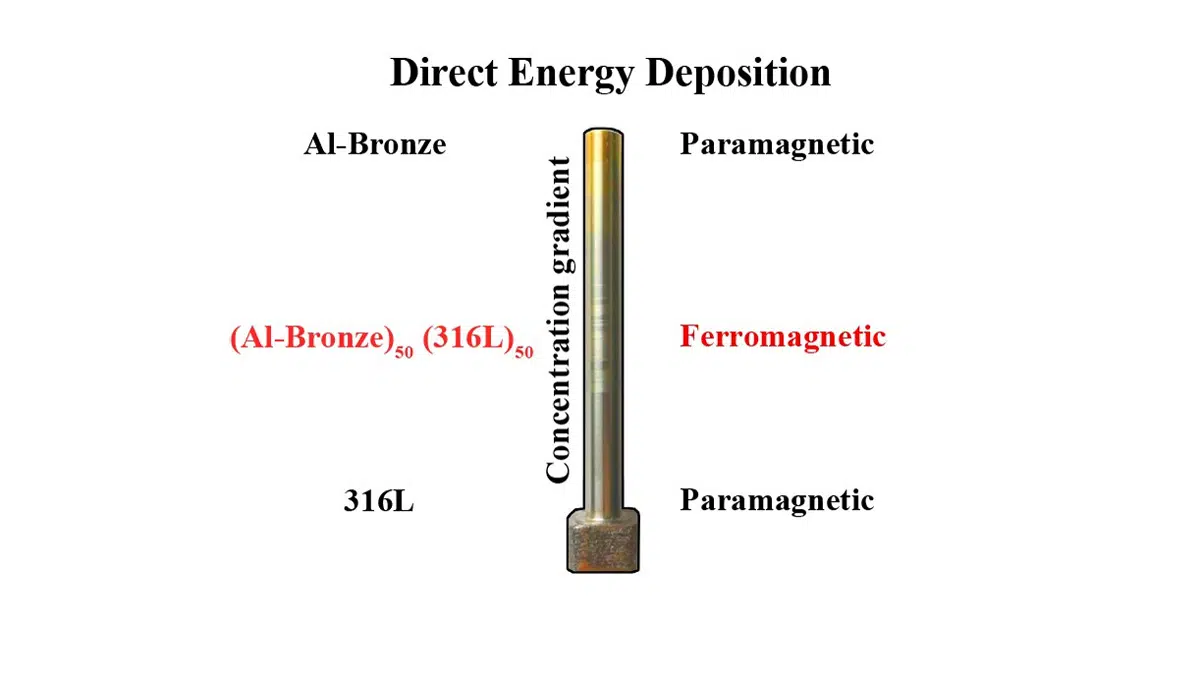
The magnetic properties of the metal rod continuously change from para- to ferromagnetic and back due to the shift in the relative proportions of the two constituent materials: marine-grade stainless steel (labeled 316L) and aluminum bronze (Al-Bronze). Credit: Oleg Dubinin et al./The Journal of Materials Processing Technology

The magnetic properties of the metal rod continuously change from para- to ferromagnetic and back due to the shift in the relative proportions of the two constituent materials: marine-grade stainless steel (labeled 316L) and aluminum bronze (Al-Bronze). Credit: Oleg Dubinin et al./The Journal of Materials Processing Technology

Scientists from Skoltech and their colleagues have used a 3D printer to fuse two materials in an alloy whose composition continuously changes from one region of the sample to the other, endowing the alloy with gradient magnetic properties. Despite the nonmagnetic nature of the constituent materials, the alloy exhibits magnetic properties. Published in The Journal of Materials Processing Technology, the study also offers a theoretical explanation for the phenomenon.

Once perceived as a mere novelty tool for rapid prototyping, 3D printing has grown into a full-blown industrial technology used to produce airplane parts, patient-matched implants and prosthetics, jewelry, and custom-fit shoes, among other things.

RelatedPosts

Electroninks Releases Gold and Platinum Particle-Free Conductive Inks

Peak Nano Installs Production Line for Innovative Capacitor Films

Electrical Properties Study of SMD Resistor Integrated Metallic Yarn for Smart Textiles

The main advantage of 3D printing is the ability to produce objects with very complex shapes that are impossible or too expensive to make with conventional manufacturing techniques, such as casting, rolling, and stamping. The technology also enables faster and riskier prototyping, and greater flexibility in terms of product customization and how many items are produced. And then there’s the added benefit of reduced waste.

One of the limitations of 3D printing is that it tends to use one homogeneous material or mixture throughout the entire item produced. By varying the composition from one part of the item to another, it could be endowed with properties that continuously change.

Image. The 3D printer used in the study. Credit: Oleg Dubinin et al./The Journal of Materials Processing Technology

An example of this would be a rod made of an alloy of two metals whose ratio changes from 100% metal A to fifty-fifty, to 100% metal B, and so on. Provided that the metals in question mix well, without giving rise to defects, the rod’s gradient properties — including magnetic ones — could be technologically useful, for example, for motor rotors, strips for magnetic encoders, or transformators.

The authors of a recent Skoltech-led study published in The Journal of Materials Processing Technology report an experiment where they produced such an alloy. Its two components — the metals A and B above — are themselves alloys: aluminum bronze (copper, aluminum, and iron) and marine-grade stainless steel (mostly iron, chromium, and nickel). Both are technically known as paramagnetic, or “nonmagnetic” in layman’s terms. That is, they don’t stick to a magnet. Yet when they are mixed in equal proportions, the resulting alloy turns out to be a “soft” ferromagnet. That is, it is attracted to “hard” ferromagnets — like the one on the fridge — but does not itself become one.

“We used these two paramagnetic materials to create a gradient alloy with an InssTek MX-1000 3D printer. It employs a technique called directed energy deposition, which involves depositing powdered material from a nozzle and simultaneously melting it with a laser. The resulting alloy exhibited ferromagnetic properties to an extent that depended on the ratio between the two constituent materials,” said the study’s lead author Oleg Dubinin from the Additive Manufacturing Lab at Skoltech.

“Our study also provides a theoretical explanation of the emergence of ferromagnetic properties in the alloy in terms of its atomic structure,” the researcher went on. “While the two initial materials have a so-called face-centered cubic crystal structure, their combination results in a body-centered cubic structure.”

In the former, metal atoms sit in the corners of imaginary cubes and on their faces. In the latter, there are metal atoms at the centers of the invisible cubes instead of on their faces. This second arrangement gives the material its ferromagnetic properties.

“Gradient soft magnetic alloys could find applications in machine engineering, for example, in electrical motors,” commented PI Stanislav Evlashin, a leading research scientist at Skoltech. “Our findings show that directed energy deposition is not just a way to 3D-print gradient materials, but also a way to discover new alloys. Besides that, the technology is highly efficient and suitable for manufacturing even large-size parts quickly.”
Related

Source: Skoltech

Recent Posts

Bourns Introduced High-Current Coupled Inductor for 48 V Hybrid and IBC Converters

24.6.2026
11

Würth Elektronik Expands Nanocrystalline Cable Cores for Broadband EMI Suppression

23.6.2026
12

Bourns Releases Automotive Gate Driver Transformer for Isolated Power

22.6.2026
20

Vishay Unveils 1.5 kV IHDV High Voltage Power Inductors for EV and Industrial Converters

19.6.2026
33

DMASS: European Components Distribution Returns To Growth In Q1 2026

16.6.2026
59

German Component Distribution Market Rebounds in Q1 2026 According to FBDi

16.6.2026
39

Ultrahigh Energy Storage in Lead‑Free BiFeO₃‑Based Ceramic Capacitors via Local Polar Structure Design

16.6.2026
36

Sumida Introduces SMD Metal Inductors for High‑Current Automotive DC/DC Converters

15.6.2026
32

Imec Presents High-density MIMCAP RF interposer for III-V chiplets

15.6.2026
53

Upcoming Events

Jun 30
17:00 - 18:00 CEST

PSMA Capacitor Committee Webinar: High Voltage Pulse Capacitors

Jul 14
16:00 - 17:00 CEST

EMC Design Essentials: Mastering Varistors and Common Mode Chokes

Jul 21
16:00 - 17:00 CEST

Safety by design: X and Y Interference suppression capacitors for power line filters

View Calendar

Popular Posts

  • Boost Converter Design and Calculation

    0 shares
    Share 0 Tweet 0
  • Buck Converter Design and Calculation

    0 shares
    Share 0 Tweet 0
  • LLC Resonant Converter Design and Calculation

    0 shares
    Share 0 Tweet 0
  • Flyback Converter Design and Calculation

    0 shares
    Share 0 Tweet 0
  • MLCC and Ceramic Capacitors

    0 shares
    Share 0 Tweet 0
  • Earthing Systems and IEC Classification Explained

    0 shares
    Share 0 Tweet 0
  • Nvidia Vera Rubin: Why One AI Rack Needs So Many More MLCC Capacitors

    0 shares
    Share 0 Tweet 0
  • Dual Active Bridge (DAB) Topology

    0 shares
    Share 0 Tweet 0
  • SEPIC Converter Design and Calculation

    0 shares
    Share 0 Tweet 0
  • MLCC Case Sizes Standards Explained

    0 shares
    Share 0 Tweet 0

Newsletter Subscription


Passive Components Blog

© EPCI - Leading Passive Components Educational and Information Site

  • Home
  • Privacy Policy
  • EPCI Membership & Advertisement
  • About

No Result
View All Result
  • Home
  • Knowledge Blog
  • Dossiers
  • PCNS

© EPCI - Leading Passive Components Educational and Information Site

This website uses cookies. By continuing to use this website you are giving consent to cookies being used. Visit our Privacy and Cookie Policy.
Go to mobile version