















Passive Components Blog
No Result
View All Result
  • Home
  • NewsFilter
    • All
    • Aerospace & Defence
    • Antenna
    • Applications
    • Automotive
    • Capacitors
    • Circuit Protection Devices
    • electro-mechanical news
    • Filters
    • Fuses
    • Inductors
    • Industrial
    • Integrated Passives
    • inter-connect news
    • Market & Supply Chain
    • Market Insights
    • Medical
    • Modelling and Simulation
    • New Materials & Supply
    • New Technologies
    • Non-linear Passives
    • Oscillators
    • Passive Sensors News
    • Resistors
    • RF & Microwave
    • Telecommunication
    • Weekly Digest

    Vishay Releases High‑Current Radial Inductors up to 209 A

    May 2026 Interconnect, Passives and Electromechanical Components Market Insights

    Passive Components Enable Safe and Reliable ADAS Architectures

    Current Sense Transformer Datasheet and Design‑in Guide

    Designing a USB Type‑C Flyback Planar Transformer with Frenetic’s Planar Tool

    YMIN Releases Square Supercapacitors for AI Server Power System

    Exxelia Extends Temperature Range of its PP Film Capacitors to 140C

    How Long-Term Storage Causes Aging in Electronic Components

    Nichicon Presents Self-Charging LTO Board for Maintenance-Free IoT Nodes

    Trending Tags

    • Ripple Current
    • RF
    • Leakage Current
    • Tantalum vs Ceramic
    • Snubber
    • Low ESR
    • Feedthrough
    • Derating
    • Dielectric Constant
    • New Products
    • Market Reports
  • VideoFilter
    • All
    • Antenna videos
    • Capacitor videos
    • Circuit Protection Video
    • Filter videos
    • Fuse videos
    • Inductor videos
    • Inter-Connect Video
    • Non-linear passives videos
    • Oscillator videos
    • Passive sensors videos
    • Resistor videos

    Current Sense Transformer Datasheet and Design‑in Guide

    Designing a USB Type‑C Flyback Planar Transformer with Frenetic’s Planar Tool

    Magnetics Design in High‑Frequency GaN Converters

    Qi2 Wireless Charging: Inductors, Capacitors and EMC Filters

    Two‑capacitor paradox explained for engineers

    Capacitances of Nonlinear MLCCs: What Datasheets Don’t Tell You

    Tapped Inductor Buck Converter Fundamentals

    Planar vs Conventional Transformer: When it Make Sense

    Modeling Fringing Field Losses in Inductors & Transformers

    Trending Tags

    • Capacitors explained
    • Inductors explained
    • Resistors explained
    • Filters explained
    • Application Video Guidelines
    • EMC
    • New Products
    • Ripple Current
    • Simulation
    • Tantalum vs Ceramic
  • Knowledge Blog
  • DossiersNew
  • Suppliers
    • Who is Who
  • PCNS
    • PCNS 2025
    • PCNS 2023
    • PCNS 2021
    • PCNS 2019
    • PCNS 2017
  • Events
  • Home
  • NewsFilter
    • All
    • Aerospace & Defence
    • Antenna
    • Applications
    • Automotive
    • Capacitors
    • Circuit Protection Devices
    • electro-mechanical news
    • Filters
    • Fuses
    • Inductors
    • Industrial
    • Integrated Passives
    • inter-connect news
    • Market & Supply Chain
    • Market Insights
    • Medical
    • Modelling and Simulation
    • New Materials & Supply
    • New Technologies
    • Non-linear Passives
    • Oscillators
    • Passive Sensors News
    • Resistors
    • RF & Microwave
    • Telecommunication
    • Weekly Digest

    Vishay Releases High‑Current Radial Inductors up to 209 A

    May 2026 Interconnect, Passives and Electromechanical Components Market Insights

    Passive Components Enable Safe and Reliable ADAS Architectures

    Current Sense Transformer Datasheet and Design‑in Guide

    Designing a USB Type‑C Flyback Planar Transformer with Frenetic’s Planar Tool

    YMIN Releases Square Supercapacitors for AI Server Power System

    Exxelia Extends Temperature Range of its PP Film Capacitors to 140C

    How Long-Term Storage Causes Aging in Electronic Components

    Nichicon Presents Self-Charging LTO Board for Maintenance-Free IoT Nodes

    Trending Tags

    • Ripple Current
    • RF
    • Leakage Current
    • Tantalum vs Ceramic
    • Snubber
    • Low ESR
    • Feedthrough
    • Derating
    • Dielectric Constant
    • New Products
    • Market Reports
  • VideoFilter
    • All
    • Antenna videos
    • Capacitor videos
    • Circuit Protection Video
    • Filter videos
    • Fuse videos
    • Inductor videos
    • Inter-Connect Video
    • Non-linear passives videos
    • Oscillator videos
    • Passive sensors videos
    • Resistor videos

    Current Sense Transformer Datasheet and Design‑in Guide

    Designing a USB Type‑C Flyback Planar Transformer with Frenetic’s Planar Tool

    Magnetics Design in High‑Frequency GaN Converters

    Qi2 Wireless Charging: Inductors, Capacitors and EMC Filters

    Two‑capacitor paradox explained for engineers

    Capacitances of Nonlinear MLCCs: What Datasheets Don’t Tell You

    Tapped Inductor Buck Converter Fundamentals

    Planar vs Conventional Transformer: When it Make Sense

    Modeling Fringing Field Losses in Inductors & Transformers

    Trending Tags

    • Capacitors explained
    • Inductors explained
    • Resistors explained
    • Filters explained
    • Application Video Guidelines
    • EMC
    • New Products
    • Ripple Current
    • Simulation
    • Tantalum vs Ceramic
  • Knowledge Blog
  • DossiersNew
  • Suppliers
    • Who is Who
  • PCNS
    • PCNS 2025
    • PCNS 2023
    • PCNS 2021
    • PCNS 2019
    • PCNS 2017
  • Events
No Result
View All Result
Passive Components Blog
No Result
View All Result

binder Supports Miniaturization of Power Supplies with M12 Compact Connectors

29.7.2025
Reading Time: 2 mins read
A A

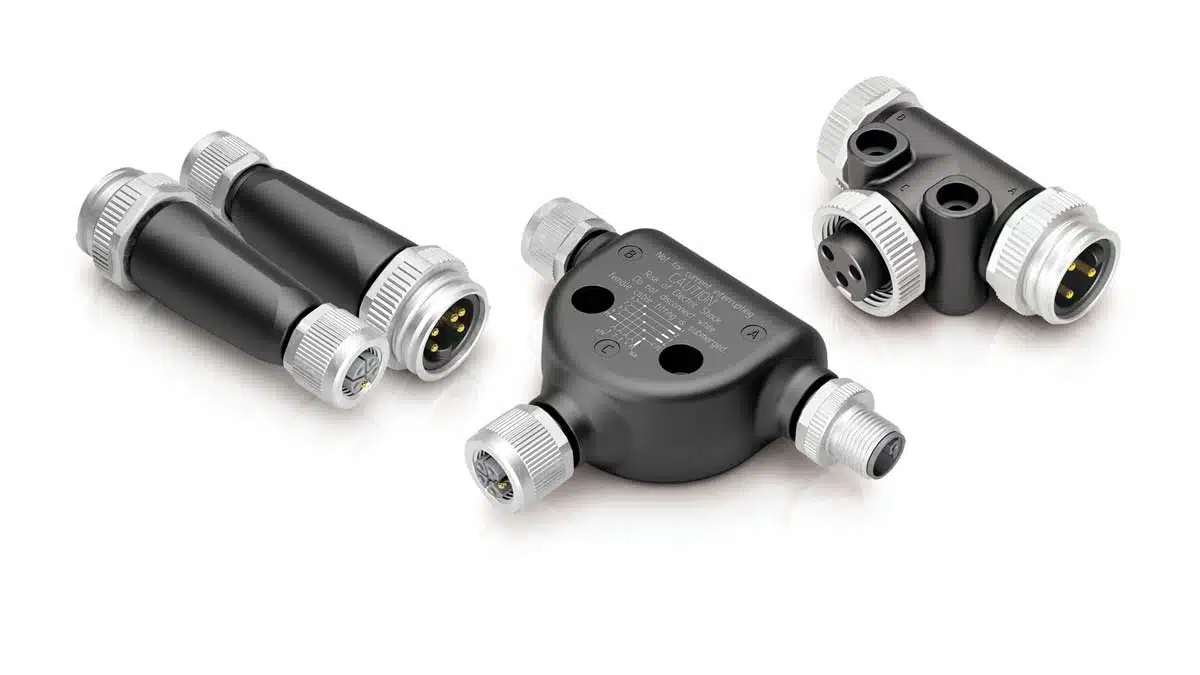
M12 compact connector are increasingly used in smaller machines – 7/8” connectors remain essential for existing systems. binder expands its M12 connector portfolio to meet miniaturization, modern and legacy automation needs.

M12 Connectors: The Future of Compact and Powerful Solutions

RelatedPosts

Binder Hybrid Connector Simplifies One Cable Automation

binder Releases Tool‑Tightenable M12 Connectors for Improved Reliability

Binder Introduces Triangular Moulding for M16 and M12 Cable Connectors

In response to the trend towards decentralization and compact device designs, binder’s M12 connectors have become a standard for signal, data, and power transmission.

These connectors are renowned for their small size and robust performance, supporting voltages up to 630 V. Their standardized codings, including S, T, K, and L, ensure safe and precise solutions for a wide array of applications.

Ron Hautzinger, Product Manager at binder, highlights the versatility of M12 Power connectors, stating, “They are ideal for providing a stable power supply within the familiar M12 form factor, from AC motors and frequency converters to LED lighting and network devices.”

7/8-Inch Connectors: Reliability for Legacy Systems

While M12 solutions are gaining popularity in modern machines, 7/8” connectors remain essential in existing systems. Known for their robust construction, these connectors are ideal for high-voltage and high-power transmission. “In the USA, 7/8” connectors are still the standard, as the trend toward miniaturization is less pronounced there,” notes Hautzinger. binder’s 7/8” connectors offer proven reliability, making them the right choice for applications where larger components are appropriate.

Seamless Integration with New Accessories and Adapters

To facilitate the integration of modern and legacy technologies, binder has introduced an expanded range of accessories and interconnection solutions. New additions include a redesigned 7/8” T-splitter and a 5-pin T-splitter with L-coding, both designed to enhance network performance and power distribution. Additionally, two new adapter solutions enable intelligent connections between 7/8” and L-coded connectors, supporting the gradual modernization of existing systems.

Product Specifications:

  • Series: 813, 814, 820, 823, 824, and 870
  • Coding: K, L, S, T, and 7/8”
  • Pins: 3 to 5, depending on coding
  • Protection Class: IP67 or IP68
  • Mechanical Durability: >100 mating cycles
  • Operating Temperature Range: -40 °C to +85 °C
  • UL Standards Compliance: UL2237 & UL2238

binder’s commitment to innovation and reliability ensures that automation professionals can respond flexibly to the needs of both modern and legacy infrastructure. All products are available immediately, providing customers with the tools they need to build efficient and secure systems.

Related

Source: binder

Recent Posts

Hirose Expands Compact High‑Voltage EV connectors

21.5.2026
24

YAGEO Releases Compact RJ45 Connector for Multi‑Gigabit Ethernet

18.5.2026
26

Binder Hybrid Connector Simplifies One Cable Automation

13.5.2026
26

binder Releases Tool‑Tightenable M12 Connectors for Improved Reliability

30.4.2026
17

Kyocera Developed Multilayer Ceramic Core Substrate for AI Packages

30.4.2026
101

Heatsink Design and Thermal Interface Materials for Reliable Electronics

27.4.2026
77

Amphenol Explanded Liquid Cooling Connectors for AI, ESS and EV Systems

17.4.2026
58

Hirose Introduced BGA connector for PCIe Gen6 for AI and Edge Computing

17.4.2026
37

Molex Completes Acquisition of Smiths Interconnect, Expanding Portfolio of High-Reliability Connectivity Solutions

1.4.2026
24

Upcoming Events

Jun 2
16:00 - 17:00 CEST

Calculation, Simulation and Measurement of 800V EMC Filters

Jun 16
16:00 - 17:00 CEST

EMC with EMC – EMC‑compliant design with electromechanical connectors

View Calendar

Popular Posts

  • Buck Converter Design and Calculation

    0 shares
    Share 0 Tweet 0
  • Boost Converter Design and Calculation

    0 shares
    Share 0 Tweet 0
  • Flyback Converter Design and Calculation

    0 shares
    Share 0 Tweet 0
  • MLCC and Ceramic Capacitors

    0 shares
    Share 0 Tweet 0
  • LLC Resonant Converter Design and Calculation

    0 shares
    Share 0 Tweet 0
  • Capacitor Charging and Discharging

    0 shares
    Share 0 Tweet 0
  • What Electronics Engineer Needs to Know About Passive Low Pass Filters

    0 shares
    Share 0 Tweet 0
  • Dual Active Bridge (DAB) Topology

    0 shares
    Share 0 Tweet 0
  • Ripple Current and its Effects on the Performance of Capacitors

    3 shares
    Share 3 Tweet 0
  • Samsung Electro-Mechanics Releases High-Capacitance MLCCs for AI Server Applications

    0 shares
    Share 0 Tweet 0

Newsletter Subscription


Passive Components Blog

© EPCI - Leading Passive Components Educational and Information Site

  • Home
  • Privacy Policy
  • EPCI Membership & Advertisement
  • About

No Result
View All Result
  • Home
  • Knowledge Blog
  • Dossiers
  • PCNS

© EPCI - Leading Passive Components Educational and Information Site

This website uses cookies. By continuing to use this website you are giving consent to cookies being used. Visit our Privacy and Cookie Policy.
Go to mobile version