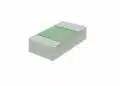




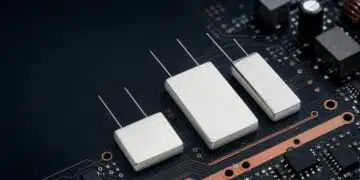


YAGEO’s RCHIP PK Series introduces a robust family of metal current sensors aimed at precise current measurement in high‑power applications such as AI servers, automotive electronics and alternative energy systems.
The YAGEO series combines low resistance values, high operating temperatures and excellent thermal behavior, making it a practical option wherever engineers need accurate current sensing without sacrificing board space or reliability.
Key features and benefits
- High operating temperature capability – The PK Series is specified from −55 °C up to 170 °C, allowing reliable operation in demanding automotive, industrial and server environments where ambient and hotspot temperatures can be significantly elevated.
- High power rating in compact footprints – Devices in this family offer power ratings from 2 W up to 5 W while maintaining a maximum surface temperature of 100 °C, enabling high‑current measurement in space‑constrained layouts without excessive self‑heating.
- Low resistance values for minimal losses – Standard resistance values span approximately 0.5 mΩ to 20 mΩ, which keeps conduction losses low while providing a measurable voltage drop for current sensing circuitry according to manufacturer datasheet.
- Metal plate construction for thermal performance – The metal plate design improves heat spreading and stability under high‑current conditions, helping to avoid local hotspots and improving long‑term reliability compared to typical thick‑film current‑sense resistors.
- Automotive‑grade qualification – Full AEC‑Q200 qualification makes the PK Series suitable for use in automotive electronics and other applications where structured reliability testing and qualification are required.
- Anti‑sulfuration design – An anti‑sulfuration construction provides superior resistance against sulfur‑containing atmospheres, which can be found in certain industrial, automotive or outdoor environments, thereby protecting against drift and open‑circuit failures.
- Lead‑free and RoHS compliant – The series is designed to meet current environmental regulations, simplifying global design‑in and long‑term compliance.
Typical applications
YAGEO positions the PK Series as a versatile current sensor solution for a broad range of high‑power designs. Typical use cases include:
- AI servers and data‑center hardware
Current sensing in high‑current busbars, DC‑DC converters for CPUs/GPUs, board‑level power distribution and protection stages. - Automotive electronics
Battery monitoring, DC‑DC converters, motor drives, power steering modules, onboard chargers and ECU protection stages where accurate current measurement and AEC‑Q200 compliance are expected. - Alternative energy systems
Inverters, DC link monitoring, battery energy storage systems and charge controllers that need stable current feedback across wide temperature and load ranges. - Industrial and general power systems
Power supplies, motor drives, industrial controllers and protection circuits requiring robust current monitoring in compact SMD footprints.
Technical highlights
The key technical parameters of the PK Series can be summarized as follows:
| Parameter | Typical value/range (PK Series) |
|---|---|
| Operating temperature | −55 °C to 170 °C |
| Power rating | 2 W to 5 W (surface temperature limited to 100 °C) |
| Resistance range | 0.5 mΩ to 20 mΩ |
| Case sizes | 1206 and 2512 SMD footprints |
| Temperature coefficient | 50 ppm/°C and 100 ppm/°C options |
| Qualification | AEC‑Q200 |
| Construction | Metal plate, anti‑sulfuration design |
| Compliance | Pb‑free, RoHS compliant |
In practice, the combination of low resistance and defined temperature coefficients simplifies accurate current measurements across temperature, especially when the sense element is part of closed‑loop control or protection circuitry. The availability of standard SMD case sizes such as 1206 and 2512 also makes it straightforward to integrate the PK Series into existing footprints or standard sense‑resistor locations.
Note: current sensor vs. shunt resistor
In many power designs, the PK Series “current sensor” acts functionally as what engineers commonly call a shunt resistor: a low‑value resistor placed in series with the load so the current can be measured via the voltage drop according to Ohm’s law. YAGEO’s PK family is a specialized implementation of this principle using metal plate construction, low temperature coefficient options and automotive‑grade qualification, all optimized for high‑power, high‑temperature environments. In everyday design practice, you would use a PK current sensor in much the same way as a shunt resistor, but benefit from tighter thermal behavior, higher power capability and proven reliability under demanding conditions according to manufacturer information.
Design‑in notes for engineers
- Match resistance value to measurement range
Choose the lowest resistance that still produces a usable sense voltage at maximum current, keeping power dissipation and efficiency under control while avoiding saturating the measurement circuitry. - Check power rating and thermal limits
Verify that the calculated power P=I2×R under worst‑case current stays within the specified 2 W to 5 W rating and keeps the component surface temperature below 100 °C according to layout and cooling conditions. - Consider temperature coefficient for accuracy
For precise current measurement over wide temperature ranges, select the 50 ppm/°C option where available, and include the resistor’s temperature behavior in your error budget. - Use appropriate footprint and copper area
Leverage the 1206 vs. 2512 sizing to balance board space and thermal performance. Wider copper pours and thermal vias underneath and around the sense resistor can significantly improve heat spreading. - Account for anti‑sulfuration benefits in harsh environments
In applications exposed to sulfur‑bearing atmospheres (for example near exhaust systems or certain industrial processes), the PK Series’ anti‑sulfuration design can reduce field failures and long‑term drift compared to standard thick‑film solutions. - Integrate into protection and control loops
Use the PK sense element not only for simple current monitoring but also as a feedback device in over‑current protection, soft‑start circuits and closed‑loop current control, taking advantage of its stable characteristics.
Source
This article is based on information provided in YAGEO Group’s official PK Series RCHIP metal current sensor press release and related product documentation available from the manufacturer’s website.