







Passive Components Blog
No Result
View All Result
  • Home
  • News
    • All
    • Aerospace & Defence
    • Antenna
    • Applications
    • Automotive
    • Capacitors
    • Circuit Protection Devices
    • electro-mechanical news
    • Filters
    • Fuses
    • Inductors
    • Industrial
    • Integrated Passives
    • inter-connect news
    • Market & Supply Chain
    • Market Insights
    • Medical
    • Modelling and Simulation
    • New Materials & Supply
    • New Technologies
    • Non-linear Passives
    • Optoelectronics and Isolation
    • Oscillators
    • Passive Sensors News
    • Resistors
    • RF & Microwave
    • Telecommunication
    • Weekly Digest
    Rheinmetall Pierburg Pump Technology NanoLam DC-link capacitors for high-power electric vehicle traction inverter applications

    Rheinmetall Funds NanoLam Capacitor Production Scale-Up

    Bourns CSS4C-1216 four-terminal metal-strip current sense resistor for high-current Kelvin measurement

    Bourns Extends 1216 Kelvin Current Sense Resistors

    Modelithics COMPLETE+3D Library v26.3 for Ansys HFSS with RF passive component and 3D electromagnetic simulation models

    Modelithics COMPLETE+3D v26.3 Expands HFSS RF Models

    Samsung Electro-Mechanics low-profile and embedded MLCCs for compact PCB and power-delivery applications

    Samsung Low-Profile and Embedded MLCCs for Compact Devices

    Wk 36 Electronics Supply Chain Digest

    Bourns Adds ACXX57SQ Air Coil Inductors for RF Design

    Samsung Electro-Mechanics MLCC capacitor solutions for high-voltage converter snubbing and GPU power delivery

    Samsung MLCC Options for 1 MW AI Rack Power

    Frenetic planar ER transformer simulation for a 5 kW 800 V-to-50 V PSFB converter, showing low-profile core geometry and high-current planar winding arrangement

    5 kW 800 V-to-50 V PSFB Transformer Design for Data Centers

    Samtec 100-CM 1.0 mm vertical solderless compression-mount 50 ohm RF PCB connector

    Samtec 100-CM 1.0 mm RF Connectors Extend to 120 GHz

    Trending Tags

    • Ripple Current
    • RF
    • Leakage Current
    • Tantalum vs Ceramic
    • Snubber
    • Low ESR
    • Feedthrough
    • Derating
    • Dielectric Constant
    • New Products
    • Market Reports
  • Knowledge Blog
  • Dossiers
    • AI Hardware Dossier
    • Automotive Dossier
    • Industrial Robotics Dossier
    • Power Converter Dossier
    • Capacitor Dossier
    • Resistor Dossier
    • Inductor Dossier
    • Circuit Protection Dossier
  • Suppliers
    • Who is Who
  • PCNS
    • PCNS 2025
    • PCNS 2023
    • PCNS 2021
    • PCNS 2019
    • PCNS 2017
  • Events
  • Home
  • News
    • All
    • Aerospace & Defence
    • Antenna
    • Applications
    • Automotive
    • Capacitors
    • Circuit Protection Devices
    • electro-mechanical news
    • Filters
    • Fuses
    • Inductors
    • Industrial
    • Integrated Passives
    • inter-connect news
    • Market & Supply Chain
    • Market Insights
    • Medical
    • Modelling and Simulation
    • New Materials & Supply
    • New Technologies
    • Non-linear Passives
    • Optoelectronics and Isolation
    • Oscillators
    • Passive Sensors News
    • Resistors
    • RF & Microwave
    • Telecommunication
    • Weekly Digest
    Rheinmetall Pierburg Pump Technology NanoLam DC-link capacitors for high-power electric vehicle traction inverter applications

    Rheinmetall Funds NanoLam Capacitor Production Scale-Up

    Bourns CSS4C-1216 four-terminal metal-strip current sense resistor for high-current Kelvin measurement

    Bourns Extends 1216 Kelvin Current Sense Resistors

    Modelithics COMPLETE+3D Library v26.3 for Ansys HFSS with RF passive component and 3D electromagnetic simulation models

    Modelithics COMPLETE+3D v26.3 Expands HFSS RF Models

    Samsung Electro-Mechanics low-profile and embedded MLCCs for compact PCB and power-delivery applications

    Samsung Low-Profile and Embedded MLCCs for Compact Devices

    Wk 36 Electronics Supply Chain Digest

    Bourns Adds ACXX57SQ Air Coil Inductors for RF Design

    Samsung Electro-Mechanics MLCC capacitor solutions for high-voltage converter snubbing and GPU power delivery

    Samsung MLCC Options for 1 MW AI Rack Power

    Frenetic planar ER transformer simulation for a 5 kW 800 V-to-50 V PSFB converter, showing low-profile core geometry and high-current planar winding arrangement

    5 kW 800 V-to-50 V PSFB Transformer Design for Data Centers

    Samtec 100-CM 1.0 mm vertical solderless compression-mount 50 ohm RF PCB connector

    Samtec 100-CM 1.0 mm RF Connectors Extend to 120 GHz

    Trending Tags

    • Ripple Current
    • RF
    • Leakage Current
    • Tantalum vs Ceramic
    • Snubber
    • Low ESR
    • Feedthrough
    • Derating
    • Dielectric Constant
    • New Products
    • Market Reports
  • Knowledge Blog
  • Dossiers
    • AI Hardware Dossier
    • Automotive Dossier
    • Industrial Robotics Dossier
    • Power Converter Dossier
    • Capacitor Dossier
    • Resistor Dossier
    • Inductor Dossier
    • Circuit Protection Dossier
  • Suppliers
    • Who is Who
  • PCNS
    • PCNS 2025
    • PCNS 2023
    • PCNS 2021
    • PCNS 2019
    • PCNS 2017
  • Events
No Result
View All Result
Passive Components Blog
No Result
View All Result

Improved Prediction for MLCC Failure Time by Physics-Based Machine Learning

26.7.2023
Reading Time: 6 mins read
A A

Researchers from PennState developed and published advanced MLCC failure time prediction model by physics-based machine learning model published by APL Machine Learning  Journal.

Abstract

Multilayer ceramic capacitors (MLCC) play a vital role in electronic systems, and their reliability is of critical importance. The ongoing advancement in MLCC manufacturing has improved capacitive volumetric density for both low and high voltage devices; however, concerns about long-term stability under higher fields and temperatures are always a concern, which impact their reliability and lifespan. Consequently, predicting the mean time to failure (MTTF) for MLCCs remains a challenge due to the limitations of existing models. In this study, we develop a physics-based machine learning approach using the eXtreme Gradient Boosting method to predict the MTTF of X7R MLCCs under various temperature and voltage conditions.

RelatedPosts

Rheinmetall Funds NanoLam Capacitor Production Scale-Up

Bourns Extends 1216 Kelvin Current Sense Resistors

Modelithics COMPLETE+3D v26.3 Expands HFSS RF Models

We employ a transfer learning framework to improve prediction accuracy for test conditions with limited data and to provide predictions for test conditions where no experimental data exists. We compare our model with the conventional Eyring model (EM) and, more recently, the tipping point model (TPM) in terms of accuracy and performance. Our results show that the machine learning model consistently outperforms both the EM and TPM, demonstrating superior accuracy and stability across different conditions. Our model also exhibits a reliable performance for untested voltage and temperature conditions, making it a promising approach for predicting MTTF in MLCCs.

Methods

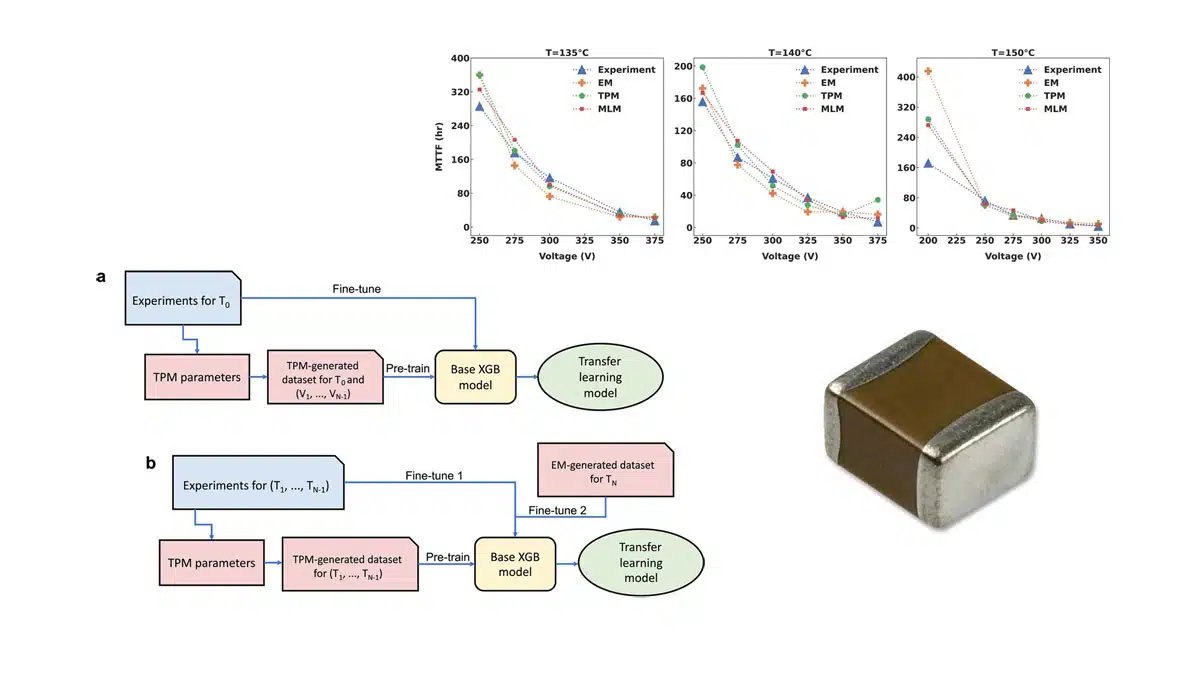
We initially utilize HALT to determine the MTTF of X7R MLCCs (EIA 1206 case size, 1 µF, and voltage rating of 50 V) under isothermal conditions at 135, 140, and 150 °C with a DC field ranging from 200 to 375 V. We declare each MLCC as failed when the leakage current exceeded 300 µA. Subsequently, to overcome the limitations of existing models, we employ the eXtreme Gradient Boosting (XGBoost) method to develop a physics-based machine learning model (MLM), capable of accurately predicting the lifetime of MLCCs.

We develop our model with two primary objectives: improving prediction accuracy for test conditions with limited data and providing predictions for test conditions where no experimental data exist, as demonstrated in Fig. 1.
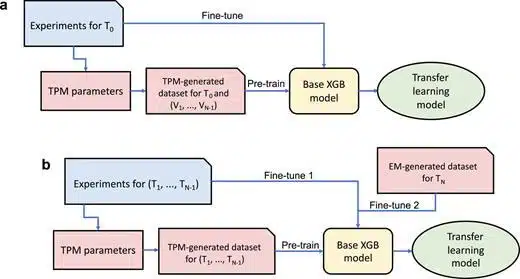
Fig.1. (a) Enhancing the lifetime prediction of MLCCs based on a XGBoost model pre-trained on data generated by TPM for the consistent T0. (b) Predicting lifetime of MLCCs for unseen experimental data for TN.. Source

Results and Discussion

To improve the accuracy of predicting MTTF for X7R MLCCs at a specific temperature across various voltages, we initially obtain MTTF data by conducting isothermal HALT under various DC field conditions. Subsequently, we use the linear least squares regression method to fit the experimental MTTF data at each temperature with the EM and TPM. Notably, at each temperature, we exclude the MTTF data associated with the target voltage condition and used the remaining MTTF data to calculate the EM parameter, n, and TPM parameters, β and C(T). This is carried out to prevent data leakage while evaluating the MLM for the target voltage. Furthermore, the activation energy of these MLCC failures was previously calculated and reported to be 1.70 ± 0.30 and 1.66 ± 0.09 eV, respectively, using the EM and TPM. However, we also prevent information leakage by only calculating the average activation energy of MTTF data that is used for training, excluding the target MTTF data. We use these calculated parameters to create our pre-training dataset, as well as make predictions using TPM and EM for final comparison.

For each target voltage, we use its corresponding TPM parameters to create a dataset for pre-training. Once the base model is created, we fine-tune the remaining experimental data, excluding the data point with the target voltage. Then, we evaluate the MLM against the target voltage and compare its performance to that of TPM and EM. . We use two evaluation metrics to compare the performance of the models. Specifically, we obtain the root mean square error (RMSE) and root mean square percentage error (RMSPE) scores, which are calculated as follows:
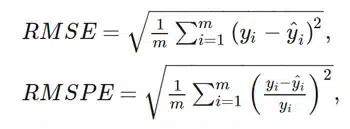
Both RMSE and RMSPE values are reported to provide a comprehensive assessment of the models’ performance. RMSE measures the average squared difference between the predicted values and the actual values and provides an idea of how far, on average, the predictions are from the actual values. It is highly sensitive to large errors or outliers in the data. Because the differences between the predicted and actual values are squared, larger errors have a significant impact on the RMSE value.

Consequently, a single large error can significantly increase the RMSE, even if the model performs well for the majority of the data points. RMSPE, on the other hand, is also sensitive to outliers; however, its sensitivity is affected by the magnitude of the actual values. For data points with large actual values, the percentage error might be small even if there is a significant absolute error. On the other hand, for data points with small actual values, a small absolute error can result in a large percentage error. Therefore, RMSPE is more sensitive to errors in the predictions for data points with smaller actual values. Moreover, since the RMSPE is expressed as percentage, it enables model comparison across datasets of different scales. This dual evaluation approach offers a better understanding of the performance of the prediction models in accurately estimating the MTTF of X7R MLCCs over a comprehensive range of voltages and specific temperature conditions.

Summary and Conclusion

In this study, we present a physics-based machine learning model (MLM) based on the XGBoost method for predicting the mean time to failure (MTTF) of multilayer ceramic capacitors (MLCCs) under various temperature and voltage conditions. The MLM employs a transfer learning framework to overcome data limitations and provides accurate predictions even for untested conditions. Unlike the heavy reliance of existing lifetime prediction models, such as the Eyring model (EM) and the tipping point model (TPM), on the availability and quantity of experimental data, the MLM uses transfer learning to leverage the underlying physics from those models and adapt to existing data to make reliable predictions.

The MLM demonstrates greater accuracy and stability across varied test conditions, capturing complex patterns with limited data. This contrasting with the performance of EM and TPM, which are considerably sensitive to the end points and have shown to introduce large prediction error at those extreme points. However, despite the relative abundance of data in our study, the size of the data is generally small, which hinders a more thorough validation of our model. Further research and validation are needed to improve the performance of the proposed model and distinguish possible dominant failure mechanisms based on limited experimental data in each regime.

In addition, our approach focuses solely on voltage and temperature as main features. Incorporating additional stress factors, such as mechanical stress and humidity, could further improve the model’s predictive capabilities. Finally, despite data constraints, our physics-based approach guarantees accuracy at least on par with EM and TPM. We contend that as long as conventional models can be utilized, our MLM can augment their accuracy, delivering superior performance and stability. This paper focused merely on predicting the MTTF. We have argued that one needs to consider the entire distribution for the lifetime of MLCCs to achieve a valid reliability estimate. The next phase of our ongoing work would be to predict the variance of the distribution as a complementary factor for thorough reliability analysis.

Read the full article:

APL Machine Learning 1, 036107 (2023) https://doi.org/10.1063/5.0158360

Related

Recent Posts

Rheinmetall Pierburg Pump Technology NanoLam DC-link capacitors for high-power electric vehicle traction inverter applications

Rheinmetall Funds NanoLam Capacitor Production Scale-Up

22.9.2026
10
Samsung Electro-Mechanics low-profile and embedded MLCCs for compact PCB and power-delivery applications

Samsung Low-Profile and Embedded MLCCs for Compact Devices

21.9.2026
9
Samsung Electro-Mechanics MLCC capacitor solutions for high-voltage converter snubbing and GPU power delivery

Samsung MLCC Options for 1 MW AI Rack Power

18.9.2026
20
Exxelia PM film capacitor and passive-component technologies for BepiColombo space electronics

Exxelia Passive Components Support BepiColombo Mission

16.9.2026
24
TDK B43657 and B43658 ultra-compact snap-in aluminum electrolytic capacitors for 500 V DC power-supply and DC-link applications

TDK Extends Compact Snap-In Capacitors to 500 V for AI Servers

16.9.2026
37

Samsung MLCC Revenue Seen Above KRW 8T by 2027, Murata EOL Actions Reshape Supply

11.9.2026
83

LG Innotek Demonstrates FC-BGA Substrates With Embedded Silicon Capacitors for AI Power Delivery

10.9.2026
64

On-Chip 3D-Printed Copper Microinductors: A New Route to Compact RF Electronics

10.9.2026
33

Emerging Capacitor Markets in Fusion Energy

10.9.2026
59

Upcoming Events

Sep 29
16:00 - 17:00 CEST

Cybersecurity 2026

Sep 30
15:00 - 16:00 CEST

Positronic Space and Military Connectors

Oct 14
17:00 - 18:00 CEST

Live Demo! Discover KYOCERA AVX Antenna Integrator Studio (AIS)

View Calendar

Popular Posts

  • Buck Converter Design and Calculation

    0 shares
    Share 0 Tweet 0
  • LLC Resonant Converter Design and Calculation

    0 shares
    Share 0 Tweet 0
  • Boost Converter Design and Calculation

    0 shares
    Share 0 Tweet 0
  • Flyback Converter Design and Calculation

    0 shares
    Share 0 Tweet 0
  • Capacitor Charging and Discharging

    0 shares
    Share 0 Tweet 0
  • Resistor Symbols

    0 shares
    Share 0 Tweet 0
  • MLCC and Ceramic Capacitors

    0 shares
    Share 0 Tweet 0
  • Ohm’s Law Answers Your Questions

    0 shares
    Share 0 Tweet 0
  • Thermistors Basics, NTC and PTC Thermistors

    0 shares
    Share 0 Tweet 0
  • Audio Capacitors: Choosing Capacitors for Crossover Circuits

    0 shares
    Share 0 Tweet 0

Newsletter Subscription


Passive Components Blog

© 2015–2026
All rights reserved

  • Home
  • Privacy Policy
  • EPCI Membership & Advertisement
  • About

No Result
View All Result
  • Home
  • Knowledge Blog
  • Dossiers
  • PCNS

© 2015–2026
All rights reserved