






Passive Components Blog
No Result
View All Result
  • Home
  • NewsFilter
    • All
    • Aerospace & Defence
    • Antenna
    • Applications
    • Automotive
    • Capacitors
    • Circuit Protection Devices
    • electro-mechanical news
    • Filters
    • Fuses
    • Inductors
    • Industrial
    • Integrated Passives
    • inter-connect news
    • Market & Supply Chain
    • Market Insights
    • Medical
    • Modelling and Simulation
    • New Materials & Supply
    • New Technologies
    • Non-linear Passives
    • Oscillators
    • Passive Sensors News
    • Resistors
    • RF & Microwave
    • Telecommunication
    • Weekly Digest

    Bourns Introduces Automotive BMS Signal Transformer with Integrated Common Mode Chokes

    Itelcond Introduces High‑Voltage Aluminium Capacitors for Modern IGBT DC‑links

    Bourns Introduces Automotive Shielded Power Inductors for Compact DC‑DC Converters

    EMC Design Fundamentals: Safe Use of Varistors and Common Mode Chokes in Mains and Data-Line Filters

    Murata Unveils Lead Disc Ceramic Capacitors for Automotive Safety and EMI Suppression

    SCHURTER Releases Intelligent Three‑Terminal Fuses for Safer Li‑ion Battery Systems

    Can Copper Conductive Inks Displace Silver in Hybrid Electronics?

    Square-Wave Harmonics and RMS Currents in Power Converters

    LeanBOM: Practical Cross‑Technology Capacitor Search by Real Working Conditions

    Trending Tags

    • Ripple Current
    • RF
    • Leakage Current
    • Tantalum vs Ceramic
    • Snubber
    • Low ESR
    • Feedthrough
    • Derating
    • Dielectric Constant
    • New Products
    • Market Reports
  • VideoFilter
    • All
    • Antenna videos
    • Capacitor videos
    • Circuit Protection Video
    • Filter videos
    • Fuse videos
    • Inductor videos
    • Inter-Connect Video
    • Non-linear passives videos
    • Oscillator videos
    • Passive sensors videos
    • Resistor videos

    EMC Design Fundamentals: Safe Use of Varistors and Common Mode Chokes in Mains and Data-Line Filters

    Ferrite versus Nanocrystalline Power Inductor Cores: Turns, Gap and Size

    KYOCERA AVX Presents Antenna Integrator Studio Tutorial for Antenna Placement and RF Design

    Power Design Simulation Tools for Faster Inductor Selection and Loss Optimization

    EMC‑Compliant PCB and Connector Design Guidelines

    Why Isolated DC/DC Power Supplies Fail Late, Würth Elektronik Podcast

    Designing 800 V DC EMC Filters: Calculation, Simulation and Measurement

    Current Sense Transformer Datasheet and Design‑in Guide

    Designing a USB Type‑C Flyback Planar Transformer with Frenetic’s Planar Tool

    Trending Tags

    • Capacitors explained
    • Inductors explained
    • Resistors explained
    • Filters explained
    • Application Video Guidelines
    • EMC
    • New Products
    • Ripple Current
    • Simulation
    • Tantalum vs Ceramic
  • Knowledge Blog
  • Dossiers
    • AI Hardware Dossier
    • Power Converter Dossier
    • Automotive Dossier
    • Capacitor Dossier
    • Resistor Dossier
    • Inductor Dossier
    • Circuit Protection Dossier
  • Suppliers
    • Who is Who
  • PCNS
    • PCNS 2025
    • PCNS 2023
    • PCNS 2021
    • PCNS 2019
    • PCNS 2017
  • Events
  • Home
  • NewsFilter
    • All
    • Aerospace & Defence
    • Antenna
    • Applications
    • Automotive
    • Capacitors
    • Circuit Protection Devices
    • electro-mechanical news
    • Filters
    • Fuses
    • Inductors
    • Industrial
    • Integrated Passives
    • inter-connect news
    • Market & Supply Chain
    • Market Insights
    • Medical
    • Modelling and Simulation
    • New Materials & Supply
    • New Technologies
    • Non-linear Passives
    • Oscillators
    • Passive Sensors News
    • Resistors
    • RF & Microwave
    • Telecommunication
    • Weekly Digest

    Bourns Introduces Automotive BMS Signal Transformer with Integrated Common Mode Chokes

    Itelcond Introduces High‑Voltage Aluminium Capacitors for Modern IGBT DC‑links

    Bourns Introduces Automotive Shielded Power Inductors for Compact DC‑DC Converters

    EMC Design Fundamentals: Safe Use of Varistors and Common Mode Chokes in Mains and Data-Line Filters

    Murata Unveils Lead Disc Ceramic Capacitors for Automotive Safety and EMI Suppression

    SCHURTER Releases Intelligent Three‑Terminal Fuses for Safer Li‑ion Battery Systems

    Can Copper Conductive Inks Displace Silver in Hybrid Electronics?

    Square-Wave Harmonics and RMS Currents in Power Converters

    LeanBOM: Practical Cross‑Technology Capacitor Search by Real Working Conditions

    Trending Tags

    • Ripple Current
    • RF
    • Leakage Current
    • Tantalum vs Ceramic
    • Snubber
    • Low ESR
    • Feedthrough
    • Derating
    • Dielectric Constant
    • New Products
    • Market Reports
  • VideoFilter
    • All
    • Antenna videos
    • Capacitor videos
    • Circuit Protection Video
    • Filter videos
    • Fuse videos
    • Inductor videos
    • Inter-Connect Video
    • Non-linear passives videos
    • Oscillator videos
    • Passive sensors videos
    • Resistor videos

    EMC Design Fundamentals: Safe Use of Varistors and Common Mode Chokes in Mains and Data-Line Filters

    Ferrite versus Nanocrystalline Power Inductor Cores: Turns, Gap and Size

    KYOCERA AVX Presents Antenna Integrator Studio Tutorial for Antenna Placement and RF Design

    Power Design Simulation Tools for Faster Inductor Selection and Loss Optimization

    EMC‑Compliant PCB and Connector Design Guidelines

    Why Isolated DC/DC Power Supplies Fail Late, Würth Elektronik Podcast

    Designing 800 V DC EMC Filters: Calculation, Simulation and Measurement

    Current Sense Transformer Datasheet and Design‑in Guide

    Designing a USB Type‑C Flyback Planar Transformer with Frenetic’s Planar Tool

    Trending Tags

    • Capacitors explained
    • Inductors explained
    • Resistors explained
    • Filters explained
    • Application Video Guidelines
    • EMC
    • New Products
    • Ripple Current
    • Simulation
    • Tantalum vs Ceramic
  • Knowledge Blog
  • Dossiers
    • AI Hardware Dossier
    • Power Converter Dossier
    • Automotive Dossier
    • Capacitor Dossier
    • Resistor Dossier
    • Inductor Dossier
    • Circuit Protection Dossier
  • Suppliers
    • Who is Who
  • PCNS
    • PCNS 2025
    • PCNS 2023
    • PCNS 2021
    • PCNS 2019
    • PCNS 2017
  • Events
No Result
View All Result
Passive Components Blog
No Result
View All Result

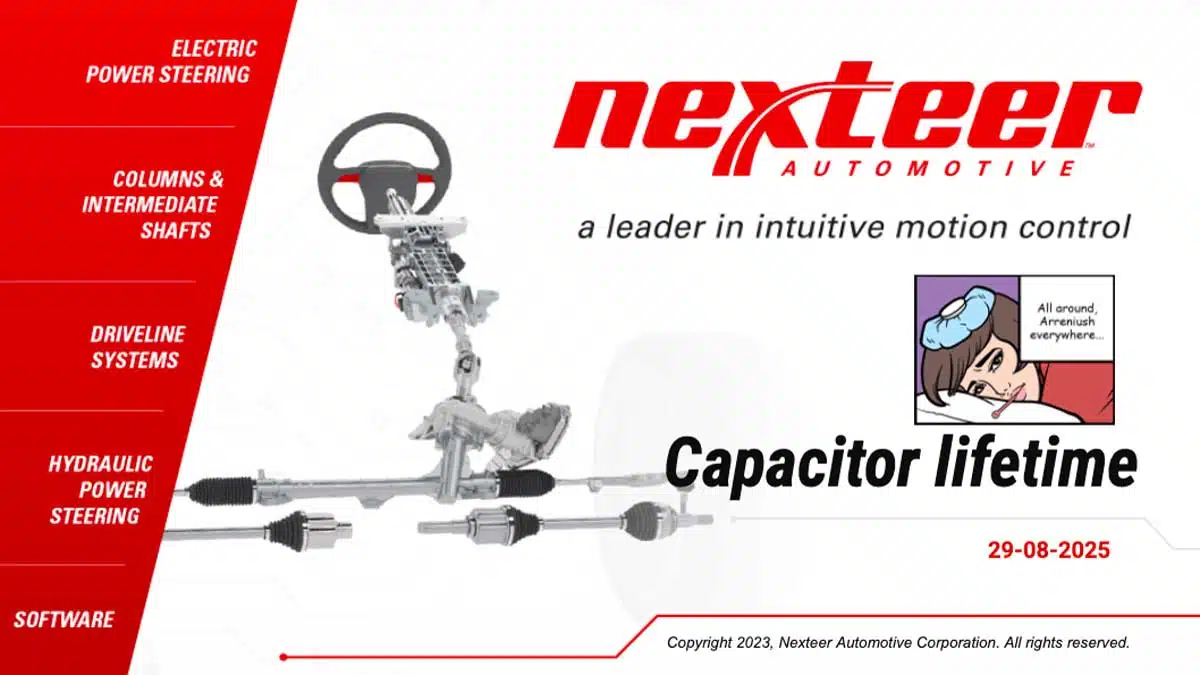
Lifetime Assessment for Capacitors in EPS Application

25.9.2025
Reading Time: 4 mins read
A A

The paper “Lifetime assessment for capacitors in EPS Electric Power Steering application” was presented by Krzysztof Ptak, Nexteer Automotive Europe, Tychy, Poland at the 5th PCNS Passive Components Networking Symposium 9-12th September 2025, Seville, Spain as paper No. 2.4.

Introduction

This article explores the complex topic of lifetime assessment for capacitors used in Electric Power Steering (EPS) applications. It delves into the historical origins of lifetime equations, the 10-degree rule, and the connection between reaction speed and aging phenomena.

RelatedPosts

Advances in the Environmental Performance of Polymer Capacitors

How to Manage Supercapacitors Leakage Current and Self Discharge 

Qualification of Commercial Supercapacitors for Space Applications

The author highlights the challenges engineers face in understanding and applying lifetime equations, particularly under variable loads and temperatures. The paper also raises open questions for the industry regarding missing data, unclear reliability levels, and non-standardized specifications.

Key Points

  • Lifetime equations for capacitors are derived from chemical reaction rate theories, particularly the Arrhenius and Berthelot approaches.
  • The 10-degree (RGT) rule forms a key basis for temperature-dependent aging assumptions.
  • Statistical treatment of lifetime data is often missing or unclear in capacitor OEM specifications.
  • Historical studies from the 19th and 20th centuries—spanning chemistry, metallurgy, and reliability engineering—inform today’s lifetime assessment practices.
  • Open questions remain regarding cumulative damage, reliability levels (Bxx or Lxx), and the correlation between endurance tests and real-life performance.

Extended Summary

Capacitors in EPS systems are critical because their failure can result in severe safety consequences, including loss of steering assist. While engineers use lifetime equations to estimate performance and validate designs for automotive OEMs, the underlying principles are often not widely understood. The paper traces the origins of lifetime equations to historical studies of reaction rates in chemistry, beginning with Arrhenius and van’t Hoff, and the 10-degree rule (RGT) that links temperature rises to reaction speed doubling.

The author examines how lifetime assessment evolved from early reliability studies in mechanics and materials, noting parallels with the Weibull and log-normal statistical distributions used to model fatigue, grain size, and breakdown behavior. Historical figures like Gompertz, Kurtz, and Winfrey contributed to the understanding of survival curves, while later work by Montsinger, Akahira, and Büssing connected thermal aging of insulation to reaction kinetics.

The article further explores the role of power law relationships for voltage stress and the application of cumulative damage models, such as the Palmgren-Miner rule, to estimate life under variable conditions. However, the author emphasizes that capacitor lifetime equations often lack clarity on critical aspects:

  • No explicit link between calculated lifetime and confidence or reliability levels.
  • Limited sample sizes and zero-failure endurance tests make statistical validation difficult.
  • OEMs rarely define how to handle cumulative thermal and electrical stress in real-world conditions.

Statistical considerations are crucial. While exponential, log-normal, and Weibull distributions are all used in reliability engineering, capacitor OEMs typically do not specify which model underpins their life equation. This opacity makes it difficult for end users to compare products or assess risk reliably. Historical comparisons to ball bearings (B10/L10 life) and LED lifetimes show that other industries provide clearer reliability metrics than capacitors.

The paper also highlights that the lifetime equation is effectively an engineering approximation: Berthelot-style adaptations of Arrhenius behavior provide safe, conservative estimates across the relatively narrow temperature ranges experienced in capacitor applications. Weight loss analysis, thermogravimetric data, and other degradation modeling approaches illustrate the deep connection between chemical reaction kinetics and observed aging.

Finally, the article presents open questions for the industry, urging OEMs to standardize how lifetime equations relate to statistical confidence, define cumulative damage rules, and clarify the link between endurance tests and field reliability.

Conclusion

The lifetime assessment of capacitors in EPS applications is grounded in a long history of chemical, material, and statistical research. The current lifetime equations used by OEMs are empirical, often conservative, and built on reaction-speed concepts dating back over a century. However, the lack of standardized statistical definitions, reliability levels, and cumulative damage treatment leaves end users with significant uncertainties. The paper calls for the industry to address these gaps to improve clarity, predictability, and trust in capacitor lifetime specifications.


2_4_Nexteer_Lifetime assesment KPtakDownload

Related

Source: PCNS

Recent Posts

Bourns Introduces Automotive BMS Signal Transformer with Integrated Common Mode Chokes

17.7.2026
9

Itelcond Introduces High‑Voltage Aluminium Capacitors for Modern IGBT DC‑links

17.7.2026
13

Bourns Introduces Automotive Shielded Power Inductors for Compact DC‑DC Converters

16.7.2026
30

EMC Design Fundamentals: Safe Use of Varistors and Common Mode Chokes in Mains and Data-Line Filters

16.7.2026
48

Murata Unveils Lead Disc Ceramic Capacitors for Automotive Safety and EMI Suppression

15.7.2026
37

SCHURTER Releases Intelligent Three‑Terminal Fuses for Safer Li‑ion Battery Systems

14.7.2026
39

Square-Wave Harmonics and RMS Currents in Power Converters

14.7.2026
40

LeanBOM: Practical Cross‑Technology Capacitor Search by Real Working Conditions

14.7.2026
49

In the Age of AI, Every Watt Counts: Implications for Components

13.7.2026
60

Upcoming Events

Jul 21
16:00 - 17:00 CEST

Safety by design: X and Y Interference suppression capacitors for power line filters

Jul 28
8:00 - 11:00 CEST

Post Procurement Testing of EEE Components for LEO Space Applications

Jul 29
17:30 - 18:30 CEST

To Ferrite or to Nanocrystalline in Transformer Design

View Calendar

Popular Posts

  • Boost Converter Design and Calculation

    0 shares
    Share 0 Tweet 0
  • Buck Converter Design and Calculation

    0 shares
    Share 0 Tweet 0
  • YAGEO Announces July 2026 Capacitor Price Increase

    0 shares
    Share 0 Tweet 0
  • Flyback Converter Design and Calculation

    0 shares
    Share 0 Tweet 0
  • LLC Resonant Converter Design and Calculation

    0 shares
    Share 0 Tweet 0
  • MLCC and Ceramic Capacitors

    0 shares
    Share 0 Tweet 0
  • Earthing Systems and IEC Classification Explained

    0 shares
    Share 0 Tweet 0
  • MLCCs in the Age of AI: Q2 2026 Market Tightness

    0 shares
    Share 0 Tweet 0
  • Nvidia Vera Rubin: Why One AI Rack Needs So Many More MLCC Capacitors

    0 shares
    Share 0 Tweet 0
  • Dual Active Bridge (DAB) Topology

    0 shares
    Share 0 Tweet 0

Newsletter Subscription


Passive Components Blog

© EPCI - Leading Passive Components Educational and Information Site

  • Home
  • Privacy Policy
  • EPCI Membership & Advertisement
  • About

No Result
View All Result
  • Home
  • Knowledge Blog
  • Dossiers
  • PCNS

© EPCI - Leading Passive Components Educational and Information Site

This website uses cookies. By continuing to use this website you are giving consent to cookies being used. Visit our Privacy and Cookie Policy.
Go to mobile version