





Passive Components Blog
No Result
View All Result
  • Home
  • NewsFilter
    • All
    • Aerospace & Defence
    • Antenna
    • Applications
    • Automotive
    • Capacitors
    • Circuit Protection Devices
    • electro-mechanical news
    • Filters
    • Fuses
    • Inductors
    • Industrial
    • Integrated Passives
    • inter-connect news
    • Market & Supply Chain
    • Market Insights
    • Medical
    • Modelling and Simulation
    • New Materials & Supply
    • New Technologies
    • Non-linear Passives
    • Oscillators
    • Passive Sensors News
    • Resistors
    • RF & Microwave
    • Telecommunication
    • Weekly Digest

    Binder Hybrid Connector Simplifies One Cable Automation

    Tapped Inductor Buck Converter Fundamentals

    TAIYO YUDEN Releases Mini Metal Power Inductors

    Molecular Memristor Shows Record 145 kH Emergent Inductance

    Planar vs Conventional Transformer: When it Make Sense

    Researchers Propose Next‑Gen Compact Memory Using Ultra-thin Ferroelectric Capacitors

    Nichicon ADN Automotive Hybrid Aluminum Capacitors Now Available in EMEA

    Wk 19 Electronics Supply Chain Digest

    Electrocaloric Multilayer Capacitors: Towards Quiet, Solid‑State Cooling Around Room Temperature

    Trending Tags

    • Ripple Current
    • RF
    • Leakage Current
    • Tantalum vs Ceramic
    • Snubber
    • Low ESR
    • Feedthrough
    • Derating
    • Dielectric Constant
    • New Products
    • Market Reports
  • VideoFilter
    • All
    • Antenna videos
    • Capacitor videos
    • Circuit Protection Video
    • Filter videos
    • Fuse videos
    • Inductor videos
    • Inter-Connect Video
    • Non-linear passives videos
    • Oscillator videos
    • Passive sensors videos
    • Resistor videos

    Tapped Inductor Buck Converter Fundamentals

    Planar vs Conventional Transformer: When it Make Sense

    Modeling Fringing Field Losses in Inductors & Transformers

    Why Power Inductors Use a Ferrite Core With an Air Gap

    Transformer-Based Power-Line Harvester Magnetic Design

    Thermal Modeling of Magnetics

    Standard vs Planar LLC transformers Comparison for Battery Chargers

    How Modern Tools Model Magnetic Components for Power Electronics

    Advanced Loss Modeling for Planar Magnetics in the Frenetic Planar Tool

    Trending Tags

    • Capacitors explained
    • Inductors explained
    • Resistors explained
    • Filters explained
    • Application Video Guidelines
    • EMC
    • New Products
    • Ripple Current
    • Simulation
    • Tantalum vs Ceramic
  • Knowledge Blog
  • DossiersNew
  • Suppliers
    • Who is Who
  • PCNS
    • PCNS 2025
    • PCNS 2023
    • PCNS 2021
    • PCNS 2019
    • PCNS 2017
  • Events
  • Home
  • NewsFilter
    • All
    • Aerospace & Defence
    • Antenna
    • Applications
    • Automotive
    • Capacitors
    • Circuit Protection Devices
    • electro-mechanical news
    • Filters
    • Fuses
    • Inductors
    • Industrial
    • Integrated Passives
    • inter-connect news
    • Market & Supply Chain
    • Market Insights
    • Medical
    • Modelling and Simulation
    • New Materials & Supply
    • New Technologies
    • Non-linear Passives
    • Oscillators
    • Passive Sensors News
    • Resistors
    • RF & Microwave
    • Telecommunication
    • Weekly Digest

    Binder Hybrid Connector Simplifies One Cable Automation

    Tapped Inductor Buck Converter Fundamentals

    TAIYO YUDEN Releases Mini Metal Power Inductors

    Molecular Memristor Shows Record 145 kH Emergent Inductance

    Planar vs Conventional Transformer: When it Make Sense

    Researchers Propose Next‑Gen Compact Memory Using Ultra-thin Ferroelectric Capacitors

    Nichicon ADN Automotive Hybrid Aluminum Capacitors Now Available in EMEA

    Wk 19 Electronics Supply Chain Digest

    Electrocaloric Multilayer Capacitors: Towards Quiet, Solid‑State Cooling Around Room Temperature

    Trending Tags

    • Ripple Current
    • RF
    • Leakage Current
    • Tantalum vs Ceramic
    • Snubber
    • Low ESR
    • Feedthrough
    • Derating
    • Dielectric Constant
    • New Products
    • Market Reports
  • VideoFilter
    • All
    • Antenna videos
    • Capacitor videos
    • Circuit Protection Video
    • Filter videos
    • Fuse videos
    • Inductor videos
    • Inter-Connect Video
    • Non-linear passives videos
    • Oscillator videos
    • Passive sensors videos
    • Resistor videos

    Tapped Inductor Buck Converter Fundamentals

    Planar vs Conventional Transformer: When it Make Sense

    Modeling Fringing Field Losses in Inductors & Transformers

    Why Power Inductors Use a Ferrite Core With an Air Gap

    Transformer-Based Power-Line Harvester Magnetic Design

    Thermal Modeling of Magnetics

    Standard vs Planar LLC transformers Comparison for Battery Chargers

    How Modern Tools Model Magnetic Components for Power Electronics

    Advanced Loss Modeling for Planar Magnetics in the Frenetic Planar Tool

    Trending Tags

    • Capacitors explained
    • Inductors explained
    • Resistors explained
    • Filters explained
    • Application Video Guidelines
    • EMC
    • New Products
    • Ripple Current
    • Simulation
    • Tantalum vs Ceramic
  • Knowledge Blog
  • DossiersNew
  • Suppliers
    • Who is Who
  • PCNS
    • PCNS 2025
    • PCNS 2023
    • PCNS 2021
    • PCNS 2019
    • PCNS 2017
  • Events
No Result
View All Result
Passive Components Blog
No Result
View All Result

New Construction For Highest Voltage Aluminium Polymer Capacitor

23.9.2025
Reading Time: 5 mins read
A A

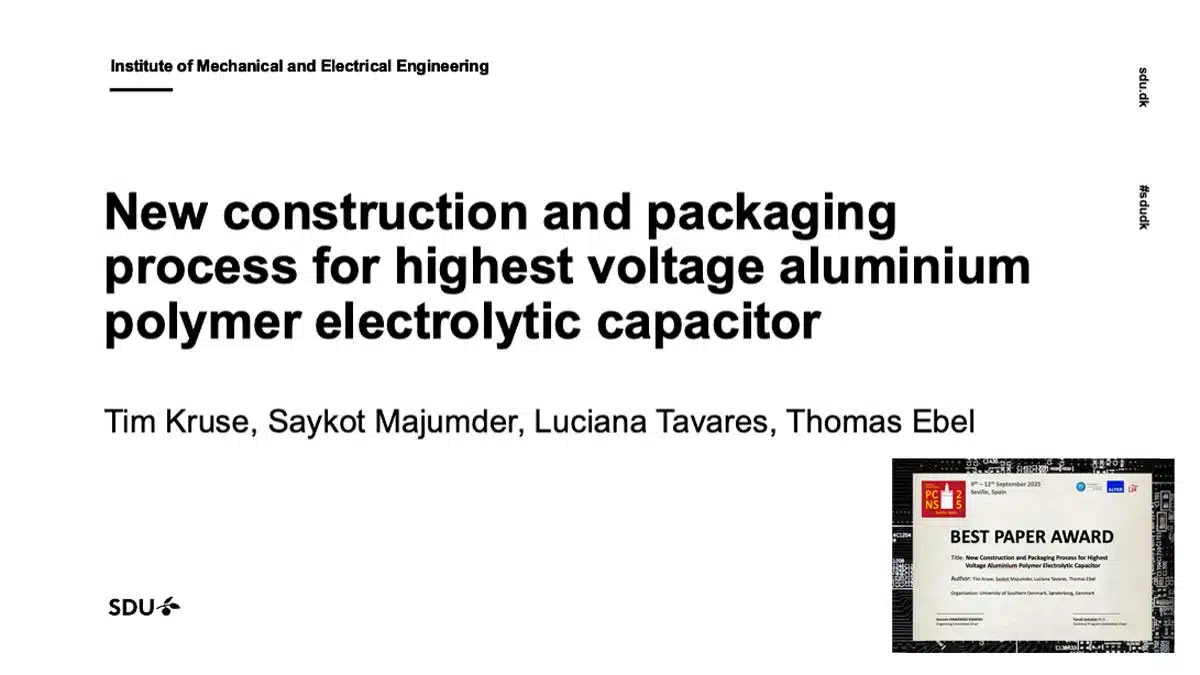
The paper “New Construction And Packaging Process For Highest Voltage Aluminium Polymer Electrolytic Capacitor” was presented by Tim Kruse, Department of Mechanical and Electrical Engineering, University of Southern Denmark, Sønderborg, Denmark at the 5th PCNS Passive Components Networking Symposium 9-12th September 2025, Seville, Spain as paper No. 3.2.

This paper was selected and awarded by TPC Technical Program Committee as the:

RelatedPosts

Advances in the Environmental Performance of Polymer Capacitors

How to Manage Supercapacitors Leakage Current and Self Discharge 

Qualification of Commercial Supercapacitors for Space Applications


BEST PAPER AWARD


Introduction

This article presents the development of a high-voltage polymer aluminum electrolytic capacitor capable of operating at 750 V, addressing one of the key limitations of current polymer capacitors which traditionally max out at 200 V. Polymer aluminum electrolytic capacitors are valued for their high capacitance density, low equivalent series resistance (ESR), and increased reliability compared to their liquid-electrolyte counterparts.

However, achieving higher voltage ratings has been challenging due to difficulties in can size scaling, winding impregnation, and dielectric formation at very high voltages. This study proposes a new construction and packaging process, as well as a high-voltage anodization approach, to overcome these challenges and expand the operational range of polymer capacitors for demanding applications such as electric vehicle drivetrains.

Key Points

  • Developed a high-voltage polymer aluminum electrolytic capacitor rated at 750 V.
  • Employed a high-voltage anodization process up to 1500 V on flat aluminum foils.
  • Designed a stacked, fan-like cathode structure to simplify PEDOT:PSS impregnation.
  • Achieved a capacitance of 2 µF and an average breakdown voltage of 835 V.
  • Demonstrated low leakage current, measurable ESR, and ripple current coolability.
  • Highlighted potential applications in high-voltage DC link circuits and electric vehicle inverters.

Extended Summary

The study begins by contextualizing the role of capacitors in high-power electronic applications, particularly in automotive traction inverters where DC link capacitors are critical to performance and can contribute significantly to weight. While polymer aluminum electrolytic capacitors offer low ESR, high reliability, and resistance to electrolyte evaporation, their traditionally low voltage ratings limit their use in high-voltage power electronics. Commercial devices typically peak at 200 V, necessitating series-parallel arrays to achieve 800 V DC link requirements, which adds complexity and requires voltage balancing.

To address this, researchers developed a capacitor structure that departs from the conventional winding approach, which complicates impregnation of the PEDOT:PSS solid electrolyte. Instead, they used a stacked configuration of flat aluminum anode foils paired with etched cathodes and paper separators, arranged in a fan-like structure. The anodes were anodized through a multistep high-voltage forming process reaching 1500 V. This included anodization in boric acid, chemical depolarization in ammonium phosphate, and thermal depolarization at 500 °C. The process was repeated to enhance oxide quality and reduce trapped charges, resulting in robust dielectric layers.

Capacitor assembly involved precoating the brittle, high-voltage anodes with PEDOT:PSS to ensure uniform electrical connection, then carefully inserting them into the cathode-paper stack housed in an aluminum can. By filling the can with PEDOT:PSS under vacuum and subsequently drying, researchers simplified the impregnation process while minimizing mechanical stress on the anodes. The final assembly was encapsulated and ultrasonically welded to secure connections and prevent environmental degradation.

Electrical characterization revealed a capacitance of approximately 2 µF at 100 Hz, with expected reductions at higher frequencies due to the use of flat foils. ESR decreased significantly with frequency, from 70 Ω at 100 Hz to 0.7 Ω at 100 kHz. Leakage current averaged 42 µA at the rated voltage of 750 V, confirming good oxide integrity. Breakdown voltage testing indicated an average of 835 V, about 55% of the forming voltage, with minor localized breakdowns that did not lead to immediate failure. Ripple current testing demonstrated the device’s effective thermal performance, with external cooling reducing surface temperature from 75 °C to 43 °C under stress conditions.

When compared to traditional liquid electrolytic capacitors and metallized film capacitors used in similar voltage ranges, the prototype demonstrated lower capacitance density and higher ESR. However, the researchers emphasized the potential for substantial improvement through surface area enhancement of the anode foils. Doubling the active area could both double capacitance and halve ESR, situating the technology competitively between existing solutions. This niche could be particularly valuable for high-voltage DC link applications requiring high ripple current handling and moderate energy density.

Conclusion

This study successfully demonstrates a novel stacked construction method and high-voltage formation process for polymer aluminum electrolytic capacitors, achieving a rated voltage of 750 V with promising leakage, ESR, and breakdown characteristics. While the current design’s capacitance density and ESR are limited by the use of flat anode foils, the approach presents a scalable foundation for future improvements in surface area and performance. The demonstrated coolability and high-voltage stability suggest strong potential for integration in electric vehicle drivetrains and other high-power applications where compact, high-voltage capacitors are needed. Further optimization of anode etching and surface area enhancement could establish this technology as a competitive alternative to liquid electrolytic and film capacitors in demanding DC link environments.


3_2_SDU_PCNS_paper_Tim_KruseDownload

Related

Source: PCNS

Recent Posts

Tapped Inductor Buck Converter Fundamentals

13.5.2026
11

Molecular Memristor Shows Record 145 kH Emergent Inductance

12.5.2026
11

Planar vs Conventional Transformer: When it Make Sense

11.5.2026
35

Researchers Propose Next‑Gen Compact Memory Using Ultra-thin Ferroelectric Capacitors

11.5.2026
28

Nichicon ADN Automotive Hybrid Aluminum Capacitors Now Available in EMEA

11.5.2026
23

Electrocaloric Multilayer Capacitors: Towards Quiet, Solid‑State Cooling Around Room Temperature

7.5.2026
186

KYOCERA 10 µF 0201 MLCC Brings High‑Capacitance into Mobile Designs

6.5.2026
54

Energy Localization in Tantalum Anode Formation: A Structural Perspective

4.5.2026
46

YAGEO Introduces C0G Flexible Termination Automotive MLCCs

30.4.2026
41

Upcoming Events

May 19
16:00 - 17:00 CEST

Designing Qi2 Wireless Power Systems: Practical Development and EMC Optimization

Jun 2
16:00 - 17:00 CEST

Calculation, Simulation and Measurement of 800V EMC Filters

Jun 16
16:00 - 17:00 CEST

EMC with EMC – EMC‑compliant design with electromechanical connectors

View Calendar

Popular Posts

  • Buck Converter Design and Calculation

    0 shares
    Share 0 Tweet 0
  • Boost Converter Design and Calculation

    0 shares
    Share 0 Tweet 0
  • Flyback Converter Design and Calculation

    0 shares
    Share 0 Tweet 0
  • LLC Resonant Converter Design and Calculation

    0 shares
    Share 0 Tweet 0
  • MLCC and Ceramic Capacitors

    0 shares
    Share 0 Tweet 0
  • Dual Active Bridge (DAB) Topology

    0 shares
    Share 0 Tweet 0
  • What Electronics Engineer Needs to Know About Passive Low Pass Filters

    0 shares
    Share 0 Tweet 0
  • Capacitor Charging and Discharging

    0 shares
    Share 0 Tweet 0
  • Ripple Current and its Effects on the Performance of Capacitors

    3 shares
    Share 3 Tweet 0
  • MLCC Case Sizes Standards Explained

    0 shares
    Share 0 Tweet 0

Newsletter Subscription


Passive Components Blog

© EPCI - Leading Passive Components Educational and Information Site

  • Home
  • Privacy Policy
  • EPCI Membership & Advertisement
  • About

No Result
View All Result
  • Home
  • Knowledge Blog
  • PCNS

© EPCI - Leading Passive Components Educational and Information Site

This website uses cookies. By continuing to use this website you are giving consent to cookies being used. Visit our Privacy and Cookie Policy.
Go to mobile version