




Passive Components Blog
No Result
View All Result
  • Home
  • News
    • All
    • Aerospace & Defence
    • Antenna
    • Applications
    • Automotive
    • Capacitors
    • Circuit Protection Devices
    • electro-mechanical news
    • Filters
    • Fuses
    • Inductors
    • Industrial
    • Integrated Passives
    • inter-connect news
    • Market & Supply Chain
    • Market Insights
    • Medical
    • Modelling and Simulation
    • New Materials & Supply
    • New Technologies
    • Non-linear Passives
    • Optoelectronics and Isolation
    • Oscillators
    • Passive Sensors News
    • Resistors
    • RF & Microwave
    • Telecommunication
    • Weekly Digest
    Power line EMI filter on a copper ground-plane fixture connected to a vector network analyzer with a toroidal balun

    How to Measure Filter Performance: Insertion Loss, VNA Fixtures and CM/DM Separation

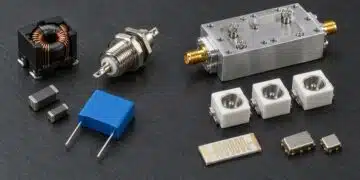
    Assorted EMI and RF filter components: common mode choke, ferrite beads, feedthrough filter, X2 capacitor, cavity filter, ceramic coaxial resonators, thin-film filter and SAW/BAW packages

    Passive Filter Technologies Compared: LC, Ferrite, Feedthrough, Ceramic, Cavity, Microstrip, SAW and BAW

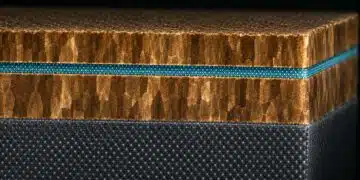
    Illustration of a thin-film capacitor stack with TiN electrodes and an ultrathin hafnium zirconium oxide ferroelectric layer on silicon

    Sub-Volt Ferroelectric HZO Capacitor Pairs Speed and Endurance

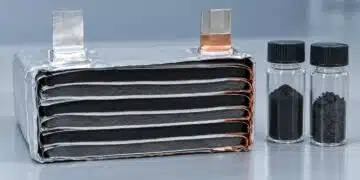
    Cut-open lithium-ion capacitor pouch cell showing stacked carbon electrodes and separators, with vials of carbon powder

    Lithium-Ion Capacitor Review Backs Hard Carbon//AC Pairing

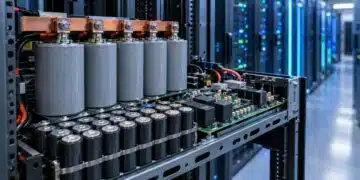
    Rack power shelf in an AI data center with film DC-link capacitors, a supercapacitor bank and a converter board

    800 VDC AI Data Centers Reshape Capacitor Demand for 2027

    Schematic of a titanium nitride thin-film inductor within a CMOS poly-resistor stack beside its integrated resonator circuit.

    TiN Superinductors Bring Compact Cryogenic Inductance to CMOS

    Close-up of reddish-brown metallic rocks illustrating TTI MarketEYE’s connector raw material cost analysis

    Connector Raw Material Costs Rise 20.9% in Q2 2026

    AI and Passive Components: Structural Growth Beyond Data Centers

    YAGEO PMT6397 push-pull transformer with a segmented toroidal winding and surface-mount terminals

    YAGEO Releases Push-Pull Transformers for Isolated 3 W Supplies

    Trending Tags

    • Ripple Current
    • RF
    • Leakage Current
    • Tantalum vs Ceramic
    • Snubber
    • Low ESR
    • Feedthrough
    • Derating
    • Dielectric Constant
    • New Products
    • Market Reports
  • Knowledge Blog
  • Dossiers
    • Aerospace and Defense Passive Components Dossier
    • AI Hardware Dossier
    • Automotive Dossier
    • Industrial Robotics Dossier
    • Power Converter Dossier
    • Capacitor Dossier
    • Circuit Protection Dossier
    • Inductor Dossier
    • Resistor Dossier
    • Silicon Capacitors and Integrated Passives Dossier
  • Suppliers
    • Who is Who
  • PCNS
    • PCNS 2025
    • PCNS 2023
    • PCNS 2021
    • PCNS 2019
    • PCNS 2017
  • Events
No Result
View All Result
Passive Components Blog
No Result
View All Result

Power Over Ethernet (PoE) and PoE+

20.9.2021
Reading Time: 3 mins read
A A

Definition
Power Over Ethernet (POE) technology allows VoIP phones, WLAN access, IP camera … to receive power as well as data over existing LAN cabling without modifying the existing system.

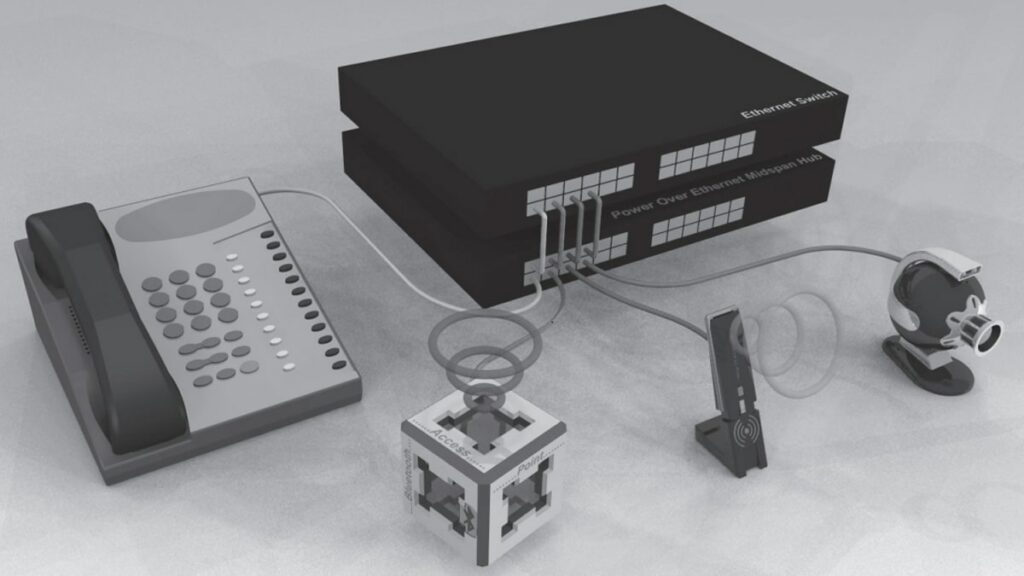
Establishment of an international standard, IEEE802.3af allows an explosion of POE installation all over the world, which was not possible while old proprietary standards were existing together. The cost of adding power supplies to Ethernet switches is getting smaller and smaller. Figure 2.159 shows a typical POE installation.
RelatedPosts

Polymer Materials and Processing

What is RF Connector

Connector Materials and Processes

Fig. 2.159: Typical POE installation

Today, most electronic applications require both data connectivity and power supply. The most familiar example is telephone which is powered via the same twisted pair that carries the voice since its invention. Did you ever plug your telephone to power before they become hand free?! Of course not so the aim of POE standard is to standardize how to do the same with Ethernet devices without modifying the communication protocol.

There were many technical constraints. A complete recognition protocol had to be defined to detect whether connected systems could receive power (without damaging them), classify their power ratings, and define the way of transmitting voltage and current.

Classification and Applications
This article does not aim to go into too much detail about POE but the attached classification gives the main characteristics of the POE & POE+ standards (POE+ being able to carry more power, up to 25.5 W like for a bigger IP camera with zoom …)
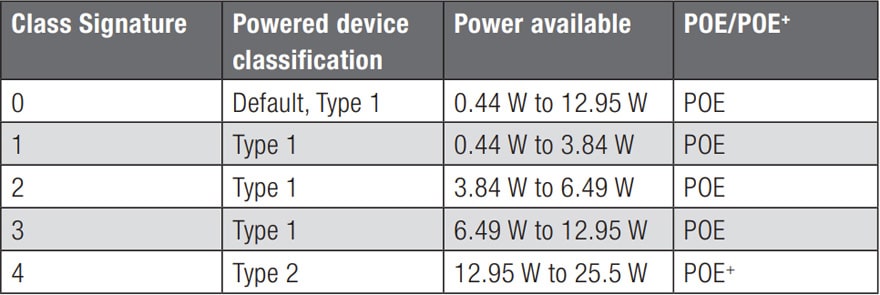
Tab. 2.18: POE classification
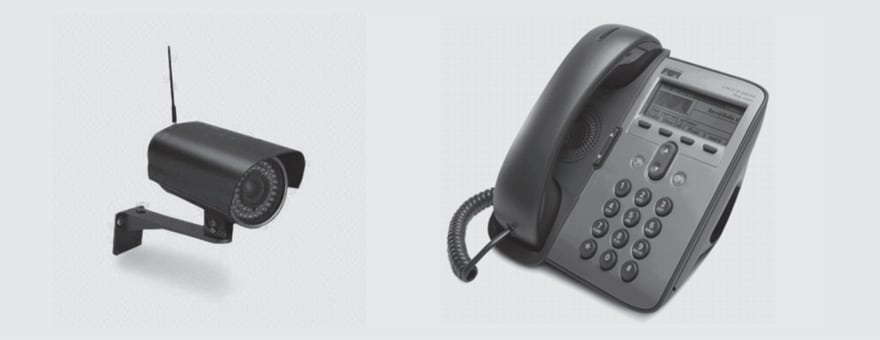
Fig. 2.160: Typical POE applications (left: IP camera/right: IP phone)

The IEEE standards are 802.3af and 802.3at respectively for PoE or PoE+.
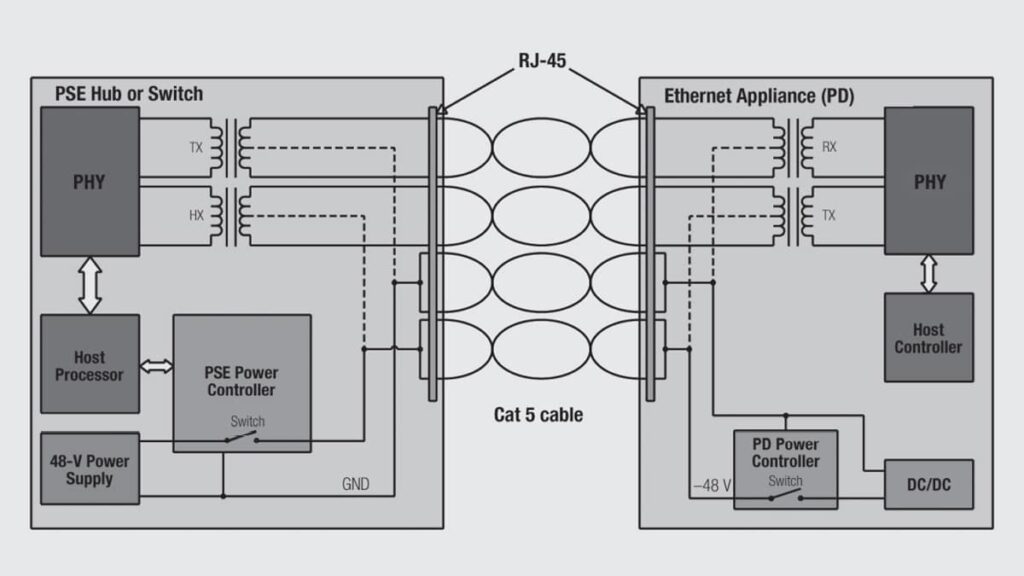
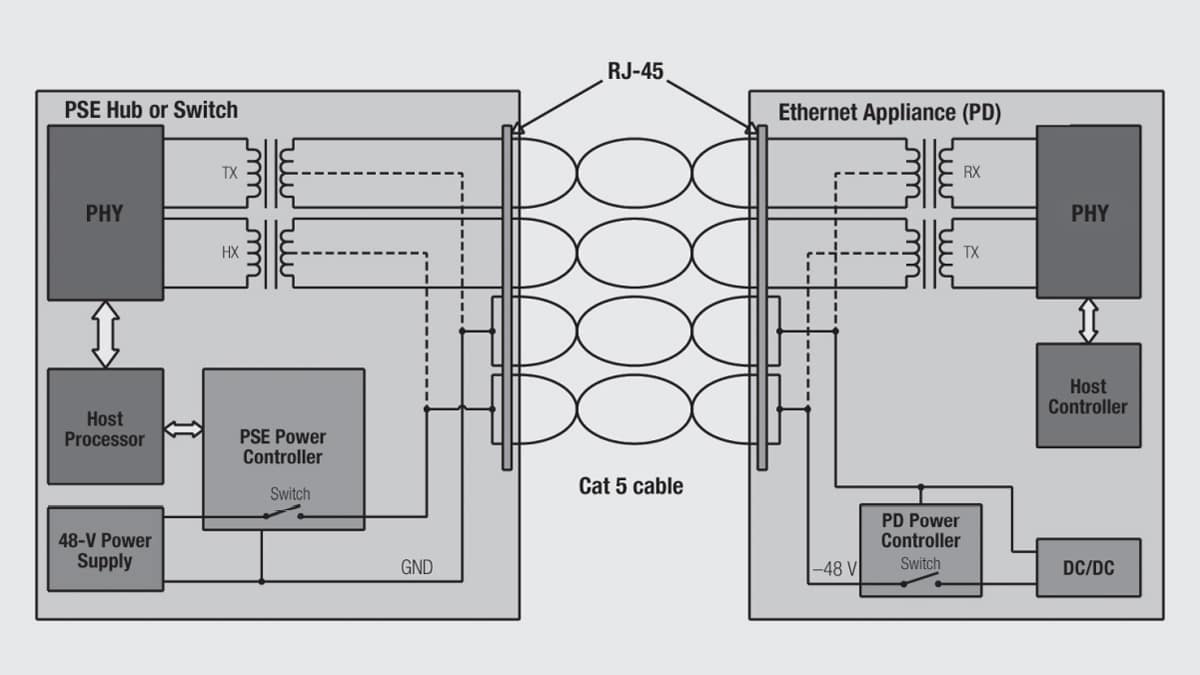
Fig. 2.161: Synopsis of a POE system

PSE: (Power Sourcing Equipment) the device that provides power.
PD: (Power Device) this is the device that receives power.

Usually, the distribution is as follows:

PHY side: TD+/–, RD+/–, PHY ground, LED pins (as LED are driven by the PHY)
Cable side: Power pins (PoE), RJ45 pins.

What about modular jacks, what does it imply on this respect?
The key point is the insulation which is carefully controlled and the interface must withstand 1500 Vrms 1 min. PHY side and cable side (remember Figure 2.155) must be insulated from each other.

The distance between RJ45 pins and between RJ45 pins & shielding must be sufficient to stand this voltage. In this case above 1.4mm.

Problems comes often from the LED pins that are in general too close to the shielding.

Summary
To stand POE standard, pins must always have a minimum distance of 1.4 mm between each other and with the shielding too. Special care must be on LED pins which are often too close to the shielding.

A connector does not have absolutely to be used with transformer to be POE compatible (a standard connector without LED should fit) but it is often necessary (for the LED one) since transformer connector designer often included the POE parameter in their concept (much more than the non-filtered one which were developed earlier)

Related

Source: Wurth elektronik

Recent Posts

Circular Connectors Coding

26.11.2025
325

Connector PCB Design Challenges

3.10.2025
152

Non-Magnetic Interconnects

23.4.2025
77

10 Tips for Ensuring Reliability of Discrete Wire Assemblies

20.2.2025
101

Polymer Materials and Processing

11.8.2025
304

Basic PCB Technology Overview

1.7.2025
85

What is RF Connector

17.12.2024
110

Creepage and Clearance of Connector

25.7.2025
139

RF Connector Types: How To Choose the Right One

3.11.2026
1.8k

Upcoming Events

Nov 24
16:00 - 17:00 CET

Select the Correct Components for Your DC/DC Converter

Dec 1
16:00 - 17:00 CET

Developing low-noise mixed-signal systems

Dec 8
16:00 - 17:00 CET

WE-CCMF: Design Principles, Layout Guidelines and Measurement Results for High-Speed EMI Filtering

View Calendar

Popular Posts

  • Buck Converter Design and Calculation

    0 shares
    Share 0 Tweet 0
  • September 2026 Interconnect, Passives and Electromechanical Components Market Insights

    0 shares
    Share 0 Tweet 0
  • Boost Converter Design and Calculation

    0 shares
    Share 0 Tweet 0
  • Capacitor Charging and Discharging

    0 shares
    Share 0 Tweet 0
  • LLC Resonant Converter Design and Calculation

    0 shares
    Share 0 Tweet 0
  • RF Connector Types: How To Choose the Right One

    0 shares
    Share 0 Tweet 0
  • Flyback Converter Design and Calculation

    0 shares
    Share 0 Tweet 0
  • Passive Low Pass Filters: Fundamentals and EMI Design

    0 shares
    Share 0 Tweet 0
  • Audio Capacitors: Choosing Capacitors for Crossover Circuits

    0 shares
    Share 0 Tweet 0
  • MLCC and Ceramic Capacitors

    0 shares
    Share 0 Tweet 0

Newsletter Subscription


Passive Components Blog

© 2015–2026
All rights reserved

  • Home
  • Privacy Policy
  • EPCI Membership & Advertisement
  • About

No Result
View All Result
  • Home
  • Knowledge Blog
  • Dossiers
  • PCNS

© 2015–2026
All rights reserved