





Passive Components Blog
No Result
View All Result
  • Home
  • News
    • All
    • Aerospace & Defence
    • Antenna
    • Applications
    • Automotive
    • Capacitors
    • Circuit Protection Devices
    • electro-mechanical news
    • Filters
    • Fuses
    • Inductors
    • Industrial
    • Integrated Passives
    • inter-connect news
    • Market & Supply Chain
    • Market Insights
    • Medical
    • Modelling and Simulation
    • New Materials & Supply
    • New Technologies
    • Non-linear Passives
    • Optoelectronics and Isolation
    • Oscillators
    • Passive Sensors News
    • Resistors
    • RF & Microwave
    • Telecommunication
    • Weekly Digest
    tungsten-bronze-ceramic-capacitor-stack

    Tungsten bronze capacitors combine high κ and thermal stability

    Bourns MF-ASMF Series surface-mount PPTC resettable fuses in the manufacturer product photograph

    Bourns Announces 0402 PPTC Fuses Target Low-Current Protection

    Conceptual illustration of Littelfuse AQ4315-01ETG and SP4315-01WTG TVS diode applications on high-speed PCB data lines

    Littelfuse Adds Low-Capacitance TVS Diodes for Fast Data Links

    Datasheet-style illustration of a TDK MLJ1608-G multilayer chip inductor with end terminals

    TDK Expands1608 Inductors for Automotive PoC Filters

    Murata electronica 2026 technology preview featuring MGJ2T2 power converters and SCI36LT inertial sensors.

    Murata Previews SiC Power and AI Sensors at electronica 2026

    Ruggedized passive component customization overview covering capacitors, resistors and inductors.

    Ruggedized Passive Components: Reliability Beyond the Datasheet

    YAGEO Group AS Series resin-coat-less multilayer piezoelectric actuator with lead wires for high-speed industrial motion control

    YAGEO Unveils Multilayer Piezoelectric Actuators

    Bourns CSI2F bolt-down current sense resistors for high-current busbar measurement

    Bourns Current Sense Resistors Reach 36 W

    Wk 38 Electronics Supply Chain Digest

    Trending Tags

    • Ripple Current
    • RF
    • Leakage Current
    • Tantalum vs Ceramic
    • Snubber
    • Low ESR
    • Feedthrough
    • Derating
    • Dielectric Constant
    • New Products
    • Market Reports
  • Knowledge Blog
  • Dossiers
    • AI Hardware Dossier
    • Automotive Dossier
    • Industrial Robotics Dossier
    • Power Converter Dossier
    • Capacitor Dossier
    • Resistor Dossier
    • Inductor Dossier
    • Circuit Protection Dossier
  • Suppliers
    • Who is Who
  • PCNS
    • PCNS 2025
    • PCNS 2023
    • PCNS 2021
    • PCNS 2019
    • PCNS 2017
  • Events
  • Home
  • News
    • All
    • Aerospace & Defence
    • Antenna
    • Applications
    • Automotive
    • Capacitors
    • Circuit Protection Devices
    • electro-mechanical news
    • Filters
    • Fuses
    • Inductors
    • Industrial
    • Integrated Passives
    • inter-connect news
    • Market & Supply Chain
    • Market Insights
    • Medical
    • Modelling and Simulation
    • New Materials & Supply
    • New Technologies
    • Non-linear Passives
    • Optoelectronics and Isolation
    • Oscillators
    • Passive Sensors News
    • Resistors
    • RF & Microwave
    • Telecommunication
    • Weekly Digest
    tungsten-bronze-ceramic-capacitor-stack

    Tungsten bronze capacitors combine high κ and thermal stability

    Bourns MF-ASMF Series surface-mount PPTC resettable fuses in the manufacturer product photograph

    Bourns Announces 0402 PPTC Fuses Target Low-Current Protection

    Conceptual illustration of Littelfuse AQ4315-01ETG and SP4315-01WTG TVS diode applications on high-speed PCB data lines

    Littelfuse Adds Low-Capacitance TVS Diodes for Fast Data Links

    Datasheet-style illustration of a TDK MLJ1608-G multilayer chip inductor with end terminals

    TDK Expands1608 Inductors for Automotive PoC Filters

    Murata electronica 2026 technology preview featuring MGJ2T2 power converters and SCI36LT inertial sensors.

    Murata Previews SiC Power and AI Sensors at electronica 2026

    Ruggedized passive component customization overview covering capacitors, resistors and inductors.

    Ruggedized Passive Components: Reliability Beyond the Datasheet

    YAGEO Group AS Series resin-coat-less multilayer piezoelectric actuator with lead wires for high-speed industrial motion control

    YAGEO Unveils Multilayer Piezoelectric Actuators

    Bourns CSI2F bolt-down current sense resistors for high-current busbar measurement

    Bourns Current Sense Resistors Reach 36 W

    Wk 38 Electronics Supply Chain Digest

    Trending Tags

    • Ripple Current
    • RF
    • Leakage Current
    • Tantalum vs Ceramic
    • Snubber
    • Low ESR
    • Feedthrough
    • Derating
    • Dielectric Constant
    • New Products
    • Market Reports
  • Knowledge Blog
  • Dossiers
    • AI Hardware Dossier
    • Automotive Dossier
    • Industrial Robotics Dossier
    • Power Converter Dossier
    • Capacitor Dossier
    • Resistor Dossier
    • Inductor Dossier
    • Circuit Protection Dossier
  • Suppliers
    • Who is Who
  • PCNS
    • PCNS 2025
    • PCNS 2023
    • PCNS 2021
    • PCNS 2019
    • PCNS 2017
  • Events
No Result
View All Result
Passive Components Blog
No Result
View All Result

Printing wirelessly rechargeable solid-state supercapacitors for soft, smart contact lenses

26.12.2019
Reading Time: 6 mins read
A A

Recent advances in smart contact lenses can assist biomedical engineers to realize medical applications and vision imaging for augmented reality with wireless communication systems. Center for Nanomedicine and Department of Engineering in Korea, described a human pilot trial for smart contact lenses with a wirelessly rechargeable, solid-state supercapacitor for continuous operation.

Previous research on smart contact lenses were driven by a wireless system or wireless power transfer with temporal and spatial restrictions. Such power sources can limit their continuous use and require energy storage devices. The rigidity, heat and large battery size are also less suited for soft, smart contact lenses.

RelatedPosts

Tungsten bronze capacitors combine high κ and thermal stability

Bourns Announces 0402 PPTC Fuses Target Low-Current Protection

Littelfuse Adds Low-Capacitance TVS Diodes for Fast Data Links

In a new report on Science Advances, Jihun Park and a research team in the departments of Materials Science and Engineering, Center for Nanomedicine and Department of Engineering in Korea, described a human pilot trial for smart contact lenses. They engineered the lenses with a wirelessly rechargeable, solid-state supercapacitor for continuous operation. The research team printed the supercapacitor and integrated all device components, including the antenna, rectifier and light emitting diode using stretchable structures to form the soft lens without obstructing vision. The device was reliable against thermal and electromagnetic radiation, with promising test results in vivo and substantial promise for smart contact lenses in the future.

Advances in wearable electronics have allowed biomedical researchers to monitor physical signs and metabolites in human body fluids. Smart contact lenses can be extensively studied as a new platform to continuously monitor vital signs in the eyes and within tears to investigate biomarkers associated with disease. The lenses can also offer expanded applications in other areas such as smart devices for drug delivery and augmented reality.

The softness of smart contact lenses is essential for the user’s comfort across long periods of time during intermittent wireless operation. The rigidity, heat generation and battery size had made preceding lenses less suited to function as required. To address existing limits, Park et al. introduced a new approach to engineer a soft, smart contact lens with a wirelessly rechargeable solid-state supercapacitor for continuous operation of the electronic device.

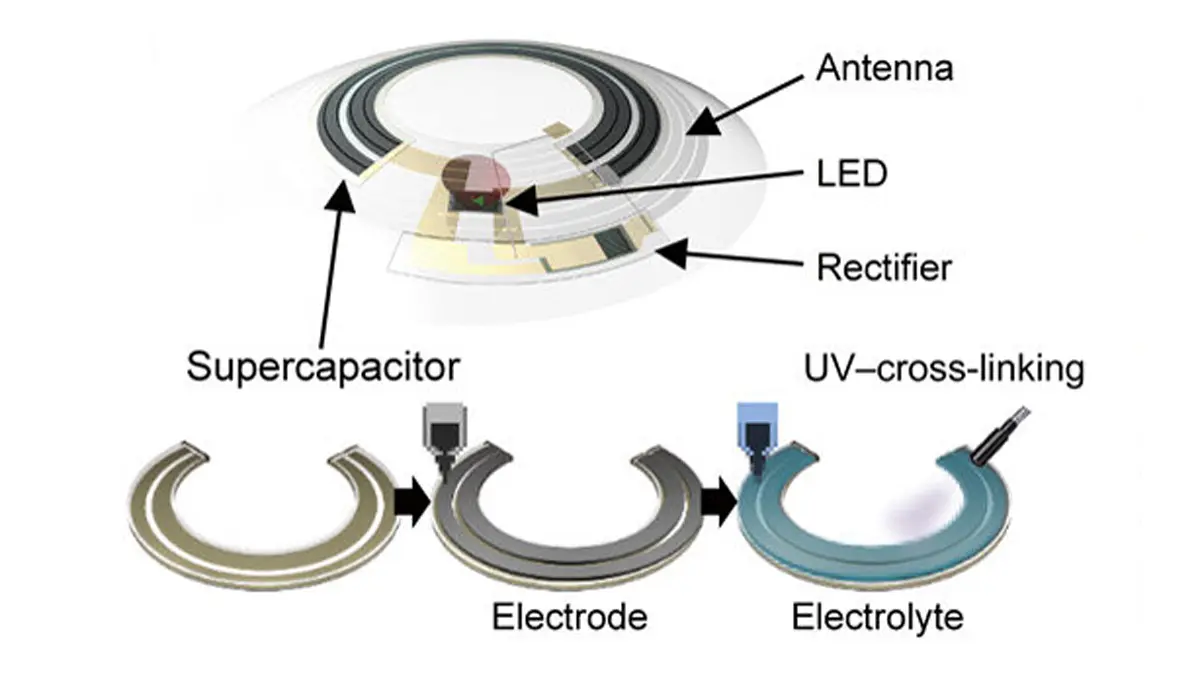
First, they formed an activated carbon-based, solid-state, electric double-layer supercapacitor using a high-precision, microscale direct ink writing (DIW) process to create the smart contact lens. Supercapacitors typically exhibit long life cycles and high-power density for consistent wireless charging and discharging operations of ingrained electronic devices within smart contact lenses. The supercapacitor in this work also served as a physical support during 3-D layer-by-layer integration with accompanying electronic circuits and antenna to form the wireless charging system. This was a challenging step due to the limited area of the smart contact lens.
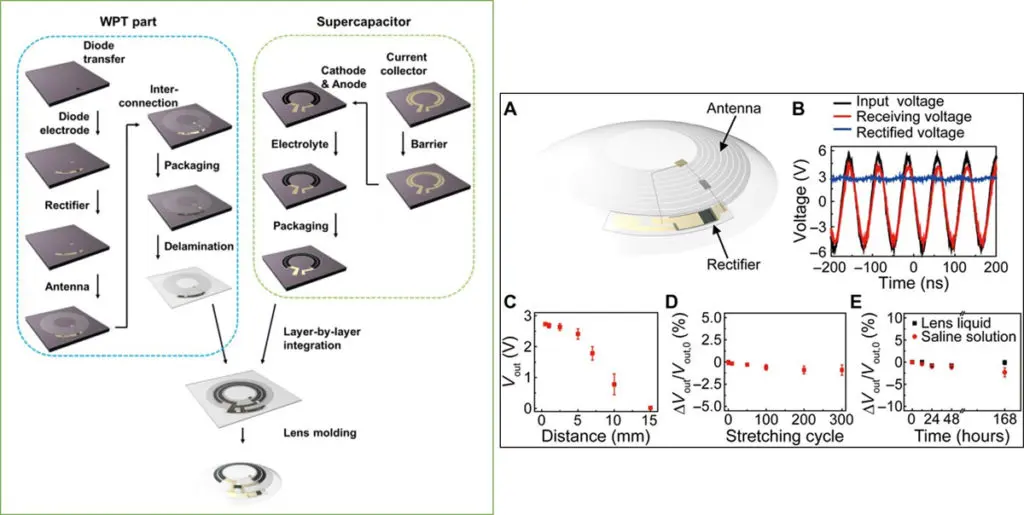
LEFT: Fabrication of a fully integrated soft, smart contact lens system. RIGHT: Characteristics of the WPT system. (A) Schematic image of the WPT circuit composed of AgNF-AgNW–based antenna and rectifier. (B) Rectified properties of the fabricated circuit. (C) Distribution of rectified voltage according to the transmission distance (from 1 to 15 mm). (D) Relative change in rectified voltage as a function of stretching-releasing cycles (biaxially tensile strain of 30%). (E) Relative change in rectified voltage after immersion tests using lens liquid and saline solution. Each data point indicates the average for 50 samples, and error bars represent the SD. Credit: Science Advances, doi: 10.1126/sciadv.aay0764

Park et al. combined the wireless charging system with the solid-state supercapacitor to facilitate continuous and repetitive operation of the smart contact lens without an external electric port. To construct stretchable geometries for the antenna, the researchers used hybrid nanostructures of ultrastrong silver nanofibers (AgNFs) and fine silver nanowires (AgNWs). Additionally, they used a stretchable hybrid substrate composed of rigidly reinforced islands and a soft matrix to improve endurance of the brittle components of the contact lens against mechanical deformation.

The system displayed superb endurance after 300 cycles with a biaxially tensile strain of 30 percent. The smart contact lens maintained high softness and comfort without obscuring the vision of the wearer, while protecting electrical devices from tear across a seven-day timeline. The wireless charging system avoided abrupt heating to protect the wearer’s safety. A human pilot trial and in vivo translational studies in live rabbits further verified the biocompatibility of the lens.

Park et al. combined the wirelessly chargeable solid-state supercapacitor with the rectifier circuit, antenna and light-emitting diode (LED) within the layout of the soft, smart contact lens. They included a wireless power transfer (WPT) unit in the upper layer of the smart contact lens and the lower layer contained the solid-state supercapacitor to repeatedly store and use electric power. The research team integrated the LED as an indicator to detect wireless operation of the smart contact lens.

The arc-shaped form factor secured maximum energy density within the limited areas of the contact lens allowing deformability when stretched. To prevent interference with the wearer’s field of vision, the team designed the smart contact lens to contain all components outside of the wearer’s pupil. They also included an in-plane electrode configuration to minimize abrupt failure of the internal short circuit. Park et al. observed the resulting electrodes and solid-state electrolyte prepared using the DIW (direct ink writing) process with scanning electron microscope (SEM) images.
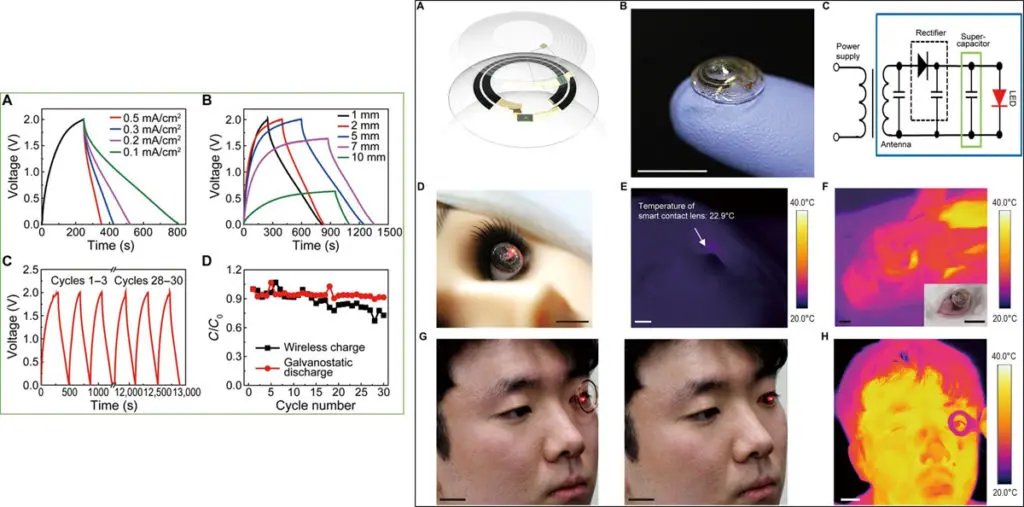
LEFT: Wireless charging system. (A) Characteristics of wireless charging/discharging by current densities. (B) Wireless charging/discharging profiles according to the transmission distance (from 1 to 10 mm). (C) Cyclic performances of the wireless charging system. (D) Capacity retention by the cyclic numbers. RIGHT: Fully integrated soft, smart contact lens system. (A) Expanded illustration of the fully integrated soft, smart contact lens. (B) Photograph of the fully integrated soft, smart contact lens. Scale bar, 1 cm. (C) Circuit diagram of the fully integrated soft, smart contact lens. (D) Photograph of the soft, smart contact lens on an eye of a mannequin. Scale bar, 1 cm. (E) IR image of the soft, smart contact lens on an eye of a mannequin. Scale bar, 1 cm. (F) IR image and photograph (inset) during the discharging state on the eye of a live rabbit eye. Scale bars, 1 cm. (G) Photographs of a person wearing the operating soft, smart contact lens (left, charging state; right, discharging state with LED on-state). Scale bars, 2 cm. (H) Heat tests while a person is wearing the operating soft, smart contact lens. Scale bar, 2 cm. Photo credits: (B and D to F) Jihun Park, Yonsei University; (G and H) Joohee Kim, Yonsei University.Credit: Science Advances, doi: 10.1126/sciadv.aay0764

The research team printed the arc-shaped, monolithically integrated solid-state supercapacitor (MIS-supercapacitor) directly to form the smart contact lens while introducing a parylene-based packing layer to prevent leakage of the constituent material into the eyes. The supercapacitor showed reasonable cycling performance combined with the wireless charging system for long-term use. The study formed a first report on a power source-integrated smart contact lens with sustainable electrochemical performance.

Park et al. then engineered the wireless power transfer (WPT) circuit to charge the supercapacitor. The underlying WPT circuit displayed good mechanical stretchability and chemical stability to endure a variety of stimulations. The circuit had negligible degradation in its electrical performance even during its stretching state—suited for flexible and soft contact lenses. The research team characterized the supercapacitor and WPT system using wireless charging/galvanostatic discharging processes and charged the supercapacitor in full using wireless charging conditions within a relatively short time (240 seconds). The wireless system provided reliable performance across multiple cycles for smart contact lenses—suited for long-term use.

The completed soft contact lens system thereby contained a wirelessly rechargeable supercapacitor, antenna, rectifier circuit and LED united in stretchable form. After assimilating the layers, the scientists encapsulated the electronic components in a silicone elastomer as a commercially available soft contact lens material molded into the shape of a contact lens. When driven wirelessly, the embedded LED indicated the status of wireless charging and discharging.

The research team first tested the device on the eye of a mannequin and monitored heat generation during wireless operation of the lens using an infrared (IR) camera. The results indicated reliability of the smart contact lens against thermal or electromagnetic radiation. During in vivo translational tests, the researchers facilitated the contact lens onto the eye of a live rabbit for reliable operation without noticeable side effects or abrupt heat generation. During subsequent human pilot trials on a human eye, Park et al. tested all functions including the wireless charging/discharging operation of the supercapacitor and LED. The results were feasible with wireless functionalities as expected and without adverse reactions.

In this way, Jihun Park and colleagues engineered a soft, smart contact lens to charge a supercapacitor wirelessly for continuous function. They embedded the electronic components including a stretchable antenna, rectifier circuits, LEDs and a supercapacitor to form the soft, smart contact lens without obstructing the wearer’s view on use. They conducted many stability tests for long-term use of the soft, smart contact lens. The pilot studies in humans and translational studies with live rabbits verified good biocompatibility. The research team expect to use the platform as a miniaturized, wearable electronics device with continuous function.

Related

Source: Phys.org

Recent Posts

tungsten-bronze-ceramic-capacitor-stack

Tungsten bronze capacitors combine high κ and thermal stability

7.10.2026
2
Ruggedized passive component customization overview covering capacitors, resistors and inductors.

Ruggedized Passive Components: Reliability Beyond the Datasheet

6.10.2026
16
YAGEO Group AS Series resin-coat-less multilayer piezoelectric actuator with lead wires for high-speed industrial motion control

YAGEO Unveils Multilayer Piezoelectric Actuators

5.10.2026
12
Heraeus C5735 thick-film gold conductor circuit with fine laser-etched RF trace pattern

Heraeus Presents Laser Etching for RF Thick-Film Gold Circuits

2.10.2026
18
TDK B3272 series boxed DC-link film capacitors with radial leads for automotive and industrial power-electronics applications

TDK Expanded DC-Link Film Capacitors to Reach +135 °C

2.10.2026
16
Film DC-link capacitor and supercapacitor energy buffer in a high-voltage power converter system

Electrification Raises Demands on DC-Link Capacitors

1.10.2026
25
YAGEO Group high-reliability polymer tantalum capacitor portfolio for aerospace and defence power electronics

YAGEO High-Reliability Polymer Tantalum Capacitors for Aerospace

1.10.2026
32
Schematic of the step-wise LPG/LPG@MnOx/LPG-O functionally graded thick cathode for a zinc-ion hybrid capacitor, Hefei Institutes of Physical Science.

Laser-Engineered Zinc-Ion Cathodes Target Thick Electrodes

1.10.2026
13
Isabellenhütte HFF flexible Kapton heater with etched MANGANIN foil structure and wire lead exit

Isabellenhütte Introduces Flexible Heaters for Space Thermal Control

1.10.2026
25

Upcoming Events

Oct 9
18:00 - 19:00 CEST

Edgewater Research 3Q26 Electronic Components Review Outlook Webinar

Oct 14
17:00 - 18:00 CEST

Live Demo! Discover KYOCERA AVX Antenna Integrator Studio (AIS)

Oct 19
15:00 - 16:00 CEST

ESCC-qualified Pt Temperature Sensors for Space Applications

View Calendar

Popular Posts

  • Buck Converter Design and Calculation

    0 shares
    Share 0 Tweet 0
  • Boost Converter Design and Calculation

    0 shares
    Share 0 Tweet 0
  • LLC Resonant Converter Design and Calculation

    0 shares
    Share 0 Tweet 0
  • Flyback Converter Design and Calculation

    0 shares
    Share 0 Tweet 0
  • Capacitor Charging and Discharging

    0 shares
    Share 0 Tweet 0
  • Resistor Symbols

    0 shares
    Share 0 Tweet 0
  • Thermistors Basics, NTC and PTC Thermistors

    0 shares
    Share 0 Tweet 0
  • Audio Capacitors: Choosing Capacitors for Crossover Circuits

    0 shares
    Share 0 Tweet 0
  • MLCC and Ceramic Capacitors

    0 shares
    Share 0 Tweet 0
  • RF Connector Types: How To Choose the Right One

    0 shares
    Share 0 Tweet 0

Newsletter Subscription


Passive Components Blog

© 2015–2026
All rights reserved

  • Home
  • Privacy Policy
  • EPCI Membership & Advertisement
  • About

No Result
View All Result
  • Home
  • Knowledge Blog
  • Dossiers
  • PCNS

© 2015–2026
All rights reserved