





A University of Minho-led team, working with ICMAB-CSIC, Brunel University London, Romania’s National Institute of Materials Physics and the University of Cambridge, has reported lead-free relaxor superlattice capacitors combining BCZT and strontium titanate.
Published in Nature Communications on 5 October 2026, the peer-reviewed, accepted paper reports recoverable energy storage density of 12.6 J/cm³ and efficiency close to 99% at an applied field of 920 kV/cm. The engineering interest is the combination of energy recovery and reduced dielectric loss—not a qualified replacement for existing capacitors.
Key takeaways
- The BCZT/SrTiO₃ superlattice achieves 12.6 J/cm³ recoverable energy density with efficiency close to 99% at 920 kV/cm.
- The reported field equals 0.92 MV/cm, or 92 V/µm. “Low field” therefore describes the research comparison, not a low electrical stress in ordinary component terms.
- The proposed mechanisms are confinement of polar nanoregions and a strain gradient that modifies the built-in electric field.
- These are thin-film research results. Measurement frequency, temperature, statistical reproducibility and qualification evidence must be checked in the full paper before publication or application assessment.
Background
A useful energy-storage dielectric must develop substantial polarization during charging while releasing most of the associated energy during discharge. Strong polarization alone is insufficient: if polarization persists after the applied field falls, or follows a strongly hysteretic path, part of the charging energy is dissipated rather than recovered.
This is the central trade-off in ferroelectric capacitor materials. Ferroelectric behavior can provide a large electrical response, but it can also introduce hysteresis, operating-point dependence and losses. Relaxor materials offer a different balance by distributing the response among small polar regions rather than relying entirely on long-range ferroelectric order.
The practical connection to ceramic capacitors is familiar. High capacitance measured under one set of conditions does not necessarily mean high usable capacitance or recoverable energy in the circuit. The blog’s explanation of DC bias characteristics of ceramic capacitors provides the relevant component-level context.
The new study addresses this balance through interfaces. Instead of treating composition as the only design variable, it combines a relaxor ferroelectric with a paraelectric material in a repeated thin-film structure.
What the researchers found
The relaxor material is:
This composition, abbreviated BCZT, is combined with paraelectric SrTiO₃, or STO. The resulting superlattice introduces repeated interfaces between the two materials.
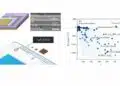
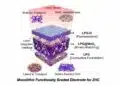
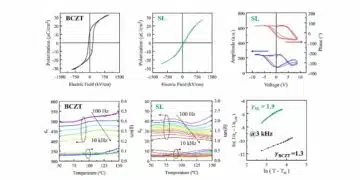
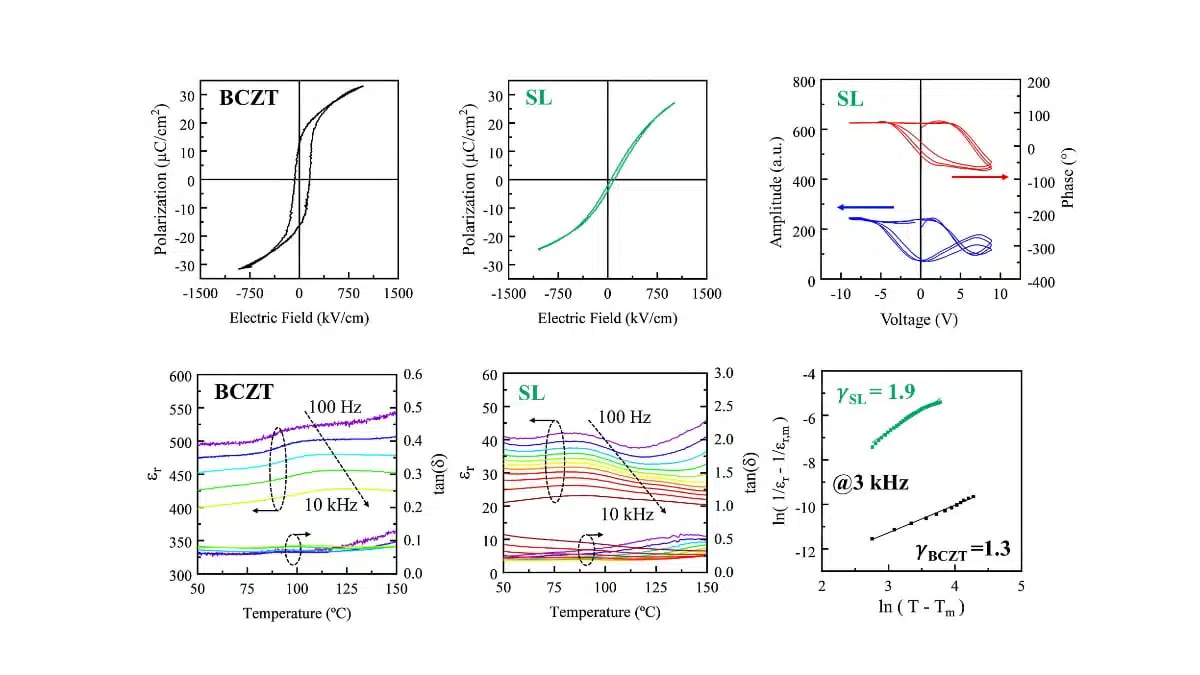
The paper identifies two mechanisms behind the improved energy-storage response. First, superlattice confinement reduces the size of polar nanoregions, promoting relaxor behavior. Second, a strain gradient modifies the built-in electric field and enhances imprint—the electrical asymmetry associated with an internal bias.
These mechanisms matter because they change how polarization develops and relaxes, rather than merely increasing its maximum value. The reported outcome is a favorable combination of recoverable energy density and efficiency.
| Parameter | Reported result | Conditions and interpretation |
|---|---|---|
| Recoverable energy density | 12.6 J/cm³ | BCZT/STO thin-film superlattice at 920 kV/cm |
| Energy-storage efficiency | Close to 99% | Same reported field; not a system-level converter efficiency |
| Applied electric field | 920 kV/cm | Equivalent to 0.92 MV/cm or 92 V/µm |
| Comparator | Single-layer BCZT thin film | Improvement stated in the abstract; numerical reference values require full-text verification |
Temperature, waveform, measurement frequency and sample statistics were not available in the accessible abstract. The table therefore preserves the verified field condition without supplying assumed test conditions.
The distinction between recoverable energy and total charging energy is important. The reported efficiency concerns the dielectric’s energy-storage response; it should not be interpreted as including driver losses, electrode resistance, interconnect losses or all losses in a practical charging circuit.
Why it matters for passive components
The closest component connection is to thin-film dielectric capacitors and, more cautiously, to future ceramic capacitor architectures. The result demonstrates an interface-design approach for balancing polarization and energy recovery in a lead-free oxide system.
For energy-storage applications, the important parameter is not simply nominal capacitance. It is the energy that can be delivered over the intended voltage excursion, together with the associated losses and electrical stress. For a nonlinear dielectric, that assessment requires its polarization–field or charge–voltage response under representative conditions.
The reported 12.6 J/cm³ is a material/device research metric, not the volumetric energy density of a packaged part. Electrodes, substrate, inactive margins, terminations and packaging all affect the final component-level result. Consequently, it cannot support a direct size-reduction claim against a commercial MLCC or film capacitor.
Interface engineering also has a broader research context. Earlier coverage of multilayer ferroelectric energy-storage dielectrics describes a different strategy using relaxor and paraelectric layers. The useful comparison is the design principle: layer arrangement can change the balance between energy density, efficiency and electrical stress. Peak energy-density numbers alone do not establish which architecture is more suitable for an application.
The authors identify future self-powered electronics as a potential destination. That remains an application prospect, rather than a demonstrated circuit implementation. Designers still need usable capacitance, leakage, discharge behavior and reliability at the actual operating point.
From lab to component
An editorial maturity estimate is TRL 3: experimental proof of concept, not an industrially qualified component. This estimate is provisional because the full methods and supplementary results could not be retrieved during verification.
The main production question is whether the beneficial interface structure can be reproduced economically and consistently in a manufacturable capacitor. A superlattice is not equivalent to a conventional MLCC stack: repeated dielectric interfaces and repeated internal metal electrodes serve different purposes.
A credible industrial assessment must therefore establish electrode compatibility, process atmosphere, thermal budget, interface uniformity and yield. Compatibility with nickel- or copper-electrode manufacturing cannot be assumed from the demonstrated oxide chemistry.
Lead-free composition is useful, but it does not establish complete environmental compliance or low manufacturing cost. Those assessments require the finished material system and process—not only the principal dielectric ingredients.
Imprint also deserves attention. An internal bias that benefits a particular charging direction may create different behavior under reversed polarity or another waveform. Its stability over time and temperature is therefore a component-design question, not merely a materials mechanism.
What engineers should watch
- Reproduction of the energy-density and efficiency result with stated temperature, frequency, waveform and integration method.
- Breakdown distributions, tested electrode area, device count and independent fabrication batches.
- Leakage and insulation resistance under sustained DC bias, rather than only during polarization measurements.
- Cycling endurance, thermal aging and stability of the built-in field and imprint.
- Transfer to practical substrates and electrodes, with demonstrated process yield and interface control.
- Packaged-device measurements of usable capacitance, pulse delivery, resistance, inductance and thermal behavior.
Summary
The study reports a lead-free BCZT/STO superlattice combining 12.6 J/cm³ recoverable energy density with efficiency close to 99% at 920 kV/cm. Its central contribution is the use of confinement and strain-related internal fields to adjust the polarization response.
For designers, the takeaway is the interface-engineering approach—not immediate component availability. The result remains a laboratory demonstration until reproducibility, operating-condition stability, manufacturability and packaged-device qualification are established.
Further reading
Source
This article is based on the accessible publisher record and abstract of a peer-reviewed, accepted paper published in Nature Communications under the Creative Commons Attribution 4.0 International license. No matching university or institute press release was located. These are research results, not qualified commercial components; engineers should await manufacturer data and standard qualification before making design decisions. Full-text and supplementary verification remains necessary before this draft is published.
References
- Matilde M. G. S. Oliveira, Ampattu R. Jayakrishnan, Duarte J. M. Ribeiro, Tiago Rodrigues, Jingye Zou, Surya K. P. Nair, Raluca Negrea, Marian C. Istrate, Manuel J. L. F. Rodrigues, Michael Belsley, Bernardo G. Almeida, Mario Pereira, Judith L. MacManus-Driscoll, Ignasi Fina, Florencio Sánchez, Luís Marques and José P. B. Silva, “Superlattice Engineering in Relaxor Ferroelectric-based Capacitors for Ultra-Highly Efficient Recoverable Energy Storage Density,” Nature Communications, 2026, published 5 October 2026, https://doi.org/10.1038/s41467-026-77971-6. Gold open access, CC BY 4.0. The accessible early-publication record does not provide a volume or article number. Publisher record and abstract accessed through search results; direct page and PDF retrieval failed.