




Passive Components Blog
No Result
View All Result
  • Home
  • NewsFilter
    • All
    • Aerospace & Defence
    • Antenna
    • Applications
    • Automotive
    • Capacitors
    • Circuit Protection Devices
    • electro-mechanical news
    • Filters
    • Fuses
    • Inductors
    • Industrial
    • Integrated Passives
    • inter-connect news
    • Market & Supply Chain
    • Market Insights
    • Medical
    • Modelling and Simulation
    • New Materials & Supply
    • New Technologies
    • Non-linear Passives
    • Oscillators
    • Passive Sensors News
    • Resistors
    • RF & Microwave
    • Telecommunication
    • Weekly Digest

    Inductor Technology Dossier

    Coilcraft Releases TLVR Inductors for High Density VRMs and PoL Converters

    Rutheniums Critical Role in Passive Component Supply Chains

    Bourns Expands its Modular Contacts for Power-Dense Systems

    Murata to Decouple China Rare Earth Supply in 3 Years

    Samtec AcceleRate Slim ARC6 Cable Assemblies with New Signaling Options

    Hirose Electric to Establish Automotive Connector Plant in India

    Schematic illustration of the electric double layer of porous carbon electrodes at elevated potentials in a a conventional electrolyte and b a weakly solvating electrolyte; source: authors

    Researchers Presented Lignin-based Electrolyte for 4V Supercapacitors with Low Self‑Discharge

    Samsung Outlines Growth Roadmap at its 52nd General Shareholders Meeting

    Trending Tags

    • Ripple Current
    • RF
    • Leakage Current
    • Tantalum vs Ceramic
    • Snubber
    • Low ESR
    • Feedthrough
    • Derating
    • Dielectric Constant
    • New Products
    • Market Reports
  • VideoFilter
    • All
    • Antenna videos
    • Capacitor videos
    • Circuit Protection Video
    • Filter videos
    • Fuse videos
    • Inductor videos
    • Inter-Connect Video
    • Non-linear passives videos
    • Oscillator videos
    • Passive sensors videos
    • Resistor videos

    Thermal Modeling of Magnetics

    Standard vs Planar LLC transformers Comparison for Battery Chargers

    How Modern Tools Model Magnetic Components for Power Electronics

    Advanced Loss Modeling for Planar Magnetics in the Frenetic Planar Tool

    2026 Power Magnetics Design Trends: Flyback, DAB and Planar

    Enabling Software‑Defined Vehicle Architectures: Automotive Ethernet and Zonal Smart Power

    Calculating Resistance Value of a Flyback RC Snubber 

    One‑Pulse Characterization of Nonlinear Power Inductors

    Thermistor Linearization Challenges

    Trending Tags

    • Capacitors explained
    • Inductors explained
    • Resistors explained
    • Filters explained
    • Application Video Guidelines
    • EMC
    • New Products
    • Ripple Current
    • Simulation
    • Tantalum vs Ceramic
  • Knowledge Blog
  • DossiersNew
  • Suppliers
    • Who is Who
  • PCNS
    • PCNS 2025
    • PCNS 2023
    • PCNS 2021
    • PCNS 2019
    • PCNS 2017
  • Events
  • Home
  • NewsFilter
    • All
    • Aerospace & Defence
    • Antenna
    • Applications
    • Automotive
    • Capacitors
    • Circuit Protection Devices
    • electro-mechanical news
    • Filters
    • Fuses
    • Inductors
    • Industrial
    • Integrated Passives
    • inter-connect news
    • Market & Supply Chain
    • Market Insights
    • Medical
    • Modelling and Simulation
    • New Materials & Supply
    • New Technologies
    • Non-linear Passives
    • Oscillators
    • Passive Sensors News
    • Resistors
    • RF & Microwave
    • Telecommunication
    • Weekly Digest

    Inductor Technology Dossier

    Coilcraft Releases TLVR Inductors for High Density VRMs and PoL Converters

    Rutheniums Critical Role in Passive Component Supply Chains

    Bourns Expands its Modular Contacts for Power-Dense Systems

    Murata to Decouple China Rare Earth Supply in 3 Years

    Samtec AcceleRate Slim ARC6 Cable Assemblies with New Signaling Options

    Hirose Electric to Establish Automotive Connector Plant in India

    Schematic illustration of the electric double layer of porous carbon electrodes at elevated potentials in a a conventional electrolyte and b a weakly solvating electrolyte; source: authors

    Researchers Presented Lignin-based Electrolyte for 4V Supercapacitors with Low Self‑Discharge

    Samsung Outlines Growth Roadmap at its 52nd General Shareholders Meeting

    Trending Tags

    • Ripple Current
    • RF
    • Leakage Current
    • Tantalum vs Ceramic
    • Snubber
    • Low ESR
    • Feedthrough
    • Derating
    • Dielectric Constant
    • New Products
    • Market Reports
  • VideoFilter
    • All
    • Antenna videos
    • Capacitor videos
    • Circuit Protection Video
    • Filter videos
    • Fuse videos
    • Inductor videos
    • Inter-Connect Video
    • Non-linear passives videos
    • Oscillator videos
    • Passive sensors videos
    • Resistor videos

    Thermal Modeling of Magnetics

    Standard vs Planar LLC transformers Comparison for Battery Chargers

    How Modern Tools Model Magnetic Components for Power Electronics

    Advanced Loss Modeling for Planar Magnetics in the Frenetic Planar Tool

    2026 Power Magnetics Design Trends: Flyback, DAB and Planar

    Enabling Software‑Defined Vehicle Architectures: Automotive Ethernet and Zonal Smart Power

    Calculating Resistance Value of a Flyback RC Snubber 

    One‑Pulse Characterization of Nonlinear Power Inductors

    Thermistor Linearization Challenges

    Trending Tags

    • Capacitors explained
    • Inductors explained
    • Resistors explained
    • Filters explained
    • Application Video Guidelines
    • EMC
    • New Products
    • Ripple Current
    • Simulation
    • Tantalum vs Ceramic
  • Knowledge Blog
  • DossiersNew
  • Suppliers
    • Who is Who
  • PCNS
    • PCNS 2025
    • PCNS 2023
    • PCNS 2021
    • PCNS 2019
    • PCNS 2017
  • Events
No Result
View All Result
Passive Components Blog
No Result
View All Result

Reliability and Sustainability of Passive Components; PCNS Theme Interview with TPC Members; #2 Lorandt Fölkel, Würth Elektronik

8.3.2021
Reading Time: 5 mins read
A A

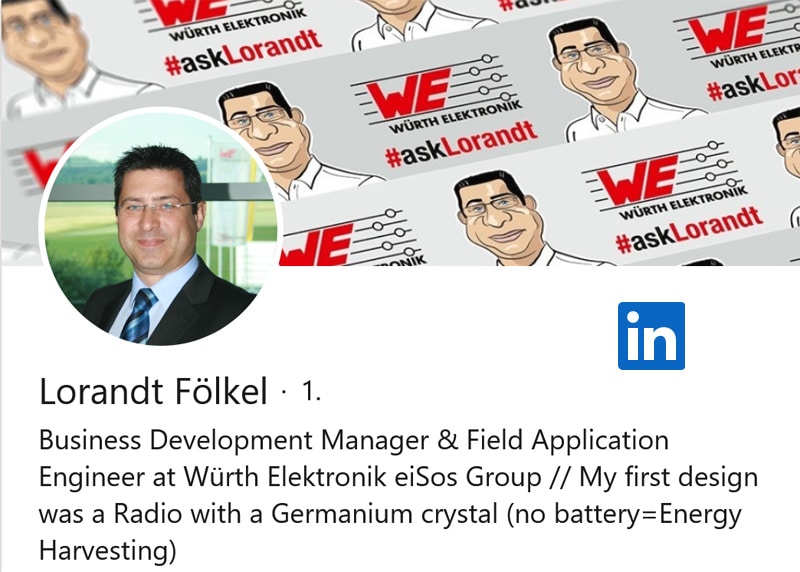
TPC Technical Program Committee of the next 3rd PCNS Passive Components Networking Symposium scheduled for Sep 7-10th 2021 in Milano, Italy selected theme of the symposium: RELIABILITY & SUSTAINABILITY of PASSIVE COMPONENTS that will be elaborated in conference Workshop, Hot Topic Panel Discussion, Keynote and papers selection preferences. EPCI, the main PCNS organizer, questioned TPC members why they consider the theme so important for today’s passive electronic components and what shall be discussed within this topic in depth. The next interview is with TPC member, Mr. Lorandt Fölkel (LF), FAE / BDM | Global Business Consultant of Würth Elektronik company.

EPCI: What ideas, issues, concerns, directions has raised on your mind when TPC selected „Reliability & Sustainability of Passive Components“ as the 3rd PCNS theme ?

RelatedPosts

Inductor Technology Dossier

Coilcraft Releases TLVR Inductors for High Density VRMs and PoL Converters

Rutheniums Critical Role in Passive Component Supply Chains

LF: – At first I was thinking is great idea to have the opportunity to chat with other manufacturer to come with a common approach and standards to be more clear and easy for users, we all need to re-think what is really behind the lifetime of passive components and how it fits to continuously changing requirements.

EPCI: What topic you would recommend for the Hot Panel Discussion and Why ?

LF: “Extending the lifetime of passive components will make future electronic indestructible?”

EPCI: You are working for Würth Elektronik company as FAE/BDM consultant. Can you comment what is hot/upcoming from your position relevant to the TPC theme?

LF: In my last 33 years of work, I did work for in total only for 4 companies, including my present one. Started as Radio-TV technician followed by Design Engineer and working in present as Field Application Engineer and Global Business Consultant.

As the global development of electronics is rising from year to year, this generate often allocations of some components. How can we solve this problem in the future? By one side the quantity is rising, but the price per piece is falling. The raw material price is increasing and same for the energy, do we have any chance for a stable margin (profit) to be maintained?

Specification wise, we see raising impact of automotive standards (AEC-Q200 for passives). The “standard” component design requirement already today is to meet automotive grade level from day one construction phase on almost all products.

EPCI: How is your company going to address this topic during PCNS ?

WE consider PCNS as an important event for people to meet face to face; Lets hope that in September time we will have a chance to meet live after this long challenging time.

Würth Elektronik is a proud exhibitor and sponsor of PCNS ! and gold EPCI passive components member supporting its activities. We plan to actively present during the PCNS with also submission of technical papers and participation on workshops.

EPCI: Thank you Lorandt and lets hope in best that we can meet live at PCNS in Milano in September

Lorandt Fölkel can be reached at his LinkedIn profile or YouTube channel

see more about PCNS on its website:

PCNS website

be active in passives ! join us and submit your paper abstract online:

Call for Papers Announced ! Abstract Deadline April 2nd 2021

About

PCNS Passive Components Networking Symposium is a bi-annual international symposium organized by EPCI European Passive Components Institute in co-operation with an European university. 3rd edition of the PCNS Passive Components Networking Days Symposium scheduled for September 7-10th, 2021 in Milano, Italy is hosted by Department of Chemistry, Materials and Chemical Engineering “Giulio Natta” and Department of Electronics, Information and Bioengineering of Politecnico di Milano. It is intended as a live event with speakers present with streaming options for virtual attendees. In worst case, the PCNS will move to virtual event; all registered attendees will get hard printed ISBN Proceedings (by mail post in virtual case).
Related

Source: EPCI

Recent Posts

Inductor Technology Dossier

19.3.2026
0

Coilcraft Releases TLVR Inductors for High Density VRMs and PoL Converters

19.3.2026
5

Rutheniums Critical Role in Passive Component Supply Chains

19.3.2026
8

Murata to Decouple China Rare Earth Supply in 3 Years

19.3.2026
16
Schematic illustration of the electric double layer of porous carbon electrodes at elevated potentials in a a conventional electrolyte and b a weakly solvating electrolyte; source: authors

Researchers Presented Lignin-based Electrolyte for 4V Supercapacitors with Low Self‑Discharge

19.3.2026
4

Samsung Outlines Growth Roadmap at its 52nd General Shareholders Meeting

19.3.2026
3

Samsung Electro-Mechanics Enters LEO Satellite Market With High‑Reliability MLCCs

19.3.2026
6

Vishay Introduced Space-Grade SMT Common Mode Choke

19.3.2026
4

Exxelia to Exhibit at APEC 2026 in San Antonio, Texas

17.3.2026
26

Upcoming Events

Mar 21
All day

PSMA Capacitor Workshop 2026

Mar 24
9:00 - 10:00 CET

Power protection in the digital age – eFuse and hot-swap strategies for modern data center design

Apr 21
16:00 - 17:00 CEST

Heatsink Solutions: Thermal Management in electronic devices

View Calendar

Popular Posts

  • Buck Converter Design and Calculation

    0 shares
    Share 0 Tweet 0
  • Boost Converter Design and Calculation

    0 shares
    Share 0 Tweet 0
  • Flyback Converter Design and Calculation

    0 shares
    Share 0 Tweet 0
  • LLC Resonant Converter Design and Calculation

    0 shares
    Share 0 Tweet 0
  • MLCC Manufacturers Consider Price Increase as AI Demand Outpaces Supply

    0 shares
    Share 0 Tweet 0
  • Dual Active Bridge (DAB) Topology

    0 shares
    Share 0 Tweet 0
  • MLCC and Ceramic Capacitors

    0 shares
    Share 0 Tweet 0
  • Ripple Current and its Effects on the Performance of Capacitors

    3 shares
    Share 3 Tweet 0
  • MLCC Case Sizes Standards Explained

    0 shares
    Share 0 Tweet 0
  • What is a Dielectric Constant and DF of Plastic Materials?

    4 shares
    Share 4 Tweet 0

Newsletter Subscription


Passive Components Blog

© EPCI - Leading Passive Components Educational and Information Site

  • Home
  • Privacy Policy
  • EPCI Membership & Advertisement
  • About

No Result
View All Result
  • Home
  • Knowledge Blog
  • PCNS

© EPCI - Leading Passive Components Educational and Information Site

This website uses cookies. By continuing to use this website you are giving consent to cookies being used. Visit our Privacy and Cookie Policy.
Go to mobile version