


Passive Components Blog
No Result
View All Result
  • Home
  • NewsFilter
    • All
    • Aerospace & Defence
    • Antenna
    • Applications
    • Automotive
    • Capacitors
    • Circuit Protection Devices
    • electro-mechanical news
    • Filters
    • Fuses
    • Inductors
    • Industrial
    • Integrated Passives
    • inter-connect news
    • Market & Supply Chain
    • Market Insights
    • Medical
    • Modelling and Simulation
    • New Materials & Supply
    • New Technologies
    • Non-linear Passives
    • Oscillators
    • Passive Sensors News
    • Resistors
    • RF & Microwave
    • Telecommunication
    • Weekly Digest

    January 2026 Interconnect, Passives and Electromechanical Components Market Insights

    Passive Components in Quantum Computing

    0603 Automotive Chip Varistors as TVS Diode Replacements, TDK Tech Note

    Miniaturization of MLCCs and Electrolytics, KAVX Tech Chat

    Exxelia Offers Custom Naval Transformers and Inductors

    Researchers Demonstrated 32nm Aluminum Vacuum Gap Capacitor

    Conductive Polymer Capacitor Market and Design‑In Guide to 2035

    TDK Releases High Performance 105C DC Link Film Capacitors

    YAGEO Offers Automotive MOVs for EV and AI power

    Trending Tags

    • Ripple Current
    • RF
    • Leakage Current
    • Tantalum vs Ceramic
    • Snubber
    • Low ESR
    • Feedthrough
    • Derating
    • Dielectric Constant
    • New Products
    • Market Reports
  • VideoFilter
    • All
    • Antenna videos
    • Capacitor videos
    • Circuit Protection Video
    • Filter videos
    • Fuse videos
    • Inductor videos
    • Inter-Connect Video
    • Non-linear passives videos
    • Oscillator videos
    • Passive sensors videos
    • Resistor videos

    One‑Pulse Characterization of Nonlinear Power Inductors

    Thermistor Linearization Challenges

    Coaxial Connectors and How to Connect with PCB

    PCB Manufacturing, Test Methods, Quality and Reliability

    Transformer Behavior – Current Transfer and Hidden Feedback

    Choosing the Right Capacitor: The Importance of Accurate Measurements

    RF Inductors: Selection and Design Challenges for High-Frequency Circuits

    Transformer Safety IEC 61558 Standard

    3-Phase EMI Filter Design, Simulation, Calculation and Test

    Trending Tags

    • Capacitors explained
    • Inductors explained
    • Resistors explained
    • Filters explained
    • Application Video Guidelines
    • EMC
    • New Products
    • Ripple Current
    • Simulation
    • Tantalum vs Ceramic
  • Knowledge Blog
  • Suppliers
    • Who is Who
  • PCNS
    • PCNS 2025
    • PCNS 2023
    • PCNS 2021
    • PCNS 2019
    • PCNS 2017
  • Events
  • Home
  • NewsFilter
    • All
    • Aerospace & Defence
    • Antenna
    • Applications
    • Automotive
    • Capacitors
    • Circuit Protection Devices
    • electro-mechanical news
    • Filters
    • Fuses
    • Inductors
    • Industrial
    • Integrated Passives
    • inter-connect news
    • Market & Supply Chain
    • Market Insights
    • Medical
    • Modelling and Simulation
    • New Materials & Supply
    • New Technologies
    • Non-linear Passives
    • Oscillators
    • Passive Sensors News
    • Resistors
    • RF & Microwave
    • Telecommunication
    • Weekly Digest

    January 2026 Interconnect, Passives and Electromechanical Components Market Insights

    Passive Components in Quantum Computing

    0603 Automotive Chip Varistors as TVS Diode Replacements, TDK Tech Note

    Miniaturization of MLCCs and Electrolytics, KAVX Tech Chat

    Exxelia Offers Custom Naval Transformers and Inductors

    Researchers Demonstrated 32nm Aluminum Vacuum Gap Capacitor

    Conductive Polymer Capacitor Market and Design‑In Guide to 2035

    TDK Releases High Performance 105C DC Link Film Capacitors

    YAGEO Offers Automotive MOVs for EV and AI power

    Trending Tags

    • Ripple Current
    • RF
    • Leakage Current
    • Tantalum vs Ceramic
    • Snubber
    • Low ESR
    • Feedthrough
    • Derating
    • Dielectric Constant
    • New Products
    • Market Reports
  • VideoFilter
    • All
    • Antenna videos
    • Capacitor videos
    • Circuit Protection Video
    • Filter videos
    • Fuse videos
    • Inductor videos
    • Inter-Connect Video
    • Non-linear passives videos
    • Oscillator videos
    • Passive sensors videos
    • Resistor videos

    One‑Pulse Characterization of Nonlinear Power Inductors

    Thermistor Linearization Challenges

    Coaxial Connectors and How to Connect with PCB

    PCB Manufacturing, Test Methods, Quality and Reliability

    Transformer Behavior – Current Transfer and Hidden Feedback

    Choosing the Right Capacitor: The Importance of Accurate Measurements

    RF Inductors: Selection and Design Challenges for High-Frequency Circuits

    Transformer Safety IEC 61558 Standard

    3-Phase EMI Filter Design, Simulation, Calculation and Test

    Trending Tags

    • Capacitors explained
    • Inductors explained
    • Resistors explained
    • Filters explained
    • Application Video Guidelines
    • EMC
    • New Products
    • Ripple Current
    • Simulation
    • Tantalum vs Ceramic
  • Knowledge Blog
  • Suppliers
    • Who is Who
  • PCNS
    • PCNS 2025
    • PCNS 2023
    • PCNS 2021
    • PCNS 2019
    • PCNS 2017
  • Events
No Result
View All Result
Passive Components Blog
No Result
View All Result

Tantalum and NbO Capacitors Failure Mode Comparison

30.8.2023
Reading Time: 5 mins read
A A

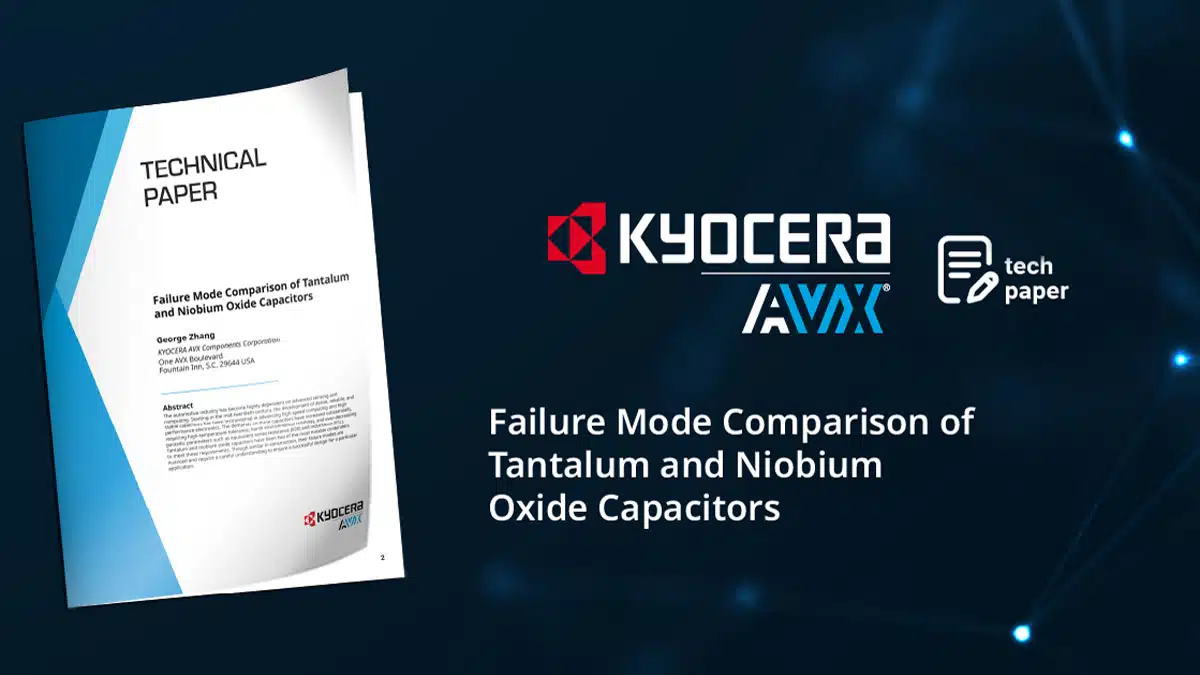
This article written by George Zhang, KYOCERA-AVX Corporation explains Tantalum and NbO Capacitors failure modes.

Introduction

The automotive industry has become highly dependent on advanced sensing and computing.

RelatedPosts

Miniaturization of MLCCs and Electrolytics, KAVX Tech Chat

Conductive Polymer Capacitor Market and Design‑In Guide to 2035

Kyocera Releases Ultra-Compact Low Voltage Clock Oscillators

Starting in the mid-twentieth century, the development of dense, reliable, and stable capacitors has been instrumental in advancing high speed computing and high performance electronics.

The demands on these capacitors have increased substantially, requiring high-temperature tolerance, harsh environmental reliability, and ever-decreasing parasitic parameters such as equivalent series resistance (ESR) and inductance (ESL).

Tantalum and niobium oxide capacitors have been two of the most notable contenders to meet these requirements. Though similar in construction, their failure modes are nuanced and require a careful understanding to ensure a successful design for a particular application.

Tantalum Capacitors
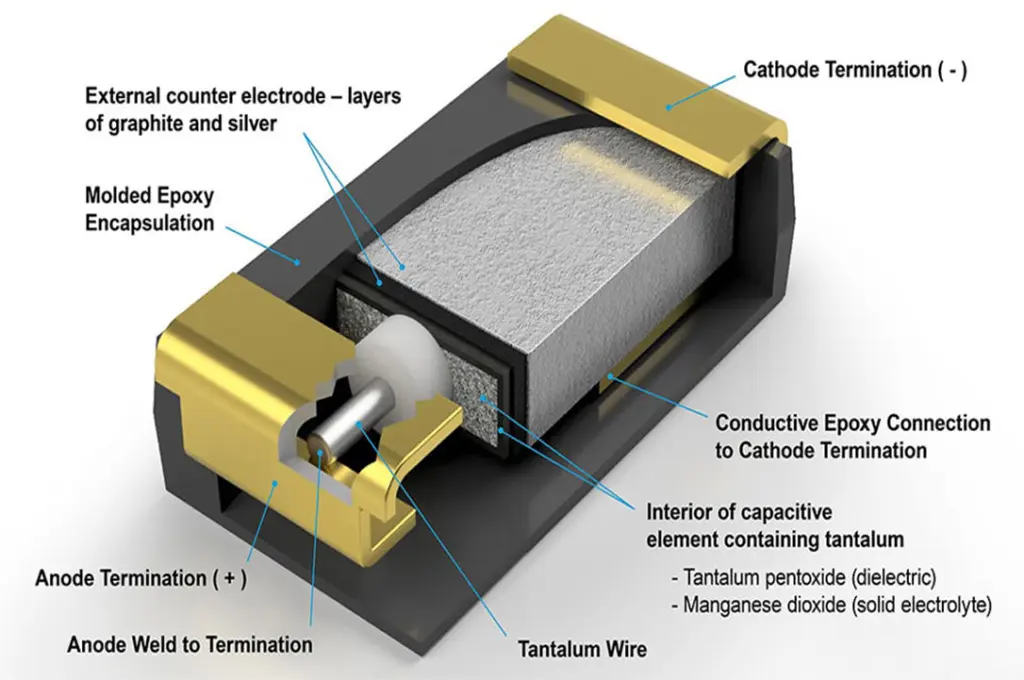
Figure 1: Solid tantalum capacitor construction; source: KYOCERA AVX

Tantalum pentoxide is the dielectric layer with semiconducting features that will only conduct current in one direction. In the reverse direction, an oxide layer readily grows under anodic conditions that act as a highly effective insulator. The anode is formed from pure tantalum powder to build a capacitor.

An oxide layer, typically Ta2O5, is grown as a dielectric and is then electrically connected using a solid or wet electrolyte. As shown in Figure 1, this material stackup can be packaged to form a high performance surface mount capacitor.

Tantalum capacitors are regarded highly in the electrolytic capacitors family for their large capacitance per unit volume and generally stable operating characteristics. They exhibit self-healing properties and typically provide low electrical series resistance (ESR) with favorable AC impedance characteristics.

For these reasons, the two primary applications of tantalum capacitors in circuit design have been as high capacity energy storage elements and as ripple filtering components in power supplies.

Niobium Oxide NbO Capacitors
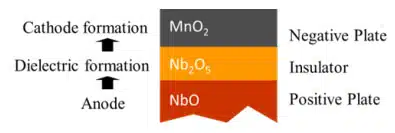
Figure 2: Niobium capacitor construction layers. Image courtesy of KYOCERA AVX

Much like their tantalum counterparts, niobium oxide capacitors are constructed using the anode, oxide, electrolyte construction. The anode material is typically passivated niobium or niobium monoxide. The dielectric is grown as niobium pentoxide, and the solid electrolyte is composed of manganese dioxide, as shown in Figure 2.

Like tantalum capacitors, niobium capacitors exhibit many favorable characteristics, including high volumetric capacitance, stable operating characteristics, and a self-healing mechanism for long-term reliability. In addition, when compared to tantalum, niobium is abundant and readily available as a raw material making the capacitor supply chain less susceptible to market fluctuations. Most importantly, niobium offers several properties that make its failure modes more graceful than comparable capacitors.

Failure Mode Comparison

Tantalum capacitors often find applications in filtering circuits where a large bulk capacitance is required. Unfortunately, these devices suffer from poor tolerance to large overages in voltage or current. A strong surge in current, a high ripple in current, or a high voltage across the circuit can quickly lead to failure. This is due mainly to the reactivity of the constituent metals with oxygen.

When a dielectric breakdown occurs, the heat generated by the large current passing through the defect site will cause the dielectric layer to be quickly destroyed. This, in turn, allows the pure tantalum anode to interact directly with oxygen at high temperatures. The resulting chemical reaction releases a significant amount of heat energy.

On the other hand, niobium capacitors use a niobium oxide anode, which is already oxygen rich and stable when exposed. During a dielectric breakdown event, the temperature rise is significantly lower than in the tantalum case. The niobium oxide layer tends to grow at elevated temperatures, resulting in a “self-arresting” mechanism. The benefit is a reduction (up to 95%) of the ignition failure mode of niobium oxide capacitors when compared to conventional tantalum devices. For this reason, niobium oxide capacitors are regarded as one of the safest capacitor technologies on the market.

Switching to Niobium Oxide Capacitors for Certain Applications

Given the seriousness of the tantalum dielectric failure mode, certain applications such as automotive, health care, and military may find significant improvements in safety by switching to niobium-based devices. The stable sub-oxide and self-arresting mechanism alone may offset any performance losses from parasitic resistance and inductance.

When used for switching power supply circuits, the niobium oxide capacitor does not need to be derated in voltage to the same degree as their Tantalum counterparts. High reliability can be achieved with no derating factor when resistance protection is added.

KYOCERA AVX offers a wide range of niobium oxide capacitors under OxiCap® trade name with high-reliability levels of 0.5%/1000hrs at 85°C or better, high safety technology with non-burning high resistance failure mode, and high break-down voltage. The OxiCap® series is available as low ESR, High CV, low profile, up to 125°C, and multi-anode technologies. It is environmentally friendly and
RoHS compliant technology in the same form, case size, and same or similar technical performance as standard tantalum capacitors. Capacitors are offered in voltage ratings up to 10V, and a majority of the series meet AEC-Q200 requirements.

Further reference links with more detailed tech information:
  • Niobium and Niobium Oxide Capacitors Overview
  • Tantalum and Niobium Capacitors

Related

Source: KYOCERA AVX

Recent Posts

Passive Components in Quantum Computing

22.1.2026
8

Miniaturization of MLCCs and Electrolytics, KAVX Tech Chat

21.1.2026
19

Researchers Demonstrated 32nm Aluminum Vacuum Gap Capacitor

20.1.2026
22

Conductive Polymer Capacitor Market and Design‑In Guide to 2035

20.1.2026
64

TDK Releases High Performance 105C DC Link Film Capacitors

19.1.2026
41

Vishay Extends Aluminum Capacitors Rating Up to 600 V for DC Links

15.1.2026
32

Würth Elektronik Introduces Product Navigator for Passive Components

14.1.2026
72

Panasonic Passive Components for Reliable Robotic Arms

14.1.2026
83

Rubycon PMLCAP DC‑Link Film Capacitors in Mass Production

9.1.2026
85

Upcoming Events

Jan 27
16:00 - 17:00 CET

Simplifying Vehicle Development with Automotive Ethernet and Zonal Smart Switch Technologies

Feb 24
16:00 - 17:00 CET

Designing Qi2 Wireless Power Systems: Practical Development and EMC Optimization

Mar 21
All day

PSMA Capacitor Workshop 2026

View Calendar

Popular Posts

  • Buck Converter Design and Calculation

    0 shares
    Share 0 Tweet 0
  • Boost Converter Design and Calculation

    0 shares
    Share 0 Tweet 0
  • LLC Resonant Converter Design and Calculation

    0 shares
    Share 0 Tweet 0
  • Flyback Converter Design and Calculation

    0 shares
    Share 0 Tweet 0
  • Ripple Current and its Effects on the Performance of Capacitors

    3 shares
    Share 3 Tweet 0
  • How Metal Prices Are Driving Passive Component Price Hikes

    0 shares
    Share 0 Tweet 0
  • MLCC and Ceramic Capacitors

    0 shares
    Share 0 Tweet 0
  • Dual Active Bridge (DAB) Topology

    0 shares
    Share 0 Tweet 0
  • What is a Dielectric Constant and DF of Plastic Materials?

    4 shares
    Share 4 Tweet 0
  • Degradation of Capacitors and its Failure Mechanisms

    0 shares
    Share 0 Tweet 0

Newsletter Subscription


Passive Components Blog

© EPCI - Leading Passive Components Educational and Information Site

  • Home
  • Privacy Policy
  • EPCI Membership & Advertisement
  • About

No Result
View All Result
  • Home
  • Knowledge Blog
  • PCNS

© EPCI - Leading Passive Components Educational and Information Site

This website uses cookies. By continuing to use this website you are giving consent to cookies being used. Visit our Privacy and Cookie Policy.
Go to mobile version