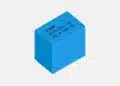





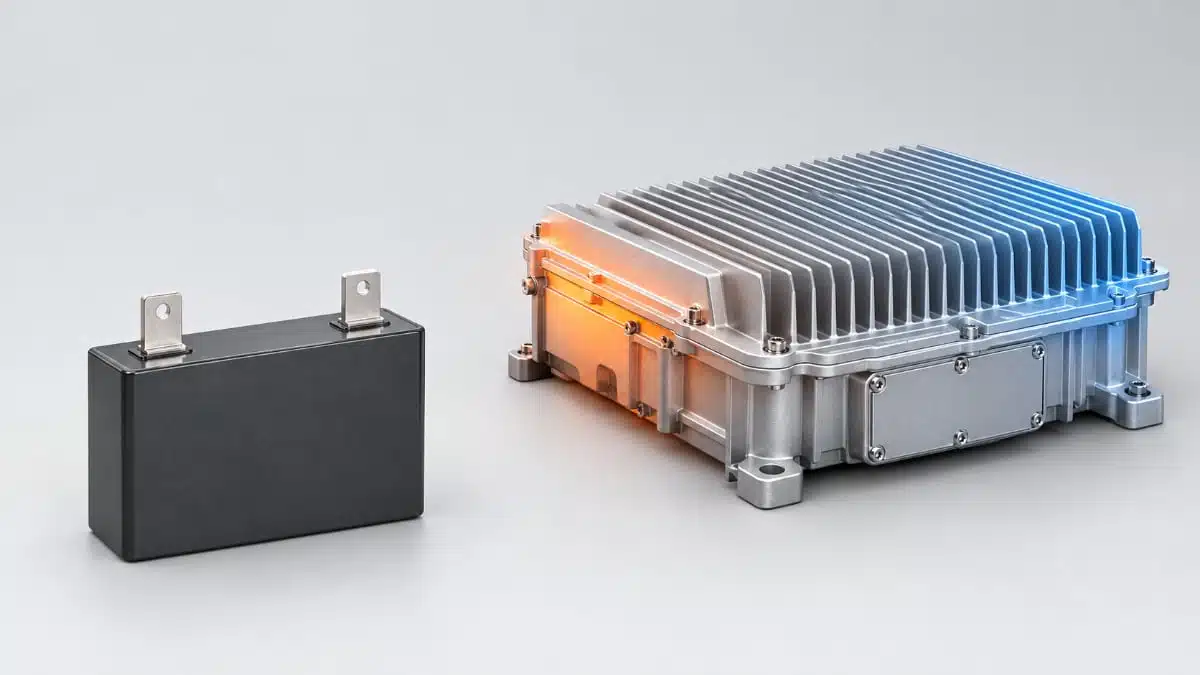
Toray has developed a prototype film capacitor using a proprietary heat-resistant dielectric film and demonstrated inverter operation at 150°C.
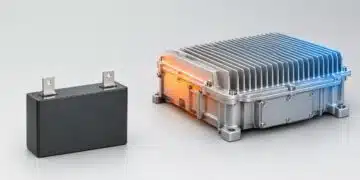
The technology addresses a thermal constraint in electric-mobility power conversion: the capacitor’s heat resistance can limit the inverter’s cooling and packaging design. Thermal simulations indicate potential to halve the size of the heat-dissipation structure in an electric-mobility power control unit.
Key features and benefits
- Heat-resistant dielectric film developed for 150°C film capacitors.
- Stable operation demonstrated in a prototype inverter at 150°C.
- Potential to halve heat-dissipation structure size in a simulated electric-mobility power control unit.
- Development directed towards air-cooled power control units for electric vehicles and flying cars.
- Joint development and evaluation by Toray and Nagoya University towards commercialisation.
Technical highlights
The component is a prototype film capacitor, with the new technology centred on its dielectric film. The practical advance is operation within a high-temperature inverter, rather than an isolated material-temperature demonstration.
Joint research with Professor Masayoshi Yamamoto of Nagoya University’s Institute of Materials and Systems for Sustainability demonstrated stable operation of the capacitor in a prototype inverter at 150°C.
| Parameter | Value or status | Context |
|---|---|---|
| Component | Prototype film capacitor | Inverter evaluation |
| Dielectric | Proprietary heat-resistant film | 150°C development |
| Inverter test temperature | 150°C | Stable operation |
| Heat-dissipation structure | Potential halving of size | Thermal simulation |
| Development stage | Development and evaluation | Towards commercialisation |
The thermal result concerns the heat-dissipation structure, not a halving of capacitor dimensions or total inverter size. It is a simulated packaging opportunity for a power control unit using more heat-resistant film capacitors.
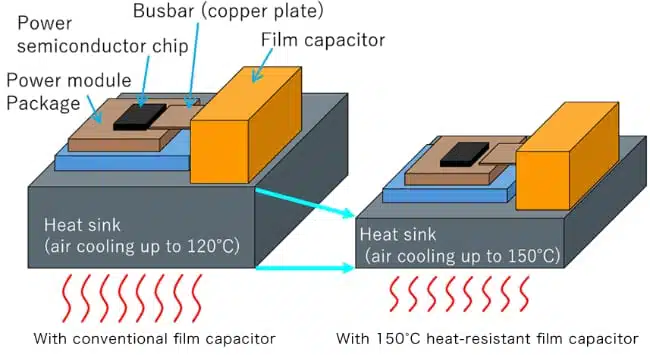
The size-reduction calculation was based on an electric-mobility power control unit assessment dated September 30, 2026. The inverter operating demonstration and the cooling-structure simulation are distinct results: one establishes prototype operation at elevated temperature; the other evaluates the scope for changing the system’s thermal architecture.
Typical applications
Target applications include:
- Electric-vehicle inverters and air-cooled power control units.
- Flying-car drive systems and power control units.
- Electrified aircraft and other next-generation mobility systems.
In these systems, film capacitors stabilise power within the inverter, which converts direct current into alternating current to control motors. Increasing the capacitor’s heat resistance addresses a component-level constraint on the temperature at which the surrounding power-conversion system can operate.
Application fit
The 150°C inverter demonstration is relevant to mobility systems where higher-output drive electronics increase the thermal demands placed on passive components. The development also supports work on reducing the size and weight of air-cooled power control units.
For flying cars, heat-dissipation structures are particularly important because their size and weight affect flight range. A capacitor capable of operating in a hotter inverter environment creates scope to reconsider cooling-system dimensions rather than retaining a thermal architecture governed by the capacitor’s temperature constraint.
The development is supported by the New Energy and Industrial Technology Development Organization through a project developing dielectric film for 150°C film capacitors. Toray and Nagoya University are continuing development and evaluation towards commercialisation.
Design-in notes for engineers
- Treat dielectric heat resistance, complete-capacitor performance and inverter operating temperature as separate design considerations.
- Evaluate cooling-structure changes at power-control-unit level rather than applying the simulated size reduction directly to the capacitor or complete inverter.
- Assess the capacitor and cooling architecture together before fixing the mechanical layout.
- Keep the demonstrated prototype operation distinct from the requirements for a production component.
- Validate final selection and thermal design under the actual operating conditions before production release.
Further reading
- DC-Link Capacitors
- Predicting Metal Film Capacitor Lifetime Using Thermal Simulation
- Electrification Raises Demands on DC-Link Capacitors
Source
This article is based on the Toray product announcement and official product documentation. Engineers should refer to the current manufacturer datasheet for final design and qualification.
References
- Toray Demonstrates 150°C Inverter Operation with Film Capacitor that Could Halve Heat-Dissipation Structure Size for Next-Generation Mobility, Toray Industries, Inc., October 8, 2026.