







Passive Components Blog
No Result
View All Result
  • Home
  • NewsFilter
    • All
    • Aerospace & Defence
    • Antenna
    • Applications
    • Automotive
    • Capacitors
    • Circuit Protection Devices
    • electro-mechanical news
    • Filters
    • Fuses
    • Inductors
    • Industrial
    • Integrated Passives
    • inter-connect news
    • Market & Supply Chain
    • Market Insights
    • Medical
    • Modelling and Simulation
    • New Materials & Supply
    • New Technologies
    • Non-linear Passives
    • Oscillators
    • Passive Sensors News
    • Resistors
    • RF & Microwave
    • Telecommunication
    • Weekly Digest

    YMIN Introduces Vibration Resistant Compact Low ESR Aluminum Capacitors for Home Appliances

    Designing a Custom Core Transformer for 10 kW LLC Data Center Power Stages

    Magnetics Design in High‑Frequency GaN Converters

    ECIA Industry Pulse April 2026: Sentiment Cools but Stays Strong

    Industrial Passive Components Markets and Technologies 2026

    Automotive Passive Components Technology Dossier

    Samsung Electro-Mechanics Signs 1.5T KRW Silicon Capacitor AI Contract

    Murata Expands Thermistor Production Capacity at Yokaichi Plant

    Hirose Expands Compact High‑Voltage EV connectors

    Trending Tags

    • Ripple Current
    • RF
    • Leakage Current
    • Tantalum vs Ceramic
    • Snubber
    • Low ESR
    • Feedthrough
    • Derating
    • Dielectric Constant
    • New Products
    • Market Reports
  • VideoFilter
    • All
    • Antenna videos
    • Capacitor videos
    • Circuit Protection Video
    • Filter videos
    • Fuse videos
    • Inductor videos
    • Inter-Connect Video
    • Non-linear passives videos
    • Oscillator videos
    • Passive sensors videos
    • Resistor videos

    Magnetics Design in High‑Frequency GaN Converters

    Qi2 Wireless Charging: Inductors, Capacitors and EMC Filters

    Two‑capacitor paradox explained for engineers

    Capacitances of Nonlinear MLCCs: What Datasheets Don’t Tell You

    Tapped Inductor Buck Converter Fundamentals

    Planar vs Conventional Transformer: When it Make Sense

    Modeling Fringing Field Losses in Inductors & Transformers

    Why Power Inductors Use a Ferrite Core With an Air Gap

    Transformer-Based Power-Line Harvester Magnetic Design

    Trending Tags

    • Capacitors explained
    • Inductors explained
    • Resistors explained
    • Filters explained
    • Application Video Guidelines
    • EMC
    • New Products
    • Ripple Current
    • Simulation
    • Tantalum vs Ceramic
  • Knowledge Blog
  • DossiersNew
  • Suppliers
    • Who is Who
  • PCNS
    • PCNS 2025
    • PCNS 2023
    • PCNS 2021
    • PCNS 2019
    • PCNS 2017
  • Events
  • Home
  • NewsFilter
    • All
    • Aerospace & Defence
    • Antenna
    • Applications
    • Automotive
    • Capacitors
    • Circuit Protection Devices
    • electro-mechanical news
    • Filters
    • Fuses
    • Inductors
    • Industrial
    • Integrated Passives
    • inter-connect news
    • Market & Supply Chain
    • Market Insights
    • Medical
    • Modelling and Simulation
    • New Materials & Supply
    • New Technologies
    • Non-linear Passives
    • Oscillators
    • Passive Sensors News
    • Resistors
    • RF & Microwave
    • Telecommunication
    • Weekly Digest

    YMIN Introduces Vibration Resistant Compact Low ESR Aluminum Capacitors for Home Appliances

    Designing a Custom Core Transformer for 10 kW LLC Data Center Power Stages

    Magnetics Design in High‑Frequency GaN Converters

    ECIA Industry Pulse April 2026: Sentiment Cools but Stays Strong

    Industrial Passive Components Markets and Technologies 2026

    Automotive Passive Components Technology Dossier

    Samsung Electro-Mechanics Signs 1.5T KRW Silicon Capacitor AI Contract

    Murata Expands Thermistor Production Capacity at Yokaichi Plant

    Hirose Expands Compact High‑Voltage EV connectors

    Trending Tags

    • Ripple Current
    • RF
    • Leakage Current
    • Tantalum vs Ceramic
    • Snubber
    • Low ESR
    • Feedthrough
    • Derating
    • Dielectric Constant
    • New Products
    • Market Reports
  • VideoFilter
    • All
    • Antenna videos
    • Capacitor videos
    • Circuit Protection Video
    • Filter videos
    • Fuse videos
    • Inductor videos
    • Inter-Connect Video
    • Non-linear passives videos
    • Oscillator videos
    • Passive sensors videos
    • Resistor videos

    Magnetics Design in High‑Frequency GaN Converters

    Qi2 Wireless Charging: Inductors, Capacitors and EMC Filters

    Two‑capacitor paradox explained for engineers

    Capacitances of Nonlinear MLCCs: What Datasheets Don’t Tell You

    Tapped Inductor Buck Converter Fundamentals

    Planar vs Conventional Transformer: When it Make Sense

    Modeling Fringing Field Losses in Inductors & Transformers

    Why Power Inductors Use a Ferrite Core With an Air Gap

    Transformer-Based Power-Line Harvester Magnetic Design

    Trending Tags

    • Capacitors explained
    • Inductors explained
    • Resistors explained
    • Filters explained
    • Application Video Guidelines
    • EMC
    • New Products
    • Ripple Current
    • Simulation
    • Tantalum vs Ceramic
  • Knowledge Blog
  • DossiersNew
  • Suppliers
    • Who is Who
  • PCNS
    • PCNS 2025
    • PCNS 2023
    • PCNS 2021
    • PCNS 2019
    • PCNS 2017
  • Events
No Result
View All Result
Passive Components Blog
No Result
View All Result

Würth Elektronik Releases Heat Sinks for TO and IC packages

31.3.2026
Reading Time: 6 mins read
A A

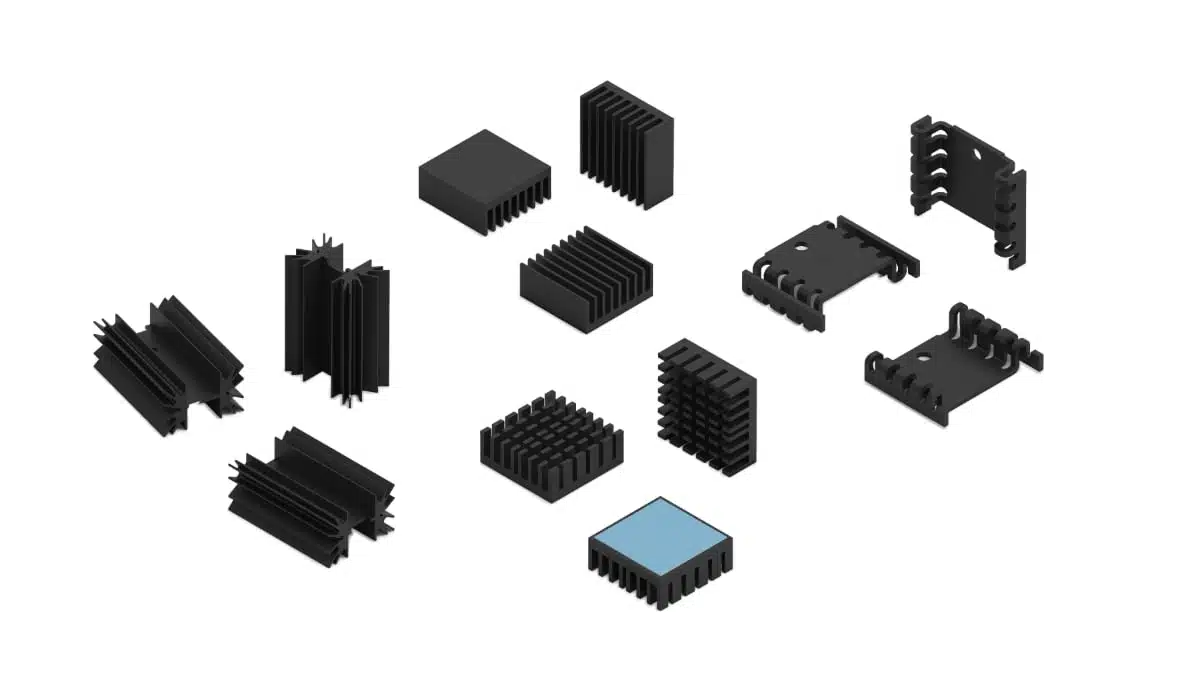
Würth Elektronik has expanded its thermal management range with a modular heat sink portfolio for power semiconductors in TO packages and ICs with flat surfaces.

The new WE-HTO, WE-HTOI, WE-HIC and WE-HICI series target design engineers who need predictable thermal performance, defined airflow behavior and simplified assembly when cooling power devices and DC/DC converters.

RelatedPosts

Qi2 Wireless Charging: Inductors, Capacitors and EMC Filters

Würth Elektronik Presents New Bidirectional Digital Isolators

Würth Elektronik Introduces Compact Flat-wire SMT Power Inductors for Automotive

Key features and benefits

Würth Elektronik now offers a coordinated family of aluminum heat sinks covering common through-hole TO packages and a wide range of IC footprints. The portfolio is structured into three main groups that share a common focus on low thermal resistance and practical handling in real designs.

  • WE-HTO heat sinks are designed for THT-TO packages such as TO-220 and TO-247, using curved sheet metal or fins to increase surface area for better heat dissipation.
  • WE-HTOI variants are factory-coated with thermal interface material (TIM), eliminating the air gap between package and heat sink and improving thermal coupling without additional assembly steps.
  • WE-HIC covers classic finned heat sinks for flat components like CPUs, DC/DC converters and power ICs, in sizes from 20 × 20 to 40 × 40 mm according to the manufacturer datasheet.
  • WE-HICI versions add an integrated thermal interface layer on the IC heat sinks for faster and more repeatable mounting in series production.
  • All series use aluminum with a black anodized surface for high emissivity and robust mechanical behavior in typical industrial environments.

From a design-in perspective, the pre-coated variants help avoid variability in thermal contact quality due to inconsistent application of pastes or pads. In compact power designs, this can translate directly into lower junction temperatures at a given load, or extra thermal margin for lifetime and derating.

Typical applications

The portfolio is aimed at a broad range of power electronics and embedded systems where discrete semiconductors or power ICs must dissipate several watts or more into ambient air.

  • Through-hole power stages using TO‑220 or TO‑247 devices, for example in offline power supplies, motor drives, industrial controllers and PFC stages.
  • DC/DC converter modules and POL regulators with flat top surfaces, where local hot spots must be managed without forced liquid cooling.
  • Embedded CPUs, FPGAs and ASICs on industrial control boards that require compact board-level cooling.
  • Gate driver ICs, power management ICs and other mixed-signal devices that combine logic and power stages on a single package.
  • Prototypes and evaluation boards, where the availability of catalog heat sinks and free samples simplifies early thermal validation.

Because the catalog parts are available from stock without minimum order quantity, they can be used both for rapid prototyping and for ramp-up into volume production, with the option of customer-specific modifications if standard sizes do not fully match the mechanical constraints.

Technical highlights

The new heat sinks are part of Würth Elektronik’s thermal management portfolio and are documented with characteristic curves and detailed performance data according to the manufacturer.

  • Material and surface: Aluminum construction with black anodized surface for increased surface emissivity and improved radiative heat transfer.
  • Form factor for TO packages (WE-HTO / WE-HTOI): Variants with curved sheet metal and fin structures that increase effective surface area for convection, optimized around common TO-220 and TO-247 mounting geometries.
  • Form factor for ICs (WE-HIC / WE-HICI): Finned blocks for IC packages with flat top surfaces; available footprints from 20 × 20 mm up to 40 × 40 mm according to the manufacturer datasheet, with different fin geometries for defined versus diffuse airflow.
  • Airflow-optimized designs:
    • Continuous fins for applications where airflow direction is known and aligned with the fins, supporting efficient channel flow.
    • Interrupted fins for environments with diffuse or poorly defined airflow, encouraging turbulence that improves heat transfer even without a clear flow channel.
  • Thermal interface options:
    • Bare versions for use with user-selected thermal pads, pastes or phase-change materials.
    • Factory pre-coated versions (WE-HTOI, WE-HICI) that include an integrated thermal interface layer, simplifying assembly and ensuring consistent thermal contact.
  • Accessory hardware: Matching M3 screws, nuts and insulating sleeves can be ordered for mechanical mounting and electrical isolation of TO packages as required.

In practice, choosing between continuous and interrupted fins lets engineers adapt the same footprint to either forced or natural convection conditions. When airflow is guided by ducts or fans, continuous fins tend to minimize pressure drop and maximize linear heat transfer, while interrupted fins become attractive in more open, compact assemblies where airflow cannot be predicted precisely.

Design-in notes for engineers

When selecting a heat sink from this portfolio, engineers should treat thermal design as an integral part of the system architecture rather than an afterthought.

  • Start from allowable junction temperature and estimated power dissipation of the component, then derive the required overall thermal resistance from junction to ambient, taking into account junction-to-case and case-to-sink contributions from the manufacturer datasheets.
  • Use the characteristic curves provided by Würth Elektronik to map thermal resistance versus airflow and mounting conditions for each heat sink series, then verify that the chosen device meets temperature rise targets under worst-case ambient and load.
  • For defined airflow (for example, near a fan or along a channel), prioritize WE-HIC variants with continuous fins; for more diffuse airflow in dense boards or enclosures, consider interrupted-fin versions to promote local turbulence.
  • If assembly throughput, repeatability and long-term stability of the interface are important, pre-coated WE-HTOI or WE-HICI parts can reduce process variation compared to manual application of thermal pastes.
  • Pay attention to electrical isolation between the semiconductor tab and the heat sink when required by safety standards or system grounding concepts; use the dedicated insulating sleeves and appropriate mounting hardware.
  • In compact power stages where EMC and thermal performance interact, coordinate the placement of heat sinks with EMI filters and shielding elements so that airflow is not blocked and hot components do not radiate directly into sensitive nodes.

As with other thermal management solutions, it is recommended to validate the chosen heat sink by measurement under realistic operating conditions, ideally using thermocouples or IR imaging to confirm junction temperature margin and airflow assumptions.

Source

This article is based on information provided by the Würth Elektronik press release on the introduction of its heat sink portfolio, complemented with data and series descriptions from the official Würth Elektronik product pages.
References

  1. Würth Elektronik heat sink portfolio – thermal management overview
  2. WE-HTO – Heatsink for TO220/247
  3. WE-HTOI – Heatsink for TO220/247 with integrated interface material
  4. WE-HIC – Heatsink for IC
  5. WE-HICI – Heatsink for IC with integrated interface material

Related

Recent Posts

Industrial Passive Components Markets and Technologies 2026

21.5.2026
87

Hirose Expands Compact High‑Voltage EV connectors

21.5.2026
17

Würth Elektronik Presents New Bidirectional Digital Isolators

20.5.2026
35

Using Stress–Strain Curves to Diagnose Tantalum Powders for Capacitors

20.5.2026
29

Coilcraft Introduces SMT Current Sense Transformers for High‑Performance Power Electronics

20.5.2026
27

Nichicon Extends Rechargeable Batteries Temperature to Rival Supercapacitors

19.5.2026
34

YAGEO Releases Compact RJ45 Connector for Multi‑Gigabit Ethernet

18.5.2026
24

Stackpole Releases Automotive Wide‑Termination Resistors

14.5.2026
32

SCHURTER Buys Biaodi to Boost High-Voltage Protection Portfolio

14.5.2026
63

Upcoming Events

Jun 2
16:00 - 17:00 CEST

Calculation, Simulation and Measurement of 800V EMC Filters

Jun 16
16:00 - 17:00 CEST

EMC with EMC – EMC‑compliant design with electromechanical connectors

View Calendar

Popular Posts

  • Buck Converter Design and Calculation

    0 shares
    Share 0 Tweet 0
  • Boost Converter Design and Calculation

    0 shares
    Share 0 Tweet 0
  • Flyback Converter Design and Calculation

    0 shares
    Share 0 Tweet 0
  • LLC Resonant Converter Design and Calculation

    0 shares
    Share 0 Tweet 0
  • MLCC and Ceramic Capacitors

    0 shares
    Share 0 Tweet 0
  • Capacitor Charging and Discharging

    0 shares
    Share 0 Tweet 0
  • What Electronics Engineer Needs to Know About Passive Low Pass Filters

    0 shares
    Share 0 Tweet 0
  • Dual Active Bridge (DAB) Topology

    0 shares
    Share 0 Tweet 0
  • Ripple Current and its Effects on the Performance of Capacitors

    3 shares
    Share 3 Tweet 0
  • Samsung Electro-Mechanics Releases High-Capacitance MLCCs for AI Server Applications

    0 shares
    Share 0 Tweet 0

Newsletter Subscription


Passive Components Blog

© EPCI - Leading Passive Components Educational and Information Site

  • Home
  • Privacy Policy
  • EPCI Membership & Advertisement
  • About

No Result
View All Result
  • Home
  • Knowledge Blog
  • Dossiers
  • PCNS

© EPCI - Leading Passive Components Educational and Information Site

This website uses cookies. By continuing to use this website you are giving consent to cookies being used. Visit our Privacy and Cookie Policy.
Go to mobile version