






Passive Components Blog
No Result
View All Result
  • Home
  • NewsFilter
    • All
    • Aerospace & Defence
    • Antenna
    • Applications
    • Automotive
    • Capacitors
    • Circuit Protection Devices
    • electro-mechanical news
    • Filters
    • Fuses
    • Inductors
    • Industrial
    • Integrated Passives
    • inter-connect news
    • Market & Supply Chain
    • Market Insights
    • Medical
    • Modelling and Simulation
    • New Materials & Supply
    • New Technologies
    • Non-linear Passives
    • Oscillators
    • Passive Sensors News
    • Resistors
    • RF & Microwave
    • Telecommunication
    • Weekly Digest

    Modelithics Releases COMPLETE v26.1 for Keysight ADS

    April 2026 Interconnect, Passives and Electromechanical Components Market Insights

    SPICE Simulation of Non-Linear Resistors: Vishay’s Thermistor and PPTC Modelling Ecosystem

    KYOCERA AVX Introduces Traction‑Grade DC Link Film Capacitors

    When More Capacitance Hurts Reliability: The Role of the Metallic Skeleton in Tantalum Anodes

    Why Power Inductors Use a Ferrite Core With an Air Gap

    Wk 16 Electronics Supply Chain Digest

    YAGEO Introduces High‑Current Y2/X1 Film Capacitors for Wide-bandgap Power Systems

    Amphenol Explanded Liquid Cooling Connectors for AI, ESS and EV Systems

    Trending Tags

    • Ripple Current
    • RF
    • Leakage Current
    • Tantalum vs Ceramic
    • Snubber
    • Low ESR
    • Feedthrough
    • Derating
    • Dielectric Constant
    • New Products
    • Market Reports
  • VideoFilter
    • All
    • Antenna videos
    • Capacitor videos
    • Circuit Protection Video
    • Filter videos
    • Fuse videos
    • Inductor videos
    • Inter-Connect Video
    • Non-linear passives videos
    • Oscillator videos
    • Passive sensors videos
    • Resistor videos

    Why Power Inductors Use a Ferrite Core With an Air Gap

    Transformer-Based Power-Line Harvester Magnetic Design

    Thermal Modeling of Magnetics

    Standard vs Planar LLC transformers Comparison for Battery Chargers

    How Modern Tools Model Magnetic Components for Power Electronics

    Advanced Loss Modeling for Planar Magnetics in the Frenetic Planar Tool

    2026 Power Magnetics Design Trends: Flyback, DAB and Planar

    Enabling Software‑Defined Vehicle Architectures: Automotive Ethernet and Zonal Smart Power

    Calculating Resistance Value of a Flyback RC Snubber 

    Trending Tags

    • Capacitors explained
    • Inductors explained
    • Resistors explained
    • Filters explained
    • Application Video Guidelines
    • EMC
    • New Products
    • Ripple Current
    • Simulation
    • Tantalum vs Ceramic
  • Knowledge Blog
  • DossiersNew
  • Suppliers
    • Who is Who
  • PCNS
    • PCNS 2025
    • PCNS 2023
    • PCNS 2021
    • PCNS 2019
    • PCNS 2017
  • Events
  • Home
  • NewsFilter
    • All
    • Aerospace & Defence
    • Antenna
    • Applications
    • Automotive
    • Capacitors
    • Circuit Protection Devices
    • electro-mechanical news
    • Filters
    • Fuses
    • Inductors
    • Industrial
    • Integrated Passives
    • inter-connect news
    • Market & Supply Chain
    • Market Insights
    • Medical
    • Modelling and Simulation
    • New Materials & Supply
    • New Technologies
    • Non-linear Passives
    • Oscillators
    • Passive Sensors News
    • Resistors
    • RF & Microwave
    • Telecommunication
    • Weekly Digest

    Modelithics Releases COMPLETE v26.1 for Keysight ADS

    April 2026 Interconnect, Passives and Electromechanical Components Market Insights

    SPICE Simulation of Non-Linear Resistors: Vishay’s Thermistor and PPTC Modelling Ecosystem

    KYOCERA AVX Introduces Traction‑Grade DC Link Film Capacitors

    When More Capacitance Hurts Reliability: The Role of the Metallic Skeleton in Tantalum Anodes

    Why Power Inductors Use a Ferrite Core With an Air Gap

    Wk 16 Electronics Supply Chain Digest

    YAGEO Introduces High‑Current Y2/X1 Film Capacitors for Wide-bandgap Power Systems

    Amphenol Explanded Liquid Cooling Connectors for AI, ESS and EV Systems

    Trending Tags

    • Ripple Current
    • RF
    • Leakage Current
    • Tantalum vs Ceramic
    • Snubber
    • Low ESR
    • Feedthrough
    • Derating
    • Dielectric Constant
    • New Products
    • Market Reports
  • VideoFilter
    • All
    • Antenna videos
    • Capacitor videos
    • Circuit Protection Video
    • Filter videos
    • Fuse videos
    • Inductor videos
    • Inter-Connect Video
    • Non-linear passives videos
    • Oscillator videos
    • Passive sensors videos
    • Resistor videos

    Why Power Inductors Use a Ferrite Core With an Air Gap

    Transformer-Based Power-Line Harvester Magnetic Design

    Thermal Modeling of Magnetics

    Standard vs Planar LLC transformers Comparison for Battery Chargers

    How Modern Tools Model Magnetic Components for Power Electronics

    Advanced Loss Modeling for Planar Magnetics in the Frenetic Planar Tool

    2026 Power Magnetics Design Trends: Flyback, DAB and Planar

    Enabling Software‑Defined Vehicle Architectures: Automotive Ethernet and Zonal Smart Power

    Calculating Resistance Value of a Flyback RC Snubber 

    Trending Tags

    • Capacitors explained
    • Inductors explained
    • Resistors explained
    • Filters explained
    • Application Video Guidelines
    • EMC
    • New Products
    • Ripple Current
    • Simulation
    • Tantalum vs Ceramic
  • Knowledge Blog
  • DossiersNew
  • Suppliers
    • Who is Who
  • PCNS
    • PCNS 2025
    • PCNS 2023
    • PCNS 2021
    • PCNS 2019
    • PCNS 2017
  • Events
No Result
View All Result
Passive Components Blog
No Result
View All Result

Additive Manufacturing of Mn-Zn Ferrite Planar Inductors

4.8.2025
Reading Time: 3 mins read
A A

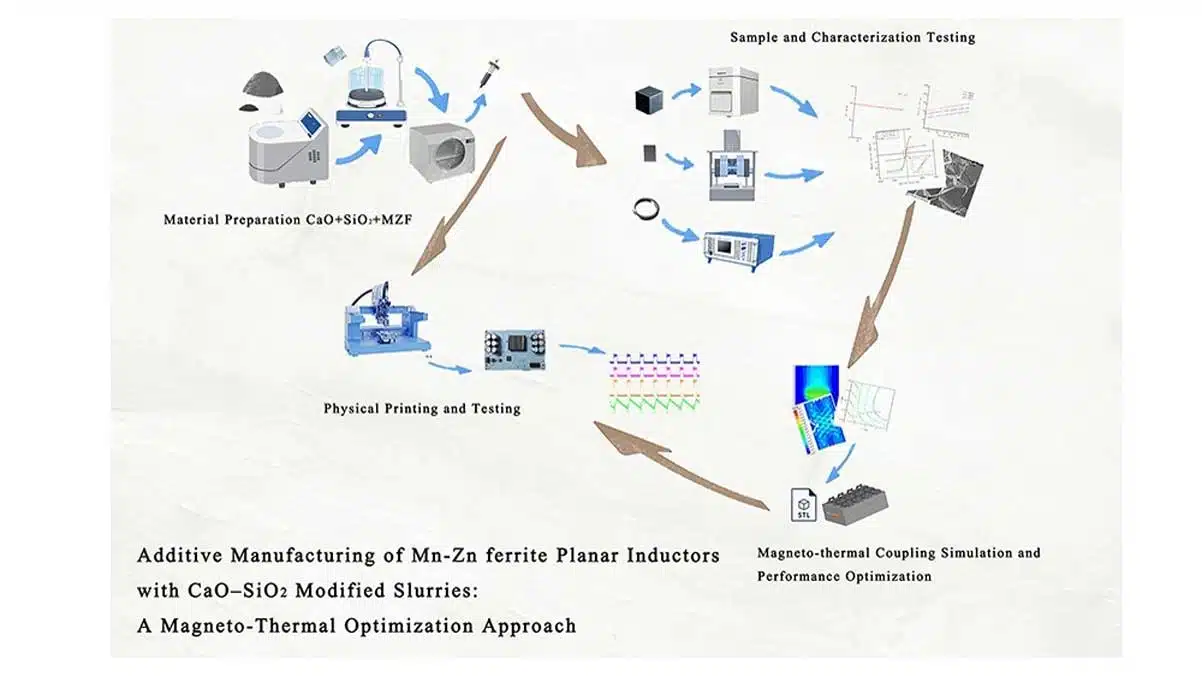
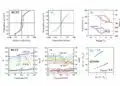
Researchers from China published results of their research Additive manufacturing of Mn-Zn ferrite planar inductors with CaO–SiO2 modified slurries: A magneto-thermal optimization approach published by Materials & Design Journal.

Introduction

RelatedPosts

Modelithics Releases COMPLETE v26.1 for Keysight ADS

April 2026 Interconnect, Passives and Electromechanical Components Market Insights

SPICE Simulation of Non-Linear Resistors: Vishay’s Thermistor and PPTC Modelling Ecosystem

The advancement of soft magnetic materials, particularly Mn-Zn ferrite powders, plays a pivotal role in enhancing the performance of integrated planar inductors.

Traditional fabrication methods, such as compression molding, often limit the design flexibility needed for customized magnetic cores. This article explores the innovative application of a multi-nozzle slurry-based printing technique to overcome these constraints, aiming to optimize both magnetic and thermal properties through additive manufacturing.

Key Points

  • Limitations of Traditional Methods: Compression molding restricts design adaptability in soft magnetic cores.
  • Innovative Printing Technique: Utilization of a multi-nozzle slurry-based printing process for Mn-Zn ferrite powders.
  • Additives for Optimization: Introduction of CaO (0.5 wt%) and SiO2 (0.05 wt%) to improve grain boundary phases.
  • Enhanced Properties: Achieving optimal microstructure, electrical resistivity, and magnetic performance through sintering at 1200°C.
  • Experimental Validation: Fabrication and testing of a prototype confirming magneto-thermal optimization capabilities.

Extended Summary

Traditional fabrication techniques for Mn-Zn ferrite powders, such as compression molding, have long been the standard in producing soft magnetic cores. However, these methods inherently limit the potential for custom designs, which are increasingly in demand for advanced electronic applications. Recognizing this limitation, the study introduces a groundbreaking multi-nozzle slurry-based printing technique tailored for commercially available Mn-Zn ferrite powders.

The innovation doesn’t stop at the printing technique. To further refine the material properties, small quantities of sintering additives—CaO (0.5 wt%) and SiO2 (0.05 wt%)—are incorporated. These additives play a crucial role in modifying grain boundary phases, which in turn enhances electrical resistivity and reduces porosity. This meticulous adjustment leads to superior microstructural attributes and magnetic properties.

Achieving the desired material characteristics requires precise thermal management. The study identifies 1200°C as the optimal sintering temperature, complemented by tailored thermal treatment conditions. This specific process results in enhanced initial permeability, improved saturation magnetization, and reduced core loss, key parameters critical for magnetic performance.

Building on these insights, the researchers have designed and fabricated a modified Mn-Zn ferrite core utilizing the composite additive manufacturing method. This new core not only integrates advanced thermal management features but also exhibits superior magnetic performance. A physical prototype of the composite inductor was produced to validate these findings experimentally. The prototype’s performance confirmed the feasibility and effectiveness of this approach in achieving magneto-thermal optimization.

Conclusion

This study showcases the potential of additive manufacturing, specifically a multi-nozzle slurry-based printing technique, in revolutionizing the fabrication of Mn-Zn ferrite magnetic cores. By incorporating strategic sintering additives and optimizing thermal treatments, the research successfully enhances both magnetic and thermal properties. The fabrication and validation of a physical prototype underscore the practical applicability of this innovative process, paving the way for more flexible and efficient designs in integrated planar inductors.

Read the full paper:

Wenjie Zhang, Qian Zhu, Huoying Tan, Jiquan Yang, Jianping Shi,
Additive manufacturing of Mn-Zn ferrite planar inductors with CaO–SiO2 modified slurries: A magneto-thermal optimization approach,
Materials & Design, Volume 257, 2025, 114438,ISSN 0264-1275,
https://doi.org/10.1016/j.matdes.2025.114438.

Related

Source: Materials and Design Journal

Recent Posts

Modelithics Releases COMPLETE v26.1 for Keysight ADS

23.4.2026
11

April 2026 Interconnect, Passives and Electromechanical Components Market Insights

22.4.2026
39

Why Power Inductors Use a Ferrite Core With an Air Gap

20.4.2026
41

TDK Introduces High‑Voltage Common‑Mode Chokes for Compact 1250 V DC Converters

16.4.2026
30

Vishay Extends Power Inductors for DC/DC with 1212 Compact Case

16.4.2026
21

Modeling Planar Magnetics Temperature: Practical Guidelines for Power Electronics Engineers

15.4.2026
23

YAGEO Releases Ferrite Shielded Power Inductors for High‑Density Designs

15.4.2026
29

YAGEO Introduces EMI Suppression High‑Current 3‑phase Common Mode Chokes

14.4.2026
35

ECIA March 2026 Industry Pulse Points to Best Sales Climate in Five Years

13.4.2026
54

Upcoming Events

Apr 27
15:00 - 16:00 CEST

Commercial Space Screening Approach for Agile, High-Reliability Payloads

Apr 29
10:00 - 11:00 CDT

SEPIC Design Done Right

Apr 30
10:00 - 11:00 CDT

Programming Embedded Systems

View Calendar

Popular Posts

  • Buck Converter Design and Calculation

    0 shares
    Share 0 Tweet 0
  • Boost Converter Design and Calculation

    0 shares
    Share 0 Tweet 0
  • Flyback Converter Design and Calculation

    0 shares
    Share 0 Tweet 0
  • LLC Resonant Converter Design and Calculation

    0 shares
    Share 0 Tweet 0
  • MLCC and Ceramic Capacitors

    0 shares
    Share 0 Tweet 0
  • Dual Active Bridge (DAB) Topology

    0 shares
    Share 0 Tweet 0
  • Capacitor Charging and Discharging

    0 shares
    Share 0 Tweet 0
  • What Electronics Engineer Needs to Know About Passive Low Pass Filters

    0 shares
    Share 0 Tweet 0
  • Ripple Current and its Effects on the Performance of Capacitors

    3 shares
    Share 3 Tweet 0
  • MLCC Case Sizes Standards Explained

    0 shares
    Share 0 Tweet 0

Newsletter Subscription


Passive Components Blog

© EPCI - Leading Passive Components Educational and Information Site

  • Home
  • Privacy Policy
  • EPCI Membership & Advertisement
  • About

No Result
View All Result
  • Home
  • Knowledge Blog
  • PCNS

© EPCI - Leading Passive Components Educational and Information Site

This website uses cookies. By continuing to use this website you are giving consent to cookies being used. Visit our Privacy and Cookie Policy.
Go to mobile version