




Passive Components Blog
No Result
View All Result
  • Home
  • NewsFilter
    • All
    • Aerospace & Defence
    • Antenna
    • Applications
    • Automotive
    • Capacitors
    • Circuit Protection Devices
    • electro-mechanical news
    • Filters
    • Fuses
    • Inductors
    • Industrial
    • Integrated Passives
    • inter-connect news
    • Market & Supply Chain
    • Market Insights
    • Medical
    • Modelling and Simulation
    • New Materials & Supply
    • New Technologies
    • Non-linear Passives
    • Oscillators
    • Passive Sensors News
    • Resistors
    • RF & Microwave
    • Telecommunication
    • Weekly Digest

    All‑Water Supercapacitor Based on 1‑nm Clay Channels and Nanoconfined Water Electrolyte

    Littelfuse Unveils High‑Current 48V SMD Fuse for AI Data Center Protection

    Modelithics Releases COMPLETE Library v26.2 for Keysight Genesys

    Why Isolated DC/DC Power Supplies Fail Late, Würth Elektronik Podcast

    Wk 23 Electronics Supply Chain Digest

    Power Converter Dossier: Passive Components Design and Selection Guide 2026

    Evans Group Unifies Four High-Rel Capacitor Leaders

    Skeleton Releases Graphene‑Based UPS for AI Data Centers

    Designing 800 V DC EMC Filters: Calculation, Simulation and Measurement

    Trending Tags

    • Ripple Current
    • RF
    • Leakage Current
    • Tantalum vs Ceramic
    • Snubber
    • Low ESR
    • Feedthrough
    • Derating
    • Dielectric Constant
    • New Products
    • Market Reports
  • VideoFilter
    • All
    • Antenna videos
    • Capacitor videos
    • Circuit Protection Video
    • Filter videos
    • Fuse videos
    • Inductor videos
    • Inter-Connect Video
    • Non-linear passives videos
    • Oscillator videos
    • Passive sensors videos
    • Resistor videos

    Why Isolated DC/DC Power Supplies Fail Late, Würth Elektronik Podcast

    Designing 800 V DC EMC Filters: Calculation, Simulation and Measurement

    Current Sense Transformer Datasheet and Design‑in Guide

    Designing a USB Type‑C Flyback Planar Transformer with Frenetic’s Planar Tool

    Magnetics Design in High‑Frequency GaN Converters

    Qi2 Wireless Charging: Inductors, Capacitors and EMC Filters

    Two‑capacitor paradox explained for engineers

    Capacitances of Nonlinear MLCCs: What Datasheets Don’t Tell You

    Tapped Inductor Buck Converter Fundamentals

    Trending Tags

    • Capacitors explained
    • Inductors explained
    • Resistors explained
    • Filters explained
    • Application Video Guidelines
    • EMC
    • New Products
    • Ripple Current
    • Simulation
    • Tantalum vs Ceramic
  • Knowledge Blog
  • DossiersNew
  • Suppliers
    • Who is Who
  • PCNS
    • PCNS 2025
    • PCNS 2023
    • PCNS 2021
    • PCNS 2019
    • PCNS 2017
  • Events
  • Home
  • NewsFilter
    • All
    • Aerospace & Defence
    • Antenna
    • Applications
    • Automotive
    • Capacitors
    • Circuit Protection Devices
    • electro-mechanical news
    • Filters
    • Fuses
    • Inductors
    • Industrial
    • Integrated Passives
    • inter-connect news
    • Market & Supply Chain
    • Market Insights
    • Medical
    • Modelling and Simulation
    • New Materials & Supply
    • New Technologies
    • Non-linear Passives
    • Oscillators
    • Passive Sensors News
    • Resistors
    • RF & Microwave
    • Telecommunication
    • Weekly Digest

    All‑Water Supercapacitor Based on 1‑nm Clay Channels and Nanoconfined Water Electrolyte

    Littelfuse Unveils High‑Current 48V SMD Fuse for AI Data Center Protection

    Modelithics Releases COMPLETE Library v26.2 for Keysight Genesys

    Why Isolated DC/DC Power Supplies Fail Late, Würth Elektronik Podcast

    Wk 23 Electronics Supply Chain Digest

    Power Converter Dossier: Passive Components Design and Selection Guide 2026

    Evans Group Unifies Four High-Rel Capacitor Leaders

    Skeleton Releases Graphene‑Based UPS for AI Data Centers

    Designing 800 V DC EMC Filters: Calculation, Simulation and Measurement

    Trending Tags

    • Ripple Current
    • RF
    • Leakage Current
    • Tantalum vs Ceramic
    • Snubber
    • Low ESR
    • Feedthrough
    • Derating
    • Dielectric Constant
    • New Products
    • Market Reports
  • VideoFilter
    • All
    • Antenna videos
    • Capacitor videos
    • Circuit Protection Video
    • Filter videos
    • Fuse videos
    • Inductor videos
    • Inter-Connect Video
    • Non-linear passives videos
    • Oscillator videos
    • Passive sensors videos
    • Resistor videos

    Why Isolated DC/DC Power Supplies Fail Late, Würth Elektronik Podcast

    Designing 800 V DC EMC Filters: Calculation, Simulation and Measurement

    Current Sense Transformer Datasheet and Design‑in Guide

    Designing a USB Type‑C Flyback Planar Transformer with Frenetic’s Planar Tool

    Magnetics Design in High‑Frequency GaN Converters

    Qi2 Wireless Charging: Inductors, Capacitors and EMC Filters

    Two‑capacitor paradox explained for engineers

    Capacitances of Nonlinear MLCCs: What Datasheets Don’t Tell You

    Tapped Inductor Buck Converter Fundamentals

    Trending Tags

    • Capacitors explained
    • Inductors explained
    • Resistors explained
    • Filters explained
    • Application Video Guidelines
    • EMC
    • New Products
    • Ripple Current
    • Simulation
    • Tantalum vs Ceramic
  • Knowledge Blog
  • DossiersNew
  • Suppliers
    • Who is Who
  • PCNS
    • PCNS 2025
    • PCNS 2023
    • PCNS 2021
    • PCNS 2019
    • PCNS 2017
  • Events
No Result
View All Result
Passive Components Blog
No Result
View All Result

Advancing Electrochemical Properties of Metal Oxides for Supercapacitor Electrodes

5.2.2024
Reading Time: 3 mins read
A A

Oxygen vacancies engineering is widely acknowledged as a potent strategy for augmenting the electrochemical performance of metal oxides in the realm of supercapacitors.

Researchers from Jinan School of Materials Science and Engineering, Shandong University, China published their study Activated carbon induced oxygen vacancies-engineered nickel ferrite with enhanced conductivity for supercapacitor application.

RelatedPosts

All‑Water Supercapacitor Based on 1‑nm Clay Channels and Nanoconfined Water Electrolyte

Littelfuse Unveils High‑Current 48V SMD Fuse for AI Data Center Protection

Modelithics Releases COMPLETE Library v26.2 for Keysight Genesys

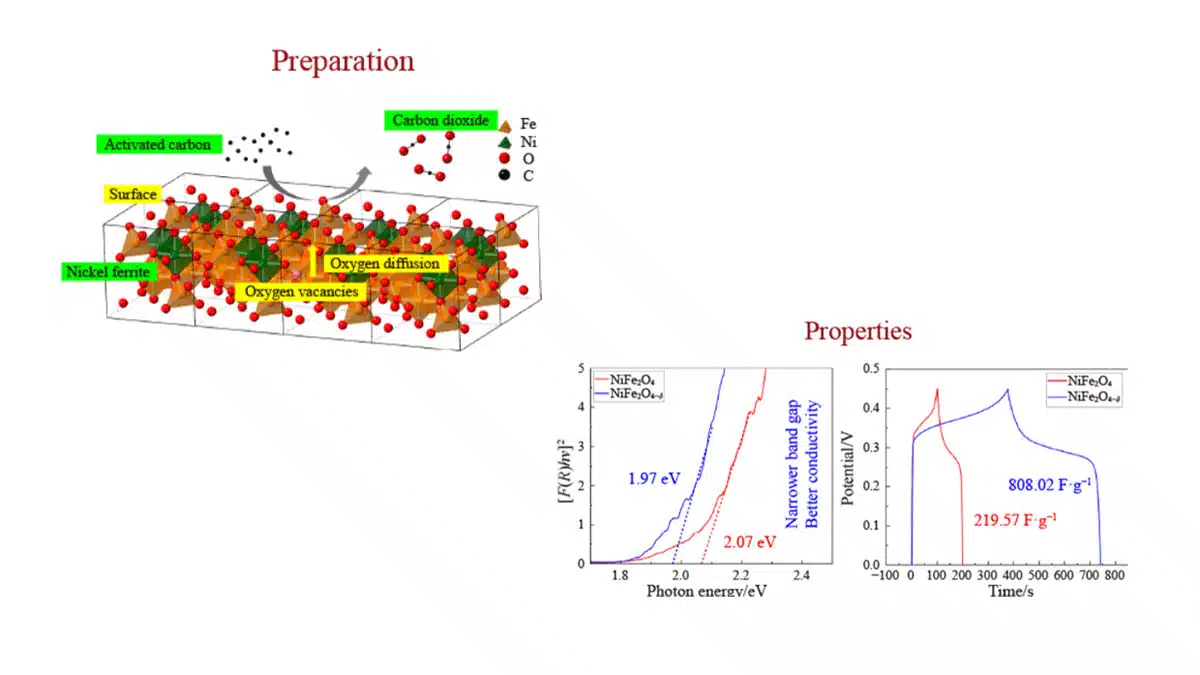
In recent research by Prof. Jianqiang Bi’s team, NiFe2O4−δ, characterized by a profusion of oxygen vacancies, was successfully synthesized through a subsequent heat treatment process within an activated carbon bed, building upon the foundation of the hydrothermal-synthesized NiFe2O4.

The meticulous treatment yielded the NiFe2O4−δ, which exhibited superior conductivity and a remarkable 3.7-fold increase in capacitance compared to its NiFe2O4 counterpart. This observed enhancement in electrochemical properties underscores the pivotal role played by oxygen vacancies in optimizing the performance of metal oxides.

The results of their study strongly support the notion that the deliberate introduction of oxygen vacancies holds substantial promise for advancing the electrochemical properties of metal oxides, thereby positioning them as promising materials for supercapacitor electrodes. Their work was published in the journal Frontiers of Chemical Science and Engineering.

This newfound understanding opens avenues for potential applications in the field of energy storage, showcasing the significant impact of oxygen vacancy engineering on the development of high-performance supercapacitors.

Abstract

NiFe2O4 is a kind of bimetallic oxide possessing excellent theoretical capacity and application prospect in the field of supercapacitors. Whereas, due to the inherent poor conductivity of metal oxides, the performance of NiFe2O4 is not ideal in practice. Oxygen vacancies can not only enhance the conductivities of NiFe2O4 but also provide better adsorption of OH, which is beneficial to the electrochemical performances. Hence, oxygen vacancies engineered NiFe2O4 (NiFe2O4‒δ) is obtained through a two-step method, including a hydrothermal reaction and a further heat treatment in activated carbon bed.

Results of electron paramagnetic resonance spectra indicate that more oxygen vacancies exist in the treated NiFe2O4‒δ than the original one. UV-Vis diffuse reflectance spectra prove that the treated NiFe2O4‒δ owns better conductivity than the original NiFe2O4. As for the electrochemical performances, the treated NiFe2O4‒δ performs a high specific capacitance of 808.02 F∙g‒1 at 1 A∙g‒1. Moreover, the asymmetric supercapacitor of NiFe2O4‒δ//active carbon displays a high energy density of 17.7 Wh∙kg‒1 at the power density of 375 W∙kg‒1. This work gives an effective way to improve the conductivity of metal oxides, which is beneficial to the application of metal oxides in supercapacitors.

Reference link to the article:

Xicheng Gao, Jianqiang Bi, Linjie Meng, Lulin Xie, Chen Liu. Activated carbon induced oxygen vacancies-engineered nickel ferrite with enhanced conductivity for supercapacitor application. Front. Chem. Sci. Eng., 2023, 17(12): 2088‒2100 https://doi.org/10.1007/s11705-023-2352-6
Related

Source: Frontiers of Chemical Science and Engineering

Recent Posts

All‑Water Supercapacitor Based on 1‑nm Clay Channels and Nanoconfined Water Electrolyte

10.6.2026
4

Modelithics Releases COMPLETE Library v26.2 for Keysight Genesys

8.6.2026
9

Power Converter Dossier: Passive Components Design and Selection Guide 2026

5.6.2026
36

Evans Group Unifies Four High-Rel Capacitor Leaders

5.6.2026
26

Skeleton Releases Graphene‑Based UPS for AI Data Centers

5.6.2026
31

TDK Releases DC-link Film Capacitors with Ultra-low Inductance for SiC Power Converters

4.6.2026
45

Murata Introduces World First 2.2uF 100V Soft‑Term MLCC in 0805 Size for Automotive

4.6.2026
34

Nvidia Vera Rubin: Why One AI Rack Needs So Many More MLCC Capacitors

2.6.2026
244

Tecate Unveils High‑temp 105C Supercapacitors for Harsh‑Environment Designs

2.6.2026
22

Upcoming Events

Jun 16
16:00 - 17:00 CEST

EMC with EMC – EMC‑compliant design with electromechanical connectors

Jul 14
16:00 - 17:00 CEST

EMC Design Essentials: Mastering Varistors and Common Mode Chokes

Jul 21
16:00 - 17:00 CEST

Safety by design: X and Y Interference suppression capacitors for power line filters

View Calendar

Popular Posts

  • Buck Converter Design and Calculation

    0 shares
    Share 0 Tweet 0
  • Boost Converter Design and Calculation

    0 shares
    Share 0 Tweet 0
  • MLCC and Ceramic Capacitors

    0 shares
    Share 0 Tweet 0
  • LLC Resonant Converter Design and Calculation

    0 shares
    Share 0 Tweet 0
  • Flyback Converter Design and Calculation

    0 shares
    Share 0 Tweet 0
  • What Electronics Engineer Needs to Know About Passive Low Pass Filters

    0 shares
    Share 0 Tweet 0
  • Dual Active Bridge (DAB) Topology

    0 shares
    Share 0 Tweet 0
  • SEPIC Converter Design and Calculation

    0 shares
    Share 0 Tweet 0
  • Capacitor Charging and Discharging

    0 shares
    Share 0 Tweet 0
  • Earthing Systems and IEC Classification Explained

    0 shares
    Share 0 Tweet 0

Newsletter Subscription


Passive Components Blog

© EPCI - Leading Passive Components Educational and Information Site

  • Home
  • Privacy Policy
  • EPCI Membership & Advertisement
  • About

No Result
View All Result
  • Home
  • Knowledge Blog
  • Dossiers
  • PCNS

© EPCI - Leading Passive Components Educational and Information Site

This website uses cookies. By continuing to use this website you are giving consent to cookies being used. Visit our Privacy and Cookie Policy.
Go to mobile version