




Passive Components Blog
No Result
View All Result
  • Home
  • NewsFilter
    • All
    • Aerospace & Defence
    • Antenna
    • Applications
    • Automotive
    • Capacitors
    • Circuit Protection Devices
    • electro-mechanical news
    • Filters
    • Fuses
    • Inductors
    • Industrial
    • Integrated Passives
    • inter-connect news
    • Market & Supply Chain
    • Market Insights
    • Medical
    • Modelling and Simulation
    • New Materials & Supply
    • New Technologies
    • Non-linear Passives
    • Oscillators
    • Passive Sensors News
    • Resistors
    • RF & Microwave
    • Telecommunication
    • Weekly Digest

    Würth Elektronik Updates REDEXPERT DC‑DC Converter Designer

    Stackpole Unveils High-Temperature Automotive Thick Film Chip Resistors for Harsh Environments

    Molex Presents MiniMix Hybrid Power and Signal Connectors for Compact Humanoid Joints

    Bourns Releases Custom SiC AFE/PFC Power Inductor for High‑Voltage Designs

    Littelfuse Releases Toggle Safety Covers for Reliable Control Panels

    Bourns Expanded Blend‑Balance Guitar Potentiometers Resistance Range

    TDK Extends Vibration‑Resistant Axial Aluminum Capacitors for Compact DC‑links

    YAGEO Releases SMD 0402 Pt Temperature Sensors for Space‑Constrained Designs

    Bourns Introduces Automotive Wide Terminal Metal Foil Current Sense Resistors for High‑Reliability Designs

    Trending Tags

    • Ripple Current
    • RF
    • Leakage Current
    • Tantalum vs Ceramic
    • Snubber
    • Low ESR
    • Feedthrough
    • Derating
    • Dielectric Constant
    • New Products
    • Market Reports
  • VideoFilter
    • All
    • Antenna videos
    • Capacitor videos
    • Circuit Protection Video
    • Filter videos
    • Fuse videos
    • Inductor videos
    • Inter-Connect Video
    • Non-linear passives videos
    • Oscillator videos
    • Passive sensors videos
    • Resistor videos

    Current Sense Transformers: Ferrite vs Nanocrystalline Cores for Accurate Current Measurement

    EMC Design Fundamentals: Safe Use of Varistors and Common Mode Chokes in Mains and Data-Line Filters

    Ferrite versus Nanocrystalline Power Inductor Cores: Turns, Gap and Size

    KYOCERA AVX Presents Antenna Integrator Studio Tutorial for Antenna Placement and RF Design

    Power Design Simulation Tools for Faster Inductor Selection and Loss Optimization

    EMC‑Compliant PCB and Connector Design Guidelines

    Why Isolated DC/DC Power Supplies Fail Late, Würth Elektronik Podcast

    Designing 800 V DC EMC Filters: Calculation, Simulation and Measurement

    Current Sense Transformer Datasheet and Design‑in Guide

    Trending Tags

    • Capacitors explained
    • Inductors explained
    • Resistors explained
    • Filters explained
    • Application Video Guidelines
    • EMC
    • New Products
    • Ripple Current
    • Simulation
    • Tantalum vs Ceramic
  • Knowledge Blog
  • Dossiers
    • AI Hardware Dossier
    • Power Converter Dossier
    • Automotive Dossier
    • Capacitor Dossier
    • Resistor Dossier
    • Inductor Dossier
    • Circuit Protection Dossier
  • Suppliers
    • Who is Who
  • PCNS
    • PCNS 2025
    • PCNS 2023
    • PCNS 2021
    • PCNS 2019
    • PCNS 2017
  • Events
  • Home
  • NewsFilter
    • All
    • Aerospace & Defence
    • Antenna
    • Applications
    • Automotive
    • Capacitors
    • Circuit Protection Devices
    • electro-mechanical news
    • Filters
    • Fuses
    • Inductors
    • Industrial
    • Integrated Passives
    • inter-connect news
    • Market & Supply Chain
    • Market Insights
    • Medical
    • Modelling and Simulation
    • New Materials & Supply
    • New Technologies
    • Non-linear Passives
    • Oscillators
    • Passive Sensors News
    • Resistors
    • RF & Microwave
    • Telecommunication
    • Weekly Digest

    Würth Elektronik Updates REDEXPERT DC‑DC Converter Designer

    Stackpole Unveils High-Temperature Automotive Thick Film Chip Resistors for Harsh Environments

    Molex Presents MiniMix Hybrid Power and Signal Connectors for Compact Humanoid Joints

    Bourns Releases Custom SiC AFE/PFC Power Inductor for High‑Voltage Designs

    Littelfuse Releases Toggle Safety Covers for Reliable Control Panels

    Bourns Expanded Blend‑Balance Guitar Potentiometers Resistance Range

    TDK Extends Vibration‑Resistant Axial Aluminum Capacitors for Compact DC‑links

    YAGEO Releases SMD 0402 Pt Temperature Sensors for Space‑Constrained Designs

    Bourns Introduces Automotive Wide Terminal Metal Foil Current Sense Resistors for High‑Reliability Designs

    Trending Tags

    • Ripple Current
    • RF
    • Leakage Current
    • Tantalum vs Ceramic
    • Snubber
    • Low ESR
    • Feedthrough
    • Derating
    • Dielectric Constant
    • New Products
    • Market Reports
  • VideoFilter
    • All
    • Antenna videos
    • Capacitor videos
    • Circuit Protection Video
    • Filter videos
    • Fuse videos
    • Inductor videos
    • Inter-Connect Video
    • Non-linear passives videos
    • Oscillator videos
    • Passive sensors videos
    • Resistor videos

    Current Sense Transformers: Ferrite vs Nanocrystalline Cores for Accurate Current Measurement

    EMC Design Fundamentals: Safe Use of Varistors and Common Mode Chokes in Mains and Data-Line Filters

    Ferrite versus Nanocrystalline Power Inductor Cores: Turns, Gap and Size

    KYOCERA AVX Presents Antenna Integrator Studio Tutorial for Antenna Placement and RF Design

    Power Design Simulation Tools for Faster Inductor Selection and Loss Optimization

    EMC‑Compliant PCB and Connector Design Guidelines

    Why Isolated DC/DC Power Supplies Fail Late, Würth Elektronik Podcast

    Designing 800 V DC EMC Filters: Calculation, Simulation and Measurement

    Current Sense Transformer Datasheet and Design‑in Guide

    Trending Tags

    • Capacitors explained
    • Inductors explained
    • Resistors explained
    • Filters explained
    • Application Video Guidelines
    • EMC
    • New Products
    • Ripple Current
    • Simulation
    • Tantalum vs Ceramic
  • Knowledge Blog
  • Dossiers
    • AI Hardware Dossier
    • Power Converter Dossier
    • Automotive Dossier
    • Capacitor Dossier
    • Resistor Dossier
    • Inductor Dossier
    • Circuit Protection Dossier
  • Suppliers
    • Who is Who
  • PCNS
    • PCNS 2025
    • PCNS 2023
    • PCNS 2021
    • PCNS 2019
    • PCNS 2017
  • Events
No Result
View All Result
Passive Components Blog
No Result
View All Result

Capacitor Ripple Current Testing: A Design Consideration

3.3.2026
Reading Time: 6 mins read
A A

This article written by Vincent Mao, Joe Hock, Caleb Winfrey  KYOCERA-AVX Corporation delves into capacitor ripple current evaluation and testing as an increasingly relevant test to complement design considerations.

The world is shifting towards electrification, with electric vehicles (EVs), renewable energy, and smaller, more powerful, yet efficient system-on-chips (SOCs) emerging as key components.

RelatedPosts

KYOCERA AVX Presents Antenna Integrator Studio Tutorial for Antenna Placement and RF Design

KYOCERA AVX Releases NTN Antenna Selection Guide Brochure

KYOCERA 10 µF 0201 MLCC Brings High‑Capacitance into Mobile Designs

This shift is driven by the growing concern about signal and power integrity across various environments. The ripple current test is commonly used to assess device performance up to 20°C above room temperature.

This overview focuses on the test setups employed to cover three ESR tiers (low, medium, and high) for applications spanning signal integrity to microwave/RF. We present initial results, procedures for data collection and analysis, and considerations for performance impacts associated with mounted parts. Additionally, we discuss ongoing challenges in this field.

Introduction:

In the evolving landscape of electrification—spanning electric vehicles (EVs), renewable energy, and advanced system-on-chips (SoCs)—ripple current has emerged as a critical factor affecting both signal and power integrity. Traditionally relevant in CPU design, ripple current now significantly impacts industries like automotive electronics. This document explores ripple current testing as an essential complement to design considerations, focusing on its relevance in assessing performance under varied environmental conditions and applications.

Key Points:

  1. Ripple Current Significance: Ripple current affects heat generation in capacitors due to equivalent series resistance (ESR) and has become increasingly relevant beyond traditional computing applications.
  2. Test Setup: Involves a combination of signal generators, power amplifiers, impedance matching components, and thermal monitoring apparatus.
  3. Capacitor Types: The study analyzes NP0, X7R, and Tantalum capacitors, each with unique ESR characteristics influencing ripple current tolerance.
  4. Data Collection & Analysis: Encompasses impedance characterization, progressive voltage application, and thermal monitoring to determine ripple current limits.
  5. Design Implications: Provides insights into optimizing power delivery and ensuring component reliability across various environments.

Extended Summary:

The increasing prevalence of embedded systems and the shift towards electrification underscore the growing importance of ripple current in electronic design. Ripple current, the AC component superimposed on a DC supply, affects the thermal performance and reliability of capacitors due to its relationship with ESR. This document details a comprehensive ripple current test designed to evaluate capacitor performance across diverse applications, from RF/microwave systems to automotive electronics.

The ripple current test setup is sophisticated, incorporating function generators, power amplifiers, impedance matching devices, and thermal imaging equipment to assess both unmounted and mounted device configurations. These setups are tailored to accommodate different ESR tiers and frequency ranges, extending up to 1 GHz for high-frequency applications.
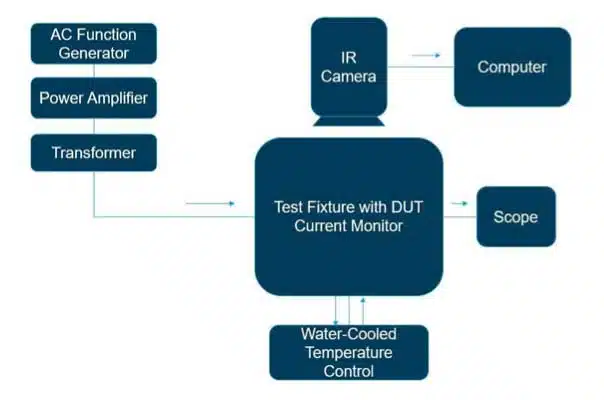
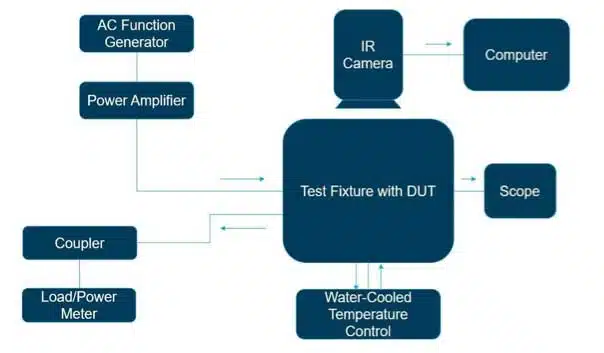
Figure 1. Block diagram of the ripple current test apparatus for low frequency ranges up to 12 MHz.
Figure 2. Block diagram of the ripple current test apparatus for high frequency ranges up to 1 GHz.

Three capacitor types—NP0, X7R MLCC capacitors, and Tantalum capacitors were studied. NP0 capacitors, known for minimal ESR and temperature stability, support high ripple currents, making them ideal for high-frequency applications. X7R capacitors offer stable performance over a broad temperature range and exhibit moderate ESR, suitable for general-purpose applications. Tantalum capacitors, with higher ESR, demonstrate self-healing properties and are robust under high ripple current conditions, beneficial for automotive applications.
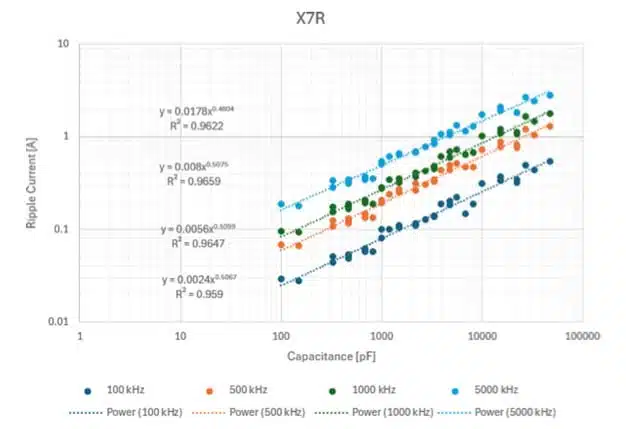
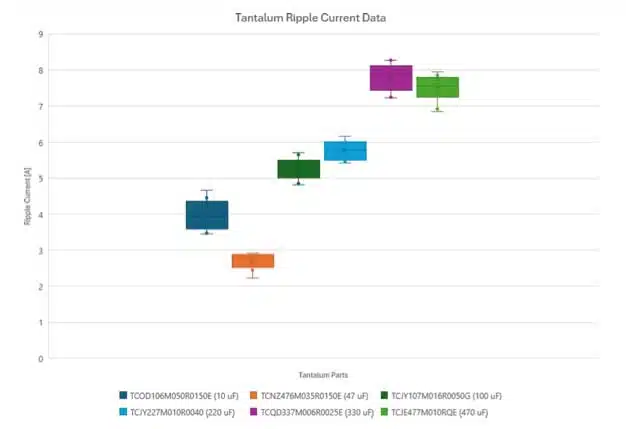
Figure 3. Capacitance vs. ripple current data for X7R parts for 100 kHz, 500 kHz, 1000 kHz, and 5000 kHz frequencies.
Figure 5. Capacitance vs. ripple current data for tantalum parts for 100 kHz frequency at 45°C baseline temperature.
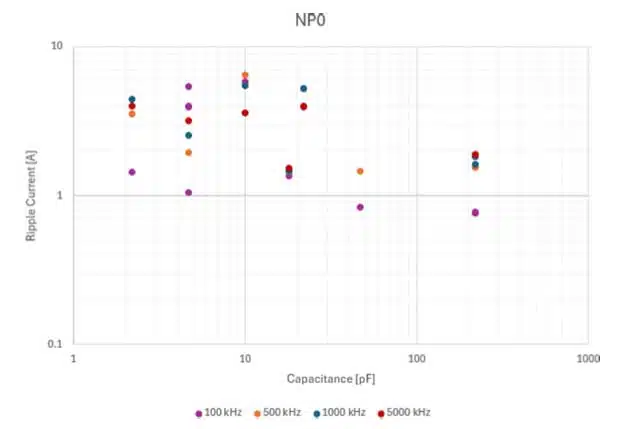
Figure 4. Capacitance vs. ripple current data for NP0 parts for 100 kHz, 500 kHz, 1000 kHz, and 5000 kHz frequencies.
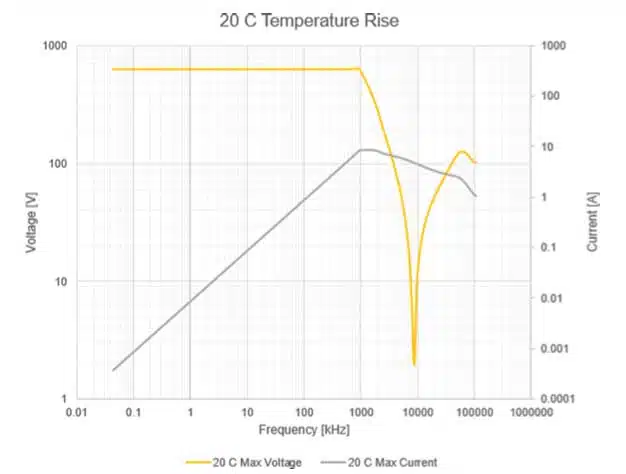
Figure 6. Max voltage and current plots for a high capacitor value NP0 part with a 630V rating.

The data collection process involved impedance and ESR characterization using precision analyzers, followed by progressive voltage application to observe thermal responses. Data analysis revealed trends correlating capacitance, frequency, and ripple current tolerances. Notably, lower ESR corresponds with higher ripple current capabilities. The study identified the need for ongoing data collection to refine predictive models, particularly for NP0 and Tantalum capacitors.

Future modifications aim to enhance test setups for higher frequency data capture and minimize measurement discrepancies. Improved models will support design decisions in EV charging systems, power-efficient circuits, and high-frequency applications, ensuring component reliability and performance across diverse operational environments.

Conclusion:

Ripple current testing is vital for modern electronic design, providing critical insights into component behavior under dynamic conditions. By understanding the interplay between ripple current, ESR, and capacitance across various capacitor types, designers can optimize electronic systems for durability, efficiency, and reliability. Ongoing research and data refinement will continue to enhance these insights, supporting the development of robust, future-ready electronic solutions.

read the full paper:

KAVX-Ripple-Current-Increasingly-Relevant-TestDownload

Related

Source: KYOCERA AVX

Recent Posts

Würth Elektronik Updates REDEXPERT DC‑DC Converter Designer

6.8.2026
25

Stackpole Unveils High-Temperature Automotive Thick Film Chip Resistors for Harsh Environments

6.8.2026
14

Molex Presents MiniMix Hybrid Power and Signal Connectors for Compact Humanoid Joints

6.8.2026
30

Bourns Releases Custom SiC AFE/PFC Power Inductor for High‑Voltage Designs

6.8.2026
21

Littelfuse Releases Toggle Safety Covers for Reliable Control Panels

6.8.2026
5

TDK Extends Vibration‑Resistant Axial Aluminum Capacitors for Compact DC‑links

4.8.2026
29

YAGEO Releases SMD 0402 Pt Temperature Sensors for Space‑Constrained Designs

3.8.2026
51

Bourns Introduces Automotive Wide Terminal Metal Foil Current Sense Resistors for High‑Reliability Designs

3.8.2026
29

Current Sense Transformers: Ferrite vs Nanocrystalline Cores for Accurate Current Measurement

5.8.2026
43

Upcoming Events

Sep 10
11:00 - 12:00 CEST

Equipment models and model strategies for Space Missions

Sep 29
16:00 - 17:00 CEST

Cybersecurity 2026

Nov 24
16:00 - 17:00 CET

Component selection with the WE REDEXPERT® DC-DC Converter Designer Tool

View Calendar

Popular Posts

  • Buck Converter Design and Calculation

    0 shares
    Share 0 Tweet 0
  • Boost Converter Design and Calculation

    0 shares
    Share 0 Tweet 0
  • LLC Resonant Converter Design and Calculation

    0 shares
    Share 0 Tweet 0
  • Flyback Converter Design and Calculation

    0 shares
    Share 0 Tweet 0
  • YAGEO Announces July 2026 Capacitor Price Increase

    0 shares
    Share 0 Tweet 0
  • MLCCs in the Age of AI: Q2 2026 Market Tightness

    0 shares
    Share 0 Tweet 0
  • MLCC and Ceramic Capacitors

    0 shares
    Share 0 Tweet 0
  • Earthing Systems and IEC Classification Explained

    0 shares
    Share 0 Tweet 0
  • Dual Active Bridge (DAB) Topology

    0 shares
    Share 0 Tweet 0
  • Ripple Current and its Effects on the Performance of Capacitors

    3 shares
    Share 3 Tweet 0

Newsletter Subscription


Passive Components Blog

© EPCI - Leading Passive Components Educational and Information Site

  • Home
  • Privacy Policy
  • EPCI Membership & Advertisement
  • About

No Result
View All Result
  • Home
  • Knowledge Blog
  • Dossiers
  • PCNS

© EPCI - Leading Passive Components Educational and Information Site