




Passive Components Blog
No Result
View All Result
  • Home
  • News
    • All
    • Aerospace & Defence
    • Antenna
    • Applications
    • Automotive
    • Capacitors
    • Circuit Protection Devices
    • electro-mechanical news
    • Filters
    • Fuses
    • Inductors
    • Industrial
    • Integrated Passives
    • inter-connect news
    • Market & Supply Chain
    • Market Insights
    • Medical
    • Modelling and Simulation
    • New Materials & Supply
    • New Technologies
    • Non-linear Passives
    • Optoelectronics and Isolation
    • Oscillators
    • Passive Sensors News
    • Resistors
    • RF & Microwave
    • Telecommunication
    • Weekly Digest
    Samsung Electro-Mechanics CL05Z106MS66PN automotive MLCC illustration with a rectangular ceramic body and metal end terminations

    Samsung Adds 0402 10 µF X7T MLCC for ADAS Power Rails

    Bourns PTVS03-450E-H power TVS diode in a surface-mount DFN package

    Bourns Releases 450 V Power TVS for DC Bus Clamping

    MLCC construction image

    Samsung Electro-Mechanics Patent Targets to Reduce Moisture and Cracks in High-Capacity MLCCs

    Samsung Electro-Mechanics MFC molded frame ceramic capacitor with epoxy encapsulation and external metal frame

    Samsung 100V Molded Frame MLCC Targets 48V AI Server PSUs

    SCHURTER EKO square-body DC fuse variants with ceramic bodies and different metal terminal arrangements

    SCHURTER EKO DC Fuses Extend to 1500 V and 2000 A

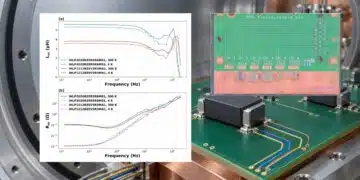
    illustration of packaged SMD power inductors on a four-wire cryogenic characterization board

    Cryogenic SMD Inductors at 4 K: Low DCR, Persistent AC Loss

    Wk 43 Electronics Supply Chain Digest

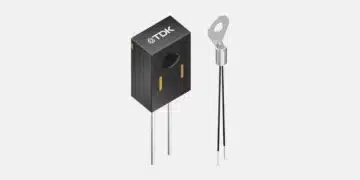
    TDK M704 and M705 NTC temperature sensors with a leaded plastic housing and metal-tag ring-lug assembly

    TDK M704 and M705 NTC Sensors for High-Voltage Power Systems

    Conceptual illustration for Modelithics COMPLETE 26.5 showing RF capacitors, inductors and resistors on a microwave PCB.

    Modelithics COMPLETE 26.5 Adds RF Passive Models for AWR

    Trending Tags

    • Ripple Current
    • RF
    • Leakage Current
    • Tantalum vs Ceramic
    • Snubber
    • Low ESR
    • Feedthrough
    • Derating
    • Dielectric Constant
    • New Products
    • Market Reports
  • Knowledge Blog
  • Dossiers
    • Aerospace and Defense Passive Components Dossier
    • AI Hardware Dossier
    • Automotive Dossier
    • Industrial Robotics Dossier
    • Power Converter Dossier
    • Capacitor Dossier
    • Circuit Protection Dossier
    • Inductor Dossier
    • Resistor Dossier
    • Silicon Capacitors and Integrated Passives Dossier
  • Suppliers
    • Who is Who
  • PCNS
    • PCNS 2025
    • PCNS 2023
    • PCNS 2021
    • PCNS 2019
    • PCNS 2017
  • Events
No Result
View All Result
Passive Components Blog
No Result
View All Result

Capacitor withstands temperatures of up to 300 degrees Celsius

3.5.2017
Reading Time: 3 mins read
A A

source: Phys.org news

Fraunhofer Institute for Microelectronic Circuits and Systems IMS is introducing a capacitor that can withstand temperatures of up to 300 degrees.

RelatedPosts

Samsung Adds 0402 10 µF X7T MLCC for ADAS Power Rails

Bourns Releases 450 V Power TVS for DC Bus Clamping

Samsung Electro-Mechanics Patent Targets to Reduce Moisture and Cracks in High-Capacity MLCCs

Heat, dust and moisture damage electronic components. Protecting against dust and moisture is fairly straightforward, but heat remains a problem because it is created within the component itself. Anywhere electricity flows, heat is generated as well. There is not always enough space in the electronic component to draw away the waste heat with cooling fins or ventilators. Devices that operate in a hot environment pose an even bigger problem. For example, a drill bit in the oil industry rotates at high speeds thousands of meters below the surface, generating temperatures of up to 250 degrees – not to mention the enormous mechanical load on the electronic components.

Fortunately, the Fraunhofer Institute for Microelectronic Circuits and Systems IMS has a solution to this problem: a capacitor that can withstand temperatures of up to 300 degrees. By comparison, conventional electronics can cope with temperatures only up to 125 degrees.

Capacitors store charge carriers and are among the most frequently used passive structural elements in electronics. The design of a capacitor is simple: it has two conducting plates, which function as the plus and minus electrodes, separated by an insulating layer called the dielectric. Dorothee Dietz, a scientist at Fraunhofer IMS, and her team were able to improve the capacitor’s heat resistance by using an innovative mix of materials and several design tricks.

3-D trick for more surface area

When manufacturing the conducting metal layers, the team etched tiny holes in the surface to increase its area. This 3-D trick increases its capacity and simultaneously makes it possible to use a thicker dielectric. A thicker layer withstands higher temperatures better and can decrease uncontrolled leakage current in the capacitor.

capacitor withstands temperatures of up to 300 degrees Celsius
Tiny holes increase the wafer’s surface area. Credit: Fraunhofer IMS

The experts are striking new paths in the production of the insulating dielectric, too, by using tantalum pentoxide, a compound of tantalum (a metal) and oxygen and aluminum oxide. This mix of materials is better at storing charge carriers than the silicon oxide usually used, so it increases the capacitor’s capacitance. For this reason, these particularly high-performing materials are also sometimes called high-k dielectrics in electric engineering.

In addition, the Fraunhofer researchers use a highly electrically conductive silicon as well as ruthenium, which is especially robust and heat-resistant. “With our material mix and design tricks, we can manufacture a capacitor that is incredibly tough and heat-tolerant without compromising performance,” explains Dietz.

Extreme precision: Layers just one atom layer thick

Yet the resistance to high temperatures is not the only advantage that the semiconductor from the Fraunhofer lab offers. The capacitors are also manufactured using the metal-oxide-semiconductor (MOS) process, which works with layers that are just one atomic layer thick (atomic layer deposition). This makes it possible to precisely determine the overall thickness of the layers, “which makes production very flexible,” says Dietz. “The manufacturer can produce components exactly according to the customer’s specifications without having to change the flow of the process.”

This expertise in high-temperature electronics can be applied to many other passive or active structural elements, such as resistors, diodes and transistors. Besides that, the technology established at Fraunhofer IMS is also suited for completely integrated circuits. Consequently, the capacitor can be incorporated not only into drill bits but also into engine injection systems or aircraft turbines – in other words, anywhere that requires extremely heat-resistant and robust components.


featured image: Capacitor withstands temperatures of up to 300 degrees Celsius. Credit: Fraunhofer IMS  

Related

Recent Posts

Samsung Electro-Mechanics CL05Z106MS66PN automotive MLCC illustration with a rectangular ceramic body and metal end terminations

Samsung Adds 0402 10 µF X7T MLCC for ADAS Power Rails

27.10.2026
8
MLCC construction image

Samsung Electro-Mechanics Patent Targets to Reduce Moisture and Cracks in High-Capacity MLCCs

26.10.2026
26
Samsung Electro-Mechanics MFC molded frame ceramic capacitor with epoxy encapsulation and external metal frame

Samsung 100V Molded Frame MLCC Targets 48V AI Server PSUs

26.10.2026
18
TDK B3201 series Y1 film safety capacitors with rectangular cases and parallel wire leads

TDK Introduces Y1 Film Safety Capacitors for 500 V AC EMI Filtering

21.10.2026
31
Modelithics COMPLETE+3D v26.4 library for RF passive-component and 3D electromagnetic simulation in Keysight ADS/RFPro

Modelithics COMPLETE+3D v26.4 Expands RF Models and 3D Workflows

19.10.2026
11
Siemens executives Markus Grabmeier and Barry Powell with Skeleton Technologies CEO Taavi Madiberk at the investment announcement

Siemens Backs Skeleton’s US AI Power Manufacturing Expansion

15.10.2026
67
Supercapacitor LSM production

LS Materials Wins $51.5M AI Data Center Supercapacitor Order

13.10.2026
96
Features of BCZT and strontium titanate dielectric layers in a thin-film superlattice

Relaxor superlattice capacitors approach 99% efficiency

12.10.2026
41
Conceptual Toray heat-resistant film capacitor beside an inverter cooling structure.

Toray Film Capacitor Enables 150°C Inverter Operation

9.10.2026
92

Upcoming Events

Oct 28
13:00 - 14:00 CDT

Inductor Design in a Multi-Phase Buck Converter

Nov 24
16:00 - 17:00 CET

Select the Correct Components for Your DC/DC Converter

Dec 1
16:00 - 17:00 CET

Developing low-noise mixed-signal systems

View Calendar

Popular Posts

  • Buck Converter Design and Calculation

    0 shares
    Share 0 Tweet 0
  • Boost Converter Design and Calculation

    0 shares
    Share 0 Tweet 0
  • LLC Resonant Converter Design and Calculation

    0 shares
    Share 0 Tweet 0
  • Capacitor Charging and Discharging

    0 shares
    Share 0 Tweet 0
  • September 2026 Interconnect, Passives and Electromechanical Components Market Insights

    0 shares
    Share 0 Tweet 0
  • Flyback Converter Design and Calculation

    0 shares
    Share 0 Tweet 0
  • MLCC and Ceramic Capacitors

    0 shares
    Share 0 Tweet 0
  • RF Connector Types: How To Choose the Right One

    0 shares
    Share 0 Tweet 0
  • Passive Low Pass Filters: Fundamentals and EMI Design

    0 shares
    Share 0 Tweet 0
  • Audio Capacitors: Choosing Capacitors for Crossover Circuits

    0 shares
    Share 0 Tweet 0

Newsletter Subscription


Passive Components Blog

© 2015–2026
All rights reserved

  • Home
  • Privacy Policy
  • EPCI Membership & Advertisement
  • About

No Result
View All Result
  • Home
  • Knowledge Blog
  • Dossiers
  • PCNS

© 2015–2026
All rights reserved