






Modelithics has introduced COMPLETE Library version 26.5 for the Cadence AWR Design Environment, adding 95 models covering nearly 2,800 components from 19 vendors.
The update expands capacitor, inductor and resistor simulation coverage, including Tecdia capacitor models validated to 67 GHz. Measurement-based models represent component behaviour together with supported substrate and mounting-pad effects, helping engineers evaluate the electrical response of mounted passives rather than nominal values alone.
Key features and benefits
- Expanded passive coverage includes capacitor, inductor and resistor models from Kyocera-AVX, Coilcraft, Cornell Dubilier, Dalicap, Knowles, Murata, Panasonic, Spectrum Control, Susumu, Knowles Syfer, Tecdia, TTM Technologies and Vishay.
- Scalable Coilcraft inductor models support component-value evaluation within the supported model ranges.
- Additional Murata capacitor models cover multiple package sizes and capacitance values.
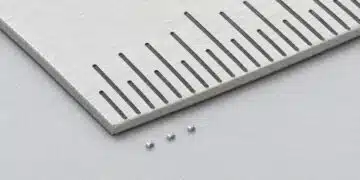
- Tecdia capacitor models extend validated simulation coverage to 67 GHz.
- New connector, filter and attenuator models extend simulation beyond discrete passive components.
- The full COMPLETE Library now represents more than 31,500 components from nearly 80 vendors.
Technical highlights
| Parameter | Version 26.5 coverage |
|---|---|
| EDA platform | Cadence AWR Design Environment |
| New models | 95 |
| Components covered by additions | Nearly 2,800 |
| Vendors represented by additions | 19 |
| Total component coverage | More than 31,500 |
| Total vendor coverage | Nearly 80 |
| Tecdia capacitor model validation | To 67 GHz |
The Modelithics model count and component count represent different levels of coverage. A scalable model can represent a component family across a range of part values, so the number of supported components exceeds the number of model elements.
Component value, substrate and pad scalability
Scalable microwave passive-component models use measurement-based equivalent circuits with parameters for component value, substrate properties and solder-pad dimensions. Supported scaling features allow engineers to tune component values and evaluate mounting conditions within the same model framework.
Substrate and pad geometry matter because they contribute parasitic effects to the mounted component response. A capacitor with the same nominal capacitance can exhibit different S-parameters on different substrates. The COMPLETE Library also includes a substrate library containing measurement-based substrate parameters.
Microwave Global Models incorporate higher-frequency and higher-order resonant behaviour. Resistive loss is typically fitted using effective series resistance measurements, complementing the S-parameter measurements used to develop the equivalent circuit.
Frequency coverage is model-specific
The 67 GHz validation applies to the highlighted Tecdia capacitor models. Each model has its own recommended validity parameters, measurement conditions and model-to-measurement comparisons.
Selection therefore depends on more than whether a component family appears in the library. The intended frequency span, component value, substrate and pad configuration must fall within the selected model’s supported operating space.
Typical applications
RF and microwave filter design
Scalable capacitor and inductor models support value tuning while retaining the effects of the mounting environment. In a low-pass filter, substrate-dependent parasitics can change the simulated reflection response even when nominal component values remain unchanged.
Part-value scaling also supports optimisation across a component family. Where tolerance analysis is supported, component tolerances can be varied to assess their effect on circuit yield.
Millimetre-wave capacitor evaluation
The Tecdia capacitor models validated to 67 GHz support capacitor evaluation within that frequency coverage. At these frequencies, pad and substrate effects become significant parts of the component response, making the mounting configuration an important simulation input.
RF power amplifiers and system-level circuits
New nonlinear Guerrilla RF transistor models support large-signal and temperature-dependent simulations for RF power-amplifier design.
Additional connector, filter and attenuator models cover devices from IEH, Mini-Circuits, Smiths Interconnect, Spectrum Control and SV Microwave. These additions support system-level simulation alongside the library’s discrete passive and active-device models.
Design-in notes for engineers
- Match the model to the intended component family, part value and package before schematic optimisation.
- Set substrate properties and solder-pad dimensions to reflect the intended PCB stack-up and land pattern.
- Check the selected model’s validity ranges for frequency, value and supported scaling parameters.
- Keep reference planes and pad treatment consistent when combining circuit models with electromagnetic layout simulation.
- Use tolerance analysis where supported to assess sensitivity before fixing component selections.
- Assess electromagnetic coupling separately when components sit close together or near shielding and interconnects. Scalable equivalent circuits do not generally capture these surrounding interactions; full-wave electromagnetic analysis addresses them.
- Validate the final circuit under its actual operating conditions before production release.
Availability
Version 26.5 is available for the Cadence AWR Design Environment. A free trial can be requested directly from Modelithics.
Further reading
- Modelithics COMPLETE+3D v26.4 Expands RF Models and 3D Workflows
- Modelithics Releases COMPLETE Library v26.2 for Keysight Genesys
Source
This article is based on the Modelithics product announcement and official product documentation. Engineers should refer to the current manufacturer datasheet for final design and qualification.
References
- Modelithics Expands COMPLETE Library with 95 New Models in Version 26.5 for Cadence AWR Design Environment Platform, Modelithics, October 20, 2026.
- Modelithics COMPLETE Library for Cadence AWR Design Environment Platform, Modelithics, October 2023.
- Modelithics Microwave Global Models, Modelithics.
- Advanced Scalable and 3D EM Models for Passive Devices, Modelithics, March 2020.