




Passive Components Blog
No Result
View All Result
  • Home
  • News
    • All
    • Aerospace & Defence
    • Antenna
    • Applications
    • Automotive
    • Capacitors
    • Circuit Protection Devices
    • electro-mechanical news
    • Filters
    • Fuses
    • Inductors
    • Industrial
    • Integrated Passives
    • inter-connect news
    • Market & Supply Chain
    • Market Insights
    • Medical
    • Modelling and Simulation
    • New Materials & Supply
    • New Technologies
    • Non-linear Passives
    • Optoelectronics and Isolation
    • Oscillators
    • Passive Sensors News
    • Resistors
    • RF & Microwave
    • Telecommunication
    • Weekly Digest
    Silicon capacitors and integrated passives dossier cover

    Silicon Capacitors and Integrated Passives Dossier Report 10/26

    Samtec automotive interconnect technologies for software-defined vehicle electronics

    Samtec Links Automotive Connector Demands to Software-Defined Cars

    Panasonic Industry PGS graphite heat-spreading technology and passive components for spacecraft thermal management

    Panasonic Targets Space Thermal Design at SPCD 2026

    tungsten-bronze-ceramic-capacitor-stack

    Tungsten bronze capacitors combine high κ and thermal stability

    Bourns MF-ASMF Series surface-mount PPTC resettable fuses in the manufacturer product photograph

    Bourns Announces 0402 PPTC Fuses Target Low-Current Protection

    Conceptual illustration of Littelfuse AQ4315-01ETG and SP4315-01WTG TVS diode applications on high-speed PCB data lines

    Littelfuse Adds Low-Capacitance TVS Diodes for Fast Data Links

    Datasheet-style illustration of a TDK MLJ1608-G multilayer chip inductor with end terminals

    TDK Expands1608 Inductors for Automotive PoC Filters

    Murata electronica 2026 technology preview featuring MGJ2T2 power converters and SCI36LT inertial sensors.

    Murata Previews SiC Power and AI Sensors at electronica 2026

    Ruggedized passive component customization overview covering capacitors, resistors and inductors.

    Ruggedized Passive Components: Reliability Beyond the Datasheet

    Trending Tags

    • Ripple Current
    • RF
    • Leakage Current
    • Tantalum vs Ceramic
    • Snubber
    • Low ESR
    • Feedthrough
    • Derating
    • Dielectric Constant
    • New Products
    • Market Reports
  • Knowledge Blog
  • Dossiers
    • Aerospace and Defense Passive Components Dossier
    • AI Hardware Dossier
    • Automotive Dossier
    • Industrial Robotics Dossier
    • Power Converter Dossier
    • Capacitor Dossier
    • Circuit Protection Dossier
    • Inductor Dossier
    • Resistor Dossier
    • Silicon Capacitors and Integrated Passives Dossier
  • Suppliers
    • Who is Who
  • PCNS
    • PCNS 2025
    • PCNS 2023
    • PCNS 2021
    • PCNS 2019
    • PCNS 2017
  • Events
  • Home
  • News
    • All
    • Aerospace & Defence
    • Antenna
    • Applications
    • Automotive
    • Capacitors
    • Circuit Protection Devices
    • electro-mechanical news
    • Filters
    • Fuses
    • Inductors
    • Industrial
    • Integrated Passives
    • inter-connect news
    • Market & Supply Chain
    • Market Insights
    • Medical
    • Modelling and Simulation
    • New Materials & Supply
    • New Technologies
    • Non-linear Passives
    • Optoelectronics and Isolation
    • Oscillators
    • Passive Sensors News
    • Resistors
    • RF & Microwave
    • Telecommunication
    • Weekly Digest
    Silicon capacitors and integrated passives dossier cover

    Silicon Capacitors and Integrated Passives Dossier Report 10/26

    Samtec automotive interconnect technologies for software-defined vehicle electronics

    Samtec Links Automotive Connector Demands to Software-Defined Cars

    Panasonic Industry PGS graphite heat-spreading technology and passive components for spacecraft thermal management

    Panasonic Targets Space Thermal Design at SPCD 2026

    tungsten-bronze-ceramic-capacitor-stack

    Tungsten bronze capacitors combine high κ and thermal stability

    Bourns MF-ASMF Series surface-mount PPTC resettable fuses in the manufacturer product photograph

    Bourns Announces 0402 PPTC Fuses Target Low-Current Protection

    Conceptual illustration of Littelfuse AQ4315-01ETG and SP4315-01WTG TVS diode applications on high-speed PCB data lines

    Littelfuse Adds Low-Capacitance TVS Diodes for Fast Data Links

    Datasheet-style illustration of a TDK MLJ1608-G multilayer chip inductor with end terminals

    TDK Expands1608 Inductors for Automotive PoC Filters

    Murata electronica 2026 technology preview featuring MGJ2T2 power converters and SCI36LT inertial sensors.

    Murata Previews SiC Power and AI Sensors at electronica 2026

    Ruggedized passive component customization overview covering capacitors, resistors and inductors.

    Ruggedized Passive Components: Reliability Beyond the Datasheet

    Trending Tags

    • Ripple Current
    • RF
    • Leakage Current
    • Tantalum vs Ceramic
    • Snubber
    • Low ESR
    • Feedthrough
    • Derating
    • Dielectric Constant
    • New Products
    • Market Reports
  • Knowledge Blog
  • Dossiers
    • Aerospace and Defense Passive Components Dossier
    • AI Hardware Dossier
    • Automotive Dossier
    • Industrial Robotics Dossier
    • Power Converter Dossier
    • Capacitor Dossier
    • Circuit Protection Dossier
    • Inductor Dossier
    • Resistor Dossier
    • Silicon Capacitors and Integrated Passives Dossier
  • Suppliers
    • Who is Who
  • PCNS
    • PCNS 2025
    • PCNS 2023
    • PCNS 2021
    • PCNS 2019
    • PCNS 2017
  • Events
No Result
View All Result
Passive Components Blog
No Result
View All Result

Computer Vision‑Driven Verification of Passive Component Assembly on Space‑Grade PCBs

23.9.2025
Reading Time: 7 mins read
A A

The paper “Computer Vision‑Driven Verification of Passive Component Assembly on Space‑Grade PCBs” was presented by Carmen Galán,  and Manuel Domínguez, ALTER Technology, Seville, Spain at the 5th PCNS Passive Components Networking Symposium 9-12th September 2025, Seville, Spain as paper No. AI 1.

ABSTRACT

RelatedPosts

Advances in the Environmental Performance of Polymer Capacitors

How to Manage Supercapacitors Leakage Current and Self Discharge 

Qualification of Commercial Supercapacitors for Space Applications

Passive components such as multilayer ceramic capacitors (MLCCs) and thick‑film chip resistors represent more than 70 % of the bill‑of‑materials for modern on‑board electronics. In order to ensure their reliability under extrem conditions affecting the space missions, it is essential to implement a verification programme.

This programme will analyse the solder integrity of assembled components after they have been subjected to thermal and mechanical stress. Herein, the first computer‑vision‑driven workflow concerning the European aerospace sector is presented. This system is based on the automatic analysis of the integrity of passive components and their soldering connections.

A YOLOv8‑based detector trained on 150 000 annotated microsection images identifies ten failure modes—including internal MLCC flex‑cracks and chip‑tilt resistors—with mAP50 of 0.94 and reduces analyst review time.The system has been in continuous production since Q2 2025, generating standardised ESA‑compliant reports and positioning ALTER Technology as a pioneer of AI‑enabled quality assurance for space‑grade passives.

Keywords— passive components; MLCC; chip resistor; computer vision; failure mode analysis; aerospace quality assurance

I. INTRODUCTION

Reliability of space hardware hinges on the integrity of multilayer ceramic capacitors (MLCCs), chip resistors, inductors and other passive components that dominate printed circuit board (PCB) population counts and their soldering connections. A single micro‑crack in an X7R capacitor can compromise mission‑critical power regulation, while tombstoned resistors jeopardise signal integrity. 

According to the ECSS standards, to demonstrate the reliability of assembled components, the integrity of both the component and its solder joints have to be analyse after being submitted to mechanical and thermal stress. In this way, the components are sitted for cross-section analysis by optical microscopy, a labour‑intensive process subject to operator bias. Concurrent trends toward 0201/01005 package sizes drive the need for faster, more objective inspection tools. In 2023 the Materials & Processes (M&P) Laboratory at ALTER Technology initiated an artificial‑intelligence programme to automate failure‑mode evaluation of assembled passive component after stress tests, leveraging recent advances in deep convolutional networks.

This paper presents the first computer vision-driven tool developed to assist to the laboratory inspectors in evaluating cross-section samples, harmonising results and optimising inspection time.

II. COMPUTER VISION FRAMEWORK

The workflow (Fig. 1) begins with high‑resolution imaging (0.5 µm pixel size) of resin‑embedded cross‑sectioned assembled components. A proprietary dataset of 150 000 images was curated, with expert metallographers annotating bounding boxes and segmentation masks for ten distinct failure modes. This failure modes were selected based on the anomalies describes in the standards ECSS-Q-ST-70-61C.

Data augmentation—rotation, translation, adaptive histogram equalisation, blur and synthetic noise—mitigated class imbalance and improved robustness against illumination artefacts. 

The detection backbone is Ultralytics YOLOv8‑L, initialised with MS‑COCO weights and trained for 400 epochs on dual NVIDIA  GPUs using a combined BCE‑CIoU loss. Custom anchor boxes matched the small‑object priors typical of 0201 packages. The tool was trained using anonymises metadata to ensure the independence of the results and to avoid any potential bias of the programme related with manufacturer, assembly technique…. This philosophy aslo guarantees the confidentiality and security of the results.
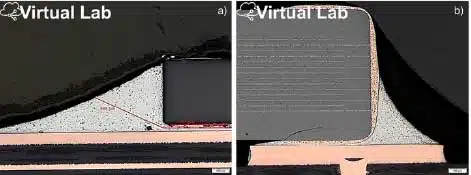
Figure 1. a) Crack in the solder joint of a resistor. b) crack in the ceramic body of a capacitor.

III. FAILURE MODE CATALOGUE

Table 1 summarises the passive‑component failure modes addressed by the model. Beyond conventional solder‑joint anomalies, the network recognises internal dielectric defects and mechanical damage unique to ceramic bodies. The catalogue was prioritised in consultation with component and process‑assurance (PA) engineers across six European satellites programs.

Failure modeDescriptionPrecisionRecall
Flex‑crack (MLCC)Diagonal crack across inner electrodes caused by board bending.0.950.92
DelaminationLayer separation within MLCC dielectric stack.0.940.90
Blow‑holeVoids in termination metallisation.0.930.91
TombstoningOne termination lifted, component stands vertically.0.960.94
Chip tiltComponent seated at >3° angle to PCB surface.0.940.92
Cold solder filletDull or insufficient wetting on termination.0.920.89
Lifted padCopper pad detached from PCB under component.0.910.88
Resistor hot‑spot burnLocalised overheating discoloration.0.930.90
Cracked resistor glazeSurface protective glaze fractured.0.920.87
Void under terminationSolder void >25 % under MLCC termination.0.950.91

IV. EXPERIMENTAL RESULTS

The trained model achieved an overall mAP50 of 0.944 and mAP50‑95 of 0.836 on a held‑out validation subset comprising 45 000 images. Failure‑mode‑specific metrics are included in Table 1. Inference throughput is 16 fps (4 k resolution) on a single RTX A6000, enabling real‑time review during microsection polishing. The false‑negative rate decreased below 3 %. A blind verification campaign with ESA PA engineers on 300 production samples confirmed 97 % agreement between AI predictions and expert consensus.

V. DISCUSSION & INDUSTRIAL IMPACT

The proposed workflow extends beyond traditional solder‑joint inspection by providing component‑level insights crucial for derating and reliability modelling. Automated quantification of flex‑crack length, solder void area and chip tilt angle feeds directly into stress‑ strength analyses, enabling earlier rejection or rework of marginal assemblies. The system’s modular architecture supports quick retraining for novel package types—e.g., high‑voltage C0G capacitors—and is now being evaluated for wire‑bond pull‑test segmentation. ALTER Technology is coordinating a pan‑European consortium to establish a shared, anonymised defect atlas, accelerating standardisation and reinforcing Europe’s strategic autonomy in semiconductor packaging.

VI. OUTLOOK FOR PA ENGINEERS

For PA engineers, the most immediate benefit lies in the harmonisation of defect classification. Machine‑generated, timestamped reports embed annotated images and quantitative metrics, reducing subjective disagreements during board acceptance reviews. Future releases will introduce Bayesian confidence estimates, allowing risk‑based escalation paths in accordance with ECSS‑Q‑30‑11A. Integration with IPC‑1782 traceability schemas is underway, paving the path toward fully digital process assurance for passive components.

VII. CONCLUSIONS

By integrating a YOLOv8 computer‑vision detector as part of the verification solder programme for passive components on space‑grade PCBs, the ALTER Technology M&P Laboratory has achieved a transformative leap in quality assurance. This is the first operational AI‑assisted inspection line for passives in the European aerospace supply chain. The approach shortens feedback cycles, increases defect detection fidelity and opens new avenues for predictive reliability modelling.

ACKNOWLEDGMENTS

The authors thank the European Space Agency’s Directorate of Technology, Engineering and Quality for continuous guidance.

REFERENCES

  • [1] ECSS‑Q‑ST‑70‑61C, “High‑reliability assembly for surface‑mount and through‑hole connections,” ESA, 2022.
  • [2] J. Kim et al., “Flex‑crack propagation in MLCCs during reflow,” Microelectronics Reliability, 2024.
  • [3] N. Jegham et al., “Evaluating the evolution of YOLO models,” arXiv:2411.00201, 2024.
  • [4] L. García et al., “AI‑based defect detection in ceramic capacitors,” Proceedings of ESTEC Components Day, 2025.

AI_1_ALTER Passive Component Verification_AIDownload

Related

Source: PCNS

Recent Posts

Silicon capacitors and integrated passives dossier cover

Silicon Capacitors and Integrated Passives Dossier Report 10/26

8.10.2026
1
Panasonic Industry PGS graphite heat-spreading technology and passive components for spacecraft thermal management

Panasonic Targets Space Thermal Design at SPCD 2026

8.10.2026
8
tungsten-bronze-ceramic-capacitor-stack

Tungsten bronze capacitors combine high κ and thermal stability

7.10.2026
14
Ruggedized passive component customization overview covering capacitors, resistors and inductors.

Ruggedized Passive Components: Reliability Beyond the Datasheet

6.10.2026
21
Bourns CSI2F bolt-down current sense resistors for high-current busbar measurement

Bourns Current Sense Resistors Reach 36 W

5.10.2026
11
bourns-crk2725-wide-terminal-current-sense-resistors

Bourns Releases 5 W Wide-Terminal Current Sense Resistors

2.10.2026
14
TDK B3272 series boxed DC-link film capacitors with radial leads for automotive and industrial power-electronics applications

TDK Expanded DC-Link Film Capacitors to Reach +135 °C

2.10.2026
24
Knowles ATT A-Series surface-mount RF attenuator in compact ceramic thin-film package

Knowles A-Series RF Attenuators Target Compact 20 GHz Designs

1.10.2026
15
Film DC-link capacitor and supercapacitor energy buffer in a high-voltage power converter system

Electrification Raises Demands on DC-Link Capacitors

1.10.2026
29

Upcoming Events

Oct 9
18:00 - 19:00 CEST

Edgewater Research 3Q26 Electronic Components Review Outlook Webinar

Oct 14
17:00 - 18:00 CEST

Live Demo! Discover KYOCERA AVX Antenna Integrator Studio (AIS)

Oct 19
15:00 - 16:00 CEST

ESCC-qualified Pt Temperature Sensors for Space Applications

View Calendar

Popular Posts

  • Buck Converter Design and Calculation

    0 shares
    Share 0 Tweet 0
  • Boost Converter Design and Calculation

    0 shares
    Share 0 Tweet 0
  • LLC Resonant Converter Design and Calculation

    0 shares
    Share 0 Tweet 0
  • Flyback Converter Design and Calculation

    0 shares
    Share 0 Tweet 0
  • Capacitor Charging and Discharging

    0 shares
    Share 0 Tweet 0
  • Resistor Symbols

    0 shares
    Share 0 Tweet 0
  • Audio Capacitors: Choosing Capacitors for Crossover Circuits

    0 shares
    Share 0 Tweet 0
  • Thermistors Basics, NTC and PTC Thermistors

    0 shares
    Share 0 Tweet 0
  • MLCC and Ceramic Capacitors

    0 shares
    Share 0 Tweet 0
  • RF Connector Types: How To Choose the Right One

    0 shares
    Share 0 Tweet 0

Newsletter Subscription


Passive Components Blog

© 2015–2026
All rights reserved

  • Home
  • Privacy Policy
  • EPCI Membership & Advertisement
  • About

No Result
View All Result
  • Home
  • Knowledge Blog
  • Dossiers
  • PCNS

© 2015–2026
All rights reserved