






Passive Components Blog
No Result
View All Result
  • Home
  • News
    • All
    • Aerospace & Defence
    • Antenna
    • Applications
    • Automotive
    • Capacitors
    • Circuit Protection Devices
    • electro-mechanical news
    • Filters
    • Fuses
    • Inductors
    • Industrial
    • Integrated Passives
    • inter-connect news
    • Market & Supply Chain
    • Market Insights
    • Medical
    • Modelling and Simulation
    • New Materials & Supply
    • New Technologies
    • Non-linear Passives
    • Optoelectronics and Isolation
    • Oscillators
    • Passive Sensors News
    • Resistors
    • RF & Microwave
    • Telecommunication
    • Weekly Digest
    Siemens executives Markus Grabmeier and Barry Powell with Skeleton Technologies CEO Taavi Madiberk at the investment announcement

    Siemens Backs Skeleton’s US AI Power Manufacturing Expansion

    Concept illustration of an LTCC antenna module with multilayer ceramic substrate, antenna elements and an integrated beamforming IC

    Murata LTCC 6G Antenna Module Demonstrates 135 GHz Operation

    TDK X series surface-mount multilayer varistors with ceramic chip bodies and metal end terminations

    TDK X Series SMD Varistors for Industrial Transient Protection

    Littelfuse TP7.0SMD-XC automotive TVS diodes with black surface-mount bodies and silver end terminals.

    Littelfuse Introduces Extremely Low Clamping Voltage TVS Diodes for Automotive Protection

    Supercapacitor LSM production

    LS Materials Wins $51.5M AI Data Center Supercapacitor Order

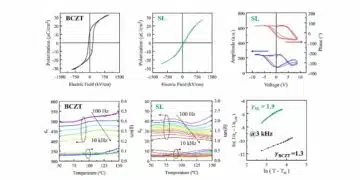
    Features of BCZT and strontium titanate dielectric layers in a thin-film superlattice

    Relaxor superlattice capacitors approach 99% efficiency

    Stackpole RMAN thick-film chip resistors with rectangular bodies and metal end terminations

    Stackpole 2512 AlN Thick-Film Resistors Rated up to 3.5 W

    ECIA September 2026 Industry Pulse electronic component trends and sentiment report

    ECIA September 2026 Pulse: Growth Holds, Supply Pressure Persists

    Wk 39 Electronics Supply Chain Digest

    Trending Tags

    • Ripple Current
    • RF
    • Leakage Current
    • Tantalum vs Ceramic
    • Snubber
    • Low ESR
    • Feedthrough
    • Derating
    • Dielectric Constant
    • New Products
    • Market Reports
  • Knowledge Blog
  • Dossiers
    • Aerospace and Defense Passive Components Dossier
    • AI Hardware Dossier
    • Automotive Dossier
    • Industrial Robotics Dossier
    • Power Converter Dossier
    • Capacitor Dossier
    • Circuit Protection Dossier
    • Inductor Dossier
    • Resistor Dossier
    • Silicon Capacitors and Integrated Passives Dossier
  • Suppliers
    • Who is Who
  • PCNS
    • PCNS 2025
    • PCNS 2023
    • PCNS 2021
    • PCNS 2019
    • PCNS 2017
  • Events
  • Home
  • News
    • All
    • Aerospace & Defence
    • Antenna
    • Applications
    • Automotive
    • Capacitors
    • Circuit Protection Devices
    • electro-mechanical news
    • Filters
    • Fuses
    • Inductors
    • Industrial
    • Integrated Passives
    • inter-connect news
    • Market & Supply Chain
    • Market Insights
    • Medical
    • Modelling and Simulation
    • New Materials & Supply
    • New Technologies
    • Non-linear Passives
    • Optoelectronics and Isolation
    • Oscillators
    • Passive Sensors News
    • Resistors
    • RF & Microwave
    • Telecommunication
    • Weekly Digest
    Siemens executives Markus Grabmeier and Barry Powell with Skeleton Technologies CEO Taavi Madiberk at the investment announcement

    Siemens Backs Skeleton’s US AI Power Manufacturing Expansion

    Concept illustration of an LTCC antenna module with multilayer ceramic substrate, antenna elements and an integrated beamforming IC

    Murata LTCC 6G Antenna Module Demonstrates 135 GHz Operation

    TDK X series surface-mount multilayer varistors with ceramic chip bodies and metal end terminations

    TDK X Series SMD Varistors for Industrial Transient Protection

    Littelfuse TP7.0SMD-XC automotive TVS diodes with black surface-mount bodies and silver end terminals.

    Littelfuse Introduces Extremely Low Clamping Voltage TVS Diodes for Automotive Protection

    Supercapacitor LSM production

    LS Materials Wins $51.5M AI Data Center Supercapacitor Order

    Features of BCZT and strontium titanate dielectric layers in a thin-film superlattice

    Relaxor superlattice capacitors approach 99% efficiency

    Stackpole RMAN thick-film chip resistors with rectangular bodies and metal end terminations

    Stackpole 2512 AlN Thick-Film Resistors Rated up to 3.5 W

    ECIA September 2026 Industry Pulse electronic component trends and sentiment report

    ECIA September 2026 Pulse: Growth Holds, Supply Pressure Persists

    Wk 39 Electronics Supply Chain Digest

    Trending Tags

    • Ripple Current
    • RF
    • Leakage Current
    • Tantalum vs Ceramic
    • Snubber
    • Low ESR
    • Feedthrough
    • Derating
    • Dielectric Constant
    • New Products
    • Market Reports
  • Knowledge Blog
  • Dossiers
    • Aerospace and Defense Passive Components Dossier
    • AI Hardware Dossier
    • Automotive Dossier
    • Industrial Robotics Dossier
    • Power Converter Dossier
    • Capacitor Dossier
    • Circuit Protection Dossier
    • Inductor Dossier
    • Resistor Dossier
    • Silicon Capacitors and Integrated Passives Dossier
  • Suppliers
    • Who is Who
  • PCNS
    • PCNS 2025
    • PCNS 2023
    • PCNS 2021
    • PCNS 2019
    • PCNS 2017
  • Events
No Result
View All Result
Passive Components Blog
No Result
View All Result

Enhanced Process Control in Tantalum Capacitor Anode Manufacturing Reduces Cost and Improves Reliability

8.4.2025
Reading Time: 5 mins read
A A

This article by Dr. V. Azbel, an Independent consultant on tantalum capacitors highlights importance of tantalum capacitors anode in-process control that provides more effective control systems for tantalum capacitors. These methods lead to reduced manufacturing costs, improved yield, and increased reliability.

Introduction

In the tantalum capacitor industry, ongoing debates center on enhancing in-process control at the anode production stage to efficiently detect early failures, reduce manufacturing costs, and improve reliability. Traditionally, manufacturers have employed a multi-stage testing process for finished capacitors, assuming that a thorough final inspection is sufficient to guarantee quality. However, practical experience and economic analysis reveal that this approach may not always be effective, particularly when systemic defects manifest as early as the anode manufacturing stage. Notably, over 60% of tantalum capacitor failures can be attributed to anode-related issues, underscoring the importance of early-stage control.

RelatedPosts

From DCL to SSC: Bridging Electrical Symptoms and Structural Indicators in Tantalum Capacitors

Using a Virtual Anode Thermal Model to Evaluate Miniaturization Risk in Tantalum Capacitors

Practical Value of Structural Diagnostics for Tantalum Capacitor Anodes

This begs the question: is additional anode inspection necessary if all finished products are already undergoing testing?

Let’s explore.

The Problem: The Cost of Late Defect Detection

When systemic defects occur in anodes, the losses at the final stage increase exponentially.

Why is this?

The anode accounts for only 20–30% of the total production cost of a finished capacitor. But as soon as the anode progresses to the finished product stage, the investment multiplies several times over. A finished capacitor already includes all expenses for materials, assembly, and testing, meaning the losses at this point are several times higher.

Economic Model: The Numbers Speak for Themselves

Let’s take a look at the calculation for a batch of 100,000 units.

StageUnit Cost, USDDefect Rate (10%)Losses, USD
Anode0.5100,000 × 10% × 0.55,000
Finished Capacitor3.0100,000 × 10% × 3.030,000

The difference—up to 6 times—is in favor of early defect detection.

Thus, every defect missed at the anode stage leads to exponentially increased losses at scale.

Hidden Costs of Late Rejection

Beyond the direct financial losses, late-stage rejection also brings hidden costs:

  • Delivery delays;
  • Increase in complaints and claims;
  • Loss of customer trust;
  • Additional costs for root cause analysis and re-manufacturing.

In short, every missed control point at the early stage triggers a chain reaction of problems downstream.

The Case for Early Process Control

It’s important to emphasize: implementing anode inspection does not replace final testing of finished products. Instead, it complements it, providing an economically sound way to reduce the risk of mass losses before assembly costs accumulate.

To put it simply:

“This is not about perfectionism—it’s about production economics.”

Anode inspection is an investment not in redundant testing, but in process stability and financial predictability.

Methods of Early Inspection

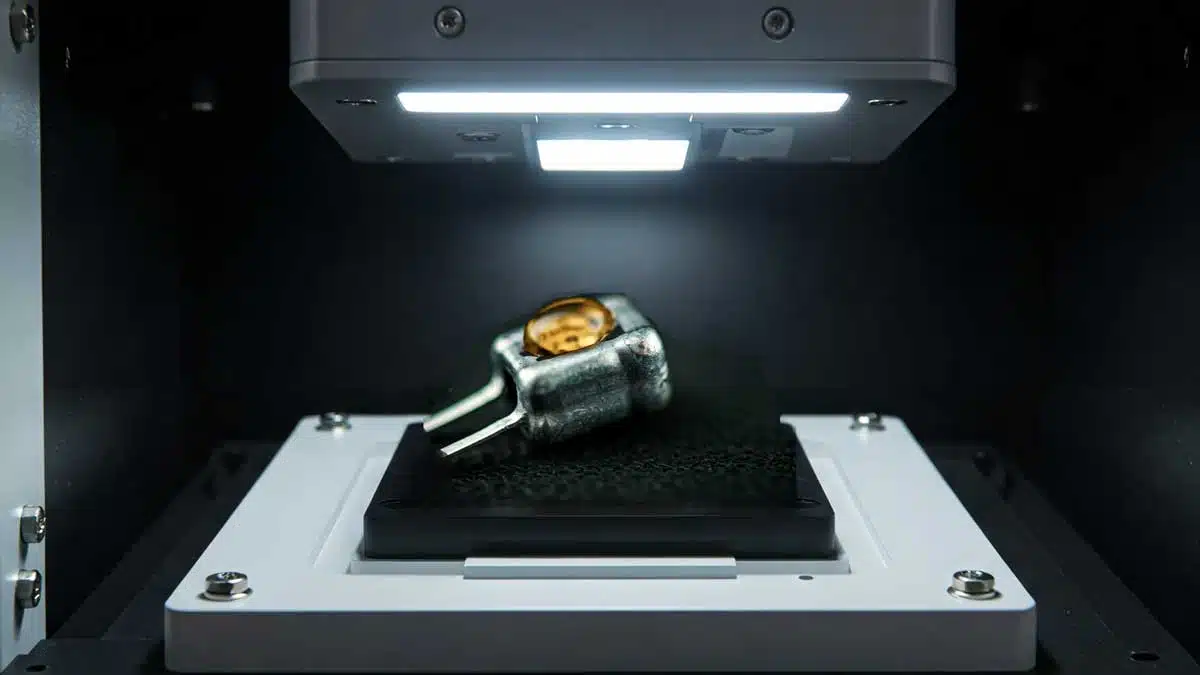
In addition to traditional methods such as metallographic analysis, X-ray structural analysis, and electrical parameter measurement, mechanical testing should also be considered for in-process control. Its implementation helps to identify defective batches at the anode production stage, before they are incorporated into the capacitor assembly.

V. Azbel, in his research, notes that the methods he proposes for operational control in anode production contribute to reducing production costs and improving overall process stability.

Conclusion

  1. Anode control is not a replacement for final testing, but a complement to it.
    Final testing acts as insurance for the customer.
    Anode control is insurance for the manufacturer.
    Their roles are not to replace each other but to work together as a system:
  • Anode control stabilizes the production process and reduces the risk of mass defects.
  • Final testing eliminates random, isolated defects in finished products.
  1. The economic efficiency of in-process control at the anode production stage is clear.
    With a systematic approach to inspecting raw materials and semi-finished products, manufacturers can not only significantly reduce financial losses but also strengthen customer trust through consistent quality and reliable delivery timelines.
    Anode control is not an additional expense — it is an investment in the future of production.

Acknowledgement

I would like to express my gratitude to Tom Zednicek for his valuable comments and suggestions, which contributed to the improvement of this article

Read more in-depth articles on this approach published in this blog https://passive-components.eu/tag/azbel/

Related

Recent Posts

Siemens executives Markus Grabmeier and Barry Powell with Skeleton Technologies CEO Taavi Madiberk at the investment announcement

Siemens Backs Skeleton’s US AI Power Manufacturing Expansion

15.10.2026
31
Supercapacitor LSM production

LS Materials Wins $51.5M AI Data Center Supercapacitor Order

13.10.2026
73
Features of BCZT and strontium titanate dielectric layers in a thin-film superlattice

Relaxor superlattice capacitors approach 99% efficiency

12.10.2026
26
Conceptual Toray heat-resistant film capacitor beside an inverter cooling structure.

Toray Film Capacitor Enables 150°C Inverter Operation

9.10.2026
56
Silicon capacitors and integrated passives dossier cover

Silicon Capacitors and Integrated Passives Dossier Report 10/26

8.10.2026
59
Panasonic Industry PGS graphite heat-spreading technology and passive components for spacecraft thermal management

Panasonic Targets Space Thermal Design at SPCD 2026

8.10.2026
36
tungsten-bronze-ceramic-capacitor-stack

Tungsten bronze capacitors combine high κ and thermal stability

7.10.2026
31
Ruggedized passive component customization overview covering capacitors, resistors and inductors.

Ruggedized Passive Components: Reliability Beyond the Datasheet

6.10.2026
43
TDK B3272 series boxed DC-link film capacitors with radial leads for automotive and industrial power-electronics applications

TDK Expanded DC-Link Film Capacitors to Reach +135 °C

2.10.2026
57

Upcoming Events

Oct 19
15:00 - 16:00 CEST

ESCC-qualified Pt Temperature Sensors for Space Applications

Oct 27
15:00 - 16:00 CET

Heraeus Electronics Webinar: What materials perform when failure is not an option?

Oct 27
16:00 - 17:00 CET

Power Inductor technologies

View Calendar

Popular Posts

  • Buck Converter Design and Calculation

    0 shares
    Share 0 Tweet 0
  • Boost Converter Design and Calculation

    0 shares
    Share 0 Tweet 0
  • LLC Resonant Converter Design and Calculation

    0 shares
    Share 0 Tweet 0
  • Flyback Converter Design and Calculation

    0 shares
    Share 0 Tweet 0
  • Capacitor Charging and Discharging

    0 shares
    Share 0 Tweet 0
  • Audio Capacitors: Choosing Capacitors for Crossover Circuits

    0 shares
    Share 0 Tweet 0
  • MLCC and Ceramic Capacitors

    0 shares
    Share 0 Tweet 0
  • Thermistors Basics, NTC and PTC Thermistors

    0 shares
    Share 0 Tweet 0
  • Passive Low Pass Filters: Fundamentals and EMI Design

    0 shares
    Share 0 Tweet 0
  • Resistor Symbols

    0 shares
    Share 0 Tweet 0

Newsletter Subscription


Passive Components Blog

© 2015–2026
All rights reserved

  • Home
  • Privacy Policy
  • EPCI Membership & Advertisement
  • About

No Result
View All Result
  • Home
  • Knowledge Blog
  • Dossiers
  • PCNS

© 2015–2026
All rights reserved