


Passive Components Blog
No Result
View All Result
  • Home
  • NewsFilter
    • All
    • Aerospace & Defence
    • Antenna
    • Applications
    • Automotive
    • Capacitors
    • Circuit Protection Devices
    • electro-mechanical news
    • Filters
    • Fuses
    • Inductors
    • Industrial
    • Integrated Passives
    • inter-connect news
    • Market & Supply Chain
    • Market Insights
    • Medical
    • Modelling and Simulation
    • New Materials & Supply
    • New Technologies
    • Non-linear Passives
    • Oscillators
    • Passive Sensors News
    • Resistors
    • RF & Microwave
    • Telecommunication
    • Weekly Digest

    ECIA Industry Pulse April 2026: Sentiment Cools but Stays Strong

    Industrial Passive Components Markets and Technologies 2026

    Automotive Passive Components Technology Dossier

    Samsung Electro-Mechanics Signs 1.5T KRW Silicon Capacitor AI Contract

    Murata Expands Thermistor Production Capacity at Yokaichi Plant

    Hirose Expands Compact High‑Voltage EV connectors

    Qi2 Wireless Charging: Inductors, Capacitors and EMC Filters

    Samsung Introduced Low ESL 3-Terminal Reverse-Geometry MLCCs for High-Performance ADAS

    Würth Elektronik Presents New Bidirectional Digital Isolators

    Trending Tags

    • Ripple Current
    • RF
    • Leakage Current
    • Tantalum vs Ceramic
    • Snubber
    • Low ESR
    • Feedthrough
    • Derating
    • Dielectric Constant
    • New Products
    • Market Reports
  • VideoFilter
    • All
    • Antenna videos
    • Capacitor videos
    • Circuit Protection Video
    • Filter videos
    • Fuse videos
    • Inductor videos
    • Inter-Connect Video
    • Non-linear passives videos
    • Oscillator videos
    • Passive sensors videos
    • Resistor videos

    Qi2 Wireless Charging: Inductors, Capacitors and EMC Filters

    Two‑capacitor paradox explained for engineers

    Capacitances of Nonlinear MLCCs: What Datasheets Don’t Tell You

    Tapped Inductor Buck Converter Fundamentals

    Planar vs Conventional Transformer: When it Make Sense

    Modeling Fringing Field Losses in Inductors & Transformers

    Why Power Inductors Use a Ferrite Core With an Air Gap

    Transformer-Based Power-Line Harvester Magnetic Design

    Thermal Modeling of Magnetics

    Trending Tags

    • Capacitors explained
    • Inductors explained
    • Resistors explained
    • Filters explained
    • Application Video Guidelines
    • EMC
    • New Products
    • Ripple Current
    • Simulation
    • Tantalum vs Ceramic
  • Knowledge Blog
  • DossiersNew
  • Suppliers
    • Who is Who
  • PCNS
    • PCNS 2025
    • PCNS 2023
    • PCNS 2021
    • PCNS 2019
    • PCNS 2017
  • Events
  • Home
  • NewsFilter
    • All
    • Aerospace & Defence
    • Antenna
    • Applications
    • Automotive
    • Capacitors
    • Circuit Protection Devices
    • electro-mechanical news
    • Filters
    • Fuses
    • Inductors
    • Industrial
    • Integrated Passives
    • inter-connect news
    • Market & Supply Chain
    • Market Insights
    • Medical
    • Modelling and Simulation
    • New Materials & Supply
    • New Technologies
    • Non-linear Passives
    • Oscillators
    • Passive Sensors News
    • Resistors
    • RF & Microwave
    • Telecommunication
    • Weekly Digest

    ECIA Industry Pulse April 2026: Sentiment Cools but Stays Strong

    Industrial Passive Components Markets and Technologies 2026

    Automotive Passive Components Technology Dossier

    Samsung Electro-Mechanics Signs 1.5T KRW Silicon Capacitor AI Contract

    Murata Expands Thermistor Production Capacity at Yokaichi Plant

    Hirose Expands Compact High‑Voltage EV connectors

    Qi2 Wireless Charging: Inductors, Capacitors and EMC Filters

    Samsung Introduced Low ESL 3-Terminal Reverse-Geometry MLCCs for High-Performance ADAS

    Würth Elektronik Presents New Bidirectional Digital Isolators

    Trending Tags

    • Ripple Current
    • RF
    • Leakage Current
    • Tantalum vs Ceramic
    • Snubber
    • Low ESR
    • Feedthrough
    • Derating
    • Dielectric Constant
    • New Products
    • Market Reports
  • VideoFilter
    • All
    • Antenna videos
    • Capacitor videos
    • Circuit Protection Video
    • Filter videos
    • Fuse videos
    • Inductor videos
    • Inter-Connect Video
    • Non-linear passives videos
    • Oscillator videos
    • Passive sensors videos
    • Resistor videos

    Qi2 Wireless Charging: Inductors, Capacitors and EMC Filters

    Two‑capacitor paradox explained for engineers

    Capacitances of Nonlinear MLCCs: What Datasheets Don’t Tell You

    Tapped Inductor Buck Converter Fundamentals

    Planar vs Conventional Transformer: When it Make Sense

    Modeling Fringing Field Losses in Inductors & Transformers

    Why Power Inductors Use a Ferrite Core With an Air Gap

    Transformer-Based Power-Line Harvester Magnetic Design

    Thermal Modeling of Magnetics

    Trending Tags

    • Capacitors explained
    • Inductors explained
    • Resistors explained
    • Filters explained
    • Application Video Guidelines
    • EMC
    • New Products
    • Ripple Current
    • Simulation
    • Tantalum vs Ceramic
  • Knowledge Blog
  • DossiersNew
  • Suppliers
    • Who is Who
  • PCNS
    • PCNS 2025
    • PCNS 2023
    • PCNS 2021
    • PCNS 2019
    • PCNS 2017
  • Events
No Result
View All Result
Passive Components Blog
No Result
View All Result

Experimental Evaluation of Wear Failures in SMD Inductors

1.10.2025
Reading Time: 4 mins read
A A

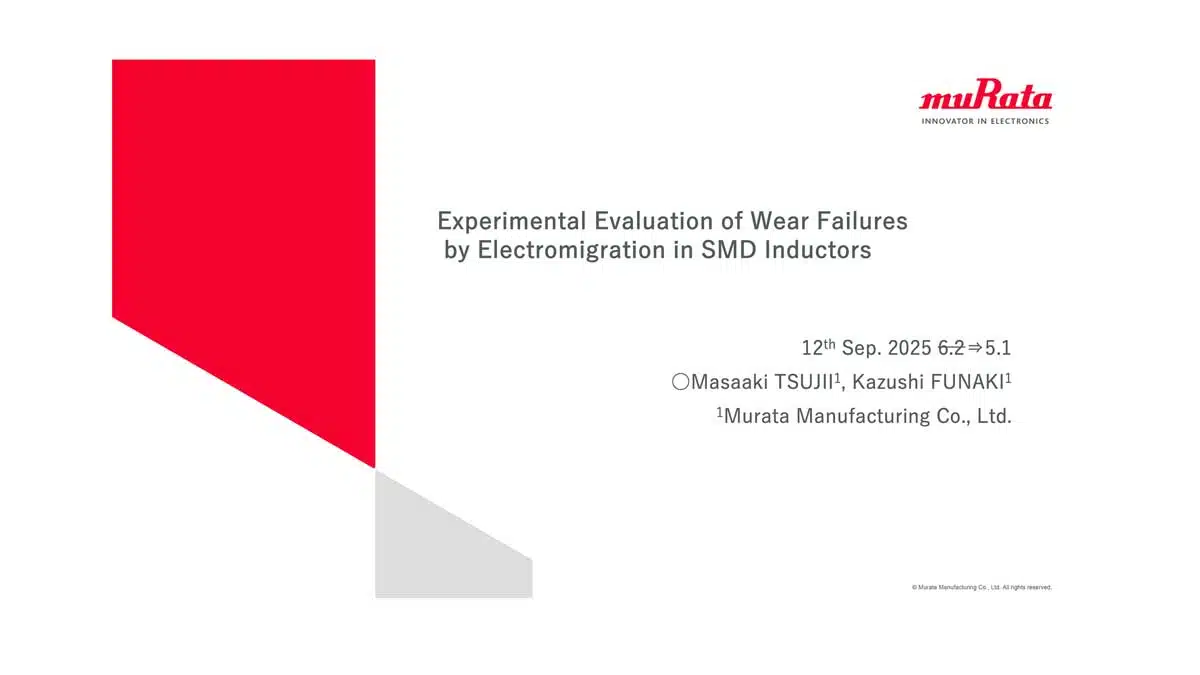
The paper “Experimental Evaluation of Wear Failures in SMD Inductors” was presented by Masaaki Tsujii, Murata Manufacturing Co., Ltd., Kyoto, Japan at the 5th PCNS Passive Components Networking Symposium 9-12th September 2025, Seville, Spain as paper No. 6.2.

Introduction

The rapid electrification of the automotive industry and the rise of autonomous driving technologies have significantly increased the operational demands placed on automotive electronic components.

RelatedPosts

Murata Expands Thermistor Production Capacity at Yokaichi Plant

Murata Introduces Crystal and NTC Set for Automotive UWB Timing

Murata New MLCC Bulk Case Packaging Cuts Packaging Material by 99%

With vehicle lifetimes extending to 10–20 years, ensuring long-term component reliability has become critical. A key approach to this challenge is Mission Profile validation, which defines the environmental and operational conditions components will face throughout their service life.

Surface-mounted device SMD inductors, such as multilayer ferrite beads, are widely used in automotive systems but have been less studied in terms of wear failure mechanisms under realistic Mission Profile conditions. This study investigates the high-temperature, high-current wear failure behavior of multilayer ferrite SMD inductors.

Key Points

  • Mission Profile assessments simulate environmental and operational stresses to predict long-term component reliability.
  • Multilayer ferrite beads with screen-printed Ag internal coils and Ni/Sn external electrodes were tested under high-stress conditions.
  • Experiments involved 10 A DC current at 150 °C, far exceeding the normal rated current.
  • Failures were associated with electromigration, intermetallic compound (IMC) formation, and void generation.
  • DC resistance increased after 200 hours due to IMC growth and voiding, leading toward potential thermal runaway and open failure.

Extended Summary

The study began by acknowledging the growing importance of Mission Profile-based validation in the automotive sector, emphasizing the lack of detailed data on SMD inductor wear failures. To explore these mechanisms, Murata fabricated prototype multilayer ferrite beads featuring two straight internal Ag coil layers and Ni/Sn-plated external electrodes. These inductors were mounted on evaluation boards using Sn-3.0Cu-0.5Ag solder and stressed in a 150 °C chamber with 10 A applied current to accelerate failure mechanisms.

Initial cross-sectional imaging confirmed the baseline structure of the inductors, with uniform Ni plating and intact Ag paste layers. For approximately 200 hours, the DC resistance remained stable, after which it began to rise. SEM and EDX analysis after 600 hours revealed polarity-dependent material migration: on the anode side, Cu and Sn intermetallics formed along the Ni plating, while on the cathode side, Ni plating was partially depleted, and Cu/Ni intermetallics developed in the solder outside the fillet. Voids were observed along the cathode external electrode, coinciding with regions of Ni loss.

The observed behavior was linked to electromigration, whereby electron flow drives Cu and Ni diffusion according to current polarity. Ni migration from the cathode toward the substrate land and Sn diffusion into the Ag paste layer led to the formation of high-resistivity intermetallic compounds. This progression caused the increase in DC resistance over time, and the voids further contributed to resistive growth. If allowed to continue, this process could result in localized heating, thermal runaway, and complete open failure.

The study also highlighted the significant role of Sn crystallographic orientation in Ni diffusion rates, explaining the uneven distribution of IMCs. The combined effects of IMC growth and void formation under accelerated conditions provide critical insight into the failure mechanisms of SMD inductors during long-term service in automotive applications.

Conclusion

This experimental evaluation demonstrated that under high-temperature, high-current stress, multilayer ferrite SMD inductors exhibit wear failures driven by electromigration. Key mechanisms include polarity-dependent diffusion of Cu and Ni, Ni plating depletion, Sn infiltration into the Ag paste layer, and intermetallic compound formation accompanied by voiding. The resulting increase in DC resistance signals the onset of potential thermal runaway and eventual open failure. This research lays the groundwork for developing accurate acceleration models, identifying countermeasures, and designing more robust inductors for the next generation of automotive electronics.


6_2_Murata_Experimental Evaluation of Wear Failures in SMD InductorsDownload

Related

Source: PCNS

Recent Posts

Industrial Passive Components Markets and Technologies 2026

21.5.2026
10

Automotive Passive Components Technology Dossier

21.5.2026
14

Hirose Expands Compact High‑Voltage EV connectors

21.5.2026
7

Qi2 Wireless Charging: Inductors, Capacitors and EMC Filters

21.5.2026
15

Samsung Introduced Low ESL 3-Terminal Reverse-Geometry MLCCs for High-Performance ADAS

20.5.2026
28

Würth Elektronik Presents New Bidirectional Digital Isolators

20.5.2026
18

Using Stress–Strain Curves to Diagnose Tantalum Powders for Capacitors

20.5.2026
24

Coilcraft Introduces SMT Current Sense Transformers for High‑Performance Power Electronics

20.5.2026
22

Nichicon Extends Rechargeable Batteries Temperature to Rival Supercapacitors

19.5.2026
26

Upcoming Events

Jun 2
16:00 - 17:00 CEST

Calculation, Simulation and Measurement of 800V EMC Filters

Jun 16
16:00 - 17:00 CEST

EMC with EMC – EMC‑compliant design with electromechanical connectors

View Calendar

Popular Posts

  • Buck Converter Design and Calculation

    0 shares
    Share 0 Tweet 0
  • Boost Converter Design and Calculation

    0 shares
    Share 0 Tweet 0
  • Flyback Converter Design and Calculation

    0 shares
    Share 0 Tweet 0
  • LLC Resonant Converter Design and Calculation

    0 shares
    Share 0 Tweet 0
  • MLCC and Ceramic Capacitors

    0 shares
    Share 0 Tweet 0
  • Capacitor Charging and Discharging

    0 shares
    Share 0 Tweet 0
  • What Electronics Engineer Needs to Know About Passive Low Pass Filters

    0 shares
    Share 0 Tweet 0
  • Dual Active Bridge (DAB) Topology

    0 shares
    Share 0 Tweet 0
  • Ripple Current and its Effects on the Performance of Capacitors

    3 shares
    Share 3 Tweet 0
  • Samsung Electro-Mechanics Releases High-Capacitance MLCCs for AI Server Applications

    0 shares
    Share 0 Tweet 0

Newsletter Subscription


Passive Components Blog

© EPCI - Leading Passive Components Educational and Information Site

  • Home
  • Privacy Policy
  • EPCI Membership & Advertisement
  • About

No Result
View All Result
  • Home
  • Knowledge Blog
  • Dossiers
  • PCNS

© EPCI - Leading Passive Components Educational and Information Site

This website uses cookies. By continuing to use this website you are giving consent to cookies being used. Visit our Privacy and Cookie Policy.
Go to mobile version