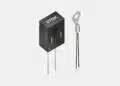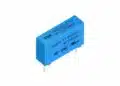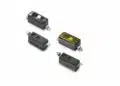





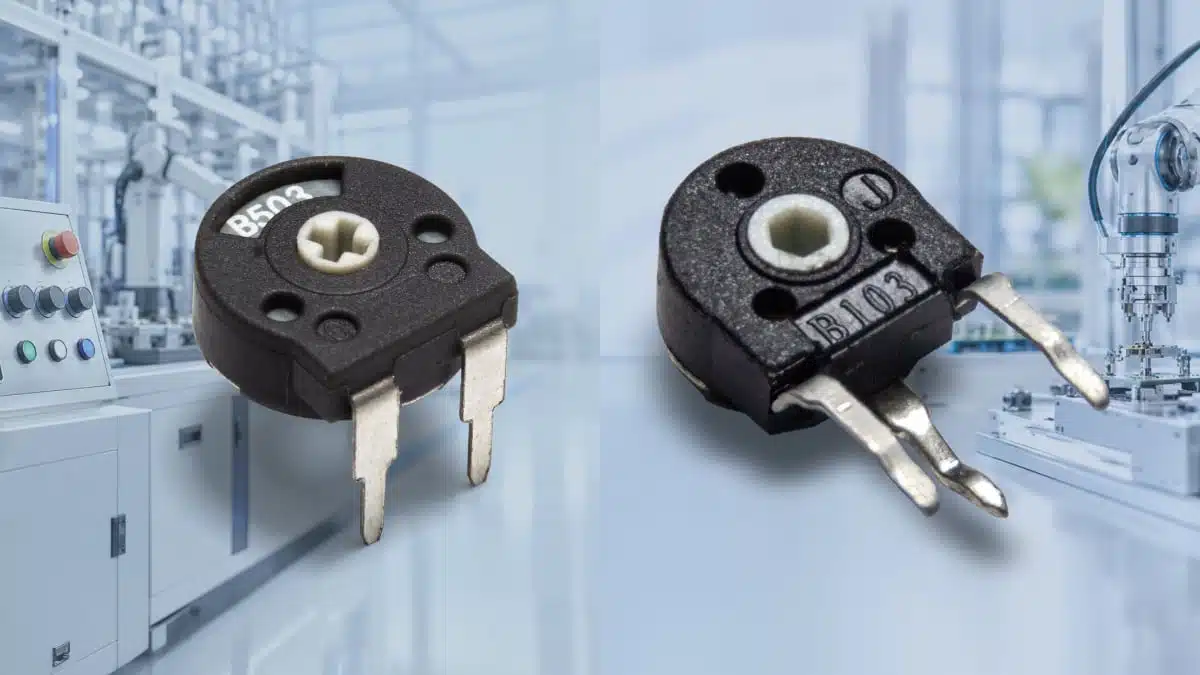
Bourns has expanded its position-feedback portfolio with the PST065 and PST10 Series incremental potentiometers.
The two families provide compact rotary analogue-position sensing options with hollow-shaft configurations and horizontal or vertical PCB mounting for industrial and commercial equipment.
Key features and benefits
- Two package sizes: The PST065 Series is specified as a 6 mm product for highly space-constrained assemblies, while the PST10 Series provides a 10 mm option within the same expansion of Bourns’ compact potentiometer offering.
- Hollow-shaft designs: Both series use a hollow shaft, which can simplify integration with the system’s mechanical control or rotary mechanism.
- Flexible PCB orientation: Bourns offers horizontal and vertical mounting configurations for both families, allowing the component orientation to be matched to enclosure, panel and board constraints.
- Linear analogue response: Both series use a linear B taper for applications requiring an analogue voltage that follows rotary position across the specified electrical travel.
- Resistance range: Both series are offered with standard resistance values from 1 kΩ to 5 MΩ.
- RoHS compliance: Bourns identifies both new potentiometer series as RoHS compliant.
- Position-feedback focus: The manufacturer positions the components for industrial controls, robotics, factory automation, motion-control equipment, human-machine interfaces and compact commercial equipment.
Product families
Bourns describes the PST065 Series as a 6 mm incremental potentiometer family with a stated 10,000-cycle rotational life rating and a 200° ±20° electrical travel specification. It uses a conventional contact-based potentiometer architecture, so the final circuit must account for wiper loading, contact resistance variation and the electrical stress applied at all shaft positions.
The PST10 Series is a 10 mm incremental potentiometer family using non-contact sensing technology. Bourns states that this construction eliminates mechanical wear associated with conventional contact potentiometers and is intended to support maintenance-free operation over its specified service life.
| Parameter | PST065 Series | PST10 Series |
|---|---|---|
| Nominal package size | 6 mm | 10 mm |
| Sensing approach | Contact potentiometer | Non-contact sensing technology |
| Shaft configuration | Hollow shaft | Hollow shaft |
| PCB mounting | Horizontal or vertical | Horizontal or vertical |
| Taper | Linear (B) | Linear (B) |
| Standard resistance range | 1 kΩ to 5 MΩ | 1 kΩ to 5 MΩ |
| Rated power | 0.1 W | 0.15 W |
| Rated voltage | 200 VAC / 100 VDC | 150 VAC / 100 VDC |
| Contact rating | 10 mA at 5 VDC | 10 mA at 5 VDC |
| Operating temperature | -10 °C to +70 °C | -10 °C to +70 °C |
| Rotational life | 10,000 cycles | 10,000 cycles |
| Additional published specification | Electrical travel: 200° ±20° | Dielectric strength: 50 VAC for 1 minute |
Technical selection points
A potentiometer is normally used as a three-terminal voltage divider. In a position-feedback circuit, the wiper voltage follows shaft position only when the input connected to the wiper has sufficiently high impedance and the component operates within its electrical and mechanical limits.
The PST065 and PST10 resistance options alone do not establish their suitability for a circuit. Designers must check the applied supply voltage, load resistance, wiper current, actual power dissipation and the potential stress at end-of-travel positions.
The PST065’s 200° ±20° electrical travel is a direct system-level consideration. A circuit or mechanism that requires a wider angle, a tightly controlled electrical angle, or position feedback over a full rotation must be checked against the current mechanical and electrical documentation.
Bourns’ published 10,000-cycle rotational-life rating should be compared with the expected adjustment or actuation duty of the finished equipment. For the PST10, non-contact sensing may reduce concerns associated with contact wear, but it does not eliminate the need to validate shaft coupling, board mounting, environmental exposure and system-level signal integrity.
Application fit
| Application | Practical role | Validation priority |
|---|---|---|
| Industrial controls | Setpoint adjustment or rotary feedback | Wiper loading, actuation life and mechanical access |
| Robotics | Rotary position information | Shaft coupling, vibration and control-loop response |
| Factory automation | Operator input and adjustment | PCB orientation, enclosure clearance and expected use cycles |
| Motion control | Position setting or analogue feedback | Electrical travel, fault response and signal conditioning |
| HMI equipment | Rotary user control | Contact-noise sensitivity and user-interface mechanics |
| Commercial equipment | Compact rotary control element | Temperature range, duty cycle and supply-voltage limits |
The PST10 press release also lists energy and storage systems, industrial power supplies, inverters and motor drives, capacitor recharge and discharge circuits, voltage regulators, telecommunications equipment, and powertrain, braking and power-conversion systems among target applications. These are system categories rather than confirmation that either potentiometer is qualified for every environmental, safety or regulatory requirement within them.
Design-in notes for engineers
- Select by complete datasheet parameters, not body size alone. Confirm the exact ordering code, resistance value, tolerance, shaft option, mounting style, outline drawing and recommended PCB footprint in the current manufacturer documentation.
- Check voltage and dissipation together. The rated voltage and power ratings are not independent allowances; actual resistor-track dissipation depends on circuit topology, resistance value, wiper position, applied voltage and ambient temperature.
- Control wiper loading. A low-resistance load connected to the wiper changes the divider transfer function. A high-input-impedance buffer may be needed where position accuracy is important.
- Evaluate signal quality. The contact-based PST065 should be validated for transient wiper noise and resistance variation in the final analogue signal chain. Filtering, software averaging or input hysteresis may be required, depending on control-loop sensitivity.
- Validate electrical travel and mechanical stops. The PST065 electrical travel is specified as 200° ±20°. Ensure that shaft travel, panel interface and mechanical end stops do not demand an unsupported operating range.
- Assess life in the actual duty cycle. The stated 10,000-cycle rotational-life rating must be compared with anticipated field use, including repeated adjustment, vibration, shock and side loads imposed by the mechanical assembly.
- Do not infer unlisted qualification. The announcements do not specify humidity performance, ingress protection, vibration, shock, flammability, automotive qualification, functional-safety status or sealing. Confirm requirements in the current datasheet and with Bourns before release.
- Review fault behaviour. A wiper discontinuity, out-of-range voltage or mechanical disconnection can create an invalid position signal. Add suitable pull networks, plausibility checks, filtering and a defined safe-state response where the application requires it.
- Perform system-level validation. Component ratings do not replace qualification of the assembled PCB, control mechanism, enclosure, wiring and end application under final electrical, thermal and environmental conditions.
Further reading
- Potentiometers, Encoder, Rheostats and Trimmers
- Potentiometers Explained
- What Is a Resistor?
- Bourns Expanded Blend-Balance Guitar Potentiometers Resistance Range
Source
This article is based on Bourns manufacturer press releases covering the PST065 and PST10 incremental potentiometer series. Engineers should consult the current Bourns datasheets, mechanical drawings and ordering information for final component selection, qualification, PCB layout and production release.