


Passive Components Blog
No Result
View All Result
  • Home
  • News
    • All
    • Aerospace & Defence
    • Antenna
    • Applications
    • Automotive
    • Capacitors
    • Circuit Protection Devices
    • electro-mechanical news
    • Filters
    • Fuses
    • Inductors
    • Industrial
    • Integrated Passives
    • inter-connect news
    • Market & Supply Chain
    • Market Insights
    • Medical
    • Modelling and Simulation
    • New Materials & Supply
    • New Technologies
    • Non-linear Passives
    • Oscillators
    • Passive Sensors News
    • Resistors
    • RF & Microwave
    • Telecommunication
    • Weekly Digest
    Bourns PST065 and PST10 Series compact incremental potentiometers with hollow shafts for rotary position feedback

    Bourns Expands Compact Incremental Potentiometer Offering

    Wk 35 Electronics Supply Chain Digest

    Samsung MLCC Revenue Seen Above KRW 8T by 2027, Murata EOL Actions Reshape Supply

    ROHM SDR01 high anti-surge thick-film chip resistor in 1005 metric 0402 package with 0.33 W rated power

    ROHM Introduces Anti-Surge 0402 Resistors Rated at 0.33 W

    ECIA Industry Pulse Q3 2026 chart showing passive components, semiconductors and electro-mechanical component market sentiment and lead-time pressure

    ECIA Industry Pulse Moderates as Passive Lead Times Tighten

    LG Innotek Demonstrates FC-BGA Substrates With Embedded Silicon Capacitors for AI Power Delivery

    On-Chip 3D-Printed Copper Microinductors: A New Route to Compact RF Electronics

    Emerging Capacitor Markets in Fusion Energy

    Murata DLW32SH_MF 1210 surface-mount common mode choke coil with metal terminals for automotive CAN FD signal-line noise suppression

    Murata Introduces Common Mode Chokes for Automotive CAN FD up to 150°C

    Trending Tags

    • Ripple Current
    • RF
    • Leakage Current
    • Tantalum vs Ceramic
    • Snubber
    • Low ESR
    • Feedthrough
    • Derating
    • Dielectric Constant
    • New Products
    • Market Reports
  • Knowledge Blog
  • Dossiers
    • AI Hardware Dossier
    • Automotive Dossier
    • Industrial Robotics Dossier
    • Power Converter Dossier
    • Capacitor Dossier
    • Resistor Dossier
    • Inductor Dossier
    • Circuit Protection Dossier
  • Suppliers
    • Who is Who
  • PCNS
    • PCNS 2025
    • PCNS 2023
    • PCNS 2021
    • PCNS 2019
    • PCNS 2017
  • Events
  • Home
  • News
    • All
    • Aerospace & Defence
    • Antenna
    • Applications
    • Automotive
    • Capacitors
    • Circuit Protection Devices
    • electro-mechanical news
    • Filters
    • Fuses
    • Inductors
    • Industrial
    • Integrated Passives
    • inter-connect news
    • Market & Supply Chain
    • Market Insights
    • Medical
    • Modelling and Simulation
    • New Materials & Supply
    • New Technologies
    • Non-linear Passives
    • Oscillators
    • Passive Sensors News
    • Resistors
    • RF & Microwave
    • Telecommunication
    • Weekly Digest
    Bourns PST065 and PST10 Series compact incremental potentiometers with hollow shafts for rotary position feedback

    Bourns Expands Compact Incremental Potentiometer Offering

    Wk 35 Electronics Supply Chain Digest

    Samsung MLCC Revenue Seen Above KRW 8T by 2027, Murata EOL Actions Reshape Supply

    ROHM SDR01 high anti-surge thick-film chip resistor in 1005 metric 0402 package with 0.33 W rated power

    ROHM Introduces Anti-Surge 0402 Resistors Rated at 0.33 W

    ECIA Industry Pulse Q3 2026 chart showing passive components, semiconductors and electro-mechanical component market sentiment and lead-time pressure

    ECIA Industry Pulse Moderates as Passive Lead Times Tighten

    LG Innotek Demonstrates FC-BGA Substrates With Embedded Silicon Capacitors for AI Power Delivery

    On-Chip 3D-Printed Copper Microinductors: A New Route to Compact RF Electronics

    Emerging Capacitor Markets in Fusion Energy

    Murata DLW32SH_MF 1210 surface-mount common mode choke coil with metal terminals for automotive CAN FD signal-line noise suppression

    Murata Introduces Common Mode Chokes for Automotive CAN FD up to 150°C

    Trending Tags

    • Ripple Current
    • RF
    • Leakage Current
    • Tantalum vs Ceramic
    • Snubber
    • Low ESR
    • Feedthrough
    • Derating
    • Dielectric Constant
    • New Products
    • Market Reports
  • Knowledge Blog
  • Dossiers
    • AI Hardware Dossier
    • Automotive Dossier
    • Industrial Robotics Dossier
    • Power Converter Dossier
    • Capacitor Dossier
    • Resistor Dossier
    • Inductor Dossier
    • Circuit Protection Dossier
  • Suppliers
    • Who is Who
  • PCNS
    • PCNS 2025
    • PCNS 2023
    • PCNS 2021
    • PCNS 2019
    • PCNS 2017
  • Events
No Result
View All Result
Passive Components Blog
No Result
View All Result

Hybrid Electrochemical Electrolytic Capacitor Provides High Frequency and High Capacitance Performance

25.4.2025
Reading Time: 4 mins read
A A

This article published in Nature Communications Journal discusses advancements in high-frequency capacitors development by combining EDLC supercapacitors with electrolytic capacitors, addressing the limitations imposed by slow ion dynamics in traditional electrochemical supercapacitors.

Researchers developed a Hybrid Electrochemical Electrolytic Capacitor (HEEC) that combines electrochemical and dielectric effects to achieve both high capacitance and broad frequency range performance.

RelatedPosts

Bourns Expands Compact Incremental Potentiometer Offering

Wk 35 Electronics Supply Chain Digest

Samsung MLCC Revenue Seen Above KRW 8T by 2027, Murata EOL Actions Reshape Supply

The design features a thin dielectric layer and perfect conducting electrodes with mesopores, enabling high characteristic frequency and stable volume capacitance density.

Key points:

  • Challenge: Traditional electrochemical supercapacitors suffer from poor frequency response due to the electrical double layer effect, limiting their characteristic frequency.
  • Innovation: The HEEC design integrates monolayer graphene as a working electrode and introduces a hybrid approach to enhance both capacitance and frequency response.
  • Results: The device achieved a characteristic frequency of 44 kHz with a volume capacitance density of 800 µF/cm³, outperforming conventional electrolytic capacitors in miniaturized electronic systems.
  • Applications: The HEEC was successfully integrated into microsystem power management, demonstrating significant size reduction while maintaining performance comparable to commercial capacitors.

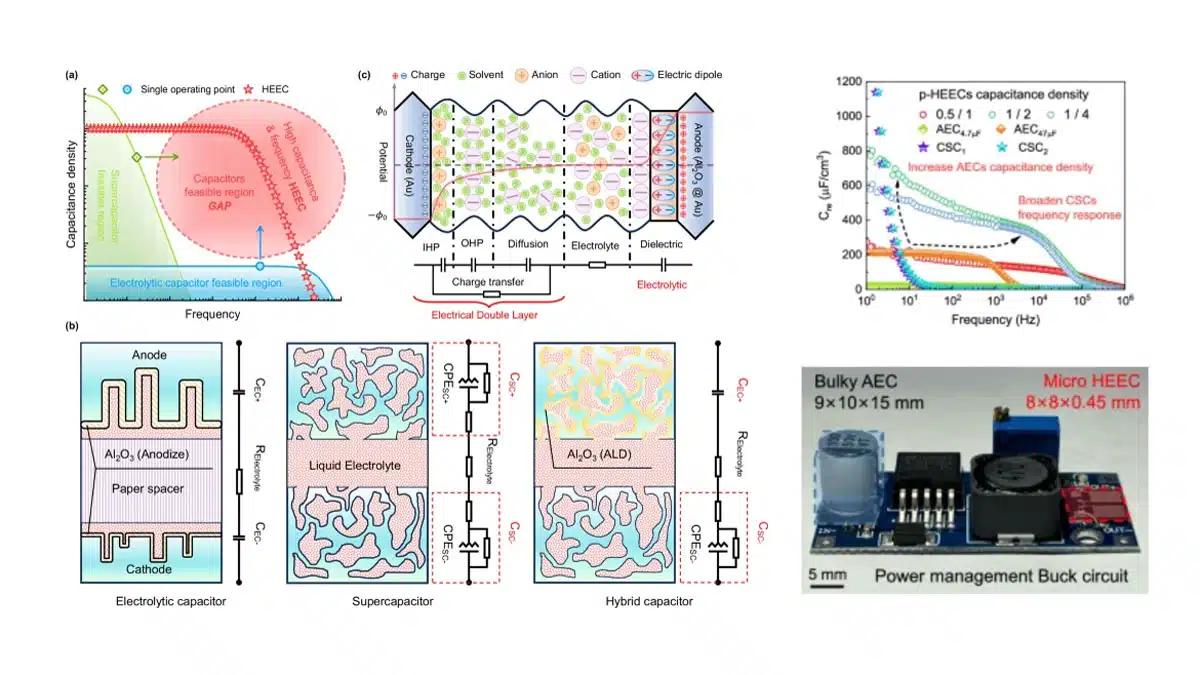
The HEEC design combines the advantages of both electrochemical and dielectric effects, providing high capacitance density at low frequencies and extending the frequency range to surpass 10 kHz. A planar micro HEEC with a characteristic frequency of 44 kHz and a stable volume capacitance density of 800 μF/cm3 was fabricated using a selective atomic layer deposition technique.

Hybrid Electrochemical Electrolytic Capacitors (HEECs) combine the high-frequency performance of electrolytic capacitors with the high capacitance of supercapacitors. The design features interdigital electrodes with different widths to balance capacitance density and a parallel circuit layout to enhance frequency response. The HEECs are fabricated using standard semiconductor processes, including lithography, PVD, ALD, and metal lift-off, and demonstrate improved performance compared to traditional hybrid capacitors.

A hybrid electrochemical energy capacitor (HEEC) is fabricated using a CMOS-compatible process, enabling wafer-level production and circuit integration. The HEEC exhibits a porous Au cathode and an Al2O3 dielectric layer on the anode, resulting in a high characteristic frequency exceeding 1 MHz and a capacitance density of 600 μF/cm3 at low frequencies. This performance surpasses commercial electrolytic, ceramic, tantalum, and film capacitors, making it suitable for high-frequency applications.

Parallel-connected HEECs (p-HEECs) are designed to improve high-frequency performance by doubling capacitance density and reducing ESR. Simulation and experimental results show a near-ideal fit, with p-HEECs exhibiting a higher characteristic frequency and lower dissipation factor compared to s-HEECs and commercial capacitors. p-HEECs demonstrate superior high-frequency capacitive behavior, outperforming commercial supercapacitors and bridging the gap between supercapacitors and aluminum capacitors (AEC) in terms of frequency response and capacitance density.

A Hybrid Electrochemical Electrolytic Capacitor (HEEC) design is presented, combining electrolytic and electrochemical capacitors to achieve a 44 kHz characteristic frequency and 800 μF/cm3 volume capacitance density. The HEEC is integrated into a compact power module and a buck circuit, demonstrating its practical utility in power management applications. The HEEC’s potential to revolutionize high-frequency power management for portable electronics is evident.

HEECs are fabricated using wafer-level CMOS-compatible processes, ensuring mass production and chip integration. The fabrication involves depositing electrodes, etching, and applying a gel electrolyte. The capacitance density and dissipation factor of HEECs are calculated based on impedance spectroscopy data, and equivalent circuit simulations are performed using ZView software.

AECs and Conventional SCs are directly purchased from different manufacturers. AECs are tested with the same equipment as HEECs under the same circumstances. The data availability and references are provided.

High-frequency supercapacitors surpassing the dynamic limit of electrical double layer effects are demonstrated. The supercapacitors, based on a hybrid structure of carbon nano-onion and graphene, exhibit ultrahigh-rate performance and are suitable for compact alternating current filtering. The research highlights the potential of these supercapacitors for advanced energy storage applications.

Discussion

This research initiates a great span bridge between commercial electrolytic and electrochemical capacitors, which meets requirements for micro capacitors operating at over kilohertz frequencies, filling the blank of this frequency region in the Ragone Plot. The Hybrid Electrochemical Electrolytic Capacitor (HEEC) design successfully overcomes the frequency limitations of micro capacitors, achieving an impressive 44 kHz characteristic frequency with 800 μF/cm3

volume capacitance density by hybrid incorporation of electrolytic and electrochemical capacitors at the circuit level. By integrating the HEEC into a compact power module and replacing the commercial AEC in the buck circuit, we demonstrate its practical utility in power management applications. The HEEC’s potential to revolutionize high-frequency power management for portable and integratable electronics is evident, offering a promising pathway for more efficient and compact microelectronic devices.

This breakthrough in capacitor design holds potential for future miniaturized electronics, enabling more efficient power solutions for wearable and portable devices.

Read the full original paper:

Li, Z., Xu, M., Xia, Y. et al. High-frequency supercapacitors surpassing dynamic limit of electrical double layer effects. Nat Commun 16, 3704 (2025). https://doi.org/10.1038/s41467-025-59015-7

Related

Source: Nature Communications Journal

Recent Posts

Samsung MLCC Revenue Seen Above KRW 8T by 2027, Murata EOL Actions Reshape Supply

11.9.2026
20

LG Innotek Demonstrates FC-BGA Substrates With Embedded Silicon Capacitors for AI Power Delivery

10.9.2026
31

On-Chip 3D-Printed Copper Microinductors: A New Route to Compact RF Electronics

10.9.2026
20

Emerging Capacitor Markets in Fusion Energy

10.9.2026
38
onsemi solid-state transformer concept for 800 V HVDC AI data center power conversion with SiC modules, DC-link capacitors and high-frequency magnetics

Solid-State Transformers for 800 V AI Data Centers: Passive Component Design Considerations

9.9.2026
75
TDK CN series 10 µF 100 V X7R soft-termination multilayer ceramic capacitor in 3225 EIA 1210 package

TDK Releases 100 V Soft-Termination X7R MLCCs 10 uF in 3225 Package

9.9.2026
15
Overview of fabricated ferroelectric capacitors improving hyperdimensional computing task learning accuracy. a The experimental work reported in this study comprises ferroelectric capacitor (FeCAP) device fabrication, structural and electrical characterization, analog state identification and their reliability study. b The computational part of the work explores the benefits of using characteristics from the fabricated devices in a hyperdimensional computing scheme; source: authors

High-Precision Hyperdimensional Computing with Multi-Level Ferroelectric HZO Capacitors

7.9.2026
23

August 2026 Interconnect, Passives and Electromechanical Components Market Insights

4.9.2026
54

Knowles Cornell Dubilier 105C Flatpack Aluminum Electrolytic Capacitors Target Low-Profile High-Density Power Designs

4.9.2026
43

Upcoming Events

Sep 16
17:00 - 18:00 CEST

Designing a 5 kW, 800 V-to-50 V PSFB Converter for Next-Generation Data Centers

Sep 29
16:00 - 17:00 CEST

Cybersecurity 2026

Nov 24
16:00 - 17:00 CET

Component selection with the WE REDEXPERT® DC-DC Converter Designer Tool

View Calendar

Popular Posts

  • Buck Converter Design and Calculation

    0 shares
    Share 0 Tweet 0
  • LLC Resonant Converter Design and Calculation

    0 shares
    Share 0 Tweet 0
  • Boost Converter Design and Calculation

    0 shares
    Share 0 Tweet 0
  • Flyback Converter Design and Calculation

    0 shares
    Share 0 Tweet 0
  • Earthing Systems and IEC Classification Explained

    0 shares
    Share 0 Tweet 0
  • MLCC and Ceramic Capacitors

    0 shares
    Share 0 Tweet 0
  • Resistor Symbols

    0 shares
    Share 0 Tweet 0
  • Capacitor Charging and Discharging

    0 shares
    Share 0 Tweet 0
  • Audio Capacitors: Choosing Capacitors for Crossover Circuits

    0 shares
    Share 0 Tweet 0
  • Thermistors Basics, NTC and PTC Thermistors

    0 shares
    Share 0 Tweet 0

Newsletter Subscription


Passive Components Blog

© 2015–2026
All rights reserved

  • Home
  • Privacy Policy
  • EPCI Membership & Advertisement
  • About

No Result
View All Result
  • Home
  • Knowledge Blog
  • Dossiers
  • PCNS

© 2015–2026
All rights reserved