





Passive Components Blog
No Result
View All Result
  • Home
  • NewsFilter
    • All
    • Aerospace & Defence
    • Antenna
    • Applications
    • Automotive
    • Capacitors
    • Circuit Protection Devices
    • electro-mechanical news
    • Filters
    • Fuses
    • Inductors
    • Industrial
    • Integrated Passives
    • inter-connect news
    • Market & Supply Chain
    • Market Insights
    • Medical
    • Modelling and Simulation
    • New Materials & Supply
    • New Technologies
    • Non-linear Passives
    • Oscillators
    • Passive Sensors News
    • Resistors
    • RF & Microwave
    • Telecommunication
    • Weekly Digest

    Wk 28 Electronics Supply Chain Digest

    Bourns Introduces Automotive BMS Signal Transformer with Integrated Common Mode Chokes

    Itelcond Introduces High‑Voltage Aluminium Capacitors for Modern IGBT DC‑links

    Bourns Introduces Automotive Shielded Power Inductors for Compact DC‑DC Converters

    EMC Design Fundamentals: Safe Use of Varistors and Common Mode Chokes in Mains and Data-Line Filters

    Murata Unveils Lead Disc Ceramic Capacitors for Automotive Safety and EMI Suppression

    SCHURTER Releases Intelligent Three‑Terminal Fuses for Safer Li‑ion Battery Systems

    Can Copper Conductive Inks Displace Silver in Hybrid Electronics?

    Square-Wave Harmonics and RMS Currents in Power Converters

    Trending Tags

    • Ripple Current
    • RF
    • Leakage Current
    • Tantalum vs Ceramic
    • Snubber
    • Low ESR
    • Feedthrough
    • Derating
    • Dielectric Constant
    • New Products
    • Market Reports
  • VideoFilter
    • All
    • Antenna videos
    • Capacitor videos
    • Circuit Protection Video
    • Filter videos
    • Fuse videos
    • Inductor videos
    • Inter-Connect Video
    • Non-linear passives videos
    • Oscillator videos
    • Passive sensors videos
    • Resistor videos

    EMC Design Fundamentals: Safe Use of Varistors and Common Mode Chokes in Mains and Data-Line Filters

    Ferrite versus Nanocrystalline Power Inductor Cores: Turns, Gap and Size

    KYOCERA AVX Presents Antenna Integrator Studio Tutorial for Antenna Placement and RF Design

    Power Design Simulation Tools for Faster Inductor Selection and Loss Optimization

    EMC‑Compliant PCB and Connector Design Guidelines

    Why Isolated DC/DC Power Supplies Fail Late, Würth Elektronik Podcast

    Designing 800 V DC EMC Filters: Calculation, Simulation and Measurement

    Current Sense Transformer Datasheet and Design‑in Guide

    Designing a USB Type‑C Flyback Planar Transformer with Frenetic’s Planar Tool

    Trending Tags

    • Capacitors explained
    • Inductors explained
    • Resistors explained
    • Filters explained
    • Application Video Guidelines
    • EMC
    • New Products
    • Ripple Current
    • Simulation
    • Tantalum vs Ceramic
  • Knowledge Blog
  • Dossiers
    • AI Hardware Dossier
    • Power Converter Dossier
    • Automotive Dossier
    • Capacitor Dossier
    • Resistor Dossier
    • Inductor Dossier
    • Circuit Protection Dossier
  • Suppliers
    • Who is Who
  • PCNS
    • PCNS 2025
    • PCNS 2023
    • PCNS 2021
    • PCNS 2019
    • PCNS 2017
  • Events
  • Home
  • NewsFilter
    • All
    • Aerospace & Defence
    • Antenna
    • Applications
    • Automotive
    • Capacitors
    • Circuit Protection Devices
    • electro-mechanical news
    • Filters
    • Fuses
    • Inductors
    • Industrial
    • Integrated Passives
    • inter-connect news
    • Market & Supply Chain
    • Market Insights
    • Medical
    • Modelling and Simulation
    • New Materials & Supply
    • New Technologies
    • Non-linear Passives
    • Oscillators
    • Passive Sensors News
    • Resistors
    • RF & Microwave
    • Telecommunication
    • Weekly Digest

    Wk 28 Electronics Supply Chain Digest

    Bourns Introduces Automotive BMS Signal Transformer with Integrated Common Mode Chokes

    Itelcond Introduces High‑Voltage Aluminium Capacitors for Modern IGBT DC‑links

    Bourns Introduces Automotive Shielded Power Inductors for Compact DC‑DC Converters

    EMC Design Fundamentals: Safe Use of Varistors and Common Mode Chokes in Mains and Data-Line Filters

    Murata Unveils Lead Disc Ceramic Capacitors for Automotive Safety and EMI Suppression

    SCHURTER Releases Intelligent Three‑Terminal Fuses for Safer Li‑ion Battery Systems

    Can Copper Conductive Inks Displace Silver in Hybrid Electronics?

    Square-Wave Harmonics and RMS Currents in Power Converters

    Trending Tags

    • Ripple Current
    • RF
    • Leakage Current
    • Tantalum vs Ceramic
    • Snubber
    • Low ESR
    • Feedthrough
    • Derating
    • Dielectric Constant
    • New Products
    • Market Reports
  • VideoFilter
    • All
    • Antenna videos
    • Capacitor videos
    • Circuit Protection Video
    • Filter videos
    • Fuse videos
    • Inductor videos
    • Inter-Connect Video
    • Non-linear passives videos
    • Oscillator videos
    • Passive sensors videos
    • Resistor videos

    EMC Design Fundamentals: Safe Use of Varistors and Common Mode Chokes in Mains and Data-Line Filters

    Ferrite versus Nanocrystalline Power Inductor Cores: Turns, Gap and Size

    KYOCERA AVX Presents Antenna Integrator Studio Tutorial for Antenna Placement and RF Design

    Power Design Simulation Tools for Faster Inductor Selection and Loss Optimization

    EMC‑Compliant PCB and Connector Design Guidelines

    Why Isolated DC/DC Power Supplies Fail Late, Würth Elektronik Podcast

    Designing 800 V DC EMC Filters: Calculation, Simulation and Measurement

    Current Sense Transformer Datasheet and Design‑in Guide

    Designing a USB Type‑C Flyback Planar Transformer with Frenetic’s Planar Tool

    Trending Tags

    • Capacitors explained
    • Inductors explained
    • Resistors explained
    • Filters explained
    • Application Video Guidelines
    • EMC
    • New Products
    • Ripple Current
    • Simulation
    • Tantalum vs Ceramic
  • Knowledge Blog
  • Dossiers
    • AI Hardware Dossier
    • Power Converter Dossier
    • Automotive Dossier
    • Capacitor Dossier
    • Resistor Dossier
    • Inductor Dossier
    • Circuit Protection Dossier
  • Suppliers
    • Who is Who
  • PCNS
    • PCNS 2025
    • PCNS 2023
    • PCNS 2021
    • PCNS 2019
    • PCNS 2017
  • Events
No Result
View All Result
Passive Components Blog
No Result
View All Result

KYOCERA AVX Extends Small, High-Power, Thin-Film Band-Pass Filters

29.1.2025
Reading Time: 3 mins read
A A

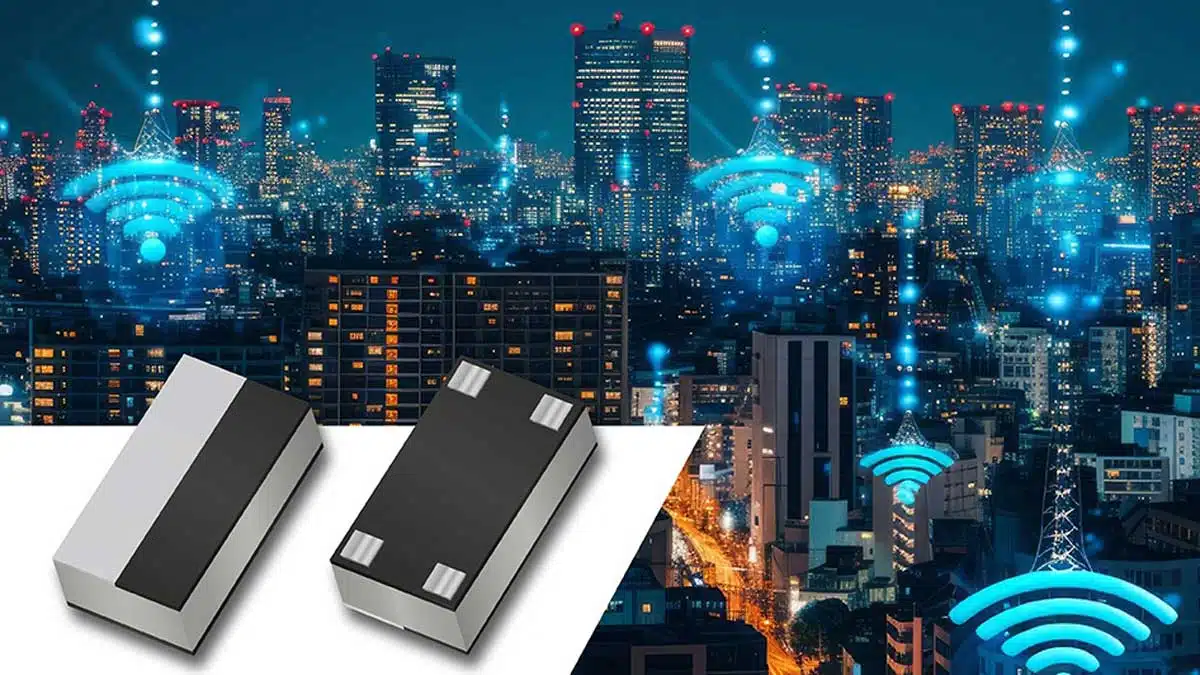
KYOCERA AVX, a global leader in advanced electronic components, has introduced two new series of compact and thin-film band-pass filters. These filters are engineered to deliver exceptional RF performance in high-power applications with crowded PCBs.

Designed to meet cross-market demands for small, high-power band-pass filters, the BP1206 and BP2816 Series utilize KYOCERA AVX’s proven multilayer integrated thin-film (ITF) technology. This technology ensures highly repeatable and reliable RF performance with low insertion loss, steep attenuation, sharp roll-off, low noise, and high temperature stability.

RelatedPosts

KYOCERA AVX Presents Antenna Integrator Studio Tutorial for Antenna Placement and RF Design

KYOCERA AVX Releases NTN Antenna Selection Guide Brochure

KYOCERA 10 µF 0201 MLCC Brings High‑Capacitance into Mobile Designs

Both series offer quick and easy adjustment of RF parameters and feature ruggedly constructed compact, low-profile cases. These cases are equipped with lead-free, solder-coated-nickel land grid array (LGA) terminations and are compatible with automated assembly processes, including reflow, wave, and vapor phase soldering.

The new BP1206 and BP2816 Series Thin-Film Band-Pass Filters have 8W continuous power handling and a characteristic impedance of 50Ω. They are rated for operating temperatures ranging from -40°C to +85°C and support various frequency bands from 240–6,100MHz. These filters cater to the diverse needs of high-frequency wireless systems across industries such as telecommunications, military, aerospace, medical, and consumer electronics.

Ideal applications for the two series include mobile communications devices like military and handheld radios, automatic vehicle locating (AVL), emergency services, and radar systems, as well as wireless LANs and test equipment. 

BP1206 Series Thin-Film Band-Pass Filters, housed in a miniature 1206 case measuring 3.10±0.10mm x 1.60±0.10mm x 0.60±0.30mm (L x W x H), offer exceptional performance in the 1,250–6,100MHz frequency range. They provide remarkable in-band performance and robust out-of-band rejection values spanning -25 to -40dB. These filters are ideal for applications such as 5G and 6G LTE networks, base stations, antenna matching, and satellite communications.

BP2816 Series Thin-Film Band-Pass Filters, in a compact 2816 case measuring 7.2±0.3mm x 4.2±0.2mm x a maximum of 1.2mm (L x W x H), extend the frequency range to 240–1,260MHz. They also exhibit excellent in-band performance and out-of-band rejection values ranging from -20 to -45dB. These filters are particularly suited for MRI machines.

Amir Kopelman, Technical Services Manager at KYOCERA AVX, expressed their excitement about the launch of these new high-power band-pass filters. “These filters leverage our proven integrated thin-film technology and advanced filter processing methods to deliver highly repeatable and reliable RF performance,” said Kopelman. “They are engineered to meet the demanding requirements of high-frequency wireless applications across various industries, including telecommunications, military, aerospace, medical, and consumer electronics. Moreover, they are housed in ruggedized cases that are smaller and lower profile compared to competing technologies, providing critical design flexibility in crowded PCBs.”

The new BP1206 and BP2816 Series Thin-Film Band-Pass Filters are meticulously manufactured in ISO-9001 facilities. Each filter undergoes rigorous testing to ensure compliance with electrical parameters, visual, and mechanical characteristics. Notably, they exhibit exceptional lot-to-lot and part-to-part repeatability. To validate their performance, each production lot is evaluated on a sample basis under specific conditions, including static humidity (85°C and 85% relative humidity for 160 hours) and endurance (125°C for four hours). Additionally, both filters adhere to RoHS regulations and are certified to IATF 16949. They are conveniently shipped in tape and reel packaging.


Source: KYOCERA AVX

Recent Posts

Murata Unveils Lead Disc Ceramic Capacitors for Automotive Safety and EMI Suppression

15.7.2026
59

In the Age of AI, Every Watt Counts: Implications for Components

13.7.2026
97

RF Filters and Passive Components Enabling the 7 Missile RF Subsystems

9.7.2026
63

Vishay Unveils Multi-Turn Position Sensor for Harsh Industrial Environments

7.7.2026
37

High-Q RF & Microwave MLCCs: A Cross-Vendor Benchmark

2.7.2026
111

YAGEO Announces July 2026 Capacitor Price Increase

1.7.2026
955

binder Prints Electronics on 3D Components Connector Surface

1.7.2026
23

100 V Hybrid Polymer Capacitor from VINA Enesol Targets 48–72 V Power Platforms

26.6.2026
265

KYOCERA AVX Releases NTN Antenna Selection Guide Brochure

25.6.2026
56

Upcoming Events

Jul 28
8:00 - 11:00 CEST

Post Procurement Testing of EEE Components for LEO Space Applications

Jul 29
17:30 - 18:30 CEST

To Ferrite or to Nanocrystalline in Transformer Design

Sep 29
16:00 - 17:00 CEST

Cybersecurity 2026

View Calendar

Popular Posts

  • Boost Converter Design and Calculation

    0 shares
    Share 0 Tweet 0
  • Buck Converter Design and Calculation

    0 shares
    Share 0 Tweet 0
  • YAGEO Announces July 2026 Capacitor Price Increase

    0 shares
    Share 0 Tweet 0
  • Flyback Converter Design and Calculation

    0 shares
    Share 0 Tweet 0
  • LLC Resonant Converter Design and Calculation

    0 shares
    Share 0 Tweet 0
  • MLCC and Ceramic Capacitors

    0 shares
    Share 0 Tweet 0
  • MLCCs in the Age of AI: Q2 2026 Market Tightness

    0 shares
    Share 0 Tweet 0
  • Earthing Systems and IEC Classification Explained

    0 shares
    Share 0 Tweet 0
  • Nvidia Vera Rubin: Why One AI Rack Needs So Many More MLCC Capacitors

    0 shares
    Share 0 Tweet 0
  • Dual Active Bridge (DAB) Topology

    0 shares
    Share 0 Tweet 0

Newsletter Subscription


Passive Components Blog

© EPCI - Leading Passive Components Educational and Information Site

  • Home
  • Privacy Policy
  • EPCI Membership & Advertisement
  • About

No Result
View All Result
  • Home
  • Knowledge Blog
  • Dossiers
  • PCNS

© EPCI - Leading Passive Components Educational and Information Site

This website uses cookies. By continuing to use this website you are giving consent to cookies being used. Visit our Privacy and Cookie Policy.