







Passive Components Blog
No Result
View All Result
  • Home
  • News
    • All
    • Aerospace & Defence
    • Antenna
    • Applications
    • Automotive
    • Capacitors
    • Circuit Protection Devices
    • electro-mechanical news
    • Filters
    • Fuses
    • Inductors
    • Industrial
    • Integrated Passives
    • inter-connect news
    • Market & Supply Chain
    • Market Insights
    • Medical
    • Modelling and Simulation
    • New Materials & Supply
    • New Technologies
    • Non-linear Passives
    • Optoelectronics and Isolation
    • Oscillators
    • Passive Sensors News
    • Resistors
    • RF & Microwave
    • Telecommunication
    • Weekly Digest
    Samtec 100-CM 1.0 mm vertical solderless compression-mount 50 ohm RF PCB connector

    Samtec 100-CM 1.0 mm RF Connectors Extend to 120 GHz

    Exxelia PM film capacitor and passive-component technologies for BepiColombo space electronics

    Exxelia Passive Components Support BepiColombo Mission

    TT Electronics OPI1268T green through-hole phototransistor optocoupler used for optical isolation in power systems.

    Optocoupler Reliability: Designing Optical Isolation for 25-Year Grid Assets

    TDK B43657 and B43658 ultra-compact snap-in aluminum electrolytic capacitors for 500 V DC power-supply and DC-link applications

    TDK Extends Compact Snap-In Capacitors to 500 V for AI Servers

    Stackpole RNAN aluminium nitride thin-film chip resistors in 0603, 0805, 1206 and 2512 package sizes for precision high-power electronics

    Stackpole RNAN AlN Thin-Film Resistors Reach 6 W

    binder angled M12-A midmount panel-mount PCB connector for centric board mounting, showing compact front-facing industrial connector geometry

    binder Adds Midmount M12-A PCB Connectors for Slim Sensors

    Bourns PST065 and PST10 Series compact incremental potentiometers with hollow shafts for rotary position feedback

    Bourns Expands Compact Incremental Potentiometer Offering

    Wk 35 Electronics Supply Chain Digest

    Samsung MLCC Revenue Seen Above KRW 8T by 2027, Murata EOL Actions Reshape Supply

    Trending Tags

    • Ripple Current
    • RF
    • Leakage Current
    • Tantalum vs Ceramic
    • Snubber
    • Low ESR
    • Feedthrough
    • Derating
    • Dielectric Constant
    • New Products
    • Market Reports
  • Knowledge Blog
  • Dossiers
    • AI Hardware Dossier
    • Automotive Dossier
    • Industrial Robotics Dossier
    • Power Converter Dossier
    • Capacitor Dossier
    • Resistor Dossier
    • Inductor Dossier
    • Circuit Protection Dossier
  • Suppliers
    • Who is Who
  • PCNS
    • PCNS 2025
    • PCNS 2023
    • PCNS 2021
    • PCNS 2019
    • PCNS 2017
  • Events
  • Home
  • News
    • All
    • Aerospace & Defence
    • Antenna
    • Applications
    • Automotive
    • Capacitors
    • Circuit Protection Devices
    • electro-mechanical news
    • Filters
    • Fuses
    • Inductors
    • Industrial
    • Integrated Passives
    • inter-connect news
    • Market & Supply Chain
    • Market Insights
    • Medical
    • Modelling and Simulation
    • New Materials & Supply
    • New Technologies
    • Non-linear Passives
    • Optoelectronics and Isolation
    • Oscillators
    • Passive Sensors News
    • Resistors
    • RF & Microwave
    • Telecommunication
    • Weekly Digest
    Samtec 100-CM 1.0 mm vertical solderless compression-mount 50 ohm RF PCB connector

    Samtec 100-CM 1.0 mm RF Connectors Extend to 120 GHz

    Exxelia PM film capacitor and passive-component technologies for BepiColombo space electronics

    Exxelia Passive Components Support BepiColombo Mission

    TT Electronics OPI1268T green through-hole phototransistor optocoupler used for optical isolation in power systems.

    Optocoupler Reliability: Designing Optical Isolation for 25-Year Grid Assets

    TDK B43657 and B43658 ultra-compact snap-in aluminum electrolytic capacitors for 500 V DC power-supply and DC-link applications

    TDK Extends Compact Snap-In Capacitors to 500 V for AI Servers

    Stackpole RNAN aluminium nitride thin-film chip resistors in 0603, 0805, 1206 and 2512 package sizes for precision high-power electronics

    Stackpole RNAN AlN Thin-Film Resistors Reach 6 W

    binder angled M12-A midmount panel-mount PCB connector for centric board mounting, showing compact front-facing industrial connector geometry

    binder Adds Midmount M12-A PCB Connectors for Slim Sensors

    Bourns PST065 and PST10 Series compact incremental potentiometers with hollow shafts for rotary position feedback

    Bourns Expands Compact Incremental Potentiometer Offering

    Wk 35 Electronics Supply Chain Digest

    Samsung MLCC Revenue Seen Above KRW 8T by 2027, Murata EOL Actions Reshape Supply

    Trending Tags

    • Ripple Current
    • RF
    • Leakage Current
    • Tantalum vs Ceramic
    • Snubber
    • Low ESR
    • Feedthrough
    • Derating
    • Dielectric Constant
    • New Products
    • Market Reports
  • Knowledge Blog
  • Dossiers
    • AI Hardware Dossier
    • Automotive Dossier
    • Industrial Robotics Dossier
    • Power Converter Dossier
    • Capacitor Dossier
    • Resistor Dossier
    • Inductor Dossier
    • Circuit Protection Dossier
  • Suppliers
    • Who is Who
  • PCNS
    • PCNS 2025
    • PCNS 2023
    • PCNS 2021
    • PCNS 2019
    • PCNS 2017
  • Events
No Result
View All Result
Passive Components Blog
No Result
View All Result

Microscopic Magnetic Structures Revealed

17.12.2015
Reading Time: 2 mins read
A A

source: ECN article

Wed, 12/16/2015 – 2:32pm by Tohoku University

RelatedPosts

Samtec 100-CM 1.0 mm RF Connectors Extend to 120 GHz

Exxelia Passive Components Support BepiColombo Mission

Optocoupler Reliability: Designing Optical Isolation for 25-Year Grid Assets

The research group of Professor Hideo Ohno and Associate Professor Shunsuke Fukami of Tohoku University has studied in detail, a slow change of microscopic magnetic structures in metallic wires induced by external driving forces, commonly called “creep” motion. This has allowed them to clarify the physics of how the driving forces, magnetic fields or electric currents, act on the magnetic structure.

Previous studies had shown that while the actions of magnetic fields and currents are the same for metallic materials, they are fundamentally different for semiconductor materials.

The present study reveals that in cases where the sample satisfies a certain condition, the current acts on the magnetic structure in a different manner from the magnetic field case, irrespective of the intricacies of the material.

The development of a high-performance magnetic memory device (where the magnetic structure is manipulated by current) has been intensively pursued recently, and the present findings are expected to facilitate the fundamental understanding to achieve the practical application.

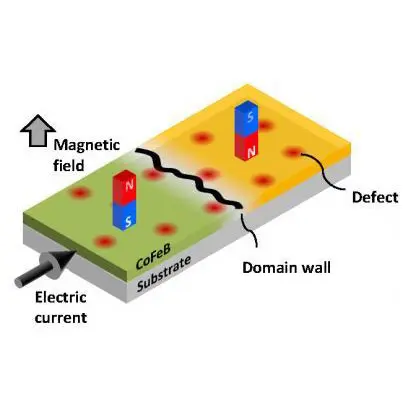
The research group fabricated a wire device consisting of a ferromagnetic metal CoFeB, and investigated the universality class of a magnetic domain wall “creep”. They evaluated the domain wall velocity for various magnitudes of magnetic field or electric current while keeping the device temperature constant, from which they derived the scaling exponent for the universality class.

The results indicate that the scaling exponent does not depend on factors such as temperature and wire width, for both magnetic field and current cases, confirming the universality of the observed feature. Interestingly, unlike the previous study on metallic systems, they found different universality classes between magnetic field and current-driven domain wall creeps in the present metallic sample.

This means that the actions of a magnetic field and current on the domain wall are fundamentally different from each other. The field-driven “creep” was found to belong to a previously known universality class, whereas the current-driven “creep” was found to belong to a different universality class which cannot be explained by the present theories and the scaling exponent was similar to the one observed previously in the magnetic semiconductor.

From detailed investigations of the behavior of the domain wall under the application of a current, they found that the current gives rise to an adiabatic spin-transfer torque acting on the domain wall which has a different symmetry to the torque induced by a magnetic field. In other words, it was clarified that, for sample in which stack structure is designed so that the adiabatic spin-transfer torque dominantly affects the domain wall, universal creep characteristics appear irrespective of the nature of material, such as metal or semiconductor, the details of microscopic structure.

The obtained findings shed light on a statistical physics of creep motion of elastic interfaces and development of high-performance magnetic memory devices.

Featured Picture: Schematic of domain wall creep. When a very weak magnetic field or electric current is applied to the magnetic wire with domain wall, the domain wall behaves as an elastic interface and slowly moves, creeps.

Related

Recent Posts

On-Chip 3D-Printed Copper Microinductors: A New Route to Compact RF Electronics

10.9.2026
30
Murata DLW32SH_MF 1210 surface-mount common mode choke coil with metal terminals for automotive CAN FD signal-line noise suppression

Murata Introduces Common Mode Chokes for Automotive CAN FD up to 150°C

10.9.2026
27
onsemi solid-state transformer concept for 800 V HVDC AI data center power conversion with SiC modules, DC-link capacitors and high-frequency magnetics

Solid-State Transformers for 800 V AI Data Centers: Passive Component Design Considerations

9.9.2026
119

Coilcraft Introduces Automotive Common Mode Chokes Target CISPR 25 Class 5 EMC Compliance

7.9.2026
25

Murata Expands Automotive Metal Power Inductor Range

7.9.2026
42

August 2026 Interconnect, Passives and Electromechanical Components Market Insights

4.9.2026
60

Vishay Extends High-Current Common-Mode Chokes with 30 A EMI Filtering up to 150 °C

3.9.2026
41

B–H Curve-Based Inductor Modelling in LTspice: A Current-Dependent Magnetic Model

31.8.2026
67

Vishay IFBT SMT Flyback Transformers Target PoE and Isolated DC/DC Designs up to 30 W

28.8.2026
28

Upcoming Events

Sep 29
16:00 - 17:00 CEST

Cybersecurity 2026

Nov 24
16:00 - 17:00 CET

Component selection with the WE REDEXPERT® DC-DC Converter Designer Tool

View Calendar

Popular Posts

  • Buck Converter Design and Calculation

    0 shares
    Share 0 Tweet 0
  • LLC Resonant Converter Design and Calculation

    0 shares
    Share 0 Tweet 0
  • Boost Converter Design and Calculation

    0 shares
    Share 0 Tweet 0
  • Flyback Converter Design and Calculation

    0 shares
    Share 0 Tweet 0
  • Earthing Systems and IEC Classification Explained

    0 shares
    Share 0 Tweet 0
  • Resistor Symbols

    0 shares
    Share 0 Tweet 0
  • Capacitor Charging and Discharging

    0 shares
    Share 0 Tweet 0
  • MLCC and Ceramic Capacitors

    0 shares
    Share 0 Tweet 0
  • Audio Capacitors: Choosing Capacitors for Crossover Circuits

    0 shares
    Share 0 Tweet 0
  • Capacitor Symbols

    0 shares
    Share 0 Tweet 0

Newsletter Subscription


Passive Components Blog

© 2015–2026
All rights reserved

  • Home
  • Privacy Policy
  • EPCI Membership & Advertisement
  • About

No Result
View All Result
  • Home
  • Knowledge Blog
  • Dossiers
  • PCNS

© 2015–2026
All rights reserved