






Passive Components Blog
No Result
View All Result
  • Home
  • NewsFilter
    • All
    • Aerospace & Defence
    • Antenna
    • Applications
    • Automotive
    • Capacitors
    • Circuit Protection Devices
    • electro-mechanical news
    • Filters
    • Fuses
    • Inductors
    • Industrial
    • Integrated Passives
    • inter-connect news
    • Market & Supply Chain
    • Market Insights
    • Medical
    • Modelling and Simulation
    • New Materials & Supply
    • New Technologies
    • Non-linear Passives
    • Oscillators
    • Passive Sensors News
    • Resistors
    • RF & Microwave
    • Telecommunication
    • Weekly Digest

    Modelithics Extends Models for Microchip PIN and Varactor Diodes

    Exxelia Offers 1200V Capacitors and Magnetics for 800V Aerospace Platforms

    Wk 28 Electronics Supply Chain Digest

    Bourns Introduces Automotive BMS Signal Transformer with Integrated Common Mode Chokes

    Itelcond Introduces High‑Voltage Aluminium Capacitors for Modern IGBT DC‑links

    Bourns Introduces Automotive Shielded Power Inductors for Compact DC‑DC Converters

    EMC Design Fundamentals: Safe Use of Varistors and Common Mode Chokes in Mains and Data-Line Filters

    Murata Unveils Lead Disc Ceramic Capacitors for Automotive Safety and EMI Suppression

    SCHURTER Releases Intelligent Three‑Terminal Fuses for Safer Li‑ion Battery Systems

    Trending Tags

    • Ripple Current
    • RF
    • Leakage Current
    • Tantalum vs Ceramic
    • Snubber
    • Low ESR
    • Feedthrough
    • Derating
    • Dielectric Constant
    • New Products
    • Market Reports
  • VideoFilter
    • All
    • Antenna videos
    • Capacitor videos
    • Circuit Protection Video
    • Filter videos
    • Fuse videos
    • Inductor videos
    • Inter-Connect Video
    • Non-linear passives videos
    • Oscillator videos
    • Passive sensors videos
    • Resistor videos

    EMC Design Fundamentals: Safe Use of Varistors and Common Mode Chokes in Mains and Data-Line Filters

    Ferrite versus Nanocrystalline Power Inductor Cores: Turns, Gap and Size

    KYOCERA AVX Presents Antenna Integrator Studio Tutorial for Antenna Placement and RF Design

    Power Design Simulation Tools for Faster Inductor Selection and Loss Optimization

    EMC‑Compliant PCB and Connector Design Guidelines

    Why Isolated DC/DC Power Supplies Fail Late, Würth Elektronik Podcast

    Designing 800 V DC EMC Filters: Calculation, Simulation and Measurement

    Current Sense Transformer Datasheet and Design‑in Guide

    Designing a USB Type‑C Flyback Planar Transformer with Frenetic’s Planar Tool

    Trending Tags

    • Capacitors explained
    • Inductors explained
    • Resistors explained
    • Filters explained
    • Application Video Guidelines
    • EMC
    • New Products
    • Ripple Current
    • Simulation
    • Tantalum vs Ceramic
  • Knowledge Blog
  • Dossiers
    • AI Hardware Dossier
    • Power Converter Dossier
    • Automotive Dossier
    • Capacitor Dossier
    • Resistor Dossier
    • Inductor Dossier
    • Circuit Protection Dossier
  • Suppliers
    • Who is Who
  • PCNS
    • PCNS 2025
    • PCNS 2023
    • PCNS 2021
    • PCNS 2019
    • PCNS 2017
  • Events
  • Home
  • NewsFilter
    • All
    • Aerospace & Defence
    • Antenna
    • Applications
    • Automotive
    • Capacitors
    • Circuit Protection Devices
    • electro-mechanical news
    • Filters
    • Fuses
    • Inductors
    • Industrial
    • Integrated Passives
    • inter-connect news
    • Market & Supply Chain
    • Market Insights
    • Medical
    • Modelling and Simulation
    • New Materials & Supply
    • New Technologies
    • Non-linear Passives
    • Oscillators
    • Passive Sensors News
    • Resistors
    • RF & Microwave
    • Telecommunication
    • Weekly Digest

    Modelithics Extends Models for Microchip PIN and Varactor Diodes

    Exxelia Offers 1200V Capacitors and Magnetics for 800V Aerospace Platforms

    Wk 28 Electronics Supply Chain Digest

    Bourns Introduces Automotive BMS Signal Transformer with Integrated Common Mode Chokes

    Itelcond Introduces High‑Voltage Aluminium Capacitors for Modern IGBT DC‑links

    Bourns Introduces Automotive Shielded Power Inductors for Compact DC‑DC Converters

    EMC Design Fundamentals: Safe Use of Varistors and Common Mode Chokes in Mains and Data-Line Filters

    Murata Unveils Lead Disc Ceramic Capacitors for Automotive Safety and EMI Suppression

    SCHURTER Releases Intelligent Three‑Terminal Fuses for Safer Li‑ion Battery Systems

    Trending Tags

    • Ripple Current
    • RF
    • Leakage Current
    • Tantalum vs Ceramic
    • Snubber
    • Low ESR
    • Feedthrough
    • Derating
    • Dielectric Constant
    • New Products
    • Market Reports
  • VideoFilter
    • All
    • Antenna videos
    • Capacitor videos
    • Circuit Protection Video
    • Filter videos
    • Fuse videos
    • Inductor videos
    • Inter-Connect Video
    • Non-linear passives videos
    • Oscillator videos
    • Passive sensors videos
    • Resistor videos

    EMC Design Fundamentals: Safe Use of Varistors and Common Mode Chokes in Mains and Data-Line Filters

    Ferrite versus Nanocrystalline Power Inductor Cores: Turns, Gap and Size

    KYOCERA AVX Presents Antenna Integrator Studio Tutorial for Antenna Placement and RF Design

    Power Design Simulation Tools for Faster Inductor Selection and Loss Optimization

    EMC‑Compliant PCB and Connector Design Guidelines

    Why Isolated DC/DC Power Supplies Fail Late, Würth Elektronik Podcast

    Designing 800 V DC EMC Filters: Calculation, Simulation and Measurement

    Current Sense Transformer Datasheet and Design‑in Guide

    Designing a USB Type‑C Flyback Planar Transformer with Frenetic’s Planar Tool

    Trending Tags

    • Capacitors explained
    • Inductors explained
    • Resistors explained
    • Filters explained
    • Application Video Guidelines
    • EMC
    • New Products
    • Ripple Current
    • Simulation
    • Tantalum vs Ceramic
  • Knowledge Blog
  • Dossiers
    • AI Hardware Dossier
    • Power Converter Dossier
    • Automotive Dossier
    • Capacitor Dossier
    • Resistor Dossier
    • Inductor Dossier
    • Circuit Protection Dossier
  • Suppliers
    • Who is Who
  • PCNS
    • PCNS 2025
    • PCNS 2023
    • PCNS 2021
    • PCNS 2019
    • PCNS 2017
  • Events
No Result
View All Result
Passive Components Blog
No Result
View All Result

Modelithics Extends Models for Microchip PIN and Varactor Diodes

23.7.2026
Reading Time: 7 mins read
A A

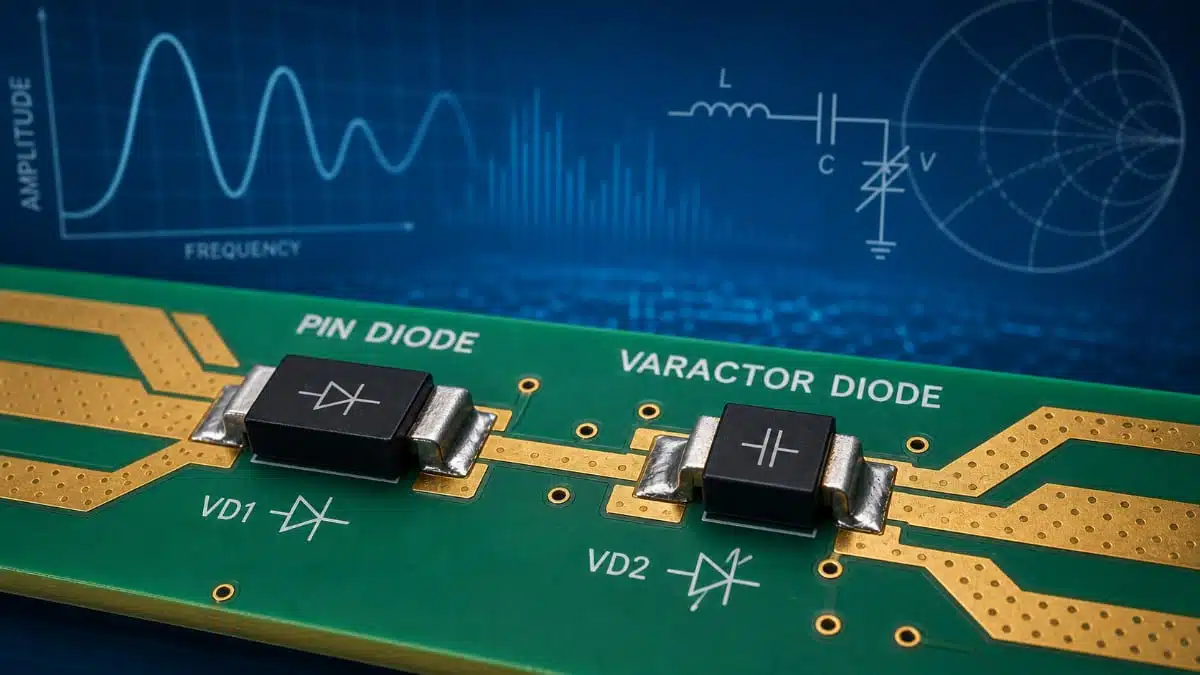
Modelithics has released a new family of nonlinear simulation models for Microchip PIN and varactor diodes, targeting RF, microwave and millimeter-wave design workflows.

These Modelithics models aim to give RF engineers more predictable behavior in switching, attenuation, limiting and tuning circuits, especially at Ka-band and beyond.

RelatedPosts

Spectrum Controls Joins Modelithics Program to Offer High‑Fidelity RF Models for Resistors, Attenuators and Terminations

Modelithics Releases COMPLETE Library v26.2 for Keysight Genesys

Modelithics Releases COMPLETE v26.1 for Keysight ADS

Key features and benefits

  • Highly accurate nonlinear models for 16 Microchip PIN diodes and 3 varactor diodes, covering a broad range of forward and reverse bias conditions according to the manufacturer’s data.
  • Broadband validation from DC up to at least 30 GHz for all supported devices, with the MV3903-STD-P2010 flip‑chip varactor model validated up to 110 GHz for high‑frequency applications.
  • Inclusion in upcoming releases of the Modelithics COMPLETE Library for leading EDA platforms, allowing engineers to use these models directly in their existing RF and microwave design environments.
  • Bias‑dependent behavior captured in the models, enabling more realistic prediction of switching loss, insertion loss and control characteristics under different drive conditions.
  • Temperature scalability typically from 25 °C to 85 °C, helping engineers evaluate performance across typical operating ranges without manually deriving temperature coefficients.
  • Validation against a comprehensive measurement set, including DC current–voltage characteristics, capacitance versus voltage, resistance versus current, multi‑bias S‑parameters and selected power‑compression measurements.
  • Support for both series and shunt configurations, making the models directly applicable to common RF topologies such as series PIN switches, shunt attenuators, limiters and bias networks.
  • Availability of several devices with large‑signal power‑compression validation, which is useful when designing high‑power RF or microwave stages where nonlinearity and compression strongly influence system behavior.

Typical applications

PIN and varactor diodes modeled at this level of detail are typically used in RF and microwave front‑ends, where accurate prediction of nonlinearity and loss is critical. These new models are intended for:

  • RF and microwave switching networks, such as transmit/receive (T/R) switches, antenna selection networks and signal routing matrices.
  • Attenuators and gain‑control circuits, including step attenuators and continuously variable attenuators operating up to and beyond Ka‑band.
  • RF limiters and protection circuits designed to protect sensitive receivers from high‑level signals or surges, where the limiter’s conduction threshold and power‑handling behavior must be modeled accurately.
  • Tunable filters and matching networks using varactor diodes, where capacitance versus voltage behavior and Q factor drive achievable tuning range and insertion loss.
  • Millimeter‑wave prototyping and research platforms, especially where the varactor model validated to 110 GHz is of interest for high‑frequency resonators, phase shifters or frequency‑agile structures.
  • Control and bias networks in high‑frequency systems, including phase‑shifter biasing, amplitude control and RF power‑control loops.

Technical highlights

The press release emphasizes that these models are based on extensive measurement campaigns and are meant to reflect realistic device behavior rather than purely idealized SPICE‑like abstractions.

Measurement and validation scope

  • DC I–V characterization over relevant forward and reverse bias ranges.
  • Capacitance versus reverse voltage, important for varactor‑based tuning and matching networks.
  • Resistance versus current, which directly influences insertion loss and switching dynamics for PIN diodes.
  • Multi‑bias S‑parameter measurements across frequency, capturing the dependence of RF behavior on different bias conditions.
  • Selected large‑signal power‑compression measurements for several devices, supporting design of high‑power RF paths where compression and clipping behavior must be anticipated.

Frequency and temperature coverage

  • Broadband validation from DC to at least 30 GHz for all modeled PIN and varactor devices, suitable for many microwave systems.
  • Extended validation up to 110 GHz for the MV3903-STD-P2010 flip‑chip varactor, which is particularly relevant for Ka‑band and emerging millimeter‑wave systems.
  • Temperature scalability from 25 °C to 85 °C as indicated by the manufacturer, allowing designers to explore performance under typical ambient and elevated temperatures without manually re‑fitting parameters.

Library and platform integration

  • The models are to be included in upcoming releases of the Modelithics COMPLETE Library, which is available for multiple major EDA tools used in RF, microwave and millimeter‑wave design.
  • A dedicated Modelithics–Microchip model library is available, and engineers without an existing COMPLETE Library license can request a free 90‑day evaluation according to the manufacturer information.

Role of accurate nonlinear models in RF design

For RF and microwave engineers, the value of these models lies less in the existence of another PIN or varactor diode and more in the ability to predict real‑world behavior before building hardware.

  • Nonlinear models with bias‑dependent behavior help simulate key effects such as turn‑on thresholds, series resistance changes and dynamic charge storage, which affect switching speed, insertion loss and distortion.
  • Temperature‑aware models allow engineers to verify whether a design that is optimal at room temperature still meets specifications at higher ambient or case temperatures, which is important for telecom, aerospace and automotive environments.
  • Broadband and high‑frequency validation reduces the risk of unexpected resonances or parasitic effects when circuits are pushed toward millimeter‑wave bands, where package parasitics and layout become dominant.
  • Power‑compression data incorporated in the models enables designers to assess how a switch, limiter or tuner behaves as it approaches its power limits, improving first‑pass success for high‑power signal chains.

Availability and access options

The new Microchip PIN and varactor diode models are distributed through Modelithics, primarily as part of the Modelithics COMPLETE Library for supported EDA platforms.

  • The models for 16 PIN diodes and 3 varactor diodes are planned to appear in upcoming COMPLETE Library releases.
  • Engineers without an existing Modelithics COMPLETE Library license can request free 90‑day access to the Modelithics–Microchip model library via the vendor program portal, according to the manufacturer announcement.
  • Additional details such as exact device list, part numbers and supported EDA environments are provided in the manufacturer documentation and should be checked in the associated datasheets and library release notes.

Design‑in notes for engineers

For design engineers and technical buyers, the main benefit of these models is the reduction of uncertainty early in the design cycle. Some practical considerations when using the new Microchip PIN and varactor models include:

  • Start with the intended operating band and required power level, then select PIN or varactor devices whose models are validated at or beyond your highest frequency of interest.
  • Use the bias‑dependent and temperature‑scalable capabilities to sweep bias current, control voltage and temperature, and derive safe operating regions before committing to layout.
  • When designing RF switches or attenuators, pay attention to resistance versus current characteristics to balance insertion loss against required drive current and thermal management.
  • In varactor‑based tuning circuits, exploit the capacitance versus voltage curves to estimate achievable tuning range, tuning sensitivity and phase shift over the full control voltage and temperature range.
  • For millimeter‑wave designs, especially near 110 GHz, cross‑check the MV3903-STD-P2010 model validation details in the Modelithics documentation and ensure that PCB stack‑up and packaging parasitics are modeled consistently.
  • Use power‑compression validation where available to avoid over‑optimistic assumptions about linearity, particularly in limiters and high‑power switching networks.
  • Coordinate with purchasing to ensure that the selected Microchip PIN and varactor part numbers are aligned with supply chain constraints, while keeping the same or equivalent parts with Modelithics models available to preserve simulation fidelity.

Source

This article is based on information provided in an official press release from Modelithics and Microchip, complemented by related manufacturer documentation for the Modelithics COMPLETE Library and associated device models.


References

  1. Modelithics press release – Microchip and Modelithics Empower RF Engineers with New PIN and Varactor Diode Models
  2. Modelithics MVP Program – Microchip page

Related

Recent Posts

LeanBOM: Practical Cross‑Technology Capacitor Search by Real Working Conditions

14.7.2026
70

Spectrum Controls Joins Modelithics Program to Offer High‑Fidelity RF Models for Resistors, Attenuators and Terminations

10.7.2026
23

RF Filters and Passive Components Enabling the 7 Missile RF Subsystems

9.7.2026
65

High-Q RF & Microwave MLCCs: A Cross-Vendor Benchmark

2.7.2026
115

Power Design Simulation Tools for Faster Inductor Selection and Loss Optimization

29.6.2026
54

KYOCERA AVX Releases NTN Antenna Selection Guide Brochure

25.6.2026
57

Coilcraft Releases 0402 Ferrite-Core Wirewound Chip Inductors for RF and EMI Control

25.6.2026
51

Stackpole Releases High-Frequency Thin Film Chip Resistors for RF up to 50 GHz

19.6.2026
58

Knowles Expands High‑Q Ceramic Core Inductors for RF designs

19.6.2026
47

Upcoming Events

Jul 28
8:00 - 11:00 CEST

Post Procurement Testing of EEE Components for LEO Space Applications

Jul 29
17:30 - 18:30 CEST

To Ferrite or to Nanocrystalline in Transformer Design

Sep 29
16:00 - 17:00 CEST

Cybersecurity 2026

View Calendar

Popular Posts

  • Boost Converter Design and Calculation

    0 shares
    Share 0 Tweet 0
  • Buck Converter Design and Calculation

    0 shares
    Share 0 Tweet 0
  • YAGEO Announces July 2026 Capacitor Price Increase

    0 shares
    Share 0 Tweet 0
  • Flyback Converter Design and Calculation

    0 shares
    Share 0 Tweet 0
  • LLC Resonant Converter Design and Calculation

    0 shares
    Share 0 Tweet 0
  • MLCC and Ceramic Capacitors

    0 shares
    Share 0 Tweet 0
  • MLCCs in the Age of AI: Q2 2026 Market Tightness

    0 shares
    Share 0 Tweet 0
  • Earthing Systems and IEC Classification Explained

    0 shares
    Share 0 Tweet 0
  • Nvidia Vera Rubin: Why One AI Rack Needs So Many More MLCC Capacitors

    0 shares
    Share 0 Tweet 0
  • Dual Active Bridge (DAB) Topology

    0 shares
    Share 0 Tweet 0

Newsletter Subscription


Passive Components Blog

© EPCI - Leading Passive Components Educational and Information Site

  • Home
  • Privacy Policy
  • EPCI Membership & Advertisement
  • About

No Result
View All Result
  • Home
  • Knowledge Blog
  • Dossiers
  • PCNS

© EPCI - Leading Passive Components Educational and Information Site

This website uses cookies. By continuing to use this website you are giving consent to cookies being used. Visit our Privacy and Cookie Policy.