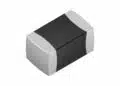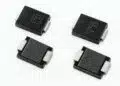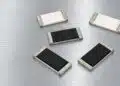





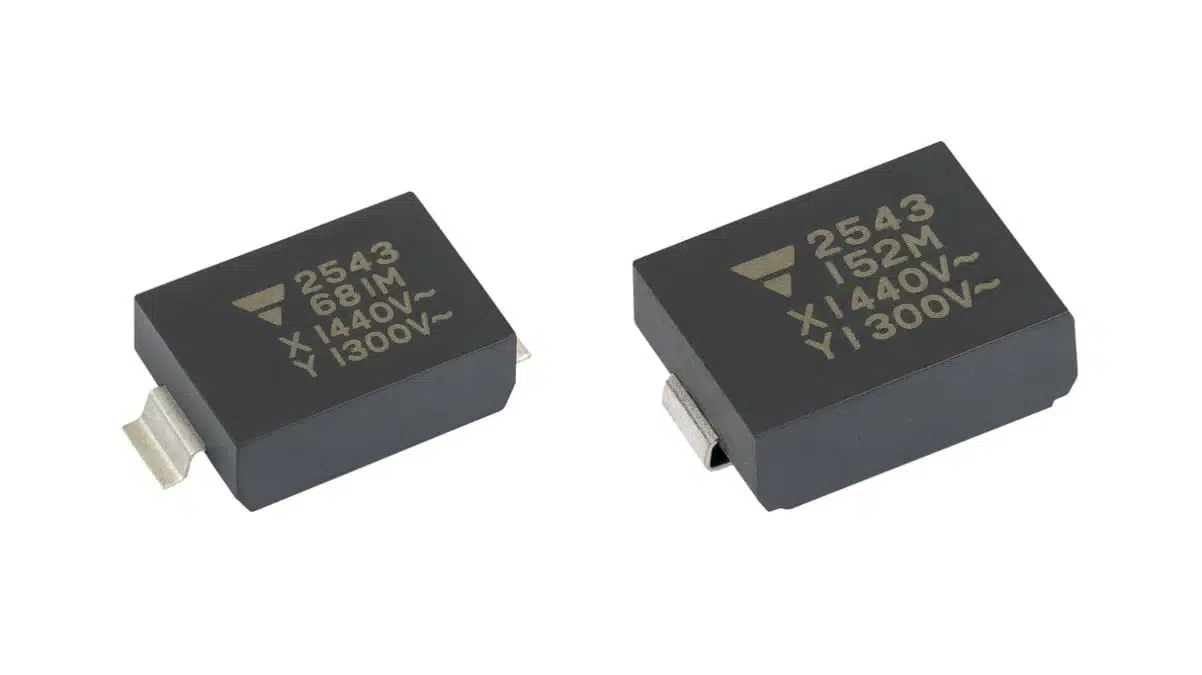
Vishay has introduced the SMDY1…S series of surface-mount ceramic disc safety capacitors for mains-connected EMI and RFI filtering.
Rated for Y1 operation at 300 VAC and 1500 VDC, the Vishay safety capacitors series addresses designs that need reinforced-insulation capability while reducing PCB area versus earlier-generation devices.
The new components combine a safety-certified single-layer ceramic capacitor construction with reflow-compatible surface-mount assembly. Vishay states that the series can reduce required board space by up to 40%, making it relevant where mains-filter functionality must fit into compact industrial, consumer, and charging equipment.
Key features and benefits
- Y1 safety classification: 300 VAC Y1 rating supports line-to-earth filtering across double or reinforced insulation systems.
- High DC-network rating: Devices are rated to 1500 VDC for use in DC networks in accordance with IEC 60384-14 Annex H.
- X1 capability: The same series also supports X1 line-to-line filtering at up to 440 VAC.
- Surface-mount construction: Reflow-process compatibility enables automated pick-and-place assembly and can eliminate manual insertion and soldering associated with through-hole safety capacitors.
- Compact safety filtering: Vishay specifies up to 40% lower board-space requirement compared with previous-generation devices.
- Extended temperature range: Operation is specified from -55 °C to +125 °C, providing additional margin for outdoor, industrial, and equipment-internal hot spots.
- Enhanced insulation resistance: Minimum insulation resistance is specified as 10,000 MΩ, above the 6000 MΩ industry-standard level cited by Vishay.
- Production screening: Every capacitor receives end-of-line testing for AC voltage, capacitance, dissipation factor, insulation resistance, and visual condition.
- Material compliance: The series is RoHS-compliant, halogen-free, and encapsulated in flame-resistant epoxy resin meeting UL 94 V-0.
Technical highlights
The SMDY1…S is a single-layer ceramic-disc safety capacitor supplied in a surface-mount casing. It is offered with Class 1 U2J dielectric and Class 2 Y5S or Y5U dielectric options, allowing designers to balance capacitance stability, available value, and application requirements.
| Parameter | SMDY1…S specification |
|---|---|
| Safety classes | Y1: 300 VAC / 1500 VDC; X1: 440 VAC |
| Capacitance range | 10 pF to 1500 pF |
| Capacitance tolerance | ±10% or ±20% |
| Dielectric options | U2J, Y5S, Y5U |
| Operating temperature | -55 °C to +125 °C |
| Insulation resistance | ≥ 10,000 MΩ |
| Mounting | Surface-mount, reflow soldering |
| Case sizes | A: 10 pF to 680 pF; B: 1000 pF to 1500 pF |
| Safety standard | IEC 60384-14 |
| Approvals | UL, CSA, VDE, ENEC, CQC |
Class 1 U2J dielectric is generally the appropriate choice where predictable capacitance behaviour over temperature and time is important. The Class 2 Y5S and Y5U variants enable higher capacitance within this compact safety-capacitor format, but designers should account for their greater capacitance variation with temperature, DC bias, and ageing according to the manufacturer datasheet.
Typical applications
The series is suited to mains-input filtering and high-voltage DC filtering positions where a certified capacitor is required between hazardous mains circuitry and accessible or protective-earth-referenced circuitry.
Typical equipment includes:
- Industrial motor drives and inverter systems
- Welding equipment
- Uninterruptible power supplies
- Rail power supplies
- HVAC controls and power stages
- LED drivers
- AC/DC converters and computer switch-mode power supplies
- Smart-home automation equipment
- Consumer appliances, including washing machines and refrigerators
- Automotive charging stations
For line-to-line suppression, the X1 configuration can be used across the AC supply. For line-to-earth filtering, the Y1 configuration is intended for positions where a capacitor bridges insulation that protects users from hazardous voltages.
Why surface-mount matters
Safety capacitors have traditionally been predominantly through-hole parts because of approval, creepage, clearance, and mechanical requirements. A surface-mount Y1 option can simplify the transition to automated assembly for compact power converters and control boards.
This can be particularly useful in high-volume products where manual through-hole insertion is a manufacturing constraint, or in dense PCBs where the EMI filter competes for area with power semiconductors, magnetic components, isolation slots, connectors, and thermal-management features.
The practical limitation remains layout: moving the capacitor to the surface does not remove the need to maintain the complete safety-insulation system. PCB creepage and clearance, slots, pollution degree, surge environment, insulation coordination, and the selected end-equipment standard must still be evaluated at system level.
Design-in notes for engineers
- Select the safety class by connection point: Use X-class capability for line-to-line suppression and Y-class capability for line-to-earth or accessible-secondary-related filtering. Do not substitute an ordinary ceramic capacitor for a certified safety component.
- Check leakage-current budget: A Y capacitor improves common-mode noise attenuation, but its capacitance contributes to mains-frequency touch or protective-earth leakage current. Confirm the final value against the applicable equipment standard.
- Choose dielectric deliberately: U2J may be preferable for lower-value, stability-sensitive filtering networks. Y5S or Y5U may be useful where higher capacitance is needed in the available case sizes, subject to tolerance and capacitance-change limits.
- Validate high-voltage use separately: The 1500 VDC rating is relevant to DC networks under IEC 60384-14 Annex H, but actual converter voltage, repetitive transients, surge exposure, altitude, and insulation coordination remain application-specific checks.
- Review the reflow process: Use Vishay’s soldering recommendation and confirm the thermal profile on the populated assembly, especially when the safety capacitor is located near heat-generating power devices.
- Preserve safety distances in layout: The component approval does not itself guarantee compliance of the finished assembly; observe required creepage and clearance around pads, copper features, vias, conductive hardware, and chassis interfaces.
- Qualify the production source: Verify the exact ordering code, dielectric, capacitance, tolerance, approved agency markings, packaging option, and current availability before release to production.
Source
This article is based on Vishay Intertechnology’s August 2026 product announcement and the official SMDY1…S product documentation. Specifications and approvals should be verified against the latest manufacturer datasheet and certification documents before design release.