




Passive Components Blog
No Result
View All Result
  • Home
  • NewsFilter
    • All
    • Aerospace & Defence
    • Antenna
    • Applications
    • Automotive
    • Capacitors
    • Circuit Protection Devices
    • electro-mechanical news
    • Filters
    • Fuses
    • Inductors
    • Industrial
    • Integrated Passives
    • inter-connect news
    • Market & Supply Chain
    • Market Insights
    • Medical
    • Modelling and Simulation
    • New Materials & Supply
    • New Technologies
    • Non-linear Passives
    • Oscillators
    • Passive Sensors News
    • Resistors
    • RF & Microwave
    • Telecommunication
    • Weekly Digest

    YMIN Introduces Polymer Tantalum Capacitors for AI Server SSDs

    Littelfuse Expands High-Voltage TVS Diodes

    DigiKey Adds 31k New In‑Stock Parts in Q1 2026

    Miniaturization of Tantalum Capacitors: Structural Limit Under Constant Rating

    Heatsink Design and Thermal Interface Materials for Reliable Electronics

    Murata New MLCC Bulk Case Packaging Cuts Packaging Material by 99%

    Wk 17 Electronics Supply Chain Digest

    Exxelia Introduces SMD High‑Voltage Mica Capacitors

    Modelithics Releases COMPLETE v26.1 for Keysight ADS

    Trending Tags

    • Ripple Current
    • RF
    • Leakage Current
    • Tantalum vs Ceramic
    • Snubber
    • Low ESR
    • Feedthrough
    • Derating
    • Dielectric Constant
    • New Products
    • Market Reports
  • VideoFilter
    • All
    • Antenna videos
    • Capacitor videos
    • Circuit Protection Video
    • Filter videos
    • Fuse videos
    • Inductor videos
    • Inter-Connect Video
    • Non-linear passives videos
    • Oscillator videos
    • Passive sensors videos
    • Resistor videos

    Why Power Inductors Use a Ferrite Core With an Air Gap

    Transformer-Based Power-Line Harvester Magnetic Design

    Thermal Modeling of Magnetics

    Standard vs Planar LLC transformers Comparison for Battery Chargers

    How Modern Tools Model Magnetic Components for Power Electronics

    Advanced Loss Modeling for Planar Magnetics in the Frenetic Planar Tool

    2026 Power Magnetics Design Trends: Flyback, DAB and Planar

    Enabling Software‑Defined Vehicle Architectures: Automotive Ethernet and Zonal Smart Power

    Calculating Resistance Value of a Flyback RC Snubber 

    Trending Tags

    • Capacitors explained
    • Inductors explained
    • Resistors explained
    • Filters explained
    • Application Video Guidelines
    • EMC
    • New Products
    • Ripple Current
    • Simulation
    • Tantalum vs Ceramic
  • Knowledge Blog
  • DossiersNew
  • Suppliers
    • Who is Who
  • PCNS
    • PCNS 2025
    • PCNS 2023
    • PCNS 2021
    • PCNS 2019
    • PCNS 2017
  • Events
  • Home
  • NewsFilter
    • All
    • Aerospace & Defence
    • Antenna
    • Applications
    • Automotive
    • Capacitors
    • Circuit Protection Devices
    • electro-mechanical news
    • Filters
    • Fuses
    • Inductors
    • Industrial
    • Integrated Passives
    • inter-connect news
    • Market & Supply Chain
    • Market Insights
    • Medical
    • Modelling and Simulation
    • New Materials & Supply
    • New Technologies
    • Non-linear Passives
    • Oscillators
    • Passive Sensors News
    • Resistors
    • RF & Microwave
    • Telecommunication
    • Weekly Digest

    YMIN Introduces Polymer Tantalum Capacitors for AI Server SSDs

    Littelfuse Expands High-Voltage TVS Diodes

    DigiKey Adds 31k New In‑Stock Parts in Q1 2026

    Miniaturization of Tantalum Capacitors: Structural Limit Under Constant Rating

    Heatsink Design and Thermal Interface Materials for Reliable Electronics

    Murata New MLCC Bulk Case Packaging Cuts Packaging Material by 99%

    Wk 17 Electronics Supply Chain Digest

    Exxelia Introduces SMD High‑Voltage Mica Capacitors

    Modelithics Releases COMPLETE v26.1 for Keysight ADS

    Trending Tags

    • Ripple Current
    • RF
    • Leakage Current
    • Tantalum vs Ceramic
    • Snubber
    • Low ESR
    • Feedthrough
    • Derating
    • Dielectric Constant
    • New Products
    • Market Reports
  • VideoFilter
    • All
    • Antenna videos
    • Capacitor videos
    • Circuit Protection Video
    • Filter videos
    • Fuse videos
    • Inductor videos
    • Inter-Connect Video
    • Non-linear passives videos
    • Oscillator videos
    • Passive sensors videos
    • Resistor videos

    Why Power Inductors Use a Ferrite Core With an Air Gap

    Transformer-Based Power-Line Harvester Magnetic Design

    Thermal Modeling of Magnetics

    Standard vs Planar LLC transformers Comparison for Battery Chargers

    How Modern Tools Model Magnetic Components for Power Electronics

    Advanced Loss Modeling for Planar Magnetics in the Frenetic Planar Tool

    2026 Power Magnetics Design Trends: Flyback, DAB and Planar

    Enabling Software‑Defined Vehicle Architectures: Automotive Ethernet and Zonal Smart Power

    Calculating Resistance Value of a Flyback RC Snubber 

    Trending Tags

    • Capacitors explained
    • Inductors explained
    • Resistors explained
    • Filters explained
    • Application Video Guidelines
    • EMC
    • New Products
    • Ripple Current
    • Simulation
    • Tantalum vs Ceramic
  • Knowledge Blog
  • DossiersNew
  • Suppliers
    • Who is Who
  • PCNS
    • PCNS 2025
    • PCNS 2023
    • PCNS 2021
    • PCNS 2019
    • PCNS 2017
  • Events
No Result
View All Result
Passive Components Blog
No Result
View All Result

Researchers Developed Reduced Graphene Oxide (rGO) High Energy Density Graphene Supercapacitors

18.9.2025
Reading Time: 4 mins read
A A

Researchers from Monash University, Australia developed and demonstrated novel reduced graphene oxide (rGO) graphene based material for high energy and power density supercapacitors.

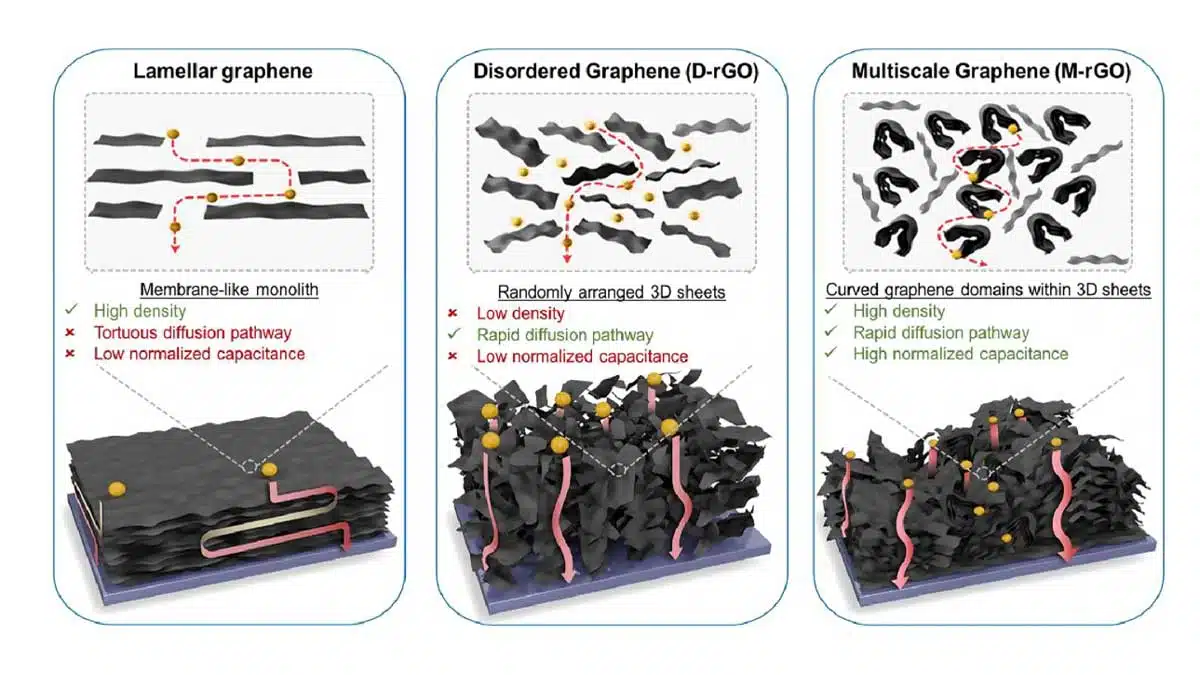
Specifically, the Monash team utilized a rapid thermal annealing process and a novel material architecture synthesized from natural graphite, an abundant Australian resource. This innovative approach enabled the creation of multiscale reduced graphene oxide (M-rGO), a highly curved graphene structure featuring precise pathways for rapid and efficient ion movement. 

RelatedPosts

YMIN Introduces Polymer Tantalum Capacitors for AI Server SSDs

Littelfuse Expands High-Voltage TVS Diodes

DigiKey Adds 31k New In‑Stock Parts in Q1 2026

Supercapacitors are critical components in modern energy storage technology because they provide high power density and rapid charge–discharge cycles. However, their volumetric energy density remains a limiting factor for compact and portable applications.

Carbon-based materials, particularly graphene and reduced graphene oxide (rGO), have attracted significant attention due to their tunable properties and high surface areas, but conventional designs face challenges with ion accessibility and poor volumetric performance. This article presents a novel approach that leverages multiscale curved graphene structures and an operando electrochemical interlayer expansion (e-IE) method to achieve volumetrically-efficient supercapacitors with exceptional high energy and high power densities.

Key Points

  1. Multiscale curved graphene (M-rGO) is synthesized via a two-step rapid thermal treatment of graphite oxide, producing curved turbostratic crystallites interwoven with disordered domains.
  2. Operando electrochemical interlayer expansion enables ion access to previously inaccessible interlayers, increasing capacitance up to threefold without excessive structural degradation.
  3. Optimized M-rGO pouch cells deliver volumetric energy densities up to 99.5 Wh/L in ionic liquids and 49.2 Wh/L in organic electrolytes, combined with high power densities.
  4. Long-term stability is achieved due to controlled interphase formation and reduced continuous electrolyte decomposition.
  5. This multiscale approach provides a practical route toward industrially relevant, high-performance, compact supercapacitors.

Extended Summary

The study addresses a critical barrier in supercapacitor technology: achieving high volumetric energy densities without sacrificing power delivery or stability. Traditional high-surface-area carbons, although excellent for maximizing gravimetric performance, suffer from low packing densities, which limit volumetric metrics to below 10 Wh/L—a fraction of even first-generation lead-acid batteries. Graphene and rGO materials offer a pathway toward higher energy densities, but their tendency to restack and obstruct ion transport has historically hindered their performance.

The authors propose a multiscale reduced graphene oxide (M-rGO) architecture. It is created through a two-step rapid thermal annealing of graphite oxide: first, a flash exfoliation at 700 °C generates disordered, wrinkled graphene sheets with meso- and microporosity; second, a brief high-temperature treatment promotes the self-assembly of curved turbostratic crystallites within those sheets. This results in micron-scale particles that integrate disordered ion-conducting domains with nanoscale curved crystalline regions capable of high capacitance.

A key innovation is the operando electrochemical interlayer expansion (e-IE) technique. By gradually extending the voltage window during initial cycling, the van der Waals-bonded curved graphene interlayers expand, allowing electrolyte ions—both in organic and ionic liquid systems—to penetrate otherwise inaccessible sites. This process activates a large number of additional capacitive sites and enables partial charge transfer phenomena under nanoconfinement, which significantly enhances the effective surface-area-normalized capacitance to 85 µF/cm² in organic electrolytes and 135 µF/cm² in ionic liquids.

Electrochemical characterization demonstrates exceptional performance at both material and device levels. Thin, dense M-rGO electrodes exhibit low internal resistance and rapid ion transport, delivering rate capability up to 200 A/g. Optimized pouch cells with practical areal loadings (≈6 mg/cm²) achieve volumetric energy densities of 49.2 Wh/L in TEABF4/acetonitrile and 99.5 Wh/L in EMIMBF4, along with high power densities up to 69.2 kW/L. Long-term cycling over 50,000 cycles maintains over 90% capacitance retention, supported by operando dilatometry, ex-situ XRD, and SEM analyses that confirm structural integrity and stable interphase formation.

The study also investigates the role of cation size in interlayer expansion and performance. Smaller cations access the interlayers more efficiently, while larger cations cause significant electrode dilation and, in extreme cases, structural exfoliation. Electrochemical impedance spectroscopy and Warburg coefficient analyses reveal that e-IE not only activates new storage sites but also improves ion diffusion kinetics by a factor of three.

From a mechanistic perspective, the combination of disordered transport highways and confined curved crystallite domains leverages both double-layer and partial pseudocapacitive contributions under nanoconfinement, providing a continuous transition from classical EDL behavior to enhanced charge storage.

Conclusion

This research demonstrates that multiscale engineering of graphene particles, coupled with operando interlayer expansion, can achieve supercapacitors with unprecedented volumetric energy and power densities, while maintaining long-term stability. The M-rGO approach offers a pathway toward industrially relevant, compact devices suitable for emerging applications in portable electronics and high-power systems. By integrating disordered transport channels, curved turbostratic crystallites, and controlled interlayer activation, the work sets a new benchmark for volumetrically-efficient all-carbon supercapacitors.

Read the complete article:

Jovanović, P., Sharifzadeh Mirshekarloo, M., Aitchison, P. et al. Operando interlayer expansion of multiscale curved graphene for volumetrically-efficient supercapacitors.Nat Commun 16, 8271 (2025). https://doi.org/10.1038/s41467-025-63485-0

Related

Source: Nature

Recent Posts

YMIN Introduces Polymer Tantalum Capacitors for AI Server SSDs

29.4.2026
8

Miniaturization of Tantalum Capacitors: Structural Limit Under Constant Rating

27.4.2026
24

Murata New MLCC Bulk Case Packaging Cuts Packaging Material by 99%

27.4.2026
39

Exxelia Introduces SMD High‑Voltage Mica Capacitors

28.4.2026
19

Modelithics Releases COMPLETE v26.1 for Keysight ADS

23.4.2026
13

April 2026 Interconnect, Passives and Electromechanical Components Market Insights

22.4.2026
68

KYOCERA AVX Introduces Traction‑Grade DC Link Film Capacitors

21.4.2026
46

When More Capacitance Hurts Reliability: The Role of the Metallic Skeleton in Tantalum Anodes

20.4.2026
44

YAGEO Introduces High‑Current Y2/X1 Film Capacitors for Wide-bandgap Power Systems

17.4.2026
41

Upcoming Events

Apr 30
10:00 - 11:00 CDT

Programming Embedded Systems

May 5
16:00 - 17:00 CEST

Understanding and Selecting Capacitors – Fundamentals, Technologies and Latest Trends

May 7
17:00 - 18:00 CEST

From Grid to Motion: How Industrial Electrification is Redefining Power System Design

View Calendar

Popular Posts

  • Buck Converter Design and Calculation

    0 shares
    Share 0 Tweet 0
  • Boost Converter Design and Calculation

    0 shares
    Share 0 Tweet 0
  • Flyback Converter Design and Calculation

    0 shares
    Share 0 Tweet 0
  • LLC Resonant Converter Design and Calculation

    0 shares
    Share 0 Tweet 0
  • MLCC and Ceramic Capacitors

    0 shares
    Share 0 Tweet 0
  • Dual Active Bridge (DAB) Topology

    0 shares
    Share 0 Tweet 0
  • What Electronics Engineer Needs to Know About Passive Low Pass Filters

    0 shares
    Share 0 Tweet 0
  • Capacitor Charging and Discharging

    0 shares
    Share 0 Tweet 0
  • MLCC Case Sizes Standards Explained

    0 shares
    Share 0 Tweet 0
  • Ripple Current and its Effects on the Performance of Capacitors

    3 shares
    Share 3 Tweet 0

Newsletter Subscription


Passive Components Blog

© EPCI - Leading Passive Components Educational and Information Site

  • Home
  • Privacy Policy
  • EPCI Membership & Advertisement
  • About

No Result
View All Result
  • Home
  • Knowledge Blog
  • PCNS

© EPCI - Leading Passive Components Educational and Information Site

This website uses cookies. By continuing to use this website you are giving consent to cookies being used. Visit our Privacy and Cookie Policy.
Go to mobile version