




Passive Components Blog
No Result
View All Result
  • Home
  • NewsFilter
    • All
    • Aerospace & Defence
    • Antenna
    • Applications
    • Automotive
    • Capacitors
    • Circuit Protection Devices
    • electro-mechanical news
    • Filters
    • Fuses
    • Inductors
    • Industrial
    • Integrated Passives
    • inter-connect news
    • Market & Supply Chain
    • Market Insights
    • Medical
    • Modelling and Simulation
    • New Materials & Supply
    • New Technologies
    • Non-linear Passives
    • Oscillators
    • Passive Sensors News
    • Resistors
    • RF & Microwave
    • Telecommunication
    • Weekly Digest

    YAGEO Introduces High‑Current Y2/X1 Film Capacitors for Wide-bandgap Power Systems

    Amphenol Explanded Liquid Cooling Connectors for AI, ESS and EV Systems

    Hirose Introduced BGA connector for PCIe Gen6 for AI and Edge Computing

    YAGEO Introduces High Rel MLCCs Beyond MIL-Spec Limits

    Würth Elektronik Expanded Capacity for Validation and Services in Asia

    Samsung Introduces Ultra-High-Voltage 1500 V MLCCs for xEV Powertrains

    YAGEO Q1 2026 Results: AI Servers and Pricing Power Behind a Moderate Q2 Outlook

    TDK Introduces High‑Voltage Common‑Mode Chokes for Compact 1250 V DC Converters

    Vishay Extends Power Inductors for DC/DC with 1212 Compact Case

    Trending Tags

    • Ripple Current
    • RF
    • Leakage Current
    • Tantalum vs Ceramic
    • Snubber
    • Low ESR
    • Feedthrough
    • Derating
    • Dielectric Constant
    • New Products
    • Market Reports
  • VideoFilter
    • All
    • Antenna videos
    • Capacitor videos
    • Circuit Protection Video
    • Filter videos
    • Fuse videos
    • Inductor videos
    • Inter-Connect Video
    • Non-linear passives videos
    • Oscillator videos
    • Passive sensors videos
    • Resistor videos

    Transformer-Based Power-Line Harvester Magnetic Design

    Thermal Modeling of Magnetics

    Standard vs Planar LLC transformers Comparison for Battery Chargers

    How Modern Tools Model Magnetic Components for Power Electronics

    Advanced Loss Modeling for Planar Magnetics in the Frenetic Planar Tool

    2026 Power Magnetics Design Trends: Flyback, DAB and Planar

    Enabling Software‑Defined Vehicle Architectures: Automotive Ethernet and Zonal Smart Power

    Calculating Resistance Value of a Flyback RC Snubber 

    One‑Pulse Characterization of Nonlinear Power Inductors

    Trending Tags

    • Capacitors explained
    • Inductors explained
    • Resistors explained
    • Filters explained
    • Application Video Guidelines
    • EMC
    • New Products
    • Ripple Current
    • Simulation
    • Tantalum vs Ceramic
  • Knowledge Blog
  • DossiersNew
  • Suppliers
    • Who is Who
  • PCNS
    • PCNS 2025
    • PCNS 2023
    • PCNS 2021
    • PCNS 2019
    • PCNS 2017
  • Events
  • Home
  • NewsFilter
    • All
    • Aerospace & Defence
    • Antenna
    • Applications
    • Automotive
    • Capacitors
    • Circuit Protection Devices
    • electro-mechanical news
    • Filters
    • Fuses
    • Inductors
    • Industrial
    • Integrated Passives
    • inter-connect news
    • Market & Supply Chain
    • Market Insights
    • Medical
    • Modelling and Simulation
    • New Materials & Supply
    • New Technologies
    • Non-linear Passives
    • Oscillators
    • Passive Sensors News
    • Resistors
    • RF & Microwave
    • Telecommunication
    • Weekly Digest

    YAGEO Introduces High‑Current Y2/X1 Film Capacitors for Wide-bandgap Power Systems

    Amphenol Explanded Liquid Cooling Connectors for AI, ESS and EV Systems

    Hirose Introduced BGA connector for PCIe Gen6 for AI and Edge Computing

    YAGEO Introduces High Rel MLCCs Beyond MIL-Spec Limits

    Würth Elektronik Expanded Capacity for Validation and Services in Asia

    Samsung Introduces Ultra-High-Voltage 1500 V MLCCs for xEV Powertrains

    YAGEO Q1 2026 Results: AI Servers and Pricing Power Behind a Moderate Q2 Outlook

    TDK Introduces High‑Voltage Common‑Mode Chokes for Compact 1250 V DC Converters

    Vishay Extends Power Inductors for DC/DC with 1212 Compact Case

    Trending Tags

    • Ripple Current
    • RF
    • Leakage Current
    • Tantalum vs Ceramic
    • Snubber
    • Low ESR
    • Feedthrough
    • Derating
    • Dielectric Constant
    • New Products
    • Market Reports
  • VideoFilter
    • All
    • Antenna videos
    • Capacitor videos
    • Circuit Protection Video
    • Filter videos
    • Fuse videos
    • Inductor videos
    • Inter-Connect Video
    • Non-linear passives videos
    • Oscillator videos
    • Passive sensors videos
    • Resistor videos

    Transformer-Based Power-Line Harvester Magnetic Design

    Thermal Modeling of Magnetics

    Standard vs Planar LLC transformers Comparison for Battery Chargers

    How Modern Tools Model Magnetic Components for Power Electronics

    Advanced Loss Modeling for Planar Magnetics in the Frenetic Planar Tool

    2026 Power Magnetics Design Trends: Flyback, DAB and Planar

    Enabling Software‑Defined Vehicle Architectures: Automotive Ethernet and Zonal Smart Power

    Calculating Resistance Value of a Flyback RC Snubber 

    One‑Pulse Characterization of Nonlinear Power Inductors

    Trending Tags

    • Capacitors explained
    • Inductors explained
    • Resistors explained
    • Filters explained
    • Application Video Guidelines
    • EMC
    • New Products
    • Ripple Current
    • Simulation
    • Tantalum vs Ceramic
  • Knowledge Blog
  • DossiersNew
  • Suppliers
    • Who is Who
  • PCNS
    • PCNS 2025
    • PCNS 2023
    • PCNS 2021
    • PCNS 2019
    • PCNS 2017
  • Events
No Result
View All Result
Passive Components Blog
No Result
View All Result

Researchers Enhanced 2D Ferromagnets Performance

16.9.2025
Reading Time: 4 mins read
A A

Ultra-thin magnets, only a few atoms thick, could enable smaller, more powerful devices, but currently only work at extremely cold temperatures. A team of international researchers led by the University of Ottawa have combined them with topological insulators to improve magnetic ordering and enable operation at higher temperatures.

Introduction

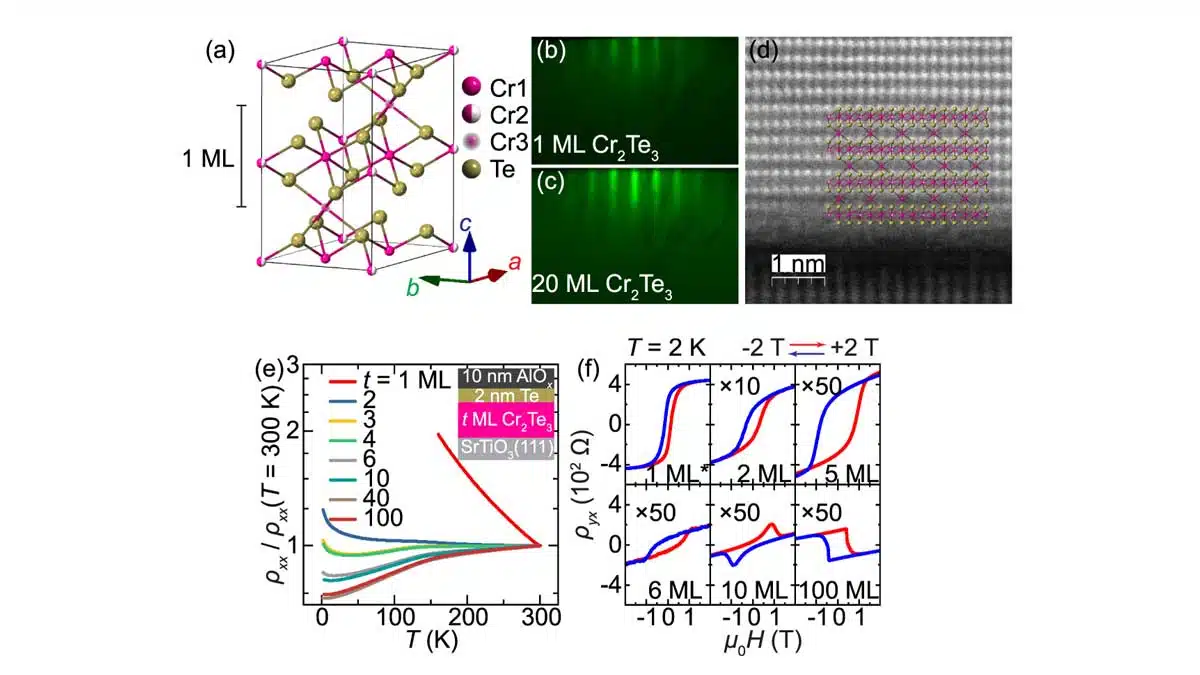
The study explores how coupling a two-dimensional (2D) ferromagnet—monolayer chromium telluride (Cr₂Te₃)—with a topological insulator (TI) can significantly enhance its magnetic properties. Using molecular beam epitaxy (MBE), researchers achieved wafer-scale growth of high-quality Cr₂Te₃ films down to a single monolayer on insulating substrates. They discovered that proximity to a TI, specifically (Bi,Sb)₂Te₃, increases the Curie temperature (T₍C₎) and magnetization, with experimental and theoretical evidence pointing to the Bloembergen–Rowland (BR) interaction as the underlying mechanism. This work opens pathways for designing interface-engineered magnetic topological devices.

RelatedPosts

YAGEO Introduces High‑Current Y2/X1 Film Capacitors for Wide-bandgap Power Systems

Amphenol Explanded Liquid Cooling Connectors for AI, ESS and EV Systems

Hirose Introduced BGA connector for PCIe Gen6 for AI and Edge Computing

Key Points

  • Material & Growth: Wafer-scale monolayer Cr₂Te₃ grown on SrTiO₃ (111) and Al₂O₃ (001) substrates via MBE.
  • Ferromagnetism in 2D Limit: Robust ferromagnetism persists down to a single monolayer.
  • TI Coupling Effect: Proximity to (Bi,Sb)₂Te₃ raises T₍C₎ from ~100 K to ~120 K in 2 ML films.
  • Experimental Evidence: Polarized neutron reflectometry (PNR) confirms significant magnetization enhancement with TI coupling.
  • Theoretical Model: BR interaction from TI surface states mediates stronger exchange coupling and perpendicular magnetic anisotropy.
  • Broader Implications: Strategy applicable to other 2D magnets for spintronic and quantum devices.

Extended Summary

Background & Motivation
Magnetism in 2D materials has become a focal point for next-generation information technologies, enabling applications in sensors, memory, and quantum devices. While several van der Waals magnets have been studied, achieving wafer-scale monolayer magnets on insulating substrates remains challenging. Cr₂Te₃ stands out due to its favorable crystalline and magnetic properties, including perpendicular magnetic anisotropy and compatibility with TI materials.

Material Growth & Characterization
The team synthesized Cr₂Te₃ films using MBE under Te-rich conditions, ensuring high crystallinity and atomically sharp interfaces. Structural analysis via RHEED, XRD, HRSTEM, and Raman spectroscopy confirmed uniformity and phase purity. Electrical transport measurements revealed metallic behavior in thick films and insulating tendencies in ultrathin layers, with anomalous Hall effect (AHE) signatures confirming ferromagnetism down to a single monolayer.

Magnetism Enhancement via TI Coupling
When 2 ML Cr₂Te₃ was interfaced with a 4-quintuple-layer (Bi,Sb)₂Te₃, the Curie temperature increased from ~100 K to ~120 K. Hall measurements and Arrott plots confirmed this enhancement, while PNR provided depth-resolved magnetization profiles, showing more than a twofold increase in saturation magnetization upon TI coupling. This effect was consistent across different substrates and measurement conditions.

Theoretical Insights
A model Hamiltonian was developed to describe the interaction between TI surface states and localized Cr moments. The analysis identified the Bloembergen–Rowland interaction—arising from virtual interband transitions in the TI—as the dominant mechanism enhancing ferromagnetic order and perpendicular magnetic anisotropy. The model predicts that this mechanism is broadly applicable to other TI–magnet heterostructures, with experimental parallels in materials like Cr₂Ge₂Te₆, Fe₃GeTe₂, LaCoO₃, and SrRuO₃.

Implications for Device Design
The findings suggest that TI-mediated exchange coupling can be a universal strategy for boosting T₍C₎ in 2D magnets, enabling stable ferromagnetism at higher temperatures. This has direct implications for spintronic devices, quantum information processing, and the development of all–van der Waals heterostructures.

Conclusion

This work demonstrates that monolayer Cr₂Te₃ retains robust ferromagnetism and that its magnetic properties can be significantly enhanced through proximity to a topological insulator. The combination of experimental measurements and theoretical modeling confirms the role of the Bloembergen–Rowland interaction in this enhancement. Beyond Cr₂Te₃, the approach offers a generalizable pathway for engineering high-performance 2D magnetic systems, paving the way for advanced magnetic topological electronics and spintronic applications.

Read the full paper:

Enhanced ferromagnetism in monolayer Cr2Te3 via topological insulator coupling

Published by IOP Publishing Ltd
Reports on Progress in Physics, Volume 88, Number 6

Citation Yunbo Ou et al 2025 Rep. Prog. Phys. 88 060501DOI 10.1088/1361-6633/add9c5
Related

Recent Posts

TDK Introduces High‑Voltage Common‑Mode Chokes for Compact 1250 V DC Converters

16.4.2026
16

Vishay Extends Power Inductors for DC/DC with 1212 Compact Case

16.4.2026
13

Modeling Planar Magnetics Temperature: Practical Guidelines for Power Electronics Engineers

15.4.2026
16

YAGEO Releases Ferrite Shielded Power Inductors for High‑Density Designs

15.4.2026
13

YAGEO Introduces EMI Suppression High‑Current 3‑phase Common Mode Chokes

14.4.2026
29

ECIA March 2026 Industry Pulse Points to Best Sales Climate in Five Years

13.4.2026
34

Coilcraft Unveils Molded Power Inductors for High‑Current VRMs

8.4.2026
39

Bourns Releases Compact High Current Shielded Power Inductors

2.4.2026
29

March 2026 Interconnect, Passives and Electromechanical Components Market Insights

2.4.2026
99

Upcoming Events

Apr 21
16:00 - 17:00 CEST

Heatsink Solutions: Thermal Management in electronic devices

Apr 22
17:00 - 17:30 CEST

Magnetics in a high frequency GaN era

Apr 22
17:00 - 18:00 CEST

Derating Tantalum, Film, and Ceramic Capacitors

View Calendar

Popular Posts

  • Buck Converter Design and Calculation

    0 shares
    Share 0 Tweet 0
  • Boost Converter Design and Calculation

    0 shares
    Share 0 Tweet 0
  • Flyback Converter Design and Calculation

    0 shares
    Share 0 Tweet 0
  • LLC Resonant Converter Design and Calculation

    0 shares
    Share 0 Tweet 0
  • Dual Active Bridge (DAB) Topology

    0 shares
    Share 0 Tweet 0
  • MLCC and Ceramic Capacitors

    0 shares
    Share 0 Tweet 0
  • Capacitor Charging and Discharging

    0 shares
    Share 0 Tweet 0
  • Plastic Materials Dielectric Constant and DF

    4 shares
    Share 4 Tweet 0
  • Ripple Current and its Effects on the Performance of Capacitors

    3 shares
    Share 3 Tweet 0
  • MLCC Case Sizes Standards Explained

    0 shares
    Share 0 Tweet 0

Newsletter Subscription


Passive Components Blog

© EPCI - Leading Passive Components Educational and Information Site

  • Home
  • Privacy Policy
  • EPCI Membership & Advertisement
  • About

No Result
View All Result
  • Home
  • Knowledge Blog
  • PCNS

© EPCI - Leading Passive Components Educational and Information Site

This website uses cookies. By continuing to use this website you are giving consent to cookies being used. Visit our Privacy and Cookie Policy.
Go to mobile version