











Passive Components Blog
No Result
View All Result
  • Home
  • NewsFilter
    • All
    • Aerospace & Defence
    • Antenna
    • Applications
    • Automotive
    • Capacitors
    • Circuit Protection Devices
    • electro-mechanical news
    • Filters
    • Fuses
    • Inductors
    • Industrial
    • Integrated Passives
    • inter-connect news
    • Market & Supply Chain
    • Market Insights
    • Medical
    • Modelling and Simulation
    • New Materials & Supply
    • New Technologies
    • Non-linear Passives
    • Oscillators
    • Passive Sensors News
    • Resistors
    • RF & Microwave
    • Telecommunication
    • Weekly Digest

    Bourns Introduces LTCC GNSS L‑Band Diplexer for Compact RF Front Ends

    TT Electronics: How Qualification Underpins Reliable Selection of Thick‑Film Resistors

    Modelithics Extends Models for Microchip PIN and Varactor Diodes

    Exxelia Offers 1200V Capacitors and Magnetics for 800V Aerospace Platforms

    Wk 28 Electronics Supply Chain Digest

    Bourns Introduces Automotive BMS Signal Transformer with Integrated Common Mode Chokes

    Itelcond Introduces High‑Voltage Aluminium Capacitors for Modern IGBT DC‑links

    Bourns Introduces Automotive Shielded Power Inductors for Compact DC‑DC Converters

    EMC Design Fundamentals: Safe Use of Varistors and Common Mode Chokes in Mains and Data-Line Filters

    Trending Tags

    • Ripple Current
    • RF
    • Leakage Current
    • Tantalum vs Ceramic
    • Snubber
    • Low ESR
    • Feedthrough
    • Derating
    • Dielectric Constant
    • New Products
    • Market Reports
  • VideoFilter
    • All
    • Antenna videos
    • Capacitor videos
    • Circuit Protection Video
    • Filter videos
    • Fuse videos
    • Inductor videos
    • Inter-Connect Video
    • Non-linear passives videos
    • Oscillator videos
    • Passive sensors videos
    • Resistor videos

    EMC Design Fundamentals: Safe Use of Varistors and Common Mode Chokes in Mains and Data-Line Filters

    Ferrite versus Nanocrystalline Power Inductor Cores: Turns, Gap and Size

    KYOCERA AVX Presents Antenna Integrator Studio Tutorial for Antenna Placement and RF Design

    Power Design Simulation Tools for Faster Inductor Selection and Loss Optimization

    EMC‑Compliant PCB and Connector Design Guidelines

    Why Isolated DC/DC Power Supplies Fail Late, Würth Elektronik Podcast

    Designing 800 V DC EMC Filters: Calculation, Simulation and Measurement

    Current Sense Transformer Datasheet and Design‑in Guide

    Designing a USB Type‑C Flyback Planar Transformer with Frenetic’s Planar Tool

    Trending Tags

    • Capacitors explained
    • Inductors explained
    • Resistors explained
    • Filters explained
    • Application Video Guidelines
    • EMC
    • New Products
    • Ripple Current
    • Simulation
    • Tantalum vs Ceramic
  • Knowledge Blog
  • Dossiers
    • AI Hardware Dossier
    • Power Converter Dossier
    • Automotive Dossier
    • Capacitor Dossier
    • Resistor Dossier
    • Inductor Dossier
    • Circuit Protection Dossier
  • Suppliers
    • Who is Who
  • PCNS
    • PCNS 2025
    • PCNS 2023
    • PCNS 2021
    • PCNS 2019
    • PCNS 2017
  • Events
  • Home
  • NewsFilter
    • All
    • Aerospace & Defence
    • Antenna
    • Applications
    • Automotive
    • Capacitors
    • Circuit Protection Devices
    • electro-mechanical news
    • Filters
    • Fuses
    • Inductors
    • Industrial
    • Integrated Passives
    • inter-connect news
    • Market & Supply Chain
    • Market Insights
    • Medical
    • Modelling and Simulation
    • New Materials & Supply
    • New Technologies
    • Non-linear Passives
    • Oscillators
    • Passive Sensors News
    • Resistors
    • RF & Microwave
    • Telecommunication
    • Weekly Digest

    Bourns Introduces LTCC GNSS L‑Band Diplexer for Compact RF Front Ends

    TT Electronics: How Qualification Underpins Reliable Selection of Thick‑Film Resistors

    Modelithics Extends Models for Microchip PIN and Varactor Diodes

    Exxelia Offers 1200V Capacitors and Magnetics for 800V Aerospace Platforms

    Wk 28 Electronics Supply Chain Digest

    Bourns Introduces Automotive BMS Signal Transformer with Integrated Common Mode Chokes

    Itelcond Introduces High‑Voltage Aluminium Capacitors for Modern IGBT DC‑links

    Bourns Introduces Automotive Shielded Power Inductors for Compact DC‑DC Converters

    EMC Design Fundamentals: Safe Use of Varistors and Common Mode Chokes in Mains and Data-Line Filters

    Trending Tags

    • Ripple Current
    • RF
    • Leakage Current
    • Tantalum vs Ceramic
    • Snubber
    • Low ESR
    • Feedthrough
    • Derating
    • Dielectric Constant
    • New Products
    • Market Reports
  • VideoFilter
    • All
    • Antenna videos
    • Capacitor videos
    • Circuit Protection Video
    • Filter videos
    • Fuse videos
    • Inductor videos
    • Inter-Connect Video
    • Non-linear passives videos
    • Oscillator videos
    • Passive sensors videos
    • Resistor videos

    EMC Design Fundamentals: Safe Use of Varistors and Common Mode Chokes in Mains and Data-Line Filters

    Ferrite versus Nanocrystalline Power Inductor Cores: Turns, Gap and Size

    KYOCERA AVX Presents Antenna Integrator Studio Tutorial for Antenna Placement and RF Design

    Power Design Simulation Tools for Faster Inductor Selection and Loss Optimization

    EMC‑Compliant PCB and Connector Design Guidelines

    Why Isolated DC/DC Power Supplies Fail Late, Würth Elektronik Podcast

    Designing 800 V DC EMC Filters: Calculation, Simulation and Measurement

    Current Sense Transformer Datasheet and Design‑in Guide

    Designing a USB Type‑C Flyback Planar Transformer with Frenetic’s Planar Tool

    Trending Tags

    • Capacitors explained
    • Inductors explained
    • Resistors explained
    • Filters explained
    • Application Video Guidelines
    • EMC
    • New Products
    • Ripple Current
    • Simulation
    • Tantalum vs Ceramic
  • Knowledge Blog
  • Dossiers
    • AI Hardware Dossier
    • Power Converter Dossier
    • Automotive Dossier
    • Capacitor Dossier
    • Resistor Dossier
    • Inductor Dossier
    • Circuit Protection Dossier
  • Suppliers
    • Who is Who
  • PCNS
    • PCNS 2025
    • PCNS 2023
    • PCNS 2021
    • PCNS 2019
    • PCNS 2017
  • Events
No Result
View All Result
Passive Components Blog
No Result
View All Result

Researchers Propose Novel MLCC Dielectric Design to Increase Energy Storage Capacity

24.7.2025
Reading Time: 3 mins read
A A
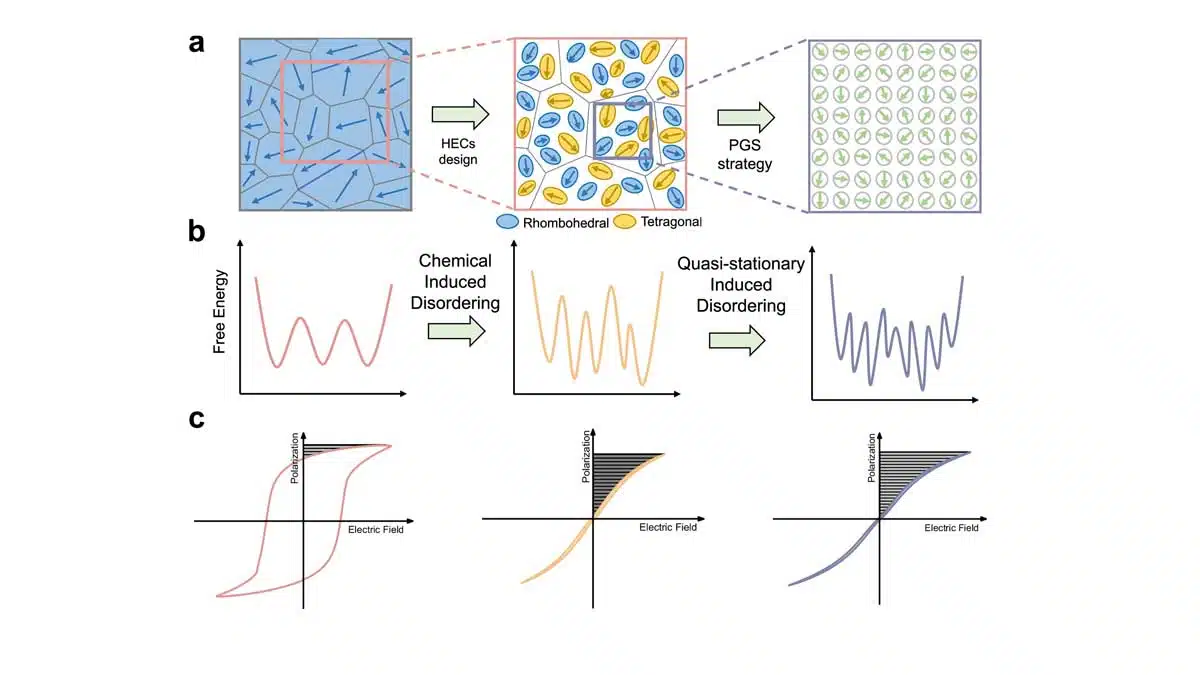
Comparative display of a grain size and domain structure; b free energy; c P-E loops after high-entropy ceramics (HECs) and PGS design. source: Nature Communications  ISSN 2041-1723

Comparative display of a grain size and domain structure; b free energy; c P-E loops after high-entropy ceramics (HECs) and PGS design. source: Nature Communications ISSN 2041-1723

Researchers from Dianzi University, Hangzhou, Zhejiang, China published their study in nature communications journal on novel polar glass state strategy to enhance energy storage performance of MLCC ceramic capacitors.

Introduction

RelatedPosts

Bourns Introduces LTCC GNSS L‑Band Diplexer for Compact RF Front Ends

TT Electronics: How Qualification Underpins Reliable Selection of Thick‑Film Resistors

Modelithics Extends Models for Microchip PIN and Varactor Diodes

Multilayer ceramic capacitors (MLCCs) are key components in modern electronics, prized for their compact size, high power density, and fast charge–discharge rates.

Despite significant progress, achieving both high recoverable energy density and efficiency across a wide temperature range remains challenging. This study introduces a novel “polar glass state” (PGS) strategy to overcome these limitations in Bi₀.₅Na₀.₅TiO₃-based MLCCs, enabling ultrahigh energy storage performance with exceptional thermal and cycling stability.

Key Points

  • A polar glass state (PGS) strategy disrupts nanoscale ferroelectric order and minimizes hysteresis loss.
  • Bi₀.₅Na₀.₅TiO₃–based MLCCs reach 22.92 J cm⁻³ recoverable energy density and 97.1% efficiency at 1200 kV cm⁻¹.
  • High breakdown strength (1200 kV cm⁻¹) is achieved via hierarchical grain refinement.
  • Stable performance up to 150 °C with less than 2% efficiency fluctuation.
  • Excellent cycling reliability demonstrated over 10⁵ charge–discharge cycles.

Extended Summary

The escalating demand for efficient and miniaturized energy storage devices, driven by electric vehicles and pulsed power systems, calls for dielectric capacitors that deliver both high energy density and efficiency. Traditional MLCCs often suffer from significant hysteresis losses and decline in performance at elevated temperatures, limiting their broader application.

To address these challenges, the authors propose the polar glass state, a non-equilibrium structural design that “freezes” the material in a state where atomic-scale polarizations are randomly distributed. By introducing controlled chemical heterogeneity and carefully tuning sintering dynamics, long-range ferroelectric regions are disrupted, reducing remnant polarization and lowering energy barriers for polarization switching.

Using a base matrix of 0.82Bi₀.₅Na₀.₅TiO₃–0.18Bi₀.₅K₀.₅TiO₃ modified with Sr(Sc₀.₅Ta₀.₅)O₃, the team fabricated tape-cast multilayer capacitors (1.88 R-MLCCs) with six dielectric layers and platinum electrodes. These capacitors exhibit ultralow hysteresis loops at room temperature, with a maximum polarization (Pₘ) of 58.5 μC cm⁻² and a remnant polarization (Pᵣ) near zero.

Energy storage testing under a field of 1200 kV cm⁻¹ reveals a recoverable energy density of 22.92 J cm⁻³ and efficiency of 97.1%. Weibull analysis shows an increase in breakdown strength from 425 kV cm⁻¹ in bulk ceramics to 1200 kV cm⁻¹ in MLCCs, thanks to grain size reduction to roughly 0.5 μm. Performance remains robust up to 150 °C, delivering over 14 J cm⁻³ with under 2% efficiency drop.

Reliability tests highlight impressive cycling stability, with less than 1% degradation after 10⁵ cycles at 800 kV cm⁻¹. Fast discharge experiments demonstrate over 16 J cm⁻³ released within 2.8 μs, confirming suitability for high-power pulsed applications.

Comprehensive structural analyses across multiple scales—atomistic via AC-STEM, short-range by total scattering, long-range by XRD, and micro-range by PFM—validate the persistence of the PGS from 25 °C to 150 °C. The randomized polarization distribution and stable R/T phase coexistence underpin both the high energy storage capabilities and thermal resilience.

Conclusion

This work establishes the polar glass state as a transformative design paradigm for MLCCs, achieving record-high energy density and efficiency alongside unmatched thermal and cycling reliability. By engineering disorder at multiple length scales, the study paves the way for next-generation dielectric capacitors in demanding applications, from compact on-chip energy storage to advanced pulsed power systems.

Read the full original scientific paper here:

Zhao, W., Liu, Z., Xu, D. et al. Advanced stability and energy storage capacity in hierarchically engineered Bi0.5Na0.5TiO3-based multilayer capacitors. Nat Commun 16, 6549 (2025). https://doi.org/10.1038/s41467-025-61936-2

Related

Source: Nat Communication

Recent Posts

Exxelia Offers 1200V Capacitors and Magnetics for 800V Aerospace Platforms

22.7.2026
51

Itelcond Introduces High‑Voltage Aluminium Capacitors for Modern IGBT DC‑links

17.7.2026
89

EMC Design Fundamentals: Safe Use of Varistors and Common Mode Chokes in Mains and Data-Line Filters

16.7.2026
131

Murata Unveils Lead Disc Ceramic Capacitors for Automotive Safety and EMI Suppression

15.7.2026
76

Square-Wave Harmonics and RMS Currents in Power Converters

14.7.2026
84

LeanBOM: Practical Cross‑Technology Capacitor Search by Real Working Conditions

14.7.2026
92

In the Age of AI, Every Watt Counts: Implications for Components

13.7.2026
120

RF Filters and Passive Components Enabling the 7 Missile RF Subsystems

9.7.2026
72

Ferrite versus Nanocrystalline Power Inductor Cores: Turns, Gap and Size

9.7.2026
102

Upcoming Events

Jul 28
8:00 - 11:00 CEST

Post Procurement Testing of EEE Components for LEO Space Applications

Jul 29
17:30 - 18:30 CEST

To Ferrite or to Nanocrystalline in Transformer Design

Sep 29
16:00 - 17:00 CEST

Cybersecurity 2026

View Calendar

Popular Posts

  • Boost Converter Design and Calculation

    0 shares
    Share 0 Tweet 0
  • Buck Converter Design and Calculation

    0 shares
    Share 0 Tweet 0
  • YAGEO Announces July 2026 Capacitor Price Increase

    0 shares
    Share 0 Tweet 0
  • Flyback Converter Design and Calculation

    0 shares
    Share 0 Tweet 0
  • LLC Resonant Converter Design and Calculation

    0 shares
    Share 0 Tweet 0
  • MLCCs in the Age of AI: Q2 2026 Market Tightness

    0 shares
    Share 0 Tweet 0
  • MLCC and Ceramic Capacitors

    0 shares
    Share 0 Tweet 0
  • Earthing Systems and IEC Classification Explained

    0 shares
    Share 0 Tweet 0
  • Dual Active Bridge (DAB) Topology

    0 shares
    Share 0 Tweet 0
  • Nvidia Vera Rubin: Why One AI Rack Needs So Many More MLCC Capacitors

    0 shares
    Share 0 Tweet 0

Newsletter Subscription


Passive Components Blog

© EPCI - Leading Passive Components Educational and Information Site

  • Home
  • Privacy Policy
  • EPCI Membership & Advertisement
  • About

No Result
View All Result
  • Home
  • Knowledge Blog
  • Dossiers
  • PCNS

© EPCI - Leading Passive Components Educational and Information Site

This website uses cookies. By continuing to use this website you are giving consent to cookies being used. Visit our Privacy and Cookie Policy.