






Passive Components Blog
No Result
View All Result
  • Home
  • NewsFilter
    • All
    • Aerospace & Defence
    • Antenna
    • Applications
    • Automotive
    • Capacitors
    • Circuit Protection Devices
    • electro-mechanical news
    • Filters
    • Fuses
    • Inductors
    • Industrial
    • Integrated Passives
    • inter-connect news
    • Market & Supply Chain
    • Market Insights
    • Medical
    • Modelling and Simulation
    • New Materials & Supply
    • New Technologies
    • Non-linear Passives
    • Oscillators
    • Passive Sensors News
    • Resistors
    • RF & Microwave
    • Telecommunication
    • Weekly Digest

    Modeling Planar Magnetics Temperature: Practical Guidelines for Power Electronics Engineers

    YAGEO Releases Ferrite Shielded Power Inductors for High‑Density Designs

    Samsung Presents MLCC Selection Guide for Humanoids and Robotic Applications

    AI-Assisted Structural Diagnostics and Physics-Based Reliability Interpretation of Tantalum Capacitor Anodes

    YAGEO Introduces EMI Suppression High‑Current 3‑phase Common Mode Chokes

    KYOCERA AVX MIL-PRF-32535 BME NP0 MLCCs Approved to the DLA QPD

    ECIA March 2026 Industry Pulse Points to Best Sales Climate in Five Years

    Vishay Releases 2-Way Wilkinson Divider / Combiner for 15–20 GHz RF Front Ends

    Wk 15 Electronics Supply Chain Digest

    Trending Tags

    • Ripple Current
    • RF
    • Leakage Current
    • Tantalum vs Ceramic
    • Snubber
    • Low ESR
    • Feedthrough
    • Derating
    • Dielectric Constant
    • New Products
    • Market Reports
  • VideoFilter
    • All
    • Antenna videos
    • Capacitor videos
    • Circuit Protection Video
    • Filter videos
    • Fuse videos
    • Inductor videos
    • Inter-Connect Video
    • Non-linear passives videos
    • Oscillator videos
    • Passive sensors videos
    • Resistor videos

    Transformer-Based Power-Line Harvester Magnetic Design

    Thermal Modeling of Magnetics

    Standard vs Planar LLC transformers Comparison for Battery Chargers

    How Modern Tools Model Magnetic Components for Power Electronics

    Advanced Loss Modeling for Planar Magnetics in the Frenetic Planar Tool

    2026 Power Magnetics Design Trends: Flyback, DAB and Planar

    Enabling Software‑Defined Vehicle Architectures: Automotive Ethernet and Zonal Smart Power

    Calculating Resistance Value of a Flyback RC Snubber 

    One‑Pulse Characterization of Nonlinear Power Inductors

    Trending Tags

    • Capacitors explained
    • Inductors explained
    • Resistors explained
    • Filters explained
    • Application Video Guidelines
    • EMC
    • New Products
    • Ripple Current
    • Simulation
    • Tantalum vs Ceramic
  • Knowledge Blog
  • DossiersNew
  • Suppliers
    • Who is Who
  • PCNS
    • PCNS 2025
    • PCNS 2023
    • PCNS 2021
    • PCNS 2019
    • PCNS 2017
  • Events
  • Home
  • NewsFilter
    • All
    • Aerospace & Defence
    • Antenna
    • Applications
    • Automotive
    • Capacitors
    • Circuit Protection Devices
    • electro-mechanical news
    • Filters
    • Fuses
    • Inductors
    • Industrial
    • Integrated Passives
    • inter-connect news
    • Market & Supply Chain
    • Market Insights
    • Medical
    • Modelling and Simulation
    • New Materials & Supply
    • New Technologies
    • Non-linear Passives
    • Oscillators
    • Passive Sensors News
    • Resistors
    • RF & Microwave
    • Telecommunication
    • Weekly Digest

    Modeling Planar Magnetics Temperature: Practical Guidelines for Power Electronics Engineers

    YAGEO Releases Ferrite Shielded Power Inductors for High‑Density Designs

    Samsung Presents MLCC Selection Guide for Humanoids and Robotic Applications

    AI-Assisted Structural Diagnostics and Physics-Based Reliability Interpretation of Tantalum Capacitor Anodes

    YAGEO Introduces EMI Suppression High‑Current 3‑phase Common Mode Chokes

    KYOCERA AVX MIL-PRF-32535 BME NP0 MLCCs Approved to the DLA QPD

    ECIA March 2026 Industry Pulse Points to Best Sales Climate in Five Years

    Vishay Releases 2-Way Wilkinson Divider / Combiner for 15–20 GHz RF Front Ends

    Wk 15 Electronics Supply Chain Digest

    Trending Tags

    • Ripple Current
    • RF
    • Leakage Current
    • Tantalum vs Ceramic
    • Snubber
    • Low ESR
    • Feedthrough
    • Derating
    • Dielectric Constant
    • New Products
    • Market Reports
  • VideoFilter
    • All
    • Antenna videos
    • Capacitor videos
    • Circuit Protection Video
    • Filter videos
    • Fuse videos
    • Inductor videos
    • Inter-Connect Video
    • Non-linear passives videos
    • Oscillator videos
    • Passive sensors videos
    • Resistor videos

    Transformer-Based Power-Line Harvester Magnetic Design

    Thermal Modeling of Magnetics

    Standard vs Planar LLC transformers Comparison for Battery Chargers

    How Modern Tools Model Magnetic Components for Power Electronics

    Advanced Loss Modeling for Planar Magnetics in the Frenetic Planar Tool

    2026 Power Magnetics Design Trends: Flyback, DAB and Planar

    Enabling Software‑Defined Vehicle Architectures: Automotive Ethernet and Zonal Smart Power

    Calculating Resistance Value of a Flyback RC Snubber 

    One‑Pulse Characterization of Nonlinear Power Inductors

    Trending Tags

    • Capacitors explained
    • Inductors explained
    • Resistors explained
    • Filters explained
    • Application Video Guidelines
    • EMC
    • New Products
    • Ripple Current
    • Simulation
    • Tantalum vs Ceramic
  • Knowledge Blog
  • DossiersNew
  • Suppliers
    • Who is Who
  • PCNS
    • PCNS 2025
    • PCNS 2023
    • PCNS 2021
    • PCNS 2019
    • PCNS 2017
  • Events
No Result
View All Result
Passive Components Blog
No Result
View All Result

Samsungs Low ESL MLCCs to Power Next-Generation ADAS SoCs

10.12.2025
Reading Time: 4 mins read
A A

Samsung Electro-Mechanics’s latest Low ESL (Equivalent Series Inductance) MLCCs, provides high-capacitance and low ESL features designed to meet the demanding requirements of Advanced Driver Assistance Systems (ADAS).

As ADAS SoCs (System-on-Chips) evolve with higher performance and increased power consumption, these new capacitors ensure stable operation in high-power and high-frequency environments.

RelatedPosts

Samsung Presents MLCC Selection Guide for Humanoids and Robotic Applications

Samsung Introduces 35V MLCCs Flying Capacitors for USB PD Fast Charging

Samsung Outlines Growth Roadmap at its 52nd General Shareholders Meeting

Key Benefits of Low ESL MLCCs

  • High Capacitance: Supports stable SoC operation under heavy loads.
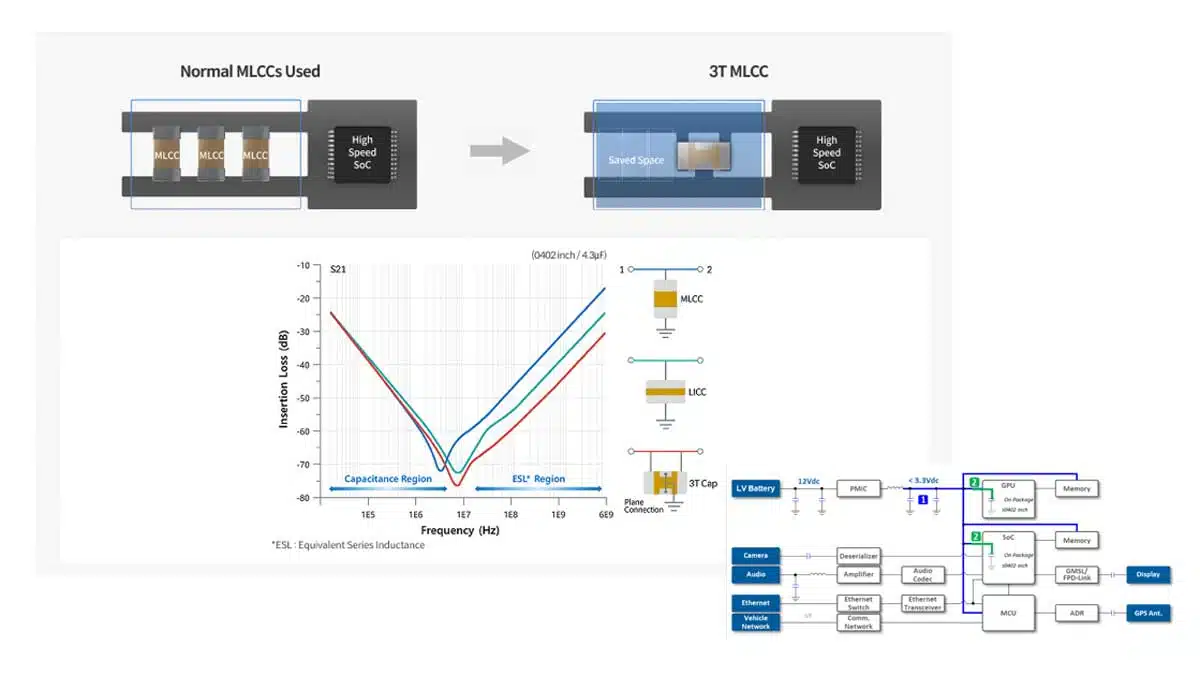
  • Low ESL Characteristics: Effectively suppresses high-frequency noise caused by loop inductance.
  • Space Efficiency: Achieves over 30% board space savings compared to conventional MLCCs.
  • Reduced Component Count: Provides stable power supply with fewer devices, ideal for compact automotive circuits.
Product Lineup

Samsung Electro-Mechanics offers a wide range of MLCCs tailored for ADAS applications:

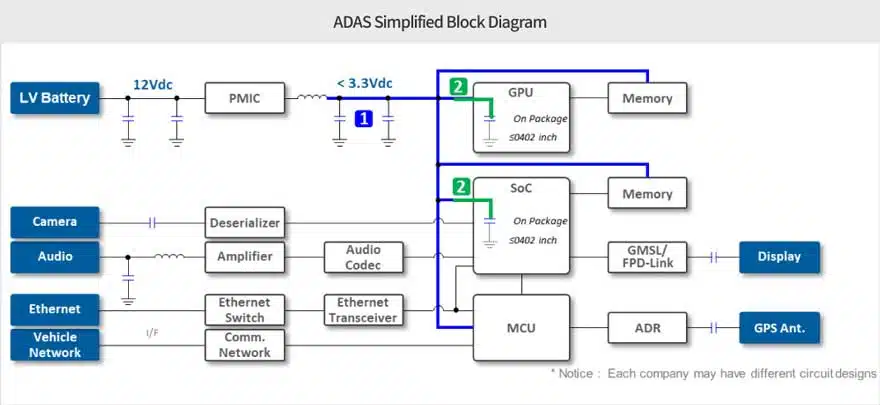
1 (see Fig above) Low Frequency Decoupling2 (see Fig above) High Frequency Decoupling
NeedsHigh-CapacitanceLow ESL Low Profile (Ultra-thin)
MLCCs0201 inch ~1㎌
0402 inch ~2.2㎌
0603/0805 inch ~22㎌
1206 inch ~47㎌
1210 inch ~220㎌
*0402 inch 10㎌
*0805 inch 47㎌
*1206 inch 100㎌
*Under Development
0402 inch Reversed Type
*0402 inch 4.3㎌ 3-Terminal
*0603 inch 10㎌ 3-Terminal

*Under Development
SamsungCL03Z105MRR6PN#
CL05Y225KP66PN#
CL10Z226MR96PN#
CL21Z226MQYVPN#
CL31Z476MQKVPN#
CL32Z227MSV6PN#
CLL5Z105MS21PN#
CL05Z105MR41PT# (New)
CL10Z105MO66PT# (New)

Second Solution: Low ESL(3T) MLCC

As ADAS SoCs evolve, there is a growing need for MLCCs which offer both high capacitance and low ESL characteristics for stable SoC operations under high power/high frequency circumstances. As the switching frequency of SoCs increases, loop inductance generates high-frequency noise, which is suppressed by MLCCs. ​

Low ESL(3T) MLCCs excel at mitigating high-frequency noise, enabling stable power supply with fewer devices compared to normal MLCCs. This makes them an excellent solution in circuits with limited board space.
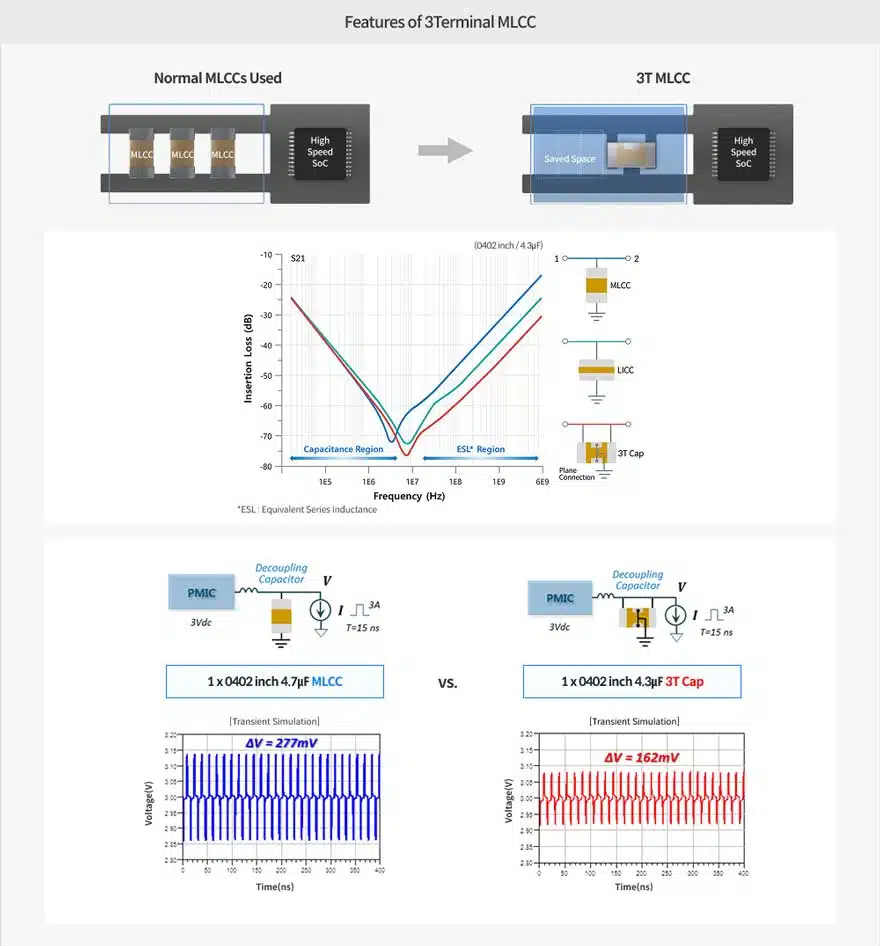
In addition to meeting the electrical requirements of this application, Low ESL(3T) MLCCs can achieve space savings of over 30%. ​

Size
(inch/mm)
Related
Voltage
TCCCapacitancePart NumberMP Status
0402/10054.0VdcX7T1.0㎌CL05Z105MR41PT#NEW
0603/160816VdcX7T1.0㎌CL10Z105MO66PT#NEW

Alongside this newly introduced product, Samsung Electro-Mechanics is also developing 3T MLCCs with sizes of 0603 inch or smaller and capacitances of 1µF or higher, and will continue to expand its MLCC line-up to meet market needs.

For more information, visit Samsung Electro-Mechanics Component Center.
Related

Source: Samsung Electro-Mechanics

Recent Posts

YAGEO Releases Ferrite Shielded Power Inductors for High‑Density Designs

15.4.2026
4

Samsung Presents MLCC Selection Guide for Humanoids and Robotic Applications

15.4.2026
4

AI-Assisted Structural Diagnostics and Physics-Based Reliability Interpretation of Tantalum Capacitor Anodes

14.4.2026
13

KYOCERA AVX MIL-PRF-32535 BME NP0 MLCCs Approved to the DLA QPD

14.4.2026
15

ECIA March 2026 Industry Pulse Points to Best Sales Climate in Five Years

13.4.2026
27

Coilcraft Unveils Molded Power Inductors for High‑Current VRMs

8.4.2026
39

Murata Automotive MLCCs Push Capacitance Limits for ADAS and Power Lines

8.4.2026
40

TDK and Nippon Chemical Launch Joint Venture for MLCC Materials

7.4.2026
42

March 2026 Interconnect, Passives and Electromechanical Components Market Insights

2.4.2026
95

Upcoming Events

Apr 21
16:00 - 17:00 CEST

Heatsink Solutions: Thermal Management in electronic devices

Apr 29
10:00 - 11:00 CDT

SEPIC Design Done Right

May 5
16:00 - 17:00 CEST

Understanding and Selecting Capacitors – Fundamentals, Technologies and Latest Trends

View Calendar

Popular Posts

  • Buck Converter Design and Calculation

    0 shares
    Share 0 Tweet 0
  • Boost Converter Design and Calculation

    0 shares
    Share 0 Tweet 0
  • Flyback Converter Design and Calculation

    0 shares
    Share 0 Tweet 0
  • LLC Resonant Converter Design and Calculation

    0 shares
    Share 0 Tweet 0
  • MLCC and Ceramic Capacitors

    0 shares
    Share 0 Tweet 0
  • Dual Active Bridge (DAB) Topology

    0 shares
    Share 0 Tweet 0
  • Capacitor Charging and Discharging

    0 shares
    Share 0 Tweet 0
  • Plastic Materials Dielectric Constant and DF

    4 shares
    Share 4 Tweet 0
  • MLCC Case Sizes Standards Explained

    0 shares
    Share 0 Tweet 0
  • Ripple Current and its Effects on the Performance of Capacitors

    3 shares
    Share 3 Tweet 0

Newsletter Subscription


Passive Components Blog

© EPCI - Leading Passive Components Educational and Information Site

  • Home
  • Privacy Policy
  • EPCI Membership & Advertisement
  • About

No Result
View All Result
  • Home
  • Knowledge Blog
  • PCNS

© EPCI - Leading Passive Components Educational and Information Site

This website uses cookies. By continuing to use this website you are giving consent to cookies being used. Visit our Privacy and Cookie Policy.
Go to mobile version