





Passive Components Blog
No Result
View All Result
  • Home
  • NewsFilter
    • All
    • Aerospace & Defence
    • Antenna
    • Applications
    • Automotive
    • Capacitors
    • Circuit Protection Devices
    • electro-mechanical news
    • Filters
    • Fuses
    • Inductors
    • Industrial
    • Integrated Passives
    • inter-connect news
    • Market & Supply Chain
    • Market Insights
    • Medical
    • Modelling and Simulation
    • New Materials & Supply
    • New Technologies
    • Non-linear Passives
    • Oscillators
    • Passive Sensors News
    • Resistors
    • RF & Microwave
    • Telecommunication
    • Weekly Digest

    EMC‑Compliant PCB and Connector Design Guidelines

    Practical Value of Structural Diagnostics for Tantalum Capacitor Anodes

    Hall-Effect Sensing for Harsh Environments: TT Electronics Selected in NASA’s Dragonfly Fan

    Bourns Releases Automotive Gate Driver Transformer for Isolated Power

    Stackpole Releases High-Frequency Thin Film Chip Resistors for RF up to 50 GHz

    Knowles Expands High‑Q Ceramic Core Inductors for RF designs

    Vishay Unveils 1.5 kV IHDV High Voltage Power Inductors for EV and Industrial Converters

    SCHURTER Introduces PPTC Resettable Overcurrent Protection for Compact Electronics

    TrendForce: CSP in‑house AI ASIC Boom Reshapes Capacitor Demand

    Trending Tags

    • Ripple Current
    • RF
    • Leakage Current
    • Tantalum vs Ceramic
    • Snubber
    • Low ESR
    • Feedthrough
    • Derating
    • Dielectric Constant
    • New Products
    • Market Reports
  • VideoFilter
    • All
    • Antenna videos
    • Capacitor videos
    • Circuit Protection Video
    • Filter videos
    • Fuse videos
    • Inductor videos
    • Inter-Connect Video
    • Non-linear passives videos
    • Oscillator videos
    • Passive sensors videos
    • Resistor videos

    EMC‑Compliant PCB and Connector Design Guidelines

    Why Isolated DC/DC Power Supplies Fail Late, Würth Elektronik Podcast

    Designing 800 V DC EMC Filters: Calculation, Simulation and Measurement

    Current Sense Transformer Datasheet and Design‑in Guide

    Designing a USB Type‑C Flyback Planar Transformer with Frenetic’s Planar Tool

    Magnetics Design in High‑Frequency GaN Converters

    Qi2 Wireless Charging: Inductors, Capacitors and EMC Filters

    Two‑capacitor paradox explained for engineers

    Capacitances of Nonlinear MLCCs: What Datasheets Don’t Tell You

    Trending Tags

    • Capacitors explained
    • Inductors explained
    • Resistors explained
    • Filters explained
    • Application Video Guidelines
    • EMC
    • New Products
    • Ripple Current
    • Simulation
    • Tantalum vs Ceramic
  • Knowledge Blog
  • DossiersNew
  • Suppliers
    • Who is Who
  • PCNS
    • PCNS 2025
    • PCNS 2023
    • PCNS 2021
    • PCNS 2019
    • PCNS 2017
  • Events
  • Home
  • NewsFilter
    • All
    • Aerospace & Defence
    • Antenna
    • Applications
    • Automotive
    • Capacitors
    • Circuit Protection Devices
    • electro-mechanical news
    • Filters
    • Fuses
    • Inductors
    • Industrial
    • Integrated Passives
    • inter-connect news
    • Market & Supply Chain
    • Market Insights
    • Medical
    • Modelling and Simulation
    • New Materials & Supply
    • New Technologies
    • Non-linear Passives
    • Oscillators
    • Passive Sensors News
    • Resistors
    • RF & Microwave
    • Telecommunication
    • Weekly Digest

    EMC‑Compliant PCB and Connector Design Guidelines

    Practical Value of Structural Diagnostics for Tantalum Capacitor Anodes

    Hall-Effect Sensing for Harsh Environments: TT Electronics Selected in NASA’s Dragonfly Fan

    Bourns Releases Automotive Gate Driver Transformer for Isolated Power

    Stackpole Releases High-Frequency Thin Film Chip Resistors for RF up to 50 GHz

    Knowles Expands High‑Q Ceramic Core Inductors for RF designs

    Vishay Unveils 1.5 kV IHDV High Voltage Power Inductors for EV and Industrial Converters

    SCHURTER Introduces PPTC Resettable Overcurrent Protection for Compact Electronics

    TrendForce: CSP in‑house AI ASIC Boom Reshapes Capacitor Demand

    Trending Tags

    • Ripple Current
    • RF
    • Leakage Current
    • Tantalum vs Ceramic
    • Snubber
    • Low ESR
    • Feedthrough
    • Derating
    • Dielectric Constant
    • New Products
    • Market Reports
  • VideoFilter
    • All
    • Antenna videos
    • Capacitor videos
    • Circuit Protection Video
    • Filter videos
    • Fuse videos
    • Inductor videos
    • Inter-Connect Video
    • Non-linear passives videos
    • Oscillator videos
    • Passive sensors videos
    • Resistor videos

    EMC‑Compliant PCB and Connector Design Guidelines

    Why Isolated DC/DC Power Supplies Fail Late, Würth Elektronik Podcast

    Designing 800 V DC EMC Filters: Calculation, Simulation and Measurement

    Current Sense Transformer Datasheet and Design‑in Guide

    Designing a USB Type‑C Flyback Planar Transformer with Frenetic’s Planar Tool

    Magnetics Design in High‑Frequency GaN Converters

    Qi2 Wireless Charging: Inductors, Capacitors and EMC Filters

    Two‑capacitor paradox explained for engineers

    Capacitances of Nonlinear MLCCs: What Datasheets Don’t Tell You

    Trending Tags

    • Capacitors explained
    • Inductors explained
    • Resistors explained
    • Filters explained
    • Application Video Guidelines
    • EMC
    • New Products
    • Ripple Current
    • Simulation
    • Tantalum vs Ceramic
  • Knowledge Blog
  • DossiersNew
  • Suppliers
    • Who is Who
  • PCNS
    • PCNS 2025
    • PCNS 2023
    • PCNS 2021
    • PCNS 2019
    • PCNS 2017
  • Events
No Result
View All Result
Passive Components Blog
No Result
View All Result

YAGEO Extends Rectangular Aluminum Electrolytic Capacitor Family

15.5.2025
Reading Time: 4 mins read
A A

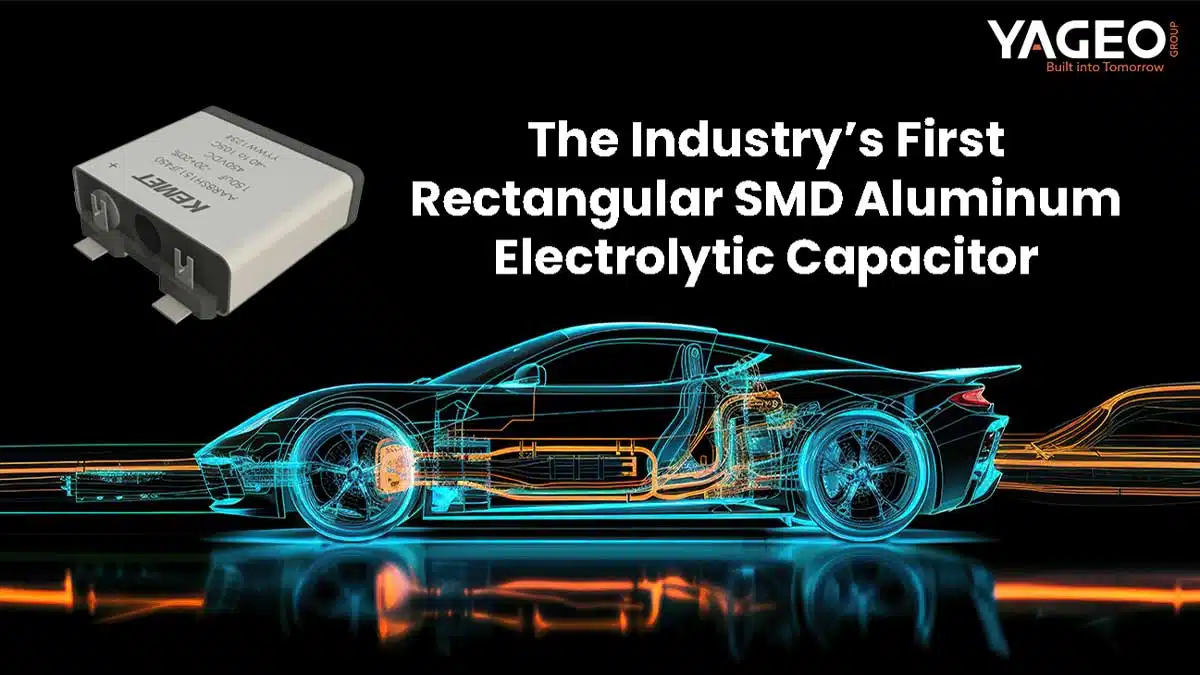
YAGEO, a leader in advanced capacitor technology, continues to push the boundaries of innovation with its latest addition to the AAR8S Rectangular Aluminum Electrolytic Capacitor family. 

AAR8S, the industry’s first-to-market rectangular aluminum electrolytic surface-mount capacitor, offers high volumetric efficiency, high reliability, and ease of thermal management, solidifying YAGEO’s position at the front of next-generation capacitor solutions.

RelatedPosts

YAGEO Introduces 310VAC SMD Y2 Safety MP Capacitors for Compact EMI Filtering

YAGEO Releases Cost Efficient Pt‑RTD Sensors with Ni wires

Passive Components Enable Safe and Reliable ADAS Architectures

Why Rectangular Capacitors?

The rectangular form factor is a game-changer in power electronics.

These capacitors provide superior volumetric efficiency, high ripple current handling, and robust vibration resistance, making them ideal for demanding applications such as automotive, industrial power supplies, renewable energy systems, and data centers.

Additionally, their large flat surface area enables seamless integration with heat sinks, enhancing thermal dissipation and increasing ripple current capability or increasing life with the same ripple current.

The introduction of the AAR8S further expands YAGEO’s rectangular aluminum electrolytic capacitor family, offering engineers and designers a surface mount component,more flexibility due to the rectangular shape, improved thermal performance, and greater efficiency for their power electronics applications.

As automotive and industrial power systems continue to evolve, YAGEO remains committed to delivering innovative capacitor solutions that meet the industry’s growing requirements. 

Key Benefits of the AAR8S:

  • Surface Mount Design for automated assembly and compact integration
  • AEC-Q200 qualified, ensuring reliability in automotive environments
  • High ripple current capability for demanding power applications
  • Low-profile rectangular shape for space-constrained designs
  • Optimized heat dissipation for better thermal management

Overview of KEMET’s Rectangular Capacitor Portfolio

APL90 – Compact 48V Polymer Capacitor with High Ripple Capability 
The APL90 is an AEC-Q200 qualified aluminum polymer capacitor designed for 48V automotive and industrial applications. Its rectangular shape allows for efficient stacking and heat sink integration, optimizing thermal performance. With high ripple current capability (up to 26A) and robust vibration resistance (20g), it is ideal for DC-link in MHEV inverters, motor drives, and data center power supplies.

Datasheet: KEM_A4121_APL90.pdf

APL9V – High-Voltage Polymer with Superior Thermal Management

The APL9V is a high-voltage aluminum polymer capacitor designed for applications up to 250V (or 500V in series). Its solid polymer technology enables exceptional ripple current performance. This coupled with vibration resistance, makes it suitable for HV inverters, e-compressors, and motor control applications.

Datasheet: KEM_A4132_APL9V.pdf

AAR70 – Robust Automotive-Grade Solution

The AAR70 is a reliable automotive-grade aluminum capacitor offering a 10,000 hour lifespan at 85°C, making it ideal for long-term, high-ripple current applications. Its shape allows easy stacking and efficient heat dissipation when used with a heat sink.

Datasheet: KEM_A4107_AAR70.pdf

AAR80 – Extended Temperature Capability

For applications requiring operation up to 105°C, the AAR80 provides high vibration resistance (up to 20g) and good ripple current performance, making it a versatile choice for automotive and industrial environments.

Datasheet: KEM_A4118_AAR80.pdf

AAR7V – High Voltage, High Performance

With a voltage rating of 500VDC, the AAR7V is a high-voltage aluminum capacitor engineered for EV powertrains, industrial power supplies, and renewable energy applications. It features a 10,000 hour lifespan at 85°C, excellent ripple current handling, and optimized thermal performance.

Datasheet: KEM_A4126_AAR7V.pdf

AAR8S – The Industry’s First Rectangular SMD Aluminum Capacitor

The AAR8S marks a significant advancement in aluminum capacitor technology. This first-to-market rectangular SMD aluminum capacitor provides high capacitance, excellent ripple current capability, and superior thermal efficiency. With a low-profile design, it is ideal for applications where height constraints are critical.

Datasheet: KEM_A4139_AAR8S.pdf

Related

Source: YAGEO

Recent Posts

Practical Value of Structural Diagnostics for Tantalum Capacitor Anodes

22.6.2026
12

Bourns Releases Automotive Gate Driver Transformer for Isolated Power

22.6.2026
11

Knowles Expands High‑Q Ceramic Core Inductors for RF designs

19.6.2026
20

Vishay Unveils 1.5 kV IHDV High Voltage Power Inductors for EV and Industrial Converters

19.6.2026
27

SCHURTER Introduces PPTC Resettable Overcurrent Protection for Compact Electronics

18.6.2026
28

TrendForce: CSP in‑house AI ASIC Boom Reshapes Capacitor Demand

18.6.2026
96

Samsung Introduces Automotive 1206 100uF X7T MLCC for Power Rails in ADAS and SoCs

17.6.2026
30

YMIN Hybrid Aluminum Capacitors for Automotive LiDAR Power Rails

17.6.2026
29

Samsung Presents Ultra‑Thin Silicon Capacitors for AI and Server PDN

17.6.2026
56

Upcoming Events

Jun 30
17:00 - 18:00 CEST

PSMA Capacitor Committee Webinar: High Voltage Pulse Capacitors

Jul 14
16:00 - 17:00 CEST

EMC Design Essentials: Mastering Varistors and Common Mode Chokes

Jul 21
16:00 - 17:00 CEST

Safety by design: X and Y Interference suppression capacitors for power line filters

View Calendar

Popular Posts

  • Boost Converter Design and Calculation

    0 shares
    Share 0 Tweet 0
  • Buck Converter Design and Calculation

    0 shares
    Share 0 Tweet 0
  • LLC Resonant Converter Design and Calculation

    0 shares
    Share 0 Tweet 0
  • Flyback Converter Design and Calculation

    0 shares
    Share 0 Tweet 0
  • MLCC and Ceramic Capacitors

    0 shares
    Share 0 Tweet 0
  • Earthing Systems and IEC Classification Explained

    0 shares
    Share 0 Tweet 0
  • Nvidia Vera Rubin: Why One AI Rack Needs So Many More MLCC Capacitors

    0 shares
    Share 0 Tweet 0
  • Dual Active Bridge (DAB) Topology

    0 shares
    Share 0 Tweet 0
  • SEPIC Converter Design and Calculation

    0 shares
    Share 0 Tweet 0
  • MLCC Case Sizes Standards Explained

    0 shares
    Share 0 Tweet 0

Newsletter Subscription


Passive Components Blog

© EPCI - Leading Passive Components Educational and Information Site

  • Home
  • Privacy Policy
  • EPCI Membership & Advertisement
  • About

No Result
View All Result
  • Home
  • Knowledge Blog
  • Dossiers
  • PCNS

© EPCI - Leading Passive Components Educational and Information Site

This website uses cookies. By continuing to use this website you are giving consent to cookies being used. Visit our Privacy and Cookie Policy.
Go to mobile version