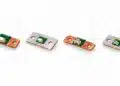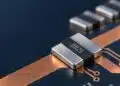





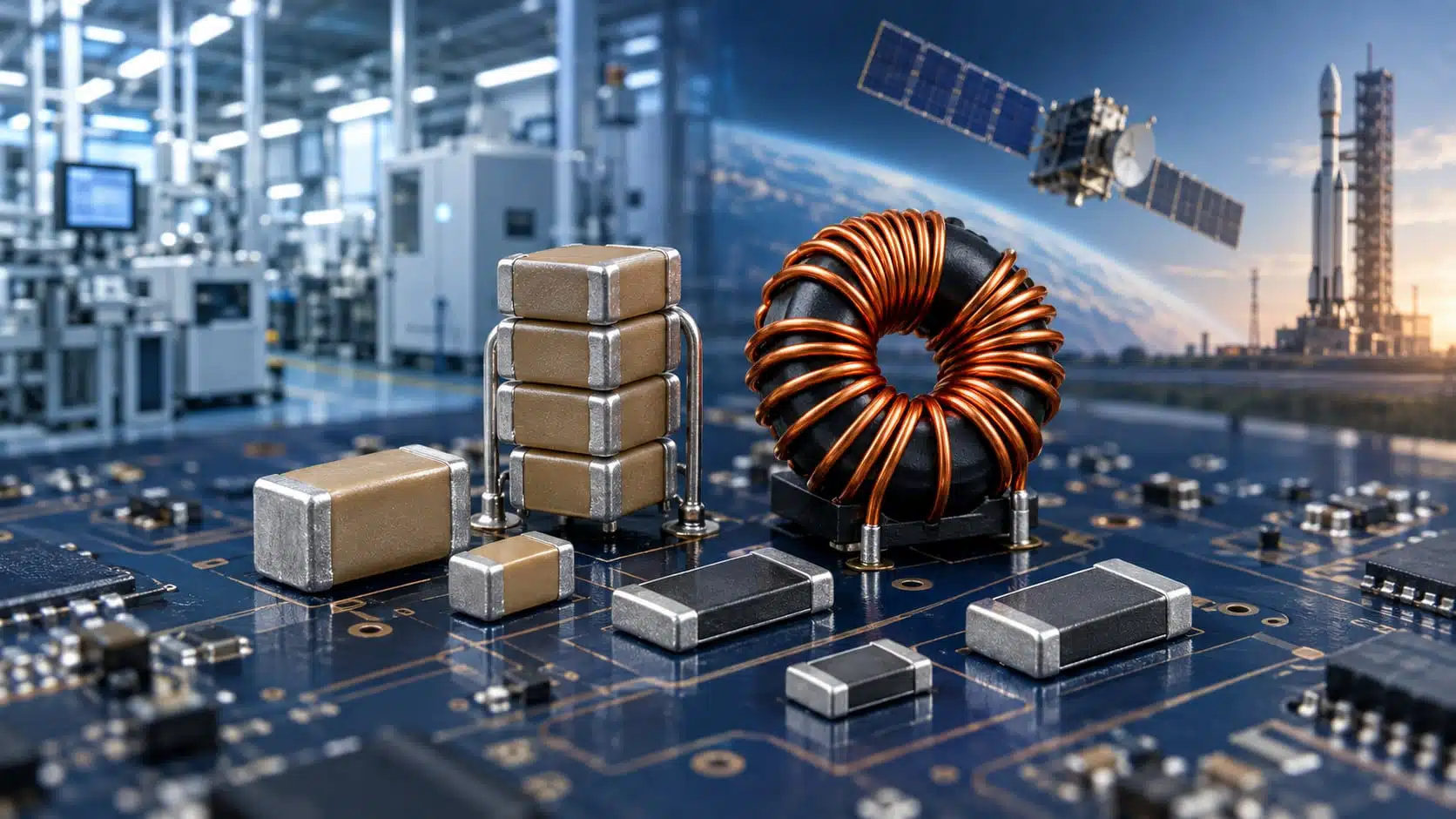
Ruggedized passive components are gaining strategic importance as defense, aerospace, energy and medical electronics demand more than standard electrical ratings.
A TTI MarketEYE analysis by Dennis M. Zogbi of Paumanok Publications examines how specialized construction, customization and qualification add value to capacitors, resistors and inductors used in demanding applications.
Published on October 6, 2026, the analysis describes a high-reliability engineering layer between component manufacturing and equipment integration. Its importance extends beyond higher voltage or temperature ratings: engineers must also consider mechanical integrity, termination compatibility, traceability and the consequences of component failure.
Five approaches to ruggedization
Ruggedization is not a single technology or a universal component grade. It encompasses several approaches that modify how a component is constructed, connected, packaged or expected to behave under defined stress conditions.
The following editorial summary connects the customization categories discussed in the analysis with practical component-selection questions.
| Ruggedization method | Typical implementation | Intended design benefit | What engineers should verify |
|---|---|---|---|
| Special terminations | Application-specific metallization or flexible termination layers | Improve assembly compatibility or address mechanical stress and finish-related risks | Finish composition, soldering compatibility and qualification of the termination system |
| Stacking and assemblies | Capacitor stacks, resistor networks and magnetic modules | Combine multiple elements in an application-specific package | Assembly ratings, interconnections, mounting stresses and thermal behavior |
| Internal construction changes | Modified electrodes, resistive elements, magnetic cores or windings | Tailor electrical performance and behavior under defined stresses | Performance trade-offs and qualification of the exact construction |
| Lead attachment | Application-specific lead geometry and attachment processes | Adapt mounting and connection arrangements | Attachment integrity, assembly process limits and mechanical test evidence |
| Failure-mode engineering | Open-mode capacitor structures or fusible resistor designs | Reduce the consequences of specified failure conditions | Documented failure behavior and whether the circuit tolerates it |
The distinction between a qualified individual component and a qualified assembly is particularly important. Combining proven components does not, by itself, establish the reliability of their interconnections, mounting structure or complete package.
Vertical Markets for Ruggedized Customization
The majority of global demand for ruggedized customization services for passive electronic components comes largely from five vertical markets. In each case, the operating environment determines which customization services the market buys.
- Defense and military electronics. This is the largest and most established vertical, serving radar, guidance, electronic warfare, communications and power systems. Demand is supported by U.S. Department of Defense budget trends, munitions replenishment, counterfeit avoidance requirements and ITAR-governed sourcing.
- Civil aviation. Avionics and airframe electronics are qualified to DO-160 and DO-254, with AS9100 and AS9102 quality systems throughout the supply chain. The A320neo, B737 MAX and B777X programs sustain demand, while eVTOL and urban air mobility platforms add new electrified airframes.
- Spacecraft and satellite systems. Space-level qualification under MIL-PRF-123, ESCC, JAXA and NASA EEE-INST-002 includes radiation hardness and total ionizing dose requirements. I note a growing divergence between legacy space and the “new space” economy, where LEO constellations favor up-screened commercial parts at volume.
- Oil and gas. Measurement-while-drilling (MWD), logging-while-drilling (LWD), wireline and seismic tools require passive components that operate at 200°C to 300°C under extreme pressure and shock. This drives demand for high-temperature dielectrics, lead wires and ferrite cores and for hermetic, pressure-tolerant packaging.
- Medical devices. Implantable cardioverter defibrillators, pacemakers and neurostimulators require biocompatible, hermetic and fail-safe components. High-energy-density capacitors for ICD high-voltage charging circuits are among the most specialized passive components produced anywhere.
Capacitors: construction matters
Capacitors offer a broad range of ruggedization opportunities across ceramic, tantalum, film and other technologies. The appropriate approach depends on the dielectric system, mechanical construction and application stresses.
For multilayer ceramic capacitors, the relationship between the ceramic body, terminations and PCB is a central reliability consideration. Board bending and thermal cycling can transfer stress into the component, potentially causing cracks.
Flexible termination layers can reduce that stress transfer. Internal electrode modifications serve a different purpose: they can reduce the likelihood that particular crack paths create a short circuit between the capacitor terminals.
Stacked capacitor assemblies provide another customization route, but their evaluation must cover more than the constituent capacitors. Interconnections, mounting arrangements and the assembly’s electrical and mechanical behavior also require assessment.
Preventing damage versus managing failure
A useful distinction in ruggedized design is the difference between reducing the probability of damage and limiting its consequences.
Flexible terminations primarily address mechanical stress transfer. Open-mode and fail-safe capacitor designs address the electrical consequences of certain damage mechanisms through approaches such as modified electrode margins or floating-electrode structures.
These measures can provide complementary protection, but they are not interchangeable. Modified electrode geometry may also involve a capacitance-density trade-off.
Consider an MLCC connected across a power rail. A short-circuit failure can load the supply and generate localized heat; an open-circuit failure avoids that particular fault but removes the capacitor’s contribution to filtering or decoupling. The preferred failure behavior therefore depends on the circuit—not simply on the component label.
Resistors and inductors require different priorities
For resistors, customization may focus on precision resistive elements, termination metallurgy, high-voltage networks, packaging or overload behavior. Initial resistance tolerance is only one selection parameter; temperature dependence and stability under the intended operating conditions can be equally important.
Fusible and flameproof constructions address different functions. A fusible resistor is intended to interrupt the circuit under specified overload conditions, whereas flameproof construction addresses ignition behavior. Neither designation should be treated as a substitute for reviewing the manufacturer’s documented fault-response characteristics.
Inductor customization centers on magnetic cores, winding arrangements, insulation, connections and packaging. The complete construction must accommodate the application’s electrical loading alongside vibration, thermal cycling and other environmental stresses.
Failure mechanisms and engineering responses
The following table summarizes the relationship between common reliability concerns and relevant design responses. It is an editorial guide, not a substitute for product-specific qualification evidence.
| Component or construction | Failure mechanism or concern | Relevant engineering response | Important limitation |
|---|---|---|---|
| MLCC | Ceramic cracking from board flex or assembly stress | Flexible terminations and controlled assembly practices | Reduced stress transfer does not eliminate every source of cracking |
| MLCC | A crack creates a short between opposing electrodes | Open-mode or floating-electrode construction | The circuit must tolerate capacitance loss or an open circuit |
| Tin-finished components | Tin-whisker risk in sensitive applications | Program-approved termination metallurgy and finish controls | Suitability depends on the exact finish and program requirements |
| Precision resistors | Resistance drift or temperature-dependent error | Appropriate resistive technology and qualified construction | Initial tolerance alone does not establish long-term stability |
| Resistors exposed to overload | Excessive heating or an unsafe fault response | Appropriately specified fusible or flameproof construction | Fusible and flameproof describe different functions |
| Inductors and magnetic assemblies | Winding fatigue, insulation damage or vibration-related failure | Application-specific winding, insulation, attachment and packaging | Testing must represent the intended electrical and mechanical stresses |
Qualification must cover the installed component
Defense, aviation, space, energy and medical applications impose different combinations of environmental stress, documentation and acceptable failure consequences. A component suitable for one program is not automatically qualified for another.
Engineers and purchasing teams should establish:
- Which construction and termination system the exact ordering code specifies.
- Which tests are performed on every production lot and which belong to initial qualification.
- Whether qualification covers the modified component or complete assembly.
- How lot identity, manufacturing changes and source traceability are controlled.
- Whether testing represents the stresses introduced by soldering, mounting and operation.
The NASA review of low-voltage MLCC cracking highlights why incoming component quality alone is insufficient. Assembly and handling can introduce damage after component manufacture, making workmanship control and board-level validation essential parts of the reliability strategy.
Supply-chain value beyond the component
The TTI analysis positions ruggedized customization as a specialist value layer supported by process expertise, qualification histories and application knowledge.
For equipment developers, this makes early engagement with component manufacturers and customization specialists valuable. Construction changes, screening requirements and documentation should be defined before the design becomes difficult to modify.
The purchasing decision consequently extends beyond unit price. It must account for qualification effort, controlled processing, traceability, change management and continuity of supply. The objective is not simply to obtain a more rugged part, but to establish a documented component solution for the intended operating environment.
Further reading
- TDK Explains Soft Termination on Capacitors, Inductors, and Chip Beads for Automotive
- Failure Analysis of Capacitors and Inductors
- Screening and Qualification of BME Feedthrough Capacitors for a Space Project
- Polymer Tantalum Capacitors Beyond AEC-Q200 LEO Satellites
Source
This article is based on Dennis M. Zogbi’s TTI MarketEYE analysis, published on October 6, 2026, with supporting technical context from Passive Components Blog. The original publication is a market analysis rather than a manufacturer product press release. Both tables are editorial summaries, not reproductions of the original figures; component suitability requires product-specific documentation and application-level assessment.
References
- TTI MarketEYE: Ruggedized Passive Components: The High-Reliability Value Layer Between the Factory and the Launchpad.[tti]
- Passive Components Blog: MLCC and Ceramic Capacitors.[passive-components]
- Passive Components Blog: When Benign is Better: Fail Safe Capacitor Technology.[passive-components]
- Passive Components Blog: NASA report evaluates low voltage MLCC cracks issues.[passive-components]