







Passive Components Blog
No Result
View All Result
  • Home
  • NewsFilter
    • All
    • Aerospace & Defence
    • Antenna
    • Applications
    • Automotive
    • Capacitors
    • Circuit Protection Devices
    • electro-mechanical news
    • Filters
    • Fuses
    • Inductors
    • Industrial
    • Integrated Passives
    • inter-connect news
    • Market & Supply Chain
    • Market Insights
    • Medical
    • Modelling and Simulation
    • New Materials & Supply
    • New Technologies
    • Non-linear Passives
    • Oscillators
    • Passive Sensors News
    • Resistors
    • RF & Microwave
    • Telecommunication
    • Weekly Digest

    SCHURTER Buys Biaodi to Boost High-Voltage Protection Portfolio

    Binder Hybrid Connector Simplifies One Cable Automation

    Tapped Inductor Buck Converter Fundamentals

    TAIYO YUDEN Releases Mini Metal Power Inductors

    Molecular Memristor Shows Record 145 kH Emergent Inductance

    Planar vs Conventional Transformer: When it Make Sense

    Researchers Propose Next‑Gen Compact Memory Using Ultra-thin Ferroelectric Capacitors

    Nichicon ADN Automotive Hybrid Aluminum Capacitors Now Available in EMEA

    Wk 19 Electronics Supply Chain Digest

    Trending Tags

    • Ripple Current
    • RF
    • Leakage Current
    • Tantalum vs Ceramic
    • Snubber
    • Low ESR
    • Feedthrough
    • Derating
    • Dielectric Constant
    • New Products
    • Market Reports
  • VideoFilter
    • All
    • Antenna videos
    • Capacitor videos
    • Circuit Protection Video
    • Filter videos
    • Fuse videos
    • Inductor videos
    • Inter-Connect Video
    • Non-linear passives videos
    • Oscillator videos
    • Passive sensors videos
    • Resistor videos

    Tapped Inductor Buck Converter Fundamentals

    Planar vs Conventional Transformer: When it Make Sense

    Modeling Fringing Field Losses in Inductors & Transformers

    Why Power Inductors Use a Ferrite Core With an Air Gap

    Transformer-Based Power-Line Harvester Magnetic Design

    Thermal Modeling of Magnetics

    Standard vs Planar LLC transformers Comparison for Battery Chargers

    How Modern Tools Model Magnetic Components for Power Electronics

    Advanced Loss Modeling for Planar Magnetics in the Frenetic Planar Tool

    Trending Tags

    • Capacitors explained
    • Inductors explained
    • Resistors explained
    • Filters explained
    • Application Video Guidelines
    • EMC
    • New Products
    • Ripple Current
    • Simulation
    • Tantalum vs Ceramic
  • Knowledge Blog
  • DossiersNew
  • Suppliers
    • Who is Who
  • PCNS
    • PCNS 2025
    • PCNS 2023
    • PCNS 2021
    • PCNS 2019
    • PCNS 2017
  • Events
  • Home
  • NewsFilter
    • All
    • Aerospace & Defence
    • Antenna
    • Applications
    • Automotive
    • Capacitors
    • Circuit Protection Devices
    • electro-mechanical news
    • Filters
    • Fuses
    • Inductors
    • Industrial
    • Integrated Passives
    • inter-connect news
    • Market & Supply Chain
    • Market Insights
    • Medical
    • Modelling and Simulation
    • New Materials & Supply
    • New Technologies
    • Non-linear Passives
    • Oscillators
    • Passive Sensors News
    • Resistors
    • RF & Microwave
    • Telecommunication
    • Weekly Digest

    SCHURTER Buys Biaodi to Boost High-Voltage Protection Portfolio

    Binder Hybrid Connector Simplifies One Cable Automation

    Tapped Inductor Buck Converter Fundamentals

    TAIYO YUDEN Releases Mini Metal Power Inductors

    Molecular Memristor Shows Record 145 kH Emergent Inductance

    Planar vs Conventional Transformer: When it Make Sense

    Researchers Propose Next‑Gen Compact Memory Using Ultra-thin Ferroelectric Capacitors

    Nichicon ADN Automotive Hybrid Aluminum Capacitors Now Available in EMEA

    Wk 19 Electronics Supply Chain Digest

    Trending Tags

    • Ripple Current
    • RF
    • Leakage Current
    • Tantalum vs Ceramic
    • Snubber
    • Low ESR
    • Feedthrough
    • Derating
    • Dielectric Constant
    • New Products
    • Market Reports
  • VideoFilter
    • All
    • Antenna videos
    • Capacitor videos
    • Circuit Protection Video
    • Filter videos
    • Fuse videos
    • Inductor videos
    • Inter-Connect Video
    • Non-linear passives videos
    • Oscillator videos
    • Passive sensors videos
    • Resistor videos

    Tapped Inductor Buck Converter Fundamentals

    Planar vs Conventional Transformer: When it Make Sense

    Modeling Fringing Field Losses in Inductors & Transformers

    Why Power Inductors Use a Ferrite Core With an Air Gap

    Transformer-Based Power-Line Harvester Magnetic Design

    Thermal Modeling of Magnetics

    Standard vs Planar LLC transformers Comparison for Battery Chargers

    How Modern Tools Model Magnetic Components for Power Electronics

    Advanced Loss Modeling for Planar Magnetics in the Frenetic Planar Tool

    Trending Tags

    • Capacitors explained
    • Inductors explained
    • Resistors explained
    • Filters explained
    • Application Video Guidelines
    • EMC
    • New Products
    • Ripple Current
    • Simulation
    • Tantalum vs Ceramic
  • Knowledge Blog
  • DossiersNew
  • Suppliers
    • Who is Who
  • PCNS
    • PCNS 2025
    • PCNS 2023
    • PCNS 2021
    • PCNS 2019
    • PCNS 2017
  • Events
No Result
View All Result
Passive Components Blog
No Result
View All Result

Design of High Precision Integrated Resistive Voltage Dividers

29.9.2025
Reading Time: 4 mins read
A A

The paper “A New Approach to the Design of High Precision Integrated Resistive Voltage Dividers” was presented by Stephen Oxley, TT Electronics, Bedlington, UK at the 5th PCNS Passive Components Networking Symposium 9-12th September 2025, Seville, Spain as paper No. 3.3.

Introduction

This article presents a new methodology for designing high precision integrated resistive voltage dividers capable of handling high voltages without the prohibitive costs and complexity of conventional precision enhancement techniques.

RelatedPosts

Advances in the Environmental Performance of Polymer Capacitors

How to Manage Supercapacitors Leakage Current and Self Discharge 

Qualification of Commercial Supercapacitors for Space Applications

Traditional designs rely on two resistive elements on a single substrate, but when high voltage requirements are added, maintaining low temperature and voltage coefficients becomes challenging.

The proposed approach, called the Cascaded Balanced Divider (CBD), leverages multi-stage balanced resistor networks to achieve superior precision using standard thick film materials and processes.

Key Points

  1. Conventional two-element dividers struggle with high voltage applications due to mismatched TCRs, VCRs, and long-term drift.
  2. Existing mitigation strategies involve improved materials, direct-write processes, or component matching and joining—each with cost and yield penalties.
  3. The new CBD design uses multiple cascaded stages of identical resistor elements to distribute voltage, reduce sensitivity to inter-stage mismatch, and achieve high precision.
  4. Initial test results show that CBD achieves TCVR and VCVR comparable to or better than top-performing conventional dividers without special manufacturing processes.
  5. Future work will focus on AC performance, trimming strategies, optimized layouts, and life stability under load.

Extended Summary

Conventional high voltage resistive dividers are comprised of a high voltage leg (R1) and a low voltage leg (R2), and the voltage division ratio depends on the ratio of these resistances. Achieving ratios in the hundreds or thousands introduces challenges in thick film technologies, which inherently have higher TCRs and are less stable than metal film technologies. Manufacturers have attempted to improve accuracy through material improvements, direct-write fabrication, and component matching. While effective, these methods increase cost and complexity.
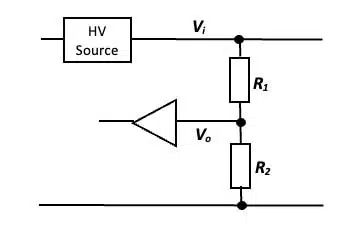
Conventional high voltage divider

To address these limitations, the paper introduces the Cascaded Balanced Divider (CBD) concept. Borrowing from the principles of the Kelvin Varley circuit, CBD divides the high voltage in multiple stages, each built from identical resistor elements arranged to form balanced ratios. By cascading these stages, the overall voltage ratio approximates the product of the stage ratios, while in-stage matching maintains high precision. Inter-stage variations in TCR or drift have minimal impact due to the design’s intrinsic insensitivity to these factors, assuming inter-stage loading is controlled.
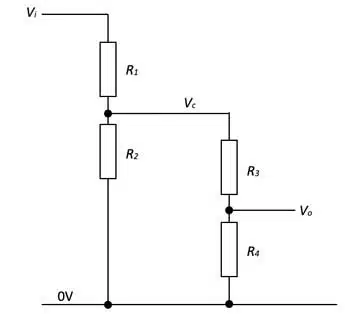
Two stage cascade balanced divider

Simulation and experimental results support the CBD approach. A two-stage 196:1 prototype achieved TCVR better than ±5 ppm/°C and VCVR around −0.2 ppm/V, demonstrating that ratio error is significantly lower than the absolute error of individual resistors. The paper also outlines layout and manufacturing considerations, such as aligning identical elements, using standard thick film inks, and minimizing fine trimming in the high voltage stages to preserve stability. Test results indicate that CBD dividers can meet or exceed the precision of top-tier conventional dividers without resorting to expensive matching or specialized processes.

Future improvements will focus on AC performance characterization, implementing coarse and fine trimming strategies, optimizing layouts for reduced power density and voltage stress, and conducting long-term drift studies under different load conditions. These steps aim to validate CBD as a cost-effective, high-performance solution for applications like energy metering, electric vehicles, and medical devices.

Conclusion

The Cascaded Balanced Divider method presents a significant advancement in high precision high voltage divider design. By leveraging cascaded multi-element stages, the approach achieves superior temperature and voltage stability using standard thick film processes, eliminating the need for costly matching or specialized fabrication. Initial prototypes confirm improved stability and pave the way for practical, manufacturable products suitable for a wide range of demanding applications.

3_3_TT Electronics PCNS 2025 PaperDownload

Related

Source: PCNS

Recent Posts

SCHURTER Buys Biaodi to Boost High-Voltage Protection Portfolio

14.5.2026
2

Binder Hybrid Connector Simplifies One Cable Automation

13.5.2026
7

Molecular Memristor Shows Record 145 kH Emergent Inductance

12.5.2026
17

Planar vs Conventional Transformer: When it Make Sense

11.5.2026
40

Nichicon ADN Automotive Hybrid Aluminum Capacitors Now Available in EMEA

11.5.2026
24

Stackpole Expanded its AlN Thick Film Chip Resistors

6.5.2026
23

Würth Elektronik Introduces Compact Flat-wire SMT Power Inductors for Automotive

5.5.2026
50

KYOCERA AVX Extends MLV Varistors for 48V Automotive Protection

5.5.2026
28

YAGEO Introduces C0G Flexible Termination Automotive MLCCs

30.4.2026
41

Upcoming Events

May 19
16:00 - 17:00 CEST

Designing Qi2 Wireless Power Systems: Practical Development and EMC Optimization

Jun 2
16:00 - 17:00 CEST

Calculation, Simulation and Measurement of 800V EMC Filters

Jun 16
16:00 - 17:00 CEST

EMC with EMC – EMC‑compliant design with electromechanical connectors

View Calendar

Popular Posts

  • Buck Converter Design and Calculation

    0 shares
    Share 0 Tweet 0
  • Boost Converter Design and Calculation

    0 shares
    Share 0 Tweet 0
  • Flyback Converter Design and Calculation

    0 shares
    Share 0 Tweet 0
  • LLC Resonant Converter Design and Calculation

    0 shares
    Share 0 Tweet 0
  • MLCC and Ceramic Capacitors

    0 shares
    Share 0 Tweet 0
  • Dual Active Bridge (DAB) Topology

    0 shares
    Share 0 Tweet 0
  • Capacitor Charging and Discharging

    0 shares
    Share 0 Tweet 0
  • What Electronics Engineer Needs to Know About Passive Low Pass Filters

    0 shares
    Share 0 Tweet 0
  • Ripple Current and its Effects on the Performance of Capacitors

    3 shares
    Share 3 Tweet 0
  • MLCC Case Sizes Standards Explained

    0 shares
    Share 0 Tweet 0

Newsletter Subscription


Passive Components Blog

© EPCI - Leading Passive Components Educational and Information Site

  • Home
  • Privacy Policy
  • EPCI Membership & Advertisement
  • About

No Result
View All Result
  • Home
  • Knowledge Blog
  • PCNS

© EPCI - Leading Passive Components Educational and Information Site

This website uses cookies. By continuing to use this website you are giving consent to cookies being used. Visit our Privacy and Cookie Policy.
Go to mobile version