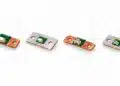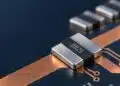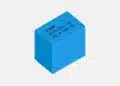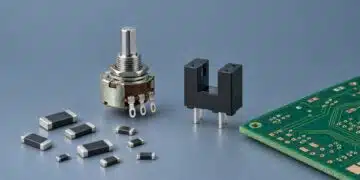






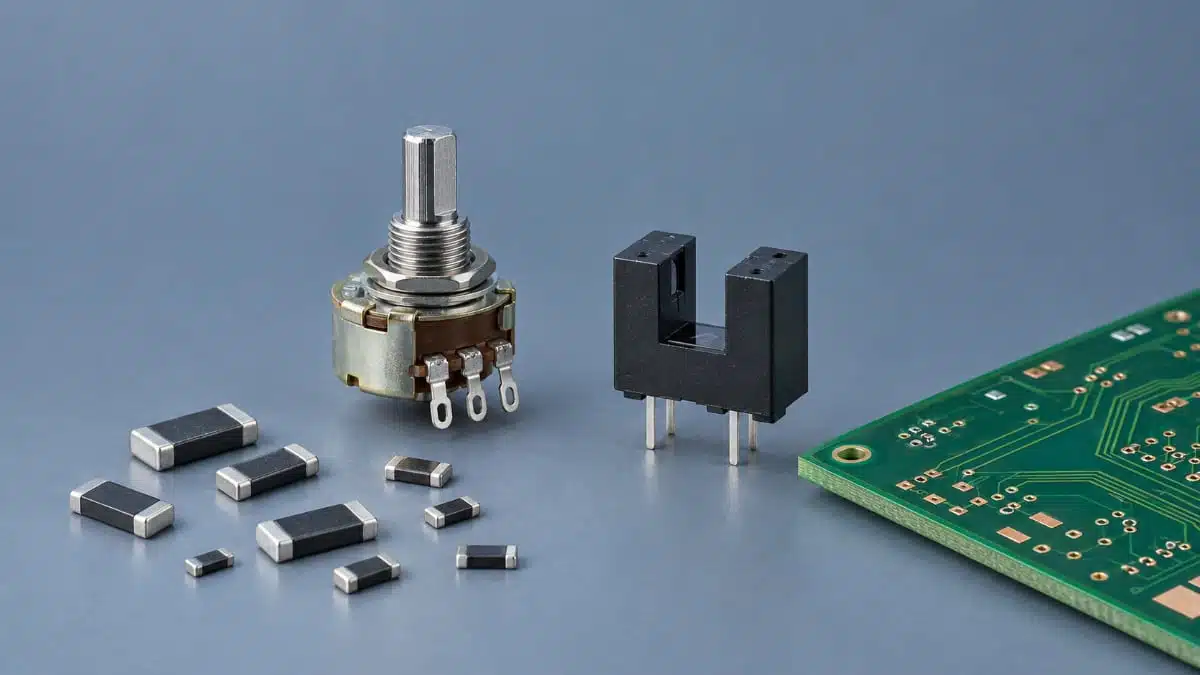
TT Electronics’ electronica 2026 portfolio brings together Welwyn and IRC resistors, BI Technologies potentiometers and trimmers, and Optek sensing technologies.
The focus is on managing heat in power-dense assemblies, measuring electrical conditions, and selecting position-sensing technologies that match the system’s operating life. These priorities connect component selection to the electrical, mechanical and commercial requirements of the finished equipment.
Key features and benefits
- Resistor technologies include thin film, thick film, metal element and wirewound constructions, covering precision, current sensing, power, high-voltage and pulse-withstanding functions.
- Precision resistor options extend to ±0.01% tolerance, with temperature coefficients of resistance as low as ±5 ppm/°C.
- BI Technologies potentiometers include conductive-plastic and cermet technologies, with single-turn, multi-turn and servo-mount configurations.
- Trimmer options include top and side adjustment, with resistance values from 10 Ω to over 2 MΩ.
- Optek sensing technologies include slotted, reflective and through-beam optical sensors, alongside Hall-effect devices for non-contact sensing.
Technical highlights
Power density makes mounting part of resistor selection
A resistor’s power rating is one selection parameter, not a complete description of its installed capability. Thermal management, mounting conditions, pulse capability and short-duration electrical stress also govern its suitability.
Industrial equipment, transportation systems, energy infrastructure and data centres place power components within assemblies where space and heat removal must be considered together. Resistor selection therefore needs to follow the thermal and electrical design of the assembly rather than treating the component as an isolated wattage value.
Selection should connect continuous operation with transient demands: a resistor used in a power circuit must accommodate both its sustained load and the short periods of electrical stress associated with that circuit.
Measurement accuracy and electrical stress drive different choices
Current sensing supports battery management, motor control, energy monitoring, power conversion and system protection. Low-resistance technologies address power loss while retaining the accuracy needed for measurement and control.
Higher-voltage circuits create a different selection problem. Resistors used for voltage measurement, feedback, balancing and discharge must withstand the electrical stress of their circuit position. Resistance accuracy and voltage capability consequently need to be evaluated together rather than treated as interchangeable performance measures.
| Component group | Portfolio options | Selection relevance |
|---|---|---|
| Precision resistors | Tolerance to ±0.01% | Resistance accuracy |
| Precision resistors | TCR as low as ±5 ppm/°C | Temperature-dependent resistance |
| Potentiometers | Conductive plastic and cermet | Adjustment technology |
| Potentiometers | Single-turn, multi-turn, servo mount | Mechanical configuration |
| Trimmers | 10 Ω to over 2 MΩ | Calibration resistance |
| Trimmers | Top or side adjustment | Adjustment access |
Position sensing remains a hardware decision
Potentiometers and trimmers provide adjustable resistance through mechanical movement. Potentiometer configurations include linear, audio and custom tapers, configurable shafts and mounting options, and sealed designs for industrial environments.
Conventional potentiometers suit applications where analogue output, simplicity and mechanical feel matter. Non-contact position sensing becomes relevant when operating-cycle requirements take priority.
Optoelectronic sensors address object detection, counting, position detection and automation. Embedded intelligence still depends on these physical inputs: a controller needs information about object presence, movement or position before it can determine the next action.
Typical applications
The component portfolio addresses several distinct circuit and system functions:
- Battery systems and energy management: current measurement for battery management, energy monitoring and protection.
- Industrial drives and robotics: current sensing for motor control, with position and object sensing for automated mechanisms.
- Charging infrastructure and renewable energy: electrical measurement and control within power-conversion and distribution systems.
- Data-centre power: current sensing and power-resistor functions within energy-management equipment.
- Industrial instrumentation: potentiometers and trimmers for adjustment, calibration and factory setup.
- Higher-voltage assemblies: resistor functions in voltage measurement, feedback, balancing and discharge.
Precision tolerance and TCR are relevant to resistance-dependent measurement accuracy. Trimmer resistance range and adjustment orientation govern calibration choices and physical access. Power and high-voltage resistor functions require selection against the electrical and thermal conditions of the particular circuit.
Application fit
Technology choice must balance performance with operating environment, availability, lifecycle expectations and cost. This is particularly important in industrial, aerospace and defence, and transportation programmes with long operating lives.
A potentiometer and a non-contact sensor address different priorities. Analogue output and mechanical feel can favour a potentiometer; operating-cycle requirements can favour a non-contact approach. Likewise, the choice between resistor constructions should follow the required precision, power, voltage and pulse functions.
The practical objective is a component that fits the whole assembly, including its mounting, adjustment access and intended service life.
Design-in notes for engineers
- Assess resistor power rating together with mounting conditions and the assembly’s thermal design.
- Evaluate pulse capability separately from continuous loading.
- Match current-sensing resistance and accuracy requirements to the measurement and control function.
- Check electrical stress in voltage-measurement, feedback, balancing and discharge positions.
- Select potentiometer taper, shaft and mounting configuration around the mechanical interface.
- Preserve access to top- or side-adjusted trimmers where calibration is required.
- Include lifecycle expectations, availability and cost in the component-selection decision.
- Validate final selection under the actual operating conditions before schematic, layout or production release.
Further reading
- Resistors Pulse Load and Derating Design Guide
- Carbon, Metal Element, Metal Oxide, Metal Foil Resistors
- Resistivity and Thermal Resistance
Source
This article is based on the TT Electronics product announcement and official product documentation. Engineers should refer to the current manufacturer datasheet for final design and qualification.
References
- Four Component Trends to Watch at electronica Munich 2026, TT Electronics.
- Electronica 2026, TT Electronics.
- Potentiometers, TT Electronics.