






Passive Components Blog
No Result
View All Result
  • Home
  • NewsFilter
    • All
    • Aerospace & Defence
    • Antenna
    • Applications
    • Automotive
    • Capacitors
    • Circuit Protection Devices
    • electro-mechanical news
    • Filters
    • Fuses
    • Inductors
    • Industrial
    • Integrated Passives
    • inter-connect news
    • Market & Supply Chain
    • Market Insights
    • Medical
    • Modelling and Simulation
    • New Materials & Supply
    • New Technologies
    • Non-linear Passives
    • Oscillators
    • Passive Sensors News
    • Resistors
    • RF & Microwave
    • Telecommunication
    • Weekly Digest

    Würth Elektronik Expands Nanocrystalline Cable Cores for Broadband EMI Suppression

    High‑Speed Supercapacitor Balancing for AI Data Center Power Systems

    Bourns Introduced Automotive TVS Diodes for Compact ESD Protection

    EMC‑Compliant PCB and Connector Design Guidelines

    Practical Value of Structural Diagnostics for Tantalum Capacitor Anodes

    Hall-Effect Sensing for Harsh Environments: TT Electronics Selected in NASA’s Dragonfly Fan

    Bourns Releases Automotive Gate Driver Transformer for Isolated Power

    Stackpole Releases High-Frequency Thin Film Chip Resistors for RF up to 50 GHz

    Knowles Expands High‑Q Ceramic Core Inductors for RF designs

    Trending Tags

    • Ripple Current
    • RF
    • Leakage Current
    • Tantalum vs Ceramic
    • Snubber
    • Low ESR
    • Feedthrough
    • Derating
    • Dielectric Constant
    • New Products
    • Market Reports
  • VideoFilter
    • All
    • Antenna videos
    • Capacitor videos
    • Circuit Protection Video
    • Filter videos
    • Fuse videos
    • Inductor videos
    • Inter-Connect Video
    • Non-linear passives videos
    • Oscillator videos
    • Passive sensors videos
    • Resistor videos

    EMC‑Compliant PCB and Connector Design Guidelines

    Why Isolated DC/DC Power Supplies Fail Late, Würth Elektronik Podcast

    Designing 800 V DC EMC Filters: Calculation, Simulation and Measurement

    Current Sense Transformer Datasheet and Design‑in Guide

    Designing a USB Type‑C Flyback Planar Transformer with Frenetic’s Planar Tool

    Magnetics Design in High‑Frequency GaN Converters

    Qi2 Wireless Charging: Inductors, Capacitors and EMC Filters

    Two‑capacitor paradox explained for engineers

    Capacitances of Nonlinear MLCCs: What Datasheets Don’t Tell You

    Trending Tags

    • Capacitors explained
    • Inductors explained
    • Resistors explained
    • Filters explained
    • Application Video Guidelines
    • EMC
    • New Products
    • Ripple Current
    • Simulation
    • Tantalum vs Ceramic
  • Knowledge Blog
  • DossiersNew
  • Suppliers
    • Who is Who
  • PCNS
    • PCNS 2025
    • PCNS 2023
    • PCNS 2021
    • PCNS 2019
    • PCNS 2017
  • Events
  • Home
  • NewsFilter
    • All
    • Aerospace & Defence
    • Antenna
    • Applications
    • Automotive
    • Capacitors
    • Circuit Protection Devices
    • electro-mechanical news
    • Filters
    • Fuses
    • Inductors
    • Industrial
    • Integrated Passives
    • inter-connect news
    • Market & Supply Chain
    • Market Insights
    • Medical
    • Modelling and Simulation
    • New Materials & Supply
    • New Technologies
    • Non-linear Passives
    • Oscillators
    • Passive Sensors News
    • Resistors
    • RF & Microwave
    • Telecommunication
    • Weekly Digest

    Würth Elektronik Expands Nanocrystalline Cable Cores for Broadband EMI Suppression

    High‑Speed Supercapacitor Balancing for AI Data Center Power Systems

    Bourns Introduced Automotive TVS Diodes for Compact ESD Protection

    EMC‑Compliant PCB and Connector Design Guidelines

    Practical Value of Structural Diagnostics for Tantalum Capacitor Anodes

    Hall-Effect Sensing for Harsh Environments: TT Electronics Selected in NASA’s Dragonfly Fan

    Bourns Releases Automotive Gate Driver Transformer for Isolated Power

    Stackpole Releases High-Frequency Thin Film Chip Resistors for RF up to 50 GHz

    Knowles Expands High‑Q Ceramic Core Inductors for RF designs

    Trending Tags

    • Ripple Current
    • RF
    • Leakage Current
    • Tantalum vs Ceramic
    • Snubber
    • Low ESR
    • Feedthrough
    • Derating
    • Dielectric Constant
    • New Products
    • Market Reports
  • VideoFilter
    • All
    • Antenna videos
    • Capacitor videos
    • Circuit Protection Video
    • Filter videos
    • Fuse videos
    • Inductor videos
    • Inter-Connect Video
    • Non-linear passives videos
    • Oscillator videos
    • Passive sensors videos
    • Resistor videos

    EMC‑Compliant PCB and Connector Design Guidelines

    Why Isolated DC/DC Power Supplies Fail Late, Würth Elektronik Podcast

    Designing 800 V DC EMC Filters: Calculation, Simulation and Measurement

    Current Sense Transformer Datasheet and Design‑in Guide

    Designing a USB Type‑C Flyback Planar Transformer with Frenetic’s Planar Tool

    Magnetics Design in High‑Frequency GaN Converters

    Qi2 Wireless Charging: Inductors, Capacitors and EMC Filters

    Two‑capacitor paradox explained for engineers

    Capacitances of Nonlinear MLCCs: What Datasheets Don’t Tell You

    Trending Tags

    • Capacitors explained
    • Inductors explained
    • Resistors explained
    • Filters explained
    • Application Video Guidelines
    • EMC
    • New Products
    • Ripple Current
    • Simulation
    • Tantalum vs Ceramic
  • Knowledge Blog
  • DossiersNew
  • Suppliers
    • Who is Who
  • PCNS
    • PCNS 2025
    • PCNS 2023
    • PCNS 2021
    • PCNS 2019
    • PCNS 2017
  • Events
No Result
View All Result
Passive Components Blog
No Result
View All Result

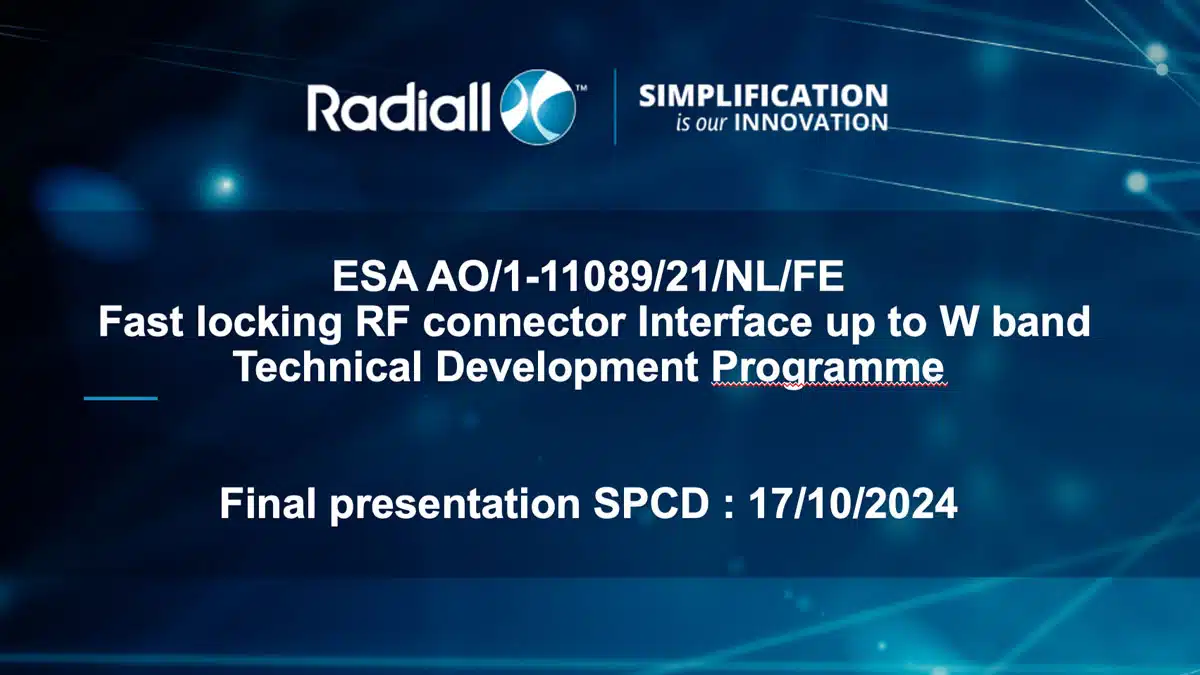
Development of a New Fast-Lock RF Connector Interface up to W-Band for Space Applications

26.4.2025
Reading Time: 6 mins read
A A

This paper on new fast lock RF interface was presented by Olivier Berenfeld, Radiall SA, France during the 5th Space Passive Component Days (SPCD), an International Symposium held from October 15th to 18th, 2024, at ESA/ESTEC in Noordwijk, the Netherlands. Published under permission from ESA SPCD organizers.

RADIALL and AXON collaborated to develop a new fast-lock RF connector interface for satellite RF systems up to 110 GHz.

RelatedPosts

ESA SPCD 26 Registration Open

ESA SPCD 26 Call for Papers Extended to 30th March

High-Density PCB Assemblies For Space Applications

The project, funded by ESA, aimed to achieve TRL 4 and involved five work packages, including requirements analysis, design trade-offs, manufacturing, testing, and evaluation.

While the fast-lock system demonstrated robustness and reliability, the high cost and limited market demand prompted a reevaluation of the project’s direction, with a focus on qualifying a 110 GHz solution with a standard 1.0 mm interface for space applications.

Key Points:

  • Market Analysis: No existing space applications for 110 GHz cable assemblies were found, with most available products designed for test and measurement.
  • Fast-lock System Selection: Push and twist (“bayonet”) mechanism chosen for its simplicity, safety, and visibility, with an anti-rotation system to prevent cable twist.
  • RF Line Optimization: Simulations optimized the 1.0 mm RF line, including socket shape, pin-socket gap, and center contact captivation method, to achieve best RF performance.
  • Interface Development: Development and manufacturing of the new RF interface with a fast-locking mechanism, featuring a spring system for pressure between reference planes and manual mating/unmating.
  • Connector Development: Developed truncated flange and 4-hole flange connectors with various contact outputs and adapters.
  • Performance Evaluation: Evaluated connector pairs based on ESCC standards, identifying minor anomalies and comparing RF performances of fast-lock and screw-in versions.
  • Project Conclusion: Fast-lock system is robust, reliable, and easy to use with good RF performance up to 110 GHz, but expensive with no immediate market.
  • Technology Maturity: Coaxial technology at 110 GHz is concrete and promising, currently at TRL7.
  • Next Steps: Qualify a 110 GHz solution with a standard 1.0 mm interface (screw-in) for space applications (TRL8).
  • Market Considerations: Standardization and reliability are crucial for the Test and Measurement market, favoring screw-in interfaces over fast-lock.

Extensive Summary of the Development of a New Fast-Lock RF Connector Interface up to W-Band

The collaboration between RADIALL and AXON, funded by the European Space Agency (ESA), focused on developing a new fast-lock RF connector interface designed to operate effectively up to the W-Band (110 GHz). This development addresses future satellite manufacturer demands for higher frequency applications, following trends from X, Ku, Ka, and Q bands.
Project Structure (Work Packages)

  1. WP1: Space Applications Review & Requirements Benchmark
    • Reviewed existing 110 GHz cable assemblies. Found no current space applications.
    • Identified a lack of fast-lock systems with 1.0 mm connectors.
    • Finalized specifications based on ESA tender requirements.
  2. WP2: RF Interconnection Design Review & Trade-off
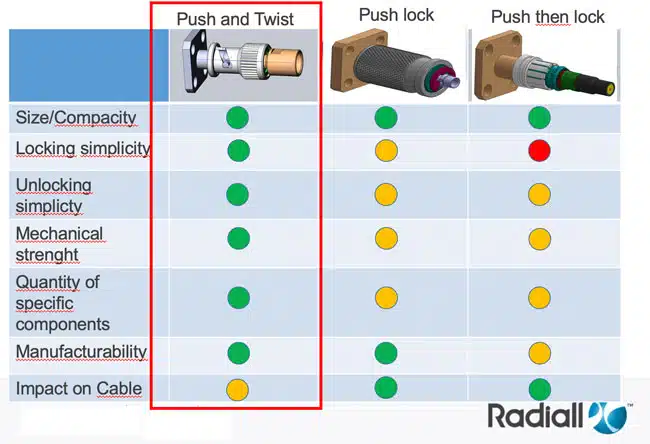
    • Evaluated three fast-lock mechanisms:
      • Push-Lock (1 step): Simple but complex mechanisms and higher locking forces.
      • Push & Lock (2 step): Compact with heritage in space but not optimized for very high frequencies.
      • Push & Twist (Bayonet system): Chosen solution due to locking simplicity, safety, and clear visual confirmation of lock status.
    • Anti-rotation systems were implemented to avoid cable twisting.
    • Conducted extensive RF simulations to optimize performance.
  3. WP3: Development & Manufacturing
    • Developed new RF interfaces with fast-lock mechanisms, including:
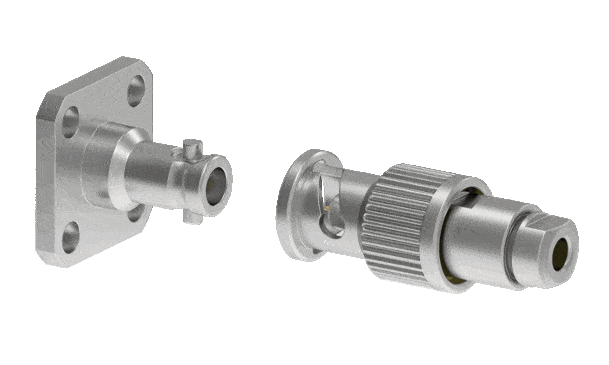
      • Spring systems for effective pressure without cable damage.
      • Various flanges and connectors to compare fast-lock with traditional screw-in systems.
      • Manufactured sample cable assemblies for evaluation.
  1. WP4: Characterization Tests & Optimization
    • Performed tests based on ESCC standards.
    • Minor anomalies identified with connector pairs, targeted for resolution in industrialization.
    • Fast-lock connectors showed good insertion loss and VSWR but lower RF shielding effectiveness compared to screw-in versions, with performance degradation after repeated bending.
  2. WP5: Limitations, Improvements, & Payload Impact
    • Conclusions:
      • Fast-lock system is robust, reliable, and easy to use.
      • Achieved good RF performance up to 110 GHz, except for RF leakage.
      • High development costs with no immediate market demand for space applications.
      • The traditional screw-in version remains preferable for Test & Measurement markets due to better performance stability and cost-effectiveness.

Final Remarks & Roadmap

  • To reach Technology Readiness Level (TRL) 8:
    • Address RF leakage issues through design improvements.
    • Conduct industrialization and supplier analysis for mass production.
    • Consider whether maintaining two interface types is cost-effective.
  • Next Steps:
    • More relevant to qualify a 110 GHz solution with a standard 1.0 mm screw-in interface for space applications.

Read the full paper:

RADIALL_Fast lock W-BandDownload

Related

Source: ESA SPCD

Recent Posts

EMC‑Compliant PCB and Connector Design Guidelines

22.6.2026
22

Hall-Effect Sensing for Harsh Environments: TT Electronics Selected in NASA’s Dragonfly Fan

22.6.2026
20

Stackpole Releases High-Frequency Thin Film Chip Resistors for RF up to 50 GHz

19.6.2026
10

Hirose Releases Ultra‑low Profile FPC‑to‑board Connector

17.6.2026
13

Molex Expanded AirBorn SInergy Hybrid Connectors with 25 A Power Modules

16.6.2026
21

Hirose Releases 0.5 mm Floating Board-to-Board Connector for EV Powertrain Designs

15.6.2026
11

Bourns Completes Rakon Acquisition, Enters Timing Market

12.6.2026
64

HEICO’s Exxelia Expands High-Voltage Ceramic Capacitor Portfolio with CalRamic Acquisition

10.6.2026
53

Evans Group Unifies Four High-Rel Capacitor Leaders

5.6.2026
54

Upcoming Events

Jun 30
17:00 - 18:00 CEST

PSMA Capacitor Committee Webinar: High Voltage Pulse Capacitors

Jul 14
16:00 - 17:00 CEST

EMC Design Essentials: Mastering Varistors and Common Mode Chokes

Jul 21
16:00 - 17:00 CEST

Safety by design: X and Y Interference suppression capacitors for power line filters

View Calendar

Popular Posts

  • Boost Converter Design and Calculation

    0 shares
    Share 0 Tweet 0
  • Buck Converter Design and Calculation

    0 shares
    Share 0 Tweet 0
  • LLC Resonant Converter Design and Calculation

    0 shares
    Share 0 Tweet 0
  • Flyback Converter Design and Calculation

    0 shares
    Share 0 Tweet 0
  • MLCC and Ceramic Capacitors

    0 shares
    Share 0 Tweet 0
  • Earthing Systems and IEC Classification Explained

    0 shares
    Share 0 Tweet 0
  • Nvidia Vera Rubin: Why One AI Rack Needs So Many More MLCC Capacitors

    0 shares
    Share 0 Tweet 0
  • Dual Active Bridge (DAB) Topology

    0 shares
    Share 0 Tweet 0
  • SEPIC Converter Design and Calculation

    0 shares
    Share 0 Tweet 0
  • MLCC Case Sizes Standards Explained

    0 shares
    Share 0 Tweet 0

Newsletter Subscription


Passive Components Blog

© EPCI - Leading Passive Components Educational and Information Site

  • Home
  • Privacy Policy
  • EPCI Membership & Advertisement
  • About

No Result
View All Result
  • Home
  • Knowledge Blog
  • Dossiers
  • PCNS

© EPCI - Leading Passive Components Educational and Information Site

This website uses cookies. By continuing to use this website you are giving consent to cookies being used. Visit our Privacy and Cookie Policy.
Go to mobile version