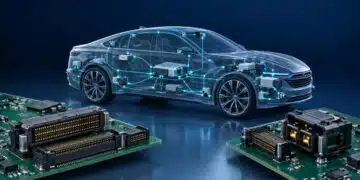





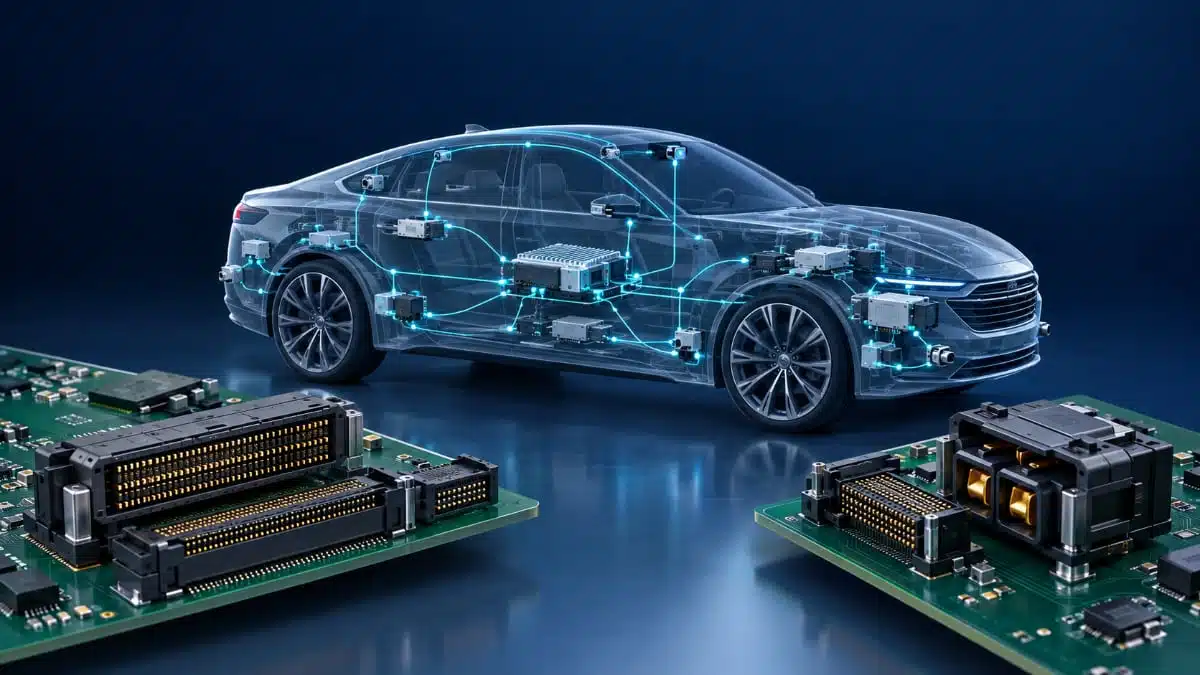
Samtec highlights how software-defined vehicles, advanced driver assistance systems and increasingly capable in-cabin electronics are reshaping automotive interconnect requirements.
Its automotive specialists identify a common design challenge: moving more data and delivering power within smaller spaces while maintaining reliability, manufacturability and cost control.
The company’s industry update points to growing opportunities in centralized computing, high-speed vehicle networks, infotainment and lighting. Rather than announcing a single new connector, Samtec outlines how its standard, automotive A-Series and customer-specific interconnect options address these evolving requirements.
More Vehicle Computing Means Greater Interconnect Demands
According to Zach Barnett, Samtec’s Automotive Industry Sales Manager, data is a primary driver of automotive connector innovation. As vehicles become more connected and software-driven, designers need higher-speed interfaces without increasing the space allocated to electronic systems.
Barnett identifies advanced driver assistance systems, centralized computing platforms and the networks connecting them as important growth areas. Electrification remains a major focus, but the transition toward software-defined architectures is changing how manufacturers approach connectivity throughout the vehicle.
Evan Baumer, Automotive Sales Application Engineer at Samtec, also highlights passenger-facing applications. More capable infotainment, lighting and embedded computing systems create opportunities for both signal and power interconnects.
For designers, the implication is that connector selection increasingly belongs within the initial system architecture discussion. A connector’s ability to meet protocol requirements depends on signal integrity, validated performance and compatibility with the intended operating environment—not simply contact count or mechanical fit.
Balancing Density, Reliability and Manufacturing Cost
Automotive engineers face several requirements simultaneously: increasing performance, reducing size and weight, accommodating constrained layouts and meeting demanding reliability expectations.
Baumer notes that the irregular shapes and installation spaces found in vehicles can make electronic packaging particularly challenging. Board orientation, stacking height, mating access and retention features therefore influence the practical suitability of an interconnect.
Samtec positions its A-Series as a way to address automotive production and cost requirements using established product platforms. Barnett emphasizes working with customers to balance performance, manufacturability and long-term reliability rather than treating each requirement in isolation.
Three Routes to Automotive Interconnect Integration
Samtec’s automotive offering distinguishes between three supply approaches:
- Standard catalog products: built to Samtec drawings within its ISO 9001 quality framework, with sampling and volume-production options.
- Automotive A-Series products: manufactured in a controlled IATF 16949 facility, built to Samtec drawings and standards, registered in the International Material Data System and supported by Level 3 Production Part Approval Process packages.
- Custom ACD-Series products: developed to support agreed customer-specific requirements within Samtec’s IATF 16949 manufacturing framework, with options including material registration and vendor-managed inventory.
This distinction helps engineering and purchasing teams align the connector with the required production documentation and customer approval process. A product’s electrical performance and its automotive supply qualification are related selection considerations, but they are not interchangeable.
Automotive Qualification Extends Beyond Initial Performance
Testing, qualification, manufacturing compliance and price are recurring priorities in Samtec’s discussions with automotive customers. Baumer states that most A-Series products have undergone additional qualification testing, with supporting reports and qualification information available through the company.
Samtec identifies three relevant testing programs:
- Design Qualification Testing covers parameters including current-carrying capacity, insulation resistance, dielectric withstand voltage, mechanical shock, vibration and mating durability.
- Severe Environment Testing adds testing beyond typical industry requirements for selected products intended for demanding applications.
- Extended Life Product testing evaluates contact resistance under simulated storage and field conditions, including mixed flowing gas exposure and repeated mating.
These programs address different aspects of connector performance. Their applicability depends on the selected series and configuration; the automotive designation should not be interpreted as a universal specification shared by every product.
Why Contact Resistance Stability Matters
A connector must maintain a dependable electrical interface after environmental exposure and mechanical stress, not only when first assembled. The measurement of connector resistance distinguishes low-level contact resistance from resistance measured at rated current, providing different ways to assess the connection.
For power interfaces, resistance contributes to voltage drop and heat generation. For signal interfaces, changes in contact condition can undermine connection stability. This makes qualification evidence and the intended environmental conditions important companions to headline current ratings or data-rate capabilities.
Connector Platforms for Signal, Power and Compact Packaging
Samtec’s automotive portfolio includes several interconnect technologies addressing different design priorities:
- Tiger Eye systems use a three-finger beryllium copper contact design and offer rugged retention options for high-reliability applications.
- SEARAY arrays provide high-density open-pin-field layouts, allowing flexibility in signal routing and ground-contact allocation.
- Razor Beam self-mating connectors support compact board-to-board arrangements, with shielded options available.
- mPOWER connectors provide compact power interfaces for board-to-board, cable-to-board and cable-to-cable connections.
- Generate edge-card sockets combine high-speed signal capability with multiple mounting orientations and selected power/signal configurations.
Samtec lists automotive A-Series versions of multiple platforms within its Severe Environment Testing and Extended Life Product programs. Engineers should check the qualification report, drawing and performance data for the exact orderable configuration rather than assuming that all variants share the same capabilities.
Engineering Takeaway: Select the Complete Connection
The useful design lesson is to evaluate connectivity as a combined electrical, mechanical and production requirement.
A high-density connector may resolve a packaging constraint, but its value depends on whether the chosen configuration also meets signal-performance requirements, current needs, retention expectations and the applicable approval process. Likewise, an automotive documentation package does not replace verification of the connection in the intended system.
A practical review should therefore bring together:
- Protocol compatibility and signal-integrity evidence.
- Current-carrying capability and temperature-rise limits.
- Board geometry, mating access and retention features.
- Environmental and durability test coverage.
- Production documentation and customer-specific requirements.
Samtec’s outlook anticipates more software-defined architectures, AI-enabled functions and higher-speed communication within vehicles. Its update positions interconnect engineering as an enabling part of that transition, with cost-sensitive implementation remaining central to automotive adoption.
Further reading
Source
This article is based on Samtec’s manufacturer-published automotive industry update, featuring insights from Zach Barnett and Evan Baumer, and supporting information from its automotive solutions overview. The original publication is a technical blog interview rather than a formal product-launch press release; the engineering context added here explains its implications for connector selection and qualification.