

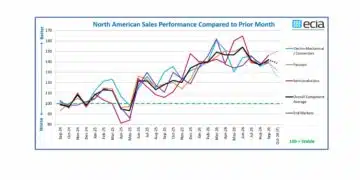





ECIA’s September 2026 Industry Pulse survey shows stronger-than-expected electronic component sentiment, with every component segment and the overall end-market measure outperforming forecasts made in August.
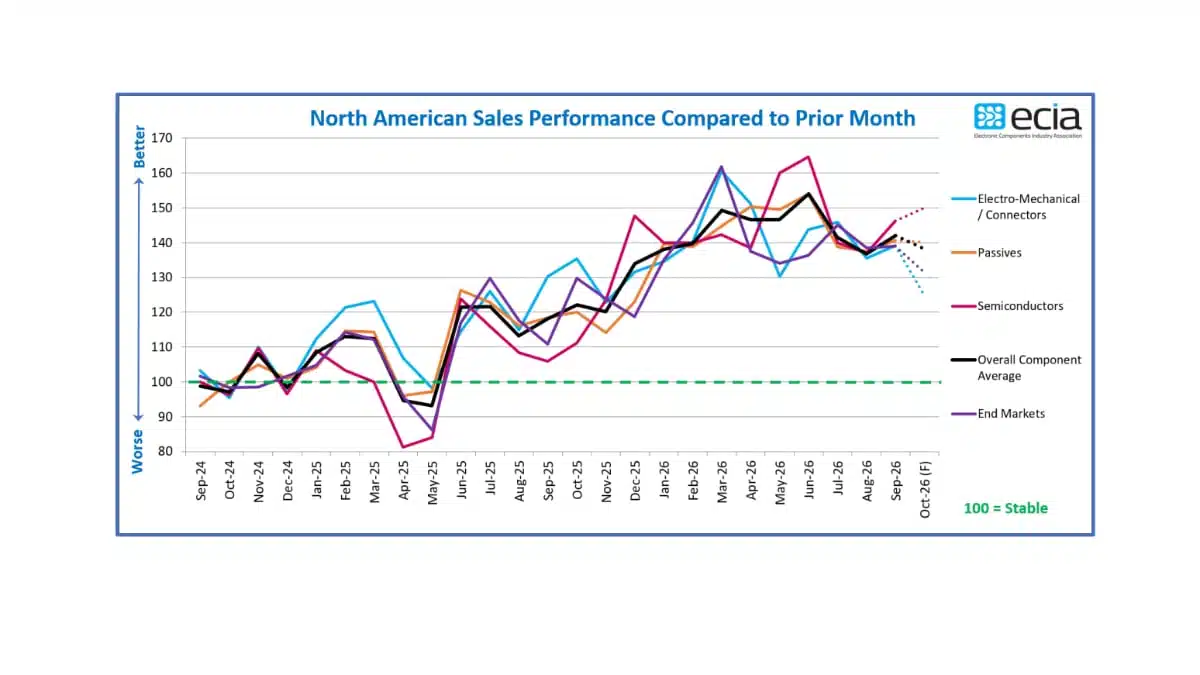
The overall component index rose to 142.0 from 136.7, while supply-chain pressure remained elevated despite some easing for passive and electro-mechanical components.
For passive component suppliers, distributors and purchasing teams, the central message is resilience: sales expectations remain positive, but the survey does not yet indicate a return to easier component availability.
September Results Beat Expectations
The Electronic Components Industry Association’s latest Industry Pulse executive summary, authored by Chief Analyst Dale Ford, reports a 5.3-point improvement in the overall component index. September’s reading exceeded the previous month’s forecast by 6.6 points.
End-market sentiment also held firm. Its overall index increased slightly from 138.5 in August to 138.9 in September, outperforming expectations by 8.1 points. Both measures remained comfortably above the survey’s 100-point growth threshold. These are sentiment index readings, not percentage changes in component sales.
Key Survey Indicators
- Overall component sentiment: 142.0 in September, up from 136.7 in August.
- Overall end-market sentiment: 138.9 in September, compared with 138.5 in August.
- October component outlook: 138.3, a projected decline of 3.7 points.
- October passive component outlook: 140.1, described by ECIA as stable.
- October semiconductor outlook: 150.0.
- October electro-mechanical outlook: 124.8, a projected decline of 14.4 points that ECIA flags for closer scrutiny.
Passive Lead-Time Pressure Eases but Remains High
The share of respondents reporting increasing lead-time pressure eased between August and September for passive and electro-mechanical components. Nevertheless, approximately 61–63% still reported increasing pressure across these two categories, and none reported declining pressure.
The distinction matters: fewer respondents reporting additional pressure does not mean delivery times have shortened. September’s results point to a less widespread deterioration, rather than clear evidence of supply-chain recovery. ECIA explicitly states that relief from supply-chain imbalances has not materialized.
Semiconductor conditions moved in the opposite direction. The proportion reporting increasing lead-time pressure rose from 72% to 77%. Although DRAM and data flash memory have attracted particular attention, ECIA notes that pressure extends across all product categories.
What This Means for Component Sourcing
For purchasing and engineering teams, the useful takeaway is to separate broad market sentiment from the availability of individual parts. Positive sales expectations and persistent delivery pressure can coexist; a category-level index cannot establish the delivery schedule of a specific capacitor, resistor or inductor.
The practical response is targeted rather than indiscriminate: monitor critical part numbers, confirm supplier commitments and review approved alternatives where substitution options are limited. This aligns with the sourcing approach discussed in Passive Components in 2026: Commodity to Design Parameter, which distinguishes technology- and grade-specific constraints from catalogue-wide shortages.
End-Market Strength Remains Broad-Based
September’s end-market results showed positive sentiment across all surveyed markets. Individual readings ranged from 104.5 for consumer electronics to 150.0 for avionics, military and space, with a notable improvement in mobile phone sentiment helping support the overall result.
ECIA reports that every end-market reading in both the September results and October outlook remained above the 100-point growth threshold. This breadth suggests that positive expectations are not confined to a single application sector, although the strength of sentiment varies substantially between markets.
The October end-market forecast falls to 131.4, down 7.5 points. However, the August survey had also anticipated a September decline that did not occur. The latest results therefore provide a reason to distinguish forward-looking caution from an observed weakening in September.
October Outlook Requires a Participation Caveat
The projected October decline in overall component sentiment is driven by the unusually weak electro-mechanical forecast. ECIA describes this result as uncharacteristic because electro-mechanical components typically perform better than the other segments.
Unusually low manufacturer participation may have skewed the result. Distributor and manufacturer representative scores broadly aligned with the overall readings, but ECIA says manufacturer participation was insufficient for a reasonable comparison with the overall average. Both participation and electro-mechanical performance will receive closer scrutiny in the October survey.
The forecast should therefore be treated as an early signal requiring confirmation, rather than firm evidence of a broad electro-mechanical downturn.
Understanding the Survey’s Scope
ECIA’s monthly and quarterly Industry Pulse reports cover sales expectations, sales outlook, cancellations, decommits and product lead times. The complete reports provide detailed views across six major electronic component categories, six semiconductor subcategories and eight end markets, with responses segmented by manufacturers, distributors and manufacturer representatives.
The September executive summary offers a near-term view of industry conditions, not a detailed availability forecast for individual passive component technologies. ECIA distributes the complete report to its members and other survey participants.
Further reading
Source
This article is based on ECIA’s September 2026 Industry Pulse: Electronic Component Trends and Sentiment executive summary, authored by Chief Analyst Dale Ford. The original source is an industry association survey summary rather than a manufacturer press release. Sourcing implications are editorial interpretation and should not be read as additional survey findings.