






Passive Components Blog
No Result
View All Result
  • Home
  • NewsFilter
    • All
    • Aerospace & Defence
    • Antenna
    • Applications
    • Automotive
    • Capacitors
    • Circuit Protection Devices
    • electro-mechanical news
    • Filters
    • Fuses
    • Inductors
    • Industrial
    • Integrated Passives
    • inter-connect news
    • Market & Supply Chain
    • Market Insights
    • Medical
    • Modelling and Simulation
    • New Materials & Supply
    • New Technologies
    • Non-linear Passives
    • Oscillators
    • Passive Sensors News
    • Resistors
    • RF & Microwave
    • Telecommunication
    • Weekly Digest

    Bourns Introduces Automotive Shielded Power Inductors for Compact DC‑DC Converters

    EMC Design Fundamentals: Safe Use of Varistors and Common Mode Chokes in Mains and Data-Line Filters

    Murata Unveils Lead Disc Ceramic Capacitors for Automotive Safety and EMI Suppression

    SCHURTER Releases Intelligent Three‑Terminal Fuses for Safer Li‑ion Battery Systems

    Can Copper Conductive Inks Displace Silver in Hybrid Electronics?

    Square-Wave Harmonics and RMS Currents in Power Converters

    LeanBOM: Practical Cross‑Technology Capacitor Search by Real Working Conditions

    In the Age of AI, Every Watt Counts: Implications for Components

    Stackpole Extends Resistance Range of 2512 High‑Power Current Sense Resistors

    Trending Tags

    • Ripple Current
    • RF
    • Leakage Current
    • Tantalum vs Ceramic
    • Snubber
    • Low ESR
    • Feedthrough
    • Derating
    • Dielectric Constant
    • New Products
    • Market Reports
  • VideoFilter
    • All
    • Antenna videos
    • Capacitor videos
    • Circuit Protection Video
    • Filter videos
    • Fuse videos
    • Inductor videos
    • Inter-Connect Video
    • Non-linear passives videos
    • Oscillator videos
    • Passive sensors videos
    • Resistor videos

    EMC Design Fundamentals: Safe Use of Varistors and Common Mode Chokes in Mains and Data-Line Filters

    Ferrite versus Nanocrystalline Power Inductor Cores: Turns, Gap and Size

    KYOCERA AVX Presents Antenna Integrator Studio Tutorial for Antenna Placement and RF Design

    Power Design Simulation Tools for Faster Inductor Selection and Loss Optimization

    EMC‑Compliant PCB and Connector Design Guidelines

    Why Isolated DC/DC Power Supplies Fail Late, Würth Elektronik Podcast

    Designing 800 V DC EMC Filters: Calculation, Simulation and Measurement

    Current Sense Transformer Datasheet and Design‑in Guide

    Designing a USB Type‑C Flyback Planar Transformer with Frenetic’s Planar Tool

    Trending Tags

    • Capacitors explained
    • Inductors explained
    • Resistors explained
    • Filters explained
    • Application Video Guidelines
    • EMC
    • New Products
    • Ripple Current
    • Simulation
    • Tantalum vs Ceramic
  • Knowledge Blog
  • Dossiers
    • AI Hardware Dossier
    • Power Converter Dossier
    • Automotive Dossier
    • Capacitor Dossier
    • Resistor Dossier
    • Inductor Dossier
    • Circuit Protection Dossier
  • Suppliers
    • Who is Who
  • PCNS
    • PCNS 2025
    • PCNS 2023
    • PCNS 2021
    • PCNS 2019
    • PCNS 2017
  • Events
  • Home
  • NewsFilter
    • All
    • Aerospace & Defence
    • Antenna
    • Applications
    • Automotive
    • Capacitors
    • Circuit Protection Devices
    • electro-mechanical news
    • Filters
    • Fuses
    • Inductors
    • Industrial
    • Integrated Passives
    • inter-connect news
    • Market & Supply Chain
    • Market Insights
    • Medical
    • Modelling and Simulation
    • New Materials & Supply
    • New Technologies
    • Non-linear Passives
    • Oscillators
    • Passive Sensors News
    • Resistors
    • RF & Microwave
    • Telecommunication
    • Weekly Digest

    Bourns Introduces Automotive Shielded Power Inductors for Compact DC‑DC Converters

    EMC Design Fundamentals: Safe Use of Varistors and Common Mode Chokes in Mains and Data-Line Filters

    Murata Unveils Lead Disc Ceramic Capacitors for Automotive Safety and EMI Suppression

    SCHURTER Releases Intelligent Three‑Terminal Fuses for Safer Li‑ion Battery Systems

    Can Copper Conductive Inks Displace Silver in Hybrid Electronics?

    Square-Wave Harmonics and RMS Currents in Power Converters

    LeanBOM: Practical Cross‑Technology Capacitor Search by Real Working Conditions

    In the Age of AI, Every Watt Counts: Implications for Components

    Stackpole Extends Resistance Range of 2512 High‑Power Current Sense Resistors

    Trending Tags

    • Ripple Current
    • RF
    • Leakage Current
    • Tantalum vs Ceramic
    • Snubber
    • Low ESR
    • Feedthrough
    • Derating
    • Dielectric Constant
    • New Products
    • Market Reports
  • VideoFilter
    • All
    • Antenna videos
    • Capacitor videos
    • Circuit Protection Video
    • Filter videos
    • Fuse videos
    • Inductor videos
    • Inter-Connect Video
    • Non-linear passives videos
    • Oscillator videos
    • Passive sensors videos
    • Resistor videos

    EMC Design Fundamentals: Safe Use of Varistors and Common Mode Chokes in Mains and Data-Line Filters

    Ferrite versus Nanocrystalline Power Inductor Cores: Turns, Gap and Size

    KYOCERA AVX Presents Antenna Integrator Studio Tutorial for Antenna Placement and RF Design

    Power Design Simulation Tools for Faster Inductor Selection and Loss Optimization

    EMC‑Compliant PCB and Connector Design Guidelines

    Why Isolated DC/DC Power Supplies Fail Late, Würth Elektronik Podcast

    Designing 800 V DC EMC Filters: Calculation, Simulation and Measurement

    Current Sense Transformer Datasheet and Design‑in Guide

    Designing a USB Type‑C Flyback Planar Transformer with Frenetic’s Planar Tool

    Trending Tags

    • Capacitors explained
    • Inductors explained
    • Resistors explained
    • Filters explained
    • Application Video Guidelines
    • EMC
    • New Products
    • Ripple Current
    • Simulation
    • Tantalum vs Ceramic
  • Knowledge Blog
  • Dossiers
    • AI Hardware Dossier
    • Power Converter Dossier
    • Automotive Dossier
    • Capacitor Dossier
    • Resistor Dossier
    • Inductor Dossier
    • Circuit Protection Dossier
  • Suppliers
    • Who is Who
  • PCNS
    • PCNS 2025
    • PCNS 2023
    • PCNS 2021
    • PCNS 2019
    • PCNS 2017
  • Events
No Result
View All Result
Passive Components Blog
No Result
View All Result

Power Paper Shows Promise of Clean High Energy Storing Capability

14.1.2022
Reading Time: 5 mins read
A A

A new pilot study from the Digital Cellulose Center on a greentech power paper shows promise for high-capacity storage of renewable energy. The electronic paper is completely made of organic material and the first testing’s show that the energy storage capacity is as efficient as conventional technology.

“The power papers energy storage capacity showed fantastic results in our pilot study, with the possibility of storing renewable energy on a large scale,” says Jesper Edberg, researcher at RISE and scientific leader at the Digital Cellulose Center. “Green electronics, like the power paper, will contribute greatly to a sustainable, digital society.”

RelatedPosts

Electroninks Releases Gold and Platinum Particle-Free Conductive Inks

Peak Nano Installs Production Line for Innovative Capacitor Films

Electrical Properties Study of SMD Resistor Integrated Metallic Yarn for Smart Textiles

Greentech power paper – a key to a fossil-free society

The transition to a fossil-free society needs to go faster. Renewable energy such as solar and wind power is a part of the transition, however it lacks efficient methods of energy storage. One of the biggest challenges for renewable energy is storing energy on a large scale to fully utilize the energy that is produced. Researchers at the Digital Cellulose Center believe that an electrode paper with the ability for high-capacity energy storage will be the solution.

The electrode paper, also called the power paper, has been a research area for many years. Jesper Edberg is one of the leading scientists in the area. Based on the previous development of the power paper by the research teams from RISE, KTH and Linköping University, the team at Digital Cellulose Center have refined the research and process for creating power electronics with organic materials.
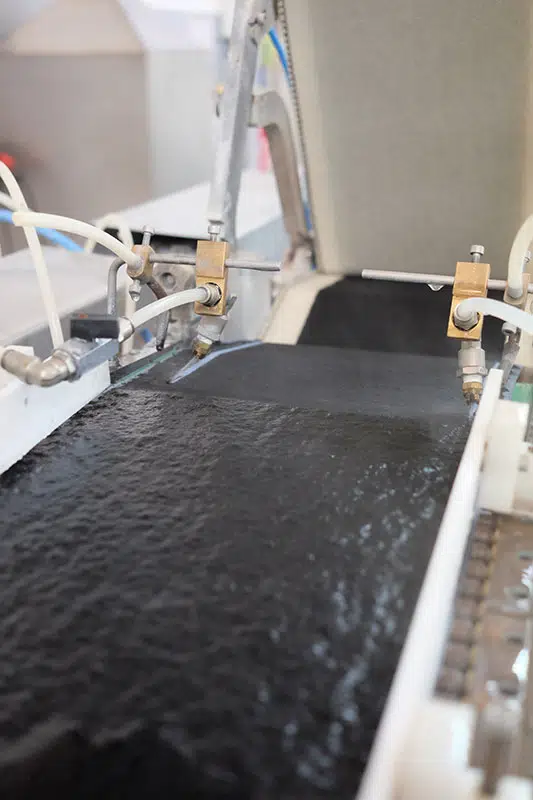
The mixture with all the components is distributed on a wire made of a fine-mesh net, where water is sucked out from below by vacuum.; image credit: Digital Cellulose Center

Large scale renewable energy storage

The first prototype of the power paper was fifteen centimeters in diameter, and a tenth of a millimeter thick. It had the ability to be charged with electricity within a few seconds and it could be reused hundreds of times.

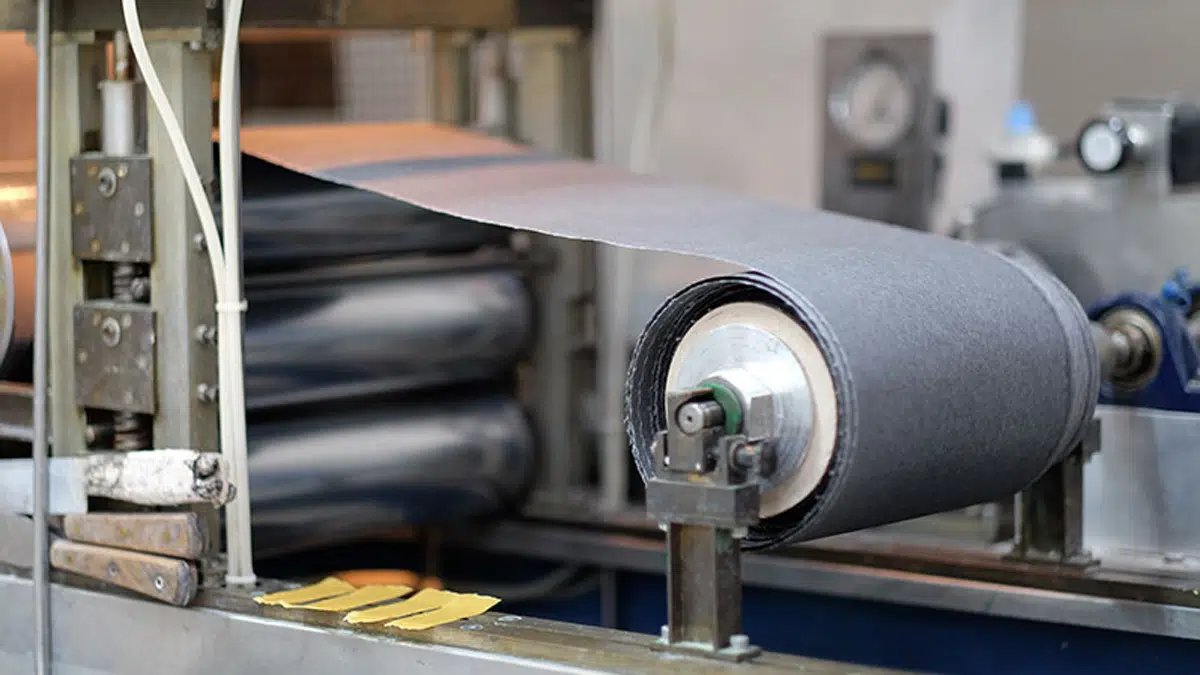
The newly re-developed power paper is made with other materials than before, it is completely composed of organic materials and has more efficient properties for high-capacity energy storage. A pilot study was conducted by the Digital Cellulose Center’s researchers and industry partners Agfa and Ahlstrom-Munksjö. The purpose was to test and verify if the power paper can be produced on a large scale. The biggest challenge was to scale up the process and take the production from the gram scale to a kilogram scale.

The test was successful, and the paper was manufactured in regular paper machines, with several paper roles produced, ten meters each. The paper can be used as electrodes in supercapacitors in order to test the energy storage capacity. The testing’s showed that the paper has an as efficient energy storage capacity as conventional supercapacitors.

The future of the power paper

“Our goal is to use the paper material to build prototype supercapacitors before the end of the year”, says Jesper Edberg. “In the future, we also plan to add electrochemically active materials that will enable the paper to be used in battery applications. Then the energy density would increase significantly because batteries can store more energy than ultracapacitors. Our previously research has also shown that such batteries can be manufactured from forest-based materials.”

The power paper can be used in many areas, for instance in smart packaging and in internet-of-things applications, where small and smart components collect information from the environment and communicates it to the user. These small and distributed devices must all have an energy source, like a thin, flexible, and foldable paper battery.
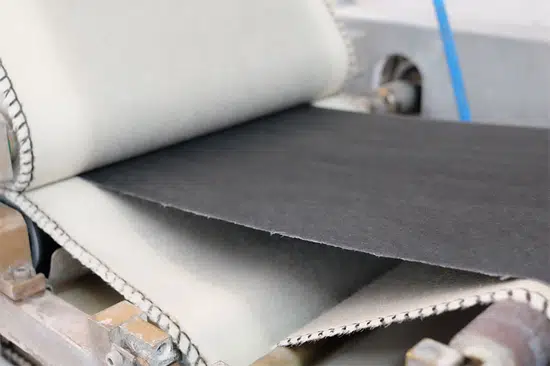
After removing some of the water by vacuum, the sheet of paper is pressed in order to remove more of the water, and at the same time increasing the strength of the paper.; image credit: Digital Cellulose Center

Cost-effective and 100% organic materials

Paper has several advantages compared to other materials. It is cost-effective and easy to manufacture on a large scale, with already existing paper manufacturing processes. Paper also has a large surface area and structure and can, therefor bind more energy-storing materials.

The power paper is made of 100 percent organic material: cellulose, conductive polymers, bio-based charcoal from coconuts. The production process gives the papers properties like durability, fixability, and it makes the paper electrically conductive.

The green power paper – A decade in the making

Ten years of research has gone into developing the power paper and in to finding the solutions on how to get the electronic renewable materials to remain in the paper, as well as in to retaining the energy storage properties over the entire surface of the paper. The result was an electrode paper, manufactured in a lab scale, with excellent energy storage properties.

The paper was first developed with support from the Knut and Alice Wallenberg Foundation (KAW) and the Swedish foundation for Strategic Research (SSF). The research and the development of the new power paper has been made in collaboration with the institutes KTH, Linköping University, and RISE, as well as industry partners Agfa, that supplied electrically conductive polymers, and Ahlstrom-Munksjö, that manages the pilot plant in France. The work was made possible by financing from Vinnova.

Production of the energy storing paper

When making conventional paper, elongated fibers are dispersed in water, a homogeneous layer is made, and then the waters is removed. To manufacture the electronic paper, the electroactive components (conductive polymers and bio-based charcoal from coconuts) must be attached to the fibers and trapped in the fiber network . The goal is to fill the paper with as much electroactive material as possible, however, using too much of the electroactive materials can make the paper not hold together. Cellulose is what binds the material together and turns it into a paper.


Related

Source: Digital Cellulose Center

Recent Posts

Murata Unveils Lead Disc Ceramic Capacitors for Automotive Safety and EMI Suppression

15.7.2026
24

Square-Wave Harmonics and RMS Currents in Power Converters

14.7.2026
24

LeanBOM: Practical Cross‑Technology Capacitor Search by Real Working Conditions

14.7.2026
33

In the Age of AI, Every Watt Counts: Implications for Components

13.7.2026
44

RF Filters and Passive Components Enabling the 7 Missile RF Subsystems

9.7.2026
51

From DCL to SSC: Bridging Electrical Symptoms and Structural Indicators in Tantalum Capacitors

7.7.2026
61

High-Q RF & Microwave MLCCs: A Cross-Vendor Benchmark

2.7.2026
93

TAIYO YUDEN Introduced Hybrid Aluminum Capacitors for 48V Automotive Power Supplies

2.7.2026
80

YAGEO Announces July 2026 Capacitor Price Increase

1.7.2026
822

Upcoming Events

Jul 21
16:00 - 17:00 CEST

Safety by design: X and Y Interference suppression capacitors for power line filters

Jul 28
8:00 - 11:00 CEST

Post Procurement Testing of EEE Components for LEO Space Applications

Jul 29
17:30 - 18:30 CEST

To Ferrite or to Nanocrystalline in Transformer Design

View Calendar

Popular Posts

  • Boost Converter Design and Calculation

    0 shares
    Share 0 Tweet 0
  • Buck Converter Design and Calculation

    0 shares
    Share 0 Tweet 0
  • Flyback Converter Design and Calculation

    0 shares
    Share 0 Tweet 0
  • YAGEO Announces July 2026 Capacitor Price Increase

    0 shares
    Share 0 Tweet 0
  • LLC Resonant Converter Design and Calculation

    0 shares
    Share 0 Tweet 0
  • MLCC and Ceramic Capacitors

    0 shares
    Share 0 Tweet 0
  • Earthing Systems and IEC Classification Explained

    0 shares
    Share 0 Tweet 0
  • Nvidia Vera Rubin: Why One AI Rack Needs So Many More MLCC Capacitors

    0 shares
    Share 0 Tweet 0
  • MLCCs in the Age of AI: Q2 2026 Market Tightness

    0 shares
    Share 0 Tweet 0
  • Dual Active Bridge (DAB) Topology

    0 shares
    Share 0 Tweet 0

Newsletter Subscription


Passive Components Blog

© EPCI - Leading Passive Components Educational and Information Site

  • Home
  • Privacy Policy
  • EPCI Membership & Advertisement
  • About

No Result
View All Result
  • Home
  • Knowledge Blog
  • Dossiers
  • PCNS

© EPCI - Leading Passive Components Educational and Information Site

This website uses cookies. By continuing to use this website you are giving consent to cookies being used. Visit our Privacy and Cookie Policy.
Go to mobile version