












Passive Components Blog
No Result
View All Result
  • Home
  • NewsFilter
    • All
    • Aerospace & Defence
    • Antenna
    • Applications
    • Automotive
    • Capacitors
    • Circuit Protection Devices
    • electro-mechanical news
    • Filters
    • Fuses
    • Inductors
    • Industrial
    • Integrated Passives
    • inter-connect news
    • Market & Supply Chain
    • Market Insights
    • Medical
    • Modelling and Simulation
    • New Materials & Supply
    • New Technologies
    • Non-linear Passives
    • Oscillators
    • Passive Sensors News
    • Resistors
    • RF & Microwave
    • Telecommunication
    • Weekly Digest

    Bourns Introduces Automotive Shielded Power Inductors for Compact DC‑DC Converters

    EMC Design Fundamentals: Safe Use of Varistors and Common Mode Chokes in Mains and Data-Line Filters

    Murata Unveils Lead Disc Ceramic Capacitors for Automotive Safety and EMI Suppression

    SCHURTER Releases Intelligent Three‑Terminal Fuses for Safer Li‑ion Battery Systems

    Can Copper Conductive Inks Displace Silver in Hybrid Electronics?

    Square-Wave Harmonics and RMS Currents in Power Converters

    LeanBOM: Practical Cross‑Technology Capacitor Search by Real Working Conditions

    In the Age of AI, Every Watt Counts: Implications for Components

    Stackpole Extends Resistance Range of 2512 High‑Power Current Sense Resistors

    Trending Tags

    • Ripple Current
    • RF
    • Leakage Current
    • Tantalum vs Ceramic
    • Snubber
    • Low ESR
    • Feedthrough
    • Derating
    • Dielectric Constant
    • New Products
    • Market Reports
  • VideoFilter
    • All
    • Antenna videos
    • Capacitor videos
    • Circuit Protection Video
    • Filter videos
    • Fuse videos
    • Inductor videos
    • Inter-Connect Video
    • Non-linear passives videos
    • Oscillator videos
    • Passive sensors videos
    • Resistor videos

    EMC Design Fundamentals: Safe Use of Varistors and Common Mode Chokes in Mains and Data-Line Filters

    Ferrite versus Nanocrystalline Power Inductor Cores: Turns, Gap and Size

    KYOCERA AVX Presents Antenna Integrator Studio Tutorial for Antenna Placement and RF Design

    Power Design Simulation Tools for Faster Inductor Selection and Loss Optimization

    EMC‑Compliant PCB and Connector Design Guidelines

    Why Isolated DC/DC Power Supplies Fail Late, Würth Elektronik Podcast

    Designing 800 V DC EMC Filters: Calculation, Simulation and Measurement

    Current Sense Transformer Datasheet and Design‑in Guide

    Designing a USB Type‑C Flyback Planar Transformer with Frenetic’s Planar Tool

    Trending Tags

    • Capacitors explained
    • Inductors explained
    • Resistors explained
    • Filters explained
    • Application Video Guidelines
    • EMC
    • New Products
    • Ripple Current
    • Simulation
    • Tantalum vs Ceramic
  • Knowledge Blog
  • Dossiers
    • AI Hardware Dossier
    • Power Converter Dossier
    • Automotive Dossier
    • Capacitor Dossier
    • Resistor Dossier
    • Inductor Dossier
    • Circuit Protection Dossier
  • Suppliers
    • Who is Who
  • PCNS
    • PCNS 2025
    • PCNS 2023
    • PCNS 2021
    • PCNS 2019
    • PCNS 2017
  • Events
  • Home
  • NewsFilter
    • All
    • Aerospace & Defence
    • Antenna
    • Applications
    • Automotive
    • Capacitors
    • Circuit Protection Devices
    • electro-mechanical news
    • Filters
    • Fuses
    • Inductors
    • Industrial
    • Integrated Passives
    • inter-connect news
    • Market & Supply Chain
    • Market Insights
    • Medical
    • Modelling and Simulation
    • New Materials & Supply
    • New Technologies
    • Non-linear Passives
    • Oscillators
    • Passive Sensors News
    • Resistors
    • RF & Microwave
    • Telecommunication
    • Weekly Digest

    Bourns Introduces Automotive Shielded Power Inductors for Compact DC‑DC Converters

    EMC Design Fundamentals: Safe Use of Varistors and Common Mode Chokes in Mains and Data-Line Filters

    Murata Unveils Lead Disc Ceramic Capacitors for Automotive Safety and EMI Suppression

    SCHURTER Releases Intelligent Three‑Terminal Fuses for Safer Li‑ion Battery Systems

    Can Copper Conductive Inks Displace Silver in Hybrid Electronics?

    Square-Wave Harmonics and RMS Currents in Power Converters

    LeanBOM: Practical Cross‑Technology Capacitor Search by Real Working Conditions

    In the Age of AI, Every Watt Counts: Implications for Components

    Stackpole Extends Resistance Range of 2512 High‑Power Current Sense Resistors

    Trending Tags

    • Ripple Current
    • RF
    • Leakage Current
    • Tantalum vs Ceramic
    • Snubber
    • Low ESR
    • Feedthrough
    • Derating
    • Dielectric Constant
    • New Products
    • Market Reports
  • VideoFilter
    • All
    • Antenna videos
    • Capacitor videos
    • Circuit Protection Video
    • Filter videos
    • Fuse videos
    • Inductor videos
    • Inter-Connect Video
    • Non-linear passives videos
    • Oscillator videos
    • Passive sensors videos
    • Resistor videos

    EMC Design Fundamentals: Safe Use of Varistors and Common Mode Chokes in Mains and Data-Line Filters

    Ferrite versus Nanocrystalline Power Inductor Cores: Turns, Gap and Size

    KYOCERA AVX Presents Antenna Integrator Studio Tutorial for Antenna Placement and RF Design

    Power Design Simulation Tools for Faster Inductor Selection and Loss Optimization

    EMC‑Compliant PCB and Connector Design Guidelines

    Why Isolated DC/DC Power Supplies Fail Late, Würth Elektronik Podcast

    Designing 800 V DC EMC Filters: Calculation, Simulation and Measurement

    Current Sense Transformer Datasheet and Design‑in Guide

    Designing a USB Type‑C Flyback Planar Transformer with Frenetic’s Planar Tool

    Trending Tags

    • Capacitors explained
    • Inductors explained
    • Resistors explained
    • Filters explained
    • Application Video Guidelines
    • EMC
    • New Products
    • Ripple Current
    • Simulation
    • Tantalum vs Ceramic
  • Knowledge Blog
  • Dossiers
    • AI Hardware Dossier
    • Power Converter Dossier
    • Automotive Dossier
    • Capacitor Dossier
    • Resistor Dossier
    • Inductor Dossier
    • Circuit Protection Dossier
  • Suppliers
    • Who is Who
  • PCNS
    • PCNS 2025
    • PCNS 2023
    • PCNS 2021
    • PCNS 2019
    • PCNS 2017
  • Events
No Result
View All Result
Passive Components Blog
No Result
View All Result

KYOCERA AVX Releases Robust Vertical-Mating Battery Connectors

25.6.2025
Reading Time: 3 mins read
A A

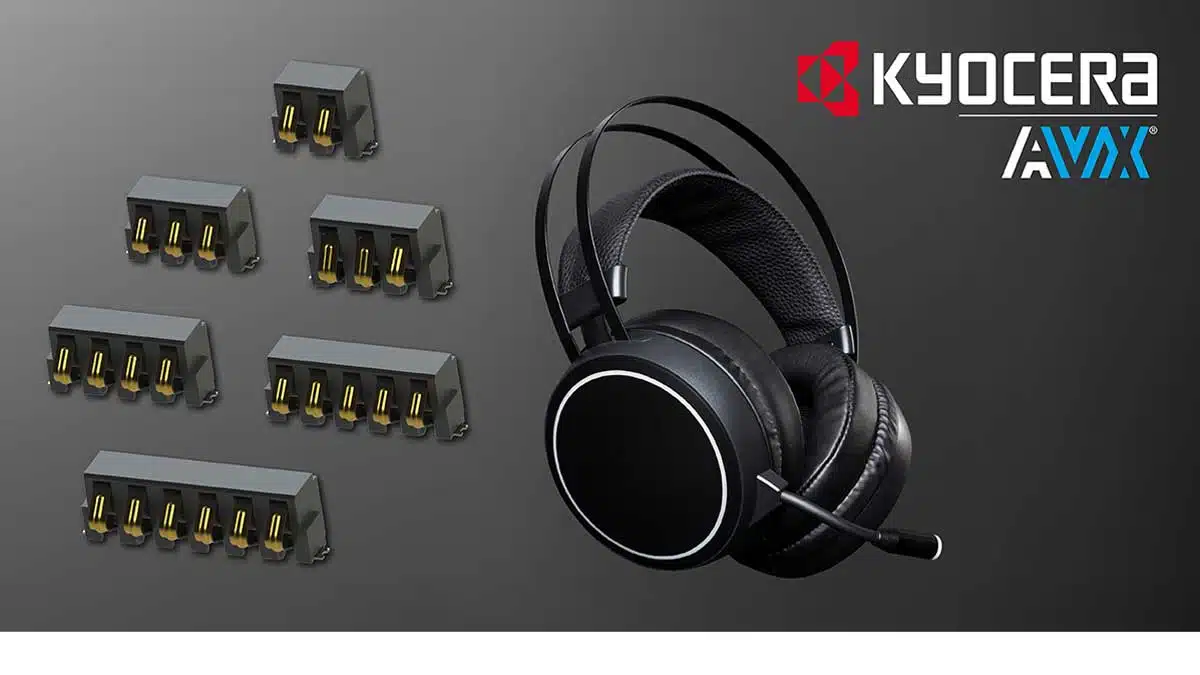
KYOCERA AVX introduces new 9155-900 Series 2.5mm-pitch vertical-mate battery connectors providing engineers in the industrial, automotive, datacom, household appliance, and consumer electronics markets with robust, reliable, and user-friendly power connectivity solutions.

KYOCERA AVX, a leading global manufacturer of advanced electronic components engineered to accelerate technological innovation and build a better future, has further expanded its industry-leading selection of standard battery connectors with the introduction of the new 9155-900 Series 2.5mm-pitch vertical-mate battery connectors. 

RelatedPosts

KYOCERA AVX Presents Antenna Integrator Studio Tutorial for Antenna Placement and RF Design

KYOCERA AVX Releases NTN Antenna Selection Guide Brochure

KYOCERA 10 µF 0201 MLCC Brings High‑Capacitance into Mobile Designs

The new 9155-900 Series 2.5mm-pitch vertical-mate battery connectors feature a unique contact geometry that deflects cleanly when a module, battery pack, mating connector, or PCB is vertically pushed into position, enabling full vertical engagement without the risk of contact damage.

Traditional right-angle battery connectors require users to engage the contacts by inserting the mating module or battery pack at an angle before rotating it into position to reliably prevent contact damage that could negatively impact connector performance and lifetime. The 9155-900 Series does not. In fact, users can mate these connectors from any angle without inadvertently damaging the contacts, ensuring high-integrity connections regardless of user experience or skill level. 

The 9155-900 Series 2.5mm-pitch vertical-mate battery connectors feature an extremely forgiving sweeping beam contact design and an anti-snag feature that reliably protects the contacts from damage during deflection, as well as when static. The series also features ultra-robust and -reliable gold-plated beryllium copper (BeCu) contacts that deliver excellent electrical and mechanical performance for up to 5,000 mating cycles and optional plastic locating bosses and solder tabs that maximize the mechanical stability of the connector in high-shock and vibration environments, like automotive applications. 

The series features flame-retardant (UL94 V-0) black, glass-filled Nylon 46 insulators, two to six BeCu contacts with either 0.4µm or 0.8µm of selective gold-over-nickel plating (the former of which is suitable for most commercial and industrial applications and the latter of which is suitable for harsh-environment applications), and pure tin tails. They are rated for 500VACRMS or the DC equivalent, up to 3A, and operating temperatures extending from -40°C to +125°C. They are also REACH and RoHS compliant and shipped in tape and reel packaging in quantities of 800 for automated pick and place assembly. 

Ideal applications for the new 9155-900 Series 2.5mm-pitch vertical-mate battery connectors extend throughout the industrial, automotive, datacom, household appliance, and consumer electronics markets and include handheld and portable industrial and consumer electronics devices that require docking or cradling, such as charging stations, internet and home appliances that require battery backup, and automotive applications that require the easy installation and removal of modules or battery packs, ranging from headsets, gaming controllers, and walkie talkies to automotive cooling fans. 

“Traditional right-angle battery connectors with exposed contacts require pluggable modules to be inserted at an angle and then gently rotated into position to prevent contact damage. And while that may seem insignificant, the extra step required to safely and successfully mate traditional battery connectors increases the potential for mismating by half,” said Perrin Hardee, Product Marketing Manager at KYOCERA AVX. “Our new 9155-900 Series 2.5mm-pitch vertical-mate battery connectors are engineered to ensure proper mating from any angle and eliminate the possibility of inadvertently damaging the contacts during the process—regardless of user experience or skill level. They’re also compact and robust enough to withstand automotive levels of shock and vibration.” 

KYOCERA AVX has been producing battery connectors for more than 25 years, and its 9155 family of battery connectors offers the broadest selection of standard battery connectors available on the market. The family includes a wide variety of robust, horizontal- and vertical-mating connector series ideally suited for board-to-board connections and battery pack integration. Additional features of the 9155 family include ultra-reliable and robust gold-plated BeCu contacts proven to provide high-integrity connections in harsh environments for up to 15,000 mating operations and tape and reel packaging compatible with automated processes. The range can also be customized to suit specific application requirements. 

For more information about the new KYOCERA AVX 9155-900 Series 2.5mm-pitch vertical-mate battery connectors, check out the product page, Fast Facts brochure, and datasheet. To order, please visit Mouser Electronics, DigiKey, or Farnell. For information about KYOCERA AVX’s industry-leading portfolio of battery connectors, please visit https://www.kyocera-avx.com/products/connectors/battery/.


Related

Source: KYOCERA AVX

Recent Posts

Bourns Introduces Automotive Shielded Power Inductors for Compact DC‑DC Converters

16.7.2026
11

Murata Unveils Lead Disc Ceramic Capacitors for Automotive Safety and EMI Suppression

15.7.2026
24

SCHURTER Releases Intelligent Three‑Terminal Fuses for Safer Li‑ion Battery Systems

14.7.2026
31

In the Age of AI, Every Watt Counts: Implications for Components

13.7.2026
43

Stackpole Extends Resistance Range of 2512 High‑Power Current Sense Resistors

13.7.2026
18

Littelfuse Announced TVS Diodes for 48 V Automotive Systems

10.7.2026
34

Coilcraft Releases High-Current Ferrite Beads for CISPR 25 EMC compliance

8.7.2026
44

Vishay Unveils Multi-Turn Position Sensor for Harsh Industrial Environments

7.7.2026
35

YAGEO Introduces Automotive MOV Surge Protection Varistor

7.7.2026
34

Upcoming Events

Jul 21
16:00 - 17:00 CEST

Safety by design: X and Y Interference suppression capacitors for power line filters

Jul 28
8:00 - 11:00 CEST

Post Procurement Testing of EEE Components for LEO Space Applications

Jul 29
17:30 - 18:30 CEST

To Ferrite or to Nanocrystalline in Transformer Design

View Calendar

Popular Posts

  • Boost Converter Design and Calculation

    0 shares
    Share 0 Tweet 0
  • Buck Converter Design and Calculation

    0 shares
    Share 0 Tweet 0
  • Flyback Converter Design and Calculation

    0 shares
    Share 0 Tweet 0
  • YAGEO Announces July 2026 Capacitor Price Increase

    0 shares
    Share 0 Tweet 0
  • LLC Resonant Converter Design and Calculation

    0 shares
    Share 0 Tweet 0
  • MLCC and Ceramic Capacitors

    0 shares
    Share 0 Tweet 0
  • Earthing Systems and IEC Classification Explained

    0 shares
    Share 0 Tweet 0
  • Nvidia Vera Rubin: Why One AI Rack Needs So Many More MLCC Capacitors

    0 shares
    Share 0 Tweet 0
  • MLCCs in the Age of AI: Q2 2026 Market Tightness

    0 shares
    Share 0 Tweet 0
  • Dual Active Bridge (DAB) Topology

    0 shares
    Share 0 Tweet 0

Newsletter Subscription


Passive Components Blog

© EPCI - Leading Passive Components Educational and Information Site

  • Home
  • Privacy Policy
  • EPCI Membership & Advertisement
  • About

No Result
View All Result
  • Home
  • Knowledge Blog
  • Dossiers
  • PCNS

© EPCI - Leading Passive Components Educational and Information Site

This website uses cookies. By continuing to use this website you are giving consent to cookies being used. Visit our Privacy and Cookie Policy.
Go to mobile version