





Passive Components Blog
No Result
View All Result
  • Home
  • NewsFilter
    • All
    • Aerospace & Defence
    • Antenna
    • Applications
    • Automotive
    • Capacitors
    • Circuit Protection Devices
    • electro-mechanical news
    • Filters
    • Fuses
    • Inductors
    • Industrial
    • Integrated Passives
    • inter-connect news
    • Market & Supply Chain
    • Market Insights
    • Medical
    • Modelling and Simulation
    • New Materials & Supply
    • New Technologies
    • Non-linear Passives
    • Oscillators
    • Passive Sensors News
    • Resistors
    • RF & Microwave
    • Telecommunication
    • Weekly Digest

    YAGEO Introduces C0G Flexible Termination Automotive MLCCs

    SCHURTER Releases SMT Micro Switch for Compact HMIs

    binder Releases Tool‑Tightenable M12 Connectors for Improved Reliability

    Vishay Introduced Thin Film Submount Platform for Optical and RF Modules

    Murata Introduces Crystal and NTC Set for Automotive UWB Timing

    Kyocera Developed Multilayer Ceramic Core Substrate for AI Packages

    Modeling Fringing Field Losses in Inductors & Transformers

    YMIN Introduces Polymer Tantalum Capacitors for AI Server SSDs

    Littelfuse Expands High-Voltage TVS Diodes

    Trending Tags

    • Ripple Current
    • RF
    • Leakage Current
    • Tantalum vs Ceramic
    • Snubber
    • Low ESR
    • Feedthrough
    • Derating
    • Dielectric Constant
    • New Products
    • Market Reports
  • VideoFilter
    • All
    • Antenna videos
    • Capacitor videos
    • Circuit Protection Video
    • Filter videos
    • Fuse videos
    • Inductor videos
    • Inter-Connect Video
    • Non-linear passives videos
    • Oscillator videos
    • Passive sensors videos
    • Resistor videos

    Modeling Fringing Field Losses in Inductors & Transformers

    Why Power Inductors Use a Ferrite Core With an Air Gap

    Transformer-Based Power-Line Harvester Magnetic Design

    Thermal Modeling of Magnetics

    Standard vs Planar LLC transformers Comparison for Battery Chargers

    How Modern Tools Model Magnetic Components for Power Electronics

    Advanced Loss Modeling for Planar Magnetics in the Frenetic Planar Tool

    2026 Power Magnetics Design Trends: Flyback, DAB and Planar

    Enabling Software‑Defined Vehicle Architectures: Automotive Ethernet and Zonal Smart Power

    Trending Tags

    • Capacitors explained
    • Inductors explained
    • Resistors explained
    • Filters explained
    • Application Video Guidelines
    • EMC
    • New Products
    • Ripple Current
    • Simulation
    • Tantalum vs Ceramic
  • Knowledge Blog
  • DossiersNew
  • Suppliers
    • Who is Who
  • PCNS
    • PCNS 2025
    • PCNS 2023
    • PCNS 2021
    • PCNS 2019
    • PCNS 2017
  • Events
  • Home
  • NewsFilter
    • All
    • Aerospace & Defence
    • Antenna
    • Applications
    • Automotive
    • Capacitors
    • Circuit Protection Devices
    • electro-mechanical news
    • Filters
    • Fuses
    • Inductors
    • Industrial
    • Integrated Passives
    • inter-connect news
    • Market & Supply Chain
    • Market Insights
    • Medical
    • Modelling and Simulation
    • New Materials & Supply
    • New Technologies
    • Non-linear Passives
    • Oscillators
    • Passive Sensors News
    • Resistors
    • RF & Microwave
    • Telecommunication
    • Weekly Digest

    YAGEO Introduces C0G Flexible Termination Automotive MLCCs

    SCHURTER Releases SMT Micro Switch for Compact HMIs

    binder Releases Tool‑Tightenable M12 Connectors for Improved Reliability

    Vishay Introduced Thin Film Submount Platform for Optical and RF Modules

    Murata Introduces Crystal and NTC Set for Automotive UWB Timing

    Kyocera Developed Multilayer Ceramic Core Substrate for AI Packages

    Modeling Fringing Field Losses in Inductors & Transformers

    YMIN Introduces Polymer Tantalum Capacitors for AI Server SSDs

    Littelfuse Expands High-Voltage TVS Diodes

    Trending Tags

    • Ripple Current
    • RF
    • Leakage Current
    • Tantalum vs Ceramic
    • Snubber
    • Low ESR
    • Feedthrough
    • Derating
    • Dielectric Constant
    • New Products
    • Market Reports
  • VideoFilter
    • All
    • Antenna videos
    • Capacitor videos
    • Circuit Protection Video
    • Filter videos
    • Fuse videos
    • Inductor videos
    • Inter-Connect Video
    • Non-linear passives videos
    • Oscillator videos
    • Passive sensors videos
    • Resistor videos

    Modeling Fringing Field Losses in Inductors & Transformers

    Why Power Inductors Use a Ferrite Core With an Air Gap

    Transformer-Based Power-Line Harvester Magnetic Design

    Thermal Modeling of Magnetics

    Standard vs Planar LLC transformers Comparison for Battery Chargers

    How Modern Tools Model Magnetic Components for Power Electronics

    Advanced Loss Modeling for Planar Magnetics in the Frenetic Planar Tool

    2026 Power Magnetics Design Trends: Flyback, DAB and Planar

    Enabling Software‑Defined Vehicle Architectures: Automotive Ethernet and Zonal Smart Power

    Trending Tags

    • Capacitors explained
    • Inductors explained
    • Resistors explained
    • Filters explained
    • Application Video Guidelines
    • EMC
    • New Products
    • Ripple Current
    • Simulation
    • Tantalum vs Ceramic
  • Knowledge Blog
  • DossiersNew
  • Suppliers
    • Who is Who
  • PCNS
    • PCNS 2025
    • PCNS 2023
    • PCNS 2021
    • PCNS 2019
    • PCNS 2017
  • Events
No Result
View All Result
Passive Components Blog
No Result
View All Result

KYOCERA AVX Releases Robust Vertical-Mating Battery Connectors

25.6.2025
Reading Time: 3 mins read
A A

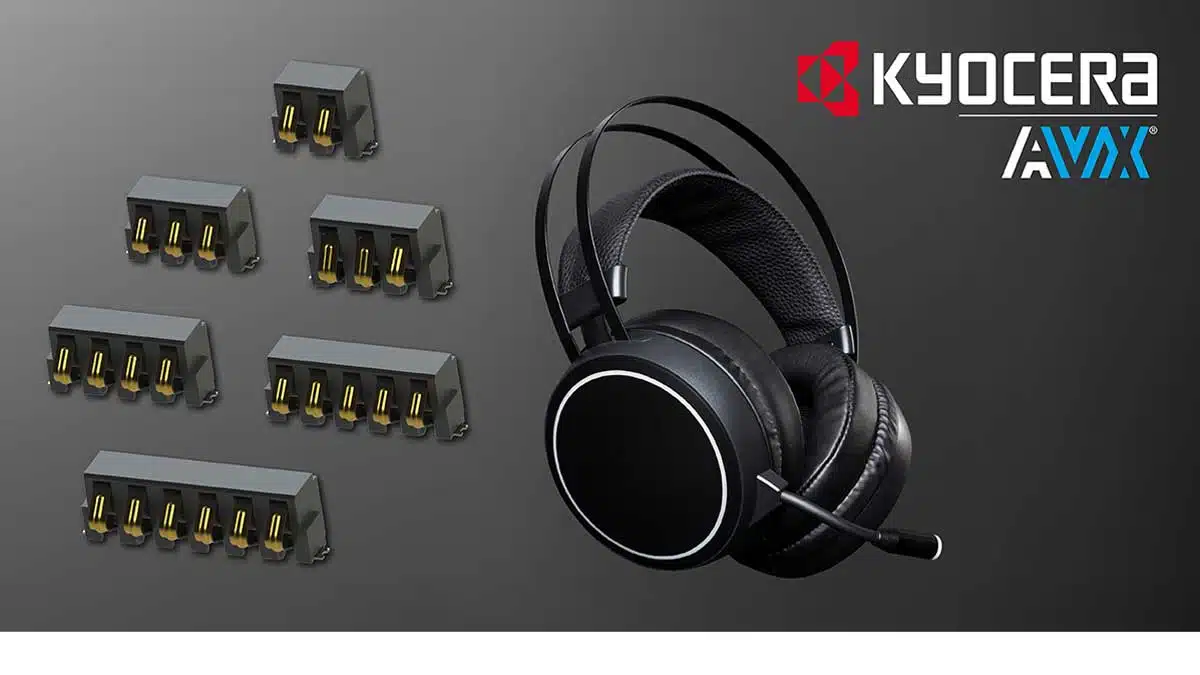
KYOCERA AVX introduces new 9155-900 Series 2.5mm-pitch vertical-mate battery connectors providing engineers in the industrial, automotive, datacom, household appliance, and consumer electronics markets with robust, reliable, and user-friendly power connectivity solutions.

KYOCERA AVX, a leading global manufacturer of advanced electronic components engineered to accelerate technological innovation and build a better future, has further expanded its industry-leading selection of standard battery connectors with the introduction of the new 9155-900 Series 2.5mm-pitch vertical-mate battery connectors. 

RelatedPosts

Kyocera Developed Multilayer Ceramic Core Substrate for AI Packages

KYOCERA AVX Introduces Traction‑Grade DC Link Film Capacitors

KYOCERA AVX MIL-PRF-32535 BME NP0 MLCCs Approved to the DLA QPD

The new 9155-900 Series 2.5mm-pitch vertical-mate battery connectors feature a unique contact geometry that deflects cleanly when a module, battery pack, mating connector, or PCB is vertically pushed into position, enabling full vertical engagement without the risk of contact damage.

Traditional right-angle battery connectors require users to engage the contacts by inserting the mating module or battery pack at an angle before rotating it into position to reliably prevent contact damage that could negatively impact connector performance and lifetime. The 9155-900 Series does not. In fact, users can mate these connectors from any angle without inadvertently damaging the contacts, ensuring high-integrity connections regardless of user experience or skill level. 

The 9155-900 Series 2.5mm-pitch vertical-mate battery connectors feature an extremely forgiving sweeping beam contact design and an anti-snag feature that reliably protects the contacts from damage during deflection, as well as when static. The series also features ultra-robust and -reliable gold-plated beryllium copper (BeCu) contacts that deliver excellent electrical and mechanical performance for up to 5,000 mating cycles and optional plastic locating bosses and solder tabs that maximize the mechanical stability of the connector in high-shock and vibration environments, like automotive applications. 

The series features flame-retardant (UL94 V-0) black, glass-filled Nylon 46 insulators, two to six BeCu contacts with either 0.4µm or 0.8µm of selective gold-over-nickel plating (the former of which is suitable for most commercial and industrial applications and the latter of which is suitable for harsh-environment applications), and pure tin tails. They are rated for 500VACRMS or the DC equivalent, up to 3A, and operating temperatures extending from -40°C to +125°C. They are also REACH and RoHS compliant and shipped in tape and reel packaging in quantities of 800 for automated pick and place assembly. 

Ideal applications for the new 9155-900 Series 2.5mm-pitch vertical-mate battery connectors extend throughout the industrial, automotive, datacom, household appliance, and consumer electronics markets and include handheld and portable industrial and consumer electronics devices that require docking or cradling, such as charging stations, internet and home appliances that require battery backup, and automotive applications that require the easy installation and removal of modules or battery packs, ranging from headsets, gaming controllers, and walkie talkies to automotive cooling fans. 

“Traditional right-angle battery connectors with exposed contacts require pluggable modules to be inserted at an angle and then gently rotated into position to prevent contact damage. And while that may seem insignificant, the extra step required to safely and successfully mate traditional battery connectors increases the potential for mismating by half,” said Perrin Hardee, Product Marketing Manager at KYOCERA AVX. “Our new 9155-900 Series 2.5mm-pitch vertical-mate battery connectors are engineered to ensure proper mating from any angle and eliminate the possibility of inadvertently damaging the contacts during the process—regardless of user experience or skill level. They’re also compact and robust enough to withstand automotive levels of shock and vibration.” 

KYOCERA AVX has been producing battery connectors for more than 25 years, and its 9155 family of battery connectors offers the broadest selection of standard battery connectors available on the market. The family includes a wide variety of robust, horizontal- and vertical-mating connector series ideally suited for board-to-board connections and battery pack integration. Additional features of the 9155 family include ultra-reliable and robust gold-plated BeCu contacts proven to provide high-integrity connections in harsh environments for up to 15,000 mating operations and tape and reel packaging compatible with automated processes. The range can also be customized to suit specific application requirements. 

For more information about the new KYOCERA AVX 9155-900 Series 2.5mm-pitch vertical-mate battery connectors, check out the product page, Fast Facts brochure, and datasheet. To order, please visit Mouser Electronics, DigiKey, or Farnell. For information about KYOCERA AVX’s industry-leading portfolio of battery connectors, please visit https://www.kyocera-avx.com/products/connectors/battery/.

Related

Source: KYOCERA AVX

Recent Posts

YAGEO Introduces C0G Flexible Termination Automotive MLCCs

30.4.2026
11

SCHURTER Releases SMT Micro Switch for Compact HMIs

30.4.2026
4

binder Releases Tool‑Tightenable M12 Connectors for Improved Reliability

30.4.2026
4

Vishay Introduced Thin Film Submount Platform for Optical and RF Modules

30.4.2026
9

Murata Introduces Crystal and NTC Set for Automotive UWB Timing

30.4.2026
8

Kyocera Developed Multilayer Ceramic Core Substrate for AI Packages

30.4.2026
12

Heatsink Design and Thermal Interface Materials for Reliable Electronics

27.4.2026
13

Murata New MLCC Bulk Case Packaging Cuts Packaging Material by 99%

27.4.2026
48

Exxelia Introduces SMD High‑Voltage Mica Capacitors

28.4.2026
23

Upcoming Events

May 5
16:00 - 17:00 CEST

Understanding and Selecting Capacitors – Fundamentals, Technologies and Latest Trends

May 7
17:00 - 18:00 CEST

From Grid to Motion: How Industrial Electrification is Redefining Power System Design

May 12
8:00 - 15:00 CEST

ESCC Space Splice connectors

View Calendar

Popular Posts

  • Buck Converter Design and Calculation

    0 shares
    Share 0 Tweet 0
  • Boost Converter Design and Calculation

    0 shares
    Share 0 Tweet 0
  • Flyback Converter Design and Calculation

    0 shares
    Share 0 Tweet 0
  • LLC Resonant Converter Design and Calculation

    0 shares
    Share 0 Tweet 0
  • MLCC and Ceramic Capacitors

    0 shares
    Share 0 Tweet 0
  • Dual Active Bridge (DAB) Topology

    0 shares
    Share 0 Tweet 0
  • What Electronics Engineer Needs to Know About Passive Low Pass Filters

    0 shares
    Share 0 Tweet 0
  • Capacitor Charging and Discharging

    0 shares
    Share 0 Tweet 0
  • MLCC Case Sizes Standards Explained

    0 shares
    Share 0 Tweet 0
  • Ripple Current and its Effects on the Performance of Capacitors

    3 shares
    Share 3 Tweet 0

Newsletter Subscription


Passive Components Blog

© EPCI - Leading Passive Components Educational and Information Site

  • Home
  • Privacy Policy
  • EPCI Membership & Advertisement
  • About

No Result
View All Result
  • Home
  • Knowledge Blog
  • PCNS

© EPCI - Leading Passive Components Educational and Information Site

This website uses cookies. By continuing to use this website you are giving consent to cookies being used. Visit our Privacy and Cookie Policy.
Go to mobile version