


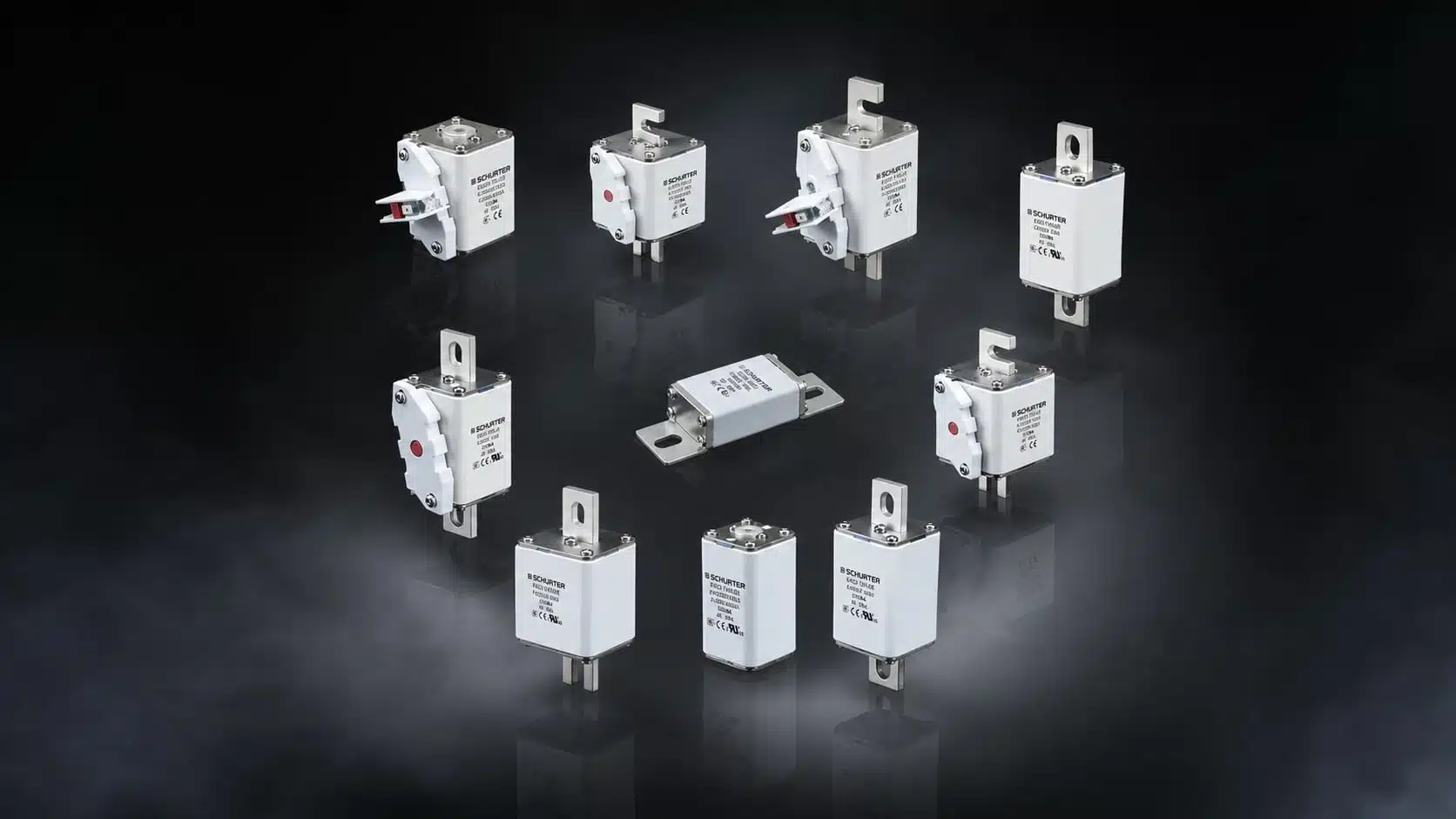
The SCHURTER EKO series is a high‑voltage fuse family designed for modern energy infrastructures such as battery energy storage systems, EV charging, power conversion, UPS and industrial equipment.
Developed with worldwide deployment in mind, the platform combines high electrical performance with global certifications to simplify design‑in, qualification and sourcing for OEMs.
Key features and benefits
- High‑voltage circuit protection platform: EKO fuses are engineered for use in high‑energy DC and AC environments typical of battery energy storage systems, EV charging infrastructure, power converters and industrial power distribution.
- Robust mechanical design: The fuse family is built to withstand demanding operating conditions, helping maintain mechanical integrity under vibration, thermal cycling and continuous load.
- Multiple mounting options: EKO is available with a comprehensive range of mounting styles, enabling use in different mechanical layouts and busbar concepts without redesigning the overall protection strategy.
- Worldwide usability: The platform is supported by internationally recognized certifications including UL and compliance with IEC, CE, RoHS and REACH, which facilitates global deployment without separate regional fuse variants.
- Simplified qualification and approval flow: Because EKO is already aligned with major global standards, manufacturers can reduce engineering time spent on re‑qualification and country‑specific approvals, shortening time to market.
- Future‑ready design philosophy: EKO represents SCHURTER’s focus on energy‑system protection solutions that anticipate higher power levels, increasing electrification, and stricter regulatory environments.
Typical applications
SCHURTER EKO fuses target power and energy installations where high fault currents and elevated system voltages demand reliable, coordinated protection.
- Battery Energy Storage Systems (BESS) in utility‑scale and commercial installations, where fuses are used to protect battery strings, DC busbars and DC/DC converter inputs.
- EV charging infrastructure, including DC fast chargers and AC/DC front ends, where high‑voltage DC output stages require fast and predictable interruption of fault currents.
- Power conversion equipment such as rectifiers, inverters and DC‑link stages in renewable energy and industrial drives.
- Uninterruptible Power Supply (UPS) systems, providing protection for battery banks, DC links and inverter modules.
- General industrial applications in electrified machinery and distribution panels where global compliance and consistent fuse performance are required.
These use cases typically involve long operating hours, cycling loads and elevated ambient temperatures, which make mechanical robustness and stable electrical characteristics essential over the lifetime of the equipment.
Technical highlights
While the press release focuses on platform positioning rather than detailed numbers, the key technical elements can be summarized as follows, with exact ratings available in the manufacturer datasheet:
- High‑voltage rating: The EKO family is designed for high‑voltage environments in modern energy systems, with specific voltage and breaking capacity values according to manufacturer datasheet.
- High electrical performance: Coordination between time‑current characteristics, breaking capacity and thermal behavior supports safe interruption of fault currents in demanding DC and AC circuits.
- Mechanical robustness: Fuse bodies and terminals are engineered to maintain contact integrity and withstand mechanical stresses typical of field installations, such as vibration and handling.
- Mounting flexibility: The platform provides a range of mounting options to fit various mechanical concepts, from panel and chassis mounting to integration with busbars or specialized holders.
- Regulatory and environmental compliance:
- UL certification for recognized fuse performance in North American markets.
- Compliance with IEC standards relevant to fuse operation in international energy systems.
- CE marking for use in equipment shipped within the European Economic Area.
- RoHS and REACH compliance ensuring adherence to substance restriction and reporting requirements.
For engineers, this combination means the same fuse platform can be evaluated for multiple regional markets without changing the basic protection concept, which simplifies global product platforms.
Compliance overview table
| Aspect | EKO platform status |
|---|---|
| UL certification | Supported for global deployment |
| IEC compliance | Designed in line with applicable IEC requirements |
| CE marking | Suitable for equipment requiring CE conformity |
| RoHS / REACH | Compliant with substance restriction frameworks |
Exact standard references and test conditions should be taken from the official EKO datasheet and product documentation.
Design‑in notes for engineers
To make the EKO platform useful in real designs, it helps to translate the high‑level positioning into practical selection and layout considerations.
- Work from the worst‑case fault scenario: Define the maximum prospective short‑circuit current and system voltage, then select EKO variants whose breaking capacity and voltage rating comfortably exceed these values according to manufacturer datasheet.
- Consider DC behavior explicitly: In BESS and EV charging, DC fault currents can be sustained; ensure that the chosen EKO fuse variant is specified for the relevant DC voltage and has appropriate interruption performance under DC conditions.
- Coordinate with upstream and downstream protection: High‑voltage fuses should be integrated into a protection hierarchy including circuit breakers and semiconductor protection devices; use manufacturer time‑current curves to coordinate tripping behavior.
- Account for thermal environment: In enclosed cabinets or dense power modules, fuse temperatures may rise significantly; design clearances and ventilation so that EKO fuses operate within their specified temperature range, and avoid mounting arrangements that trap heat.
- Mechanical layout matters:
- Choose the mounting option that aligns with your busbar or PCB concept to minimize resistance and improve thermal conduction.
- Maintain adequate creepage and clearance distances around the fuse for the highest applied voltage.
- Documentation and compliance:
- Keep datasheets and approvals for EKO variants as part of the technical file when targeting UL, IEC and CE compliance.
- For RoHS and REACH, ensure purchasing records link the specific EKO part numbers to the manufacturer compliance declarations.
From a system architecture perspective, it is often helpful to standardize on a limited set of EKO variants across different product families to simplify procurement and field service, provided all protection and compliance requirements remain satisfied.
Source
This article is based on information from SCHURTER’s official press release and accompanying EKO product documentation, interpreted and expanded for design and procurement engineers working on modern energy systems.