






Passive Components Blog
No Result
View All Result
  • Home
  • NewsFilter
    • All
    • Aerospace & Defence
    • Antenna
    • Applications
    • Automotive
    • Capacitors
    • Circuit Protection Devices
    • electro-mechanical news
    • Filters
    • Fuses
    • Inductors
    • Industrial
    • Integrated Passives
    • inter-connect news
    • Market & Supply Chain
    • Market Insights
    • Medical
    • Modelling and Simulation
    • New Materials & Supply
    • New Technologies
    • Non-linear Passives
    • Oscillators
    • Passive Sensors News
    • Resistors
    • RF & Microwave
    • Telecommunication
    • Weekly Digest

    EMC Design Fundamentals: Safe Use of Varistors and Common Mode Chokes in Mains and Data-Line Filters

    Murata Unveils Lead Disc Ceramic Capacitors for Automotive Safety and EMI Suppression

    SCHURTER Releases Intelligent Three‑Terminal Fuses for Safer Li‑ion Battery Systems

    Can Copper Conductive Inks Displace Silver in Hybrid Electronics?

    Square-Wave Harmonics and RMS Currents in Power Converters

    LeanBOM: Practical Cross‑Technology Capacitor Search by Real Working Conditions

    In the Age of AI, Every Watt Counts: Implications for Components

    Stackpole Extends Resistance Range of 2512 High‑Power Current Sense Resistors

    Wk 27 Electronics Supply Chain Digest

    Trending Tags

    • Ripple Current
    • RF
    • Leakage Current
    • Tantalum vs Ceramic
    • Snubber
    • Low ESR
    • Feedthrough
    • Derating
    • Dielectric Constant
    • New Products
    • Market Reports
  • VideoFilter
    • All
    • Antenna videos
    • Capacitor videos
    • Circuit Protection Video
    • Filter videos
    • Fuse videos
    • Inductor videos
    • Inter-Connect Video
    • Non-linear passives videos
    • Oscillator videos
    • Passive sensors videos
    • Resistor videos

    EMC Design Fundamentals: Safe Use of Varistors and Common Mode Chokes in Mains and Data-Line Filters

    Ferrite versus Nanocrystalline Power Inductor Cores: Turns, Gap and Size

    KYOCERA AVX Presents Antenna Integrator Studio Tutorial for Antenna Placement and RF Design

    Power Design Simulation Tools for Faster Inductor Selection and Loss Optimization

    EMC‑Compliant PCB and Connector Design Guidelines

    Why Isolated DC/DC Power Supplies Fail Late, Würth Elektronik Podcast

    Designing 800 V DC EMC Filters: Calculation, Simulation and Measurement

    Current Sense Transformer Datasheet and Design‑in Guide

    Designing a USB Type‑C Flyback Planar Transformer with Frenetic’s Planar Tool

    Trending Tags

    • Capacitors explained
    • Inductors explained
    • Resistors explained
    • Filters explained
    • Application Video Guidelines
    • EMC
    • New Products
    • Ripple Current
    • Simulation
    • Tantalum vs Ceramic
  • Knowledge Blog
  • Dossiers
    • AI Hardware Dossier
    • Power Converter Dossier
    • Automotive Dossier
    • Capacitor Dossier
    • Resistor Dossier
    • Inductor Dossier
    • Circuit Protection Dossier
  • Suppliers
    • Who is Who
  • PCNS
    • PCNS 2025
    • PCNS 2023
    • PCNS 2021
    • PCNS 2019
    • PCNS 2017
  • Events
  • Home
  • NewsFilter
    • All
    • Aerospace & Defence
    • Antenna
    • Applications
    • Automotive
    • Capacitors
    • Circuit Protection Devices
    • electro-mechanical news
    • Filters
    • Fuses
    • Inductors
    • Industrial
    • Integrated Passives
    • inter-connect news
    • Market & Supply Chain
    • Market Insights
    • Medical
    • Modelling and Simulation
    • New Materials & Supply
    • New Technologies
    • Non-linear Passives
    • Oscillators
    • Passive Sensors News
    • Resistors
    • RF & Microwave
    • Telecommunication
    • Weekly Digest

    EMC Design Fundamentals: Safe Use of Varistors and Common Mode Chokes in Mains and Data-Line Filters

    Murata Unveils Lead Disc Ceramic Capacitors for Automotive Safety and EMI Suppression

    SCHURTER Releases Intelligent Three‑Terminal Fuses for Safer Li‑ion Battery Systems

    Can Copper Conductive Inks Displace Silver in Hybrid Electronics?

    Square-Wave Harmonics and RMS Currents in Power Converters

    LeanBOM: Practical Cross‑Technology Capacitor Search by Real Working Conditions

    In the Age of AI, Every Watt Counts: Implications for Components

    Stackpole Extends Resistance Range of 2512 High‑Power Current Sense Resistors

    Wk 27 Electronics Supply Chain Digest

    Trending Tags

    • Ripple Current
    • RF
    • Leakage Current
    • Tantalum vs Ceramic
    • Snubber
    • Low ESR
    • Feedthrough
    • Derating
    • Dielectric Constant
    • New Products
    • Market Reports
  • VideoFilter
    • All
    • Antenna videos
    • Capacitor videos
    • Circuit Protection Video
    • Filter videos
    • Fuse videos
    • Inductor videos
    • Inter-Connect Video
    • Non-linear passives videos
    • Oscillator videos
    • Passive sensors videos
    • Resistor videos

    EMC Design Fundamentals: Safe Use of Varistors and Common Mode Chokes in Mains and Data-Line Filters

    Ferrite versus Nanocrystalline Power Inductor Cores: Turns, Gap and Size

    KYOCERA AVX Presents Antenna Integrator Studio Tutorial for Antenna Placement and RF Design

    Power Design Simulation Tools for Faster Inductor Selection and Loss Optimization

    EMC‑Compliant PCB and Connector Design Guidelines

    Why Isolated DC/DC Power Supplies Fail Late, Würth Elektronik Podcast

    Designing 800 V DC EMC Filters: Calculation, Simulation and Measurement

    Current Sense Transformer Datasheet and Design‑in Guide

    Designing a USB Type‑C Flyback Planar Transformer with Frenetic’s Planar Tool

    Trending Tags

    • Capacitors explained
    • Inductors explained
    • Resistors explained
    • Filters explained
    • Application Video Guidelines
    • EMC
    • New Products
    • Ripple Current
    • Simulation
    • Tantalum vs Ceramic
  • Knowledge Blog
  • Dossiers
    • AI Hardware Dossier
    • Power Converter Dossier
    • Automotive Dossier
    • Capacitor Dossier
    • Resistor Dossier
    • Inductor Dossier
    • Circuit Protection Dossier
  • Suppliers
    • Who is Who
  • PCNS
    • PCNS 2025
    • PCNS 2023
    • PCNS 2021
    • PCNS 2019
    • PCNS 2017
  • Events
No Result
View All Result
Passive Components Blog
No Result
View All Result

Littelfuse Releases Harsh Environment Robust Tactile Switches

5.6.2025
Reading Time: 3 mins read
A A

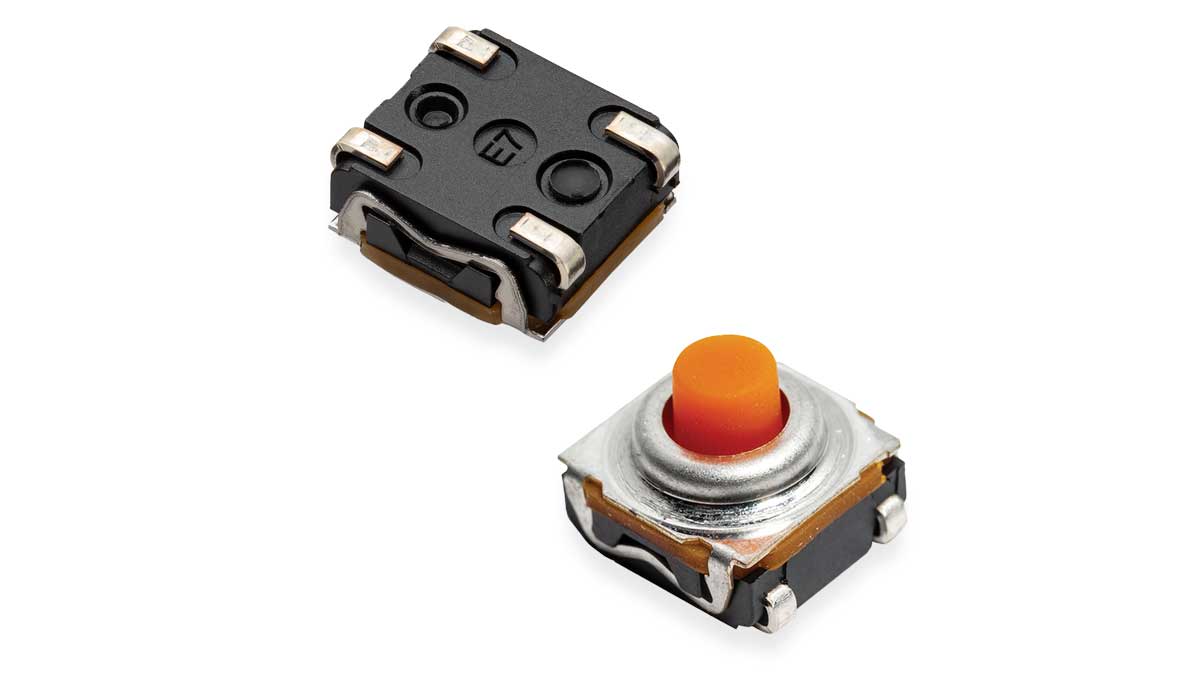
Littelfuse unveils potting process friendly tactile switches, rated for up to 1 million cycles, deliver exceptional durability and reliability for high-end consumer, aerospace, automotive, medical, and industrial applications.

Littelfuse, Inc.,a diversified, industrial technology manufacturing company empowering a sustainable, connected, and safer world, today announced the launch of the KSC PF Series sealed tactile switches for surface-mount technology (SMT).

RelatedPosts

Littelfuse Announced TVS Diodes for 48 V Automotive Systems

Littelfuse Unveils High‑Current 48V SMD Fuse for AI Data Center Protection

Littelfuse Expands High-Voltage TVS Diodes

These compact, IP67-rated momentary action switches deliver enhanced environmental protection through a unique extended cage design that simplifies the potting process and improves long-term durability in harsh environments.

Engineered to support rugged applications across industrial, transportation, medical, aerospace, and high-end consumer markets, the KSC PF Series stands out for its compact 6.2 x 6.2 x 5.2 mm footprint, a soft actuator with positive tactile feedback, and superior protection against moisture, dust, and vibration. Its potting-friendly architecture offers engineers greater flexibility when designing electronics for outdoor and mission-critical environments. (View the video in English, Chinese & Japanese.)

While sealed tactile switches are not new to the KSC portfolio, the KSC PF Series is the first optimized explicitly for potting—a process that is rapidly gaining traction across multiple industries. Potting involves fully encapsulating sensitive PCB-mounted components in resin, providing an extra layer of protection against corrosive agents, thermal shock, and vibration. Standard flat cage switch designs typically limit the depth of resin coverage, which can compromise protection. In contrast, the KSC PF’s extended cage enables deeper potting, improves tolerance for resin surface levels, and protects adjacent PCB components—all while streamlining the production process and enhancing product reliability.

“Leveraging decades of Littelfuse engineering expertise, our KSC components, when potted on PCBs, provide our customers with exceptional protection against harsh environments,” said Laurent Kubat, Europe R&D Director, EBU Switches and Sensors, at Littelfuse. “This design approach significantly enhances durability and ensures reliable long-term performance.”

Laurent Kubat added, “The KSC PF Series, with its innovative cage design around the actuator, allows for a higher resin thickness compared to standard versions. This unique feature ensures superior protection for the switch and all components on the printed circuit board, ultimately enhancing the quality and reliability of our customers’ products.”

Key Features and Benefits

  • Extended cage allows potting material to fully encapsulate and protect the switch
  • Stable performance and proper alignment during the potting process
  • IP67-rated sealing against water and dust
  • Compatible with SMT automated assembly for efficient high-volume production
  • Available in Gullwing or J-bend termination options
  • Rated up to 1 million cycles for long-lasting operation
  • Maximum power handling of 1 VA @ 32 VDC

Why Potting-Friendly Design Matters

Potting protects sensitive electronics by encapsulating them in resin, shielding them against moisture, dust, vibration, and corrosive elements. However, standard switch designs can hinder the process or limit protection. The KSC PF Series solves this with an extended cage that allows full resin coverage without compromising switch performance. This feature ensures proper alignment during potting, tolerates thicker resin layers, and enhances protection for both the switch and surrounding PCB components. As potting becomes standard in rugged applications—like e-mobility, industrial automation, and outdoor electronics—potting-friendly components like the KSC PF help engineers simplify designs and improve long-term reliability.

For additional information, see the application note, Protection of Electronic Components on Printed Circuit Boards with Potting-Friendly Tactile Switches

Related

Source: Littelfuse

Recent Posts

Panasonic Releases Relays for IEC 62955 Compliant Single‑Phase EV Wallboxes

25.6.2026
42

SCHURTER Releases SMT Micro Switch for Compact HMIs

30.4.2026
49

Littelfuse Presents Ultra-Miniature Half-Pitch SMT DIP Switches

7.4.2026
44

SCHURTER Releases Compact SMT DIP Switches

7.4.2026
39

Würth Elektronik Releases Heat Sinks for TO and IC packages

31.3.2026
64

Würth Elektronik Offers Halogen‑Free EMC Gaskets for Displays and Housings

28.1.2026
37

Littelfuse Unveils Ultra-Low-Power TMR Magnetic Switches

13.1.2026
110

Panasonic Releases Compact Tactile Switch with 3N Operation Force and 500K Cycles Life

16.12.2025
61

Industry Smallest Dual-Pole Reed Relay Wins Elektra Awards 2025

10.12.2025
59

Upcoming Events

Jul 21
16:00 - 17:00 CEST

Safety by design: X and Y Interference suppression capacitors for power line filters

Jul 28
8:00 - 11:00 CEST

Post Procurement Testing of EEE Components for LEO Space Applications

Jul 29
17:30 - 18:30 CEST

To Ferrite or to Nanocrystalline in Transformer Design

View Calendar

Popular Posts

  • Boost Converter Design and Calculation

    0 shares
    Share 0 Tweet 0
  • Buck Converter Design and Calculation

    0 shares
    Share 0 Tweet 0
  • Flyback Converter Design and Calculation

    0 shares
    Share 0 Tweet 0
  • YAGEO Announces July 2026 Capacitor Price Increase

    0 shares
    Share 0 Tweet 0
  • LLC Resonant Converter Design and Calculation

    0 shares
    Share 0 Tweet 0
  • MLCC and Ceramic Capacitors

    0 shares
    Share 0 Tweet 0
  • Earthing Systems and IEC Classification Explained

    0 shares
    Share 0 Tweet 0
  • Nvidia Vera Rubin: Why One AI Rack Needs So Many More MLCC Capacitors

    0 shares
    Share 0 Tweet 0
  • MLCCs in the Age of AI: Q2 2026 Market Tightness

    0 shares
    Share 0 Tweet 0
  • Dual Active Bridge (DAB) Topology

    0 shares
    Share 0 Tweet 0

Newsletter Subscription


Passive Components Blog

© EPCI - Leading Passive Components Educational and Information Site

  • Home
  • Privacy Policy
  • EPCI Membership & Advertisement
  • About

No Result
View All Result
  • Home
  • Knowledge Blog
  • Dossiers
  • PCNS

© EPCI - Leading Passive Components Educational and Information Site

This website uses cookies. By continuing to use this website you are giving consent to cookies being used. Visit our Privacy and Cookie Policy.
Go to mobile version