


Passive Components Blog
No Result
View All Result
  • Home
  • NewsFilter
    • All
    • Aerospace & Defence
    • Antenna
    • Applications
    • Automotive
    • Capacitors
    • Circuit Protection Devices
    • electro-mechanical news
    • Filters
    • Fuses
    • Inductors
    • Industrial
    • Integrated Passives
    • inter-connect news
    • Market & Supply Chain
    • Market Insights
    • Medical
    • Modelling and Simulation
    • New Materials & Supply
    • New Technologies
    • Non-linear Passives
    • Oscillators
    • Passive Sensors News
    • Resistors
    • RF & Microwave
    • Telecommunication
    • Weekly Digest

    All‑Water Supercapacitor Based on 1‑nm Clay Channels and Nanoconfined Water Electrolyte

    Littelfuse Unveils High‑Current 48V SMD Fuse for AI Data Center Protection

    Modelithics Releases COMPLETE Library v26.2 for Keysight Genesys

    Why Isolated DC/DC Power Supplies Fail Late, Würth Elektronik Podcast

    Wk 23 Electronics Supply Chain Digest

    Power Converter Dossier: Passive Components Design and Selection Guide 2026

    Evans Group Unifies Four High-Rel Capacitor Leaders

    Skeleton Releases Graphene‑Based UPS for AI Data Centers

    Designing 800 V DC EMC Filters: Calculation, Simulation and Measurement

    Trending Tags

    • Ripple Current
    • RF
    • Leakage Current
    • Tantalum vs Ceramic
    • Snubber
    • Low ESR
    • Feedthrough
    • Derating
    • Dielectric Constant
    • New Products
    • Market Reports
  • VideoFilter
    • All
    • Antenna videos
    • Capacitor videos
    • Circuit Protection Video
    • Filter videos
    • Fuse videos
    • Inductor videos
    • Inter-Connect Video
    • Non-linear passives videos
    • Oscillator videos
    • Passive sensors videos
    • Resistor videos

    Why Isolated DC/DC Power Supplies Fail Late, Würth Elektronik Podcast

    Designing 800 V DC EMC Filters: Calculation, Simulation and Measurement

    Current Sense Transformer Datasheet and Design‑in Guide

    Designing a USB Type‑C Flyback Planar Transformer with Frenetic’s Planar Tool

    Magnetics Design in High‑Frequency GaN Converters

    Qi2 Wireless Charging: Inductors, Capacitors and EMC Filters

    Two‑capacitor paradox explained for engineers

    Capacitances of Nonlinear MLCCs: What Datasheets Don’t Tell You

    Tapped Inductor Buck Converter Fundamentals

    Trending Tags

    • Capacitors explained
    • Inductors explained
    • Resistors explained
    • Filters explained
    • Application Video Guidelines
    • EMC
    • New Products
    • Ripple Current
    • Simulation
    • Tantalum vs Ceramic
  • Knowledge Blog
  • DossiersNew
  • Suppliers
    • Who is Who
  • PCNS
    • PCNS 2025
    • PCNS 2023
    • PCNS 2021
    • PCNS 2019
    • PCNS 2017
  • Events
  • Home
  • NewsFilter
    • All
    • Aerospace & Defence
    • Antenna
    • Applications
    • Automotive
    • Capacitors
    • Circuit Protection Devices
    • electro-mechanical news
    • Filters
    • Fuses
    • Inductors
    • Industrial
    • Integrated Passives
    • inter-connect news
    • Market & Supply Chain
    • Market Insights
    • Medical
    • Modelling and Simulation
    • New Materials & Supply
    • New Technologies
    • Non-linear Passives
    • Oscillators
    • Passive Sensors News
    • Resistors
    • RF & Microwave
    • Telecommunication
    • Weekly Digest

    All‑Water Supercapacitor Based on 1‑nm Clay Channels and Nanoconfined Water Electrolyte

    Littelfuse Unveils High‑Current 48V SMD Fuse for AI Data Center Protection

    Modelithics Releases COMPLETE Library v26.2 for Keysight Genesys

    Why Isolated DC/DC Power Supplies Fail Late, Würth Elektronik Podcast

    Wk 23 Electronics Supply Chain Digest

    Power Converter Dossier: Passive Components Design and Selection Guide 2026

    Evans Group Unifies Four High-Rel Capacitor Leaders

    Skeleton Releases Graphene‑Based UPS for AI Data Centers

    Designing 800 V DC EMC Filters: Calculation, Simulation and Measurement

    Trending Tags

    • Ripple Current
    • RF
    • Leakage Current
    • Tantalum vs Ceramic
    • Snubber
    • Low ESR
    • Feedthrough
    • Derating
    • Dielectric Constant
    • New Products
    • Market Reports
  • VideoFilter
    • All
    • Antenna videos
    • Capacitor videos
    • Circuit Protection Video
    • Filter videos
    • Fuse videos
    • Inductor videos
    • Inter-Connect Video
    • Non-linear passives videos
    • Oscillator videos
    • Passive sensors videos
    • Resistor videos

    Why Isolated DC/DC Power Supplies Fail Late, Würth Elektronik Podcast

    Designing 800 V DC EMC Filters: Calculation, Simulation and Measurement

    Current Sense Transformer Datasheet and Design‑in Guide

    Designing a USB Type‑C Flyback Planar Transformer with Frenetic’s Planar Tool

    Magnetics Design in High‑Frequency GaN Converters

    Qi2 Wireless Charging: Inductors, Capacitors and EMC Filters

    Two‑capacitor paradox explained for engineers

    Capacitances of Nonlinear MLCCs: What Datasheets Don’t Tell You

    Tapped Inductor Buck Converter Fundamentals

    Trending Tags

    • Capacitors explained
    • Inductors explained
    • Resistors explained
    • Filters explained
    • Application Video Guidelines
    • EMC
    • New Products
    • Ripple Current
    • Simulation
    • Tantalum vs Ceramic
  • Knowledge Blog
  • DossiersNew
  • Suppliers
    • Who is Who
  • PCNS
    • PCNS 2025
    • PCNS 2023
    • PCNS 2021
    • PCNS 2019
    • PCNS 2017
  • Events
No Result
View All Result
Passive Components Blog
No Result
View All Result

Murata Utilizes its Ceramic Capacitor Expertise to Produce Precious Metal Free Gas Catalyst Material 

15.4.2024
Reading Time: 3 mins read
A A

Murata is pleased to announce a revolutionary ceramic catalyst material designed to reduce the impact of industrial gas exhaust systems. The catalyst is has been developed based on Murata’s extensive ceramic capacitor knowledge.

A Chinese manufacture (F-Tech), called Shanghai FT Technology Co., Ltd, makes and sells ceramic catalysts using this material. Unlike traditional catalysts in exhaust treatment systems, this ceramic solution does not contain any precious metals, and it significantly reduces both the consumption of the natural gas used for treatment and CO2 emissions.

RelatedPosts

Murata Introduces World First 2.2uF 100V Soft‑Term MLCC in 0805 Size for Automotive

Murata and Xona Partner on LEO Satellite Navigation for Industrial Applications

Murata Expands Thermistor Production Capacity at Yokaichi Plant

Across a wide range of industrial production processes, exhaust gasses must be treated in order to prevent harmful particulate matter from entering the atmosphere. In many applications, regenerative thermal oxidizers (RTO) are used to decompose, and therefore treat, the exhaust gas by burning it with natural gas, eliminating volatile organic compounds (VOCs), hazardous air pollutants (HAPs) and odorous emissions produced during industrial processes.

Given the rise in natural gas prices and the urgent need to prioritize global sustainability, industrial production facilities are now more determined than ever to find ways to decrease their fuel consumption and reduce their carbon footprint.

Built from Murata’s extensive ceramic capacitor knowledge, the catalyst exhibits exceptional heat resistance and can be used to treat highly concentrated exhaust gas. In terms of performance, by installing Murata’s ceramic catalyst into an existing exhaust gas treatment equipment the set temperature can be lowered from around 850°C to 700°C. Through the reduction in the set temperature system, heat loss is reduced and the Self-combustion rate is increased, reducing natural gas consumption by up to 53% (Figure 1).
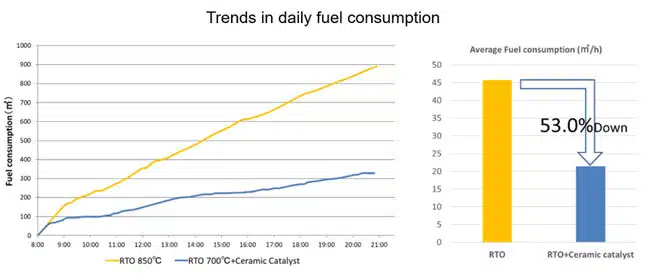
Figure 1 – And RTO with the ceramic catalyst can offer a significant reduction in natural gas consumption (Source: Murata)

Additionally, this change in operational conditions results in a decrease in CO2 emissions originating from natural gas usage, contributing to a decrease in environmental impact, as well as significantly lowering running costs.

The ceramic material also brings a number of advantages. Primarily, the initial system cost is far more predictable, free from the price fluctuations seen with precious metals. Furthermore, the performance of precious metal catalysts can become compromised when subjected to extremely high temperatures, as the active element can move and group into larger clusters. This process, referred to as sintering, reduces the number and area of active sites and deteriorates the catalyst’s performance. Alternatively, ceramic catalyst materials have active elements dispersed in their crystal structure and do not degrade even in high-temperature operation, leading to an extended lifespan compared to precious metal catalysts.

In real-world applications at both Murata’s manufacturing and partner sites the ceramic catalyst has had a significant impact on the environmental impact of RTO systems and operating costs, with the installation at Wuxi Murata Electronics Co. achieving full system payback in just 13 months.

“With Murata’s patented ceramic catalyst material, we have taken our extensive ceramic capacitor knowledge and applied it to another market to create a truly innovative solution,” said Koichi Kawakita, Vice President Manufacturing Group Ceramic Capacitor Business Unit. He continued, “In terms of operation, it can help factory designers and exhaust gas treatment manufacturers achieve significant reductions in natural gas consumption and carbon emissions, while also cutting dependence on precious metals.”

Production is now underway and engineering samples are available for both the 100cpsi and 200cpsi variants.
Related

Source: Murata

Recent Posts

Murata Introduces World First 2.2uF 100V Soft‑Term MLCC in 0805 Size for Automotive

4.6.2026
34

Würth Elektronik Presents New Bidirectional Digital Isolators

20.5.2026
53

High-Crystallinity Nanocrystalline Composites for MHz Chip Inductors

7.5.2026
105

Würth Elektronik Introduces Compact Flat-wire SMT Power Inductors for Automotive

5.5.2026
91

KYOCERA AVX Extends MLV Varistors for 48V Automotive Protection

5.5.2026
53

Murata Introduces Crystal and NTC Set for Automotive UWB Timing

30.4.2026
55

Kyocera Developed Multilayer Ceramic Core Substrate for AI Packages

30.4.2026
124

Murata New MLCC Bulk Case Packaging Cuts Packaging Material by 99%

27.4.2026
183

KYOCERA AVX Introduces Traction‑Grade DC Link Film Capacitors

21.4.2026
81

Upcoming Events

Jun 16
16:00 - 17:00 CEST

EMC with EMC – EMC‑compliant design with electromechanical connectors

Jul 14
16:00 - 17:00 CEST

EMC Design Essentials: Mastering Varistors and Common Mode Chokes

Jul 21
16:00 - 17:00 CEST

Safety by design: X and Y Interference suppression capacitors for power line filters

View Calendar

Popular Posts

  • Buck Converter Design and Calculation

    0 shares
    Share 0 Tweet 0
  • Boost Converter Design and Calculation

    0 shares
    Share 0 Tweet 0
  • MLCC and Ceramic Capacitors

    0 shares
    Share 0 Tweet 0
  • LLC Resonant Converter Design and Calculation

    0 shares
    Share 0 Tweet 0
  • Flyback Converter Design and Calculation

    0 shares
    Share 0 Tweet 0
  • What Electronics Engineer Needs to Know About Passive Low Pass Filters

    0 shares
    Share 0 Tweet 0
  • Dual Active Bridge (DAB) Topology

    0 shares
    Share 0 Tweet 0
  • Capacitor Charging and Discharging

    0 shares
    Share 0 Tweet 0
  • SEPIC Converter Design and Calculation

    0 shares
    Share 0 Tweet 0
  • Earthing Systems and IEC Classification Explained

    0 shares
    Share 0 Tweet 0

Newsletter Subscription


Passive Components Blog

© EPCI - Leading Passive Components Educational and Information Site

  • Home
  • Privacy Policy
  • EPCI Membership & Advertisement
  • About

No Result
View All Result
  • Home
  • Knowledge Blog
  • Dossiers
  • PCNS

© EPCI - Leading Passive Components Educational and Information Site

This website uses cookies. By continuing to use this website you are giving consent to cookies being used. Visit our Privacy and Cookie Policy.
Go to mobile version