




Passive Components Blog
No Result
View All Result
  • Home
  • NewsFilter
    • All
    • Aerospace & Defence
    • Antenna
    • Applications
    • Automotive
    • Capacitors
    • Circuit Protection Devices
    • electro-mechanical news
    • Filters
    • Fuses
    • Inductors
    • Industrial
    • Integrated Passives
    • inter-connect news
    • Market & Supply Chain
    • Market Insights
    • Medical
    • Modelling and Simulation
    • New Materials & Supply
    • New Technologies
    • Non-linear Passives
    • Oscillators
    • Passive Sensors News
    • Resistors
    • RF & Microwave
    • Telecommunication
    • Weekly Digest

    YAGEO Introduces High‑Current Y2/X1 Film Capacitors for Wide-bandgap Power Systems

    Amphenol Explanded Liquid Cooling Connectors for AI, ESS and EV Systems

    Hirose Introduced BGA connector for PCIe Gen6 for AI and Edge Computing

    YAGEO Introduces High Rel MLCCs Beyond MIL-Spec Limits

    Würth Elektronik Expanded Capacity for Validation and Services in Asia

    Samsung Introduces Ultra-High-Voltage 1500 V MLCCs for xEV Powertrains

    YAGEO Q1 2026 Results: AI Servers and Pricing Power Behind a Moderate Q2 Outlook

    TDK Introduces High‑Voltage Common‑Mode Chokes for Compact 1250 V DC Converters

    Vishay Extends Power Inductors for DC/DC with 1212 Compact Case

    Trending Tags

    • Ripple Current
    • RF
    • Leakage Current
    • Tantalum vs Ceramic
    • Snubber
    • Low ESR
    • Feedthrough
    • Derating
    • Dielectric Constant
    • New Products
    • Market Reports
  • VideoFilter
    • All
    • Antenna videos
    • Capacitor videos
    • Circuit Protection Video
    • Filter videos
    • Fuse videos
    • Inductor videos
    • Inter-Connect Video
    • Non-linear passives videos
    • Oscillator videos
    • Passive sensors videos
    • Resistor videos

    Transformer-Based Power-Line Harvester Magnetic Design

    Thermal Modeling of Magnetics

    Standard vs Planar LLC transformers Comparison for Battery Chargers

    How Modern Tools Model Magnetic Components for Power Electronics

    Advanced Loss Modeling for Planar Magnetics in the Frenetic Planar Tool

    2026 Power Magnetics Design Trends: Flyback, DAB and Planar

    Enabling Software‑Defined Vehicle Architectures: Automotive Ethernet and Zonal Smart Power

    Calculating Resistance Value of a Flyback RC Snubber 

    One‑Pulse Characterization of Nonlinear Power Inductors

    Trending Tags

    • Capacitors explained
    • Inductors explained
    • Resistors explained
    • Filters explained
    • Application Video Guidelines
    • EMC
    • New Products
    • Ripple Current
    • Simulation
    • Tantalum vs Ceramic
  • Knowledge Blog
  • DossiersNew
  • Suppliers
    • Who is Who
  • PCNS
    • PCNS 2025
    • PCNS 2023
    • PCNS 2021
    • PCNS 2019
    • PCNS 2017
  • Events
  • Home
  • NewsFilter
    • All
    • Aerospace & Defence
    • Antenna
    • Applications
    • Automotive
    • Capacitors
    • Circuit Protection Devices
    • electro-mechanical news
    • Filters
    • Fuses
    • Inductors
    • Industrial
    • Integrated Passives
    • inter-connect news
    • Market & Supply Chain
    • Market Insights
    • Medical
    • Modelling and Simulation
    • New Materials & Supply
    • New Technologies
    • Non-linear Passives
    • Oscillators
    • Passive Sensors News
    • Resistors
    • RF & Microwave
    • Telecommunication
    • Weekly Digest

    YAGEO Introduces High‑Current Y2/X1 Film Capacitors for Wide-bandgap Power Systems

    Amphenol Explanded Liquid Cooling Connectors for AI, ESS and EV Systems

    Hirose Introduced BGA connector for PCIe Gen6 for AI and Edge Computing

    YAGEO Introduces High Rel MLCCs Beyond MIL-Spec Limits

    Würth Elektronik Expanded Capacity for Validation and Services in Asia

    Samsung Introduces Ultra-High-Voltage 1500 V MLCCs for xEV Powertrains

    YAGEO Q1 2026 Results: AI Servers and Pricing Power Behind a Moderate Q2 Outlook

    TDK Introduces High‑Voltage Common‑Mode Chokes for Compact 1250 V DC Converters

    Vishay Extends Power Inductors for DC/DC with 1212 Compact Case

    Trending Tags

    • Ripple Current
    • RF
    • Leakage Current
    • Tantalum vs Ceramic
    • Snubber
    • Low ESR
    • Feedthrough
    • Derating
    • Dielectric Constant
    • New Products
    • Market Reports
  • VideoFilter
    • All
    • Antenna videos
    • Capacitor videos
    • Circuit Protection Video
    • Filter videos
    • Fuse videos
    • Inductor videos
    • Inter-Connect Video
    • Non-linear passives videos
    • Oscillator videos
    • Passive sensors videos
    • Resistor videos

    Transformer-Based Power-Line Harvester Magnetic Design

    Thermal Modeling of Magnetics

    Standard vs Planar LLC transformers Comparison for Battery Chargers

    How Modern Tools Model Magnetic Components for Power Electronics

    Advanced Loss Modeling for Planar Magnetics in the Frenetic Planar Tool

    2026 Power Magnetics Design Trends: Flyback, DAB and Planar

    Enabling Software‑Defined Vehicle Architectures: Automotive Ethernet and Zonal Smart Power

    Calculating Resistance Value of a Flyback RC Snubber 

    One‑Pulse Characterization of Nonlinear Power Inductors

    Trending Tags

    • Capacitors explained
    • Inductors explained
    • Resistors explained
    • Filters explained
    • Application Video Guidelines
    • EMC
    • New Products
    • Ripple Current
    • Simulation
    • Tantalum vs Ceramic
  • Knowledge Blog
  • DossiersNew
  • Suppliers
    • Who is Who
  • PCNS
    • PCNS 2025
    • PCNS 2023
    • PCNS 2021
    • PCNS 2019
    • PCNS 2017
  • Events
No Result
View All Result
Passive Components Blog
No Result
View All Result

Physicists Linking Magnetism and Electronic-​band Topology for Possible Applications in Electronic Components

6.4.2020
Reading Time: 4 mins read
A A
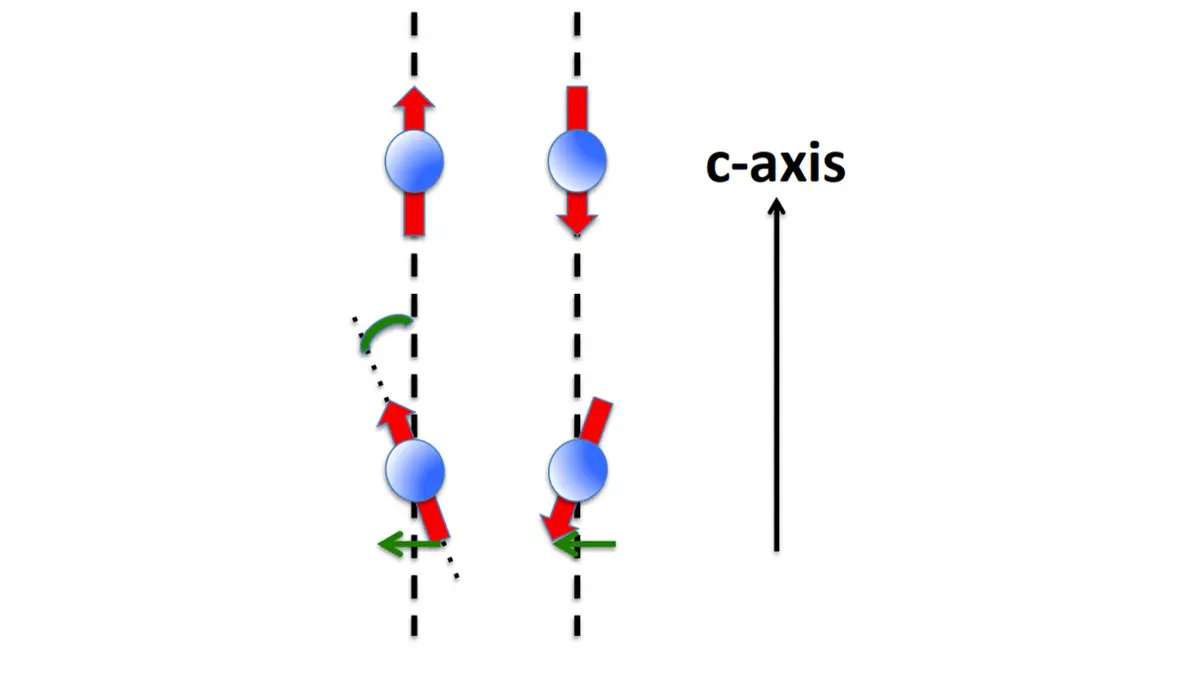
Antiferromagnetic (top) and canted-​antiferromagnetic order (bottom). In the latter case the spins are canted relative to the easy c-​axis, leading to a ferromagnetic contribution in the plane orthogonal to that axis (represented by green arrows). source: ETH Zurich

Antiferromagnetic (top) and canted-​antiferromagnetic order (bottom). In the latter case the spins are canted relative to the easy c-​axis, leading to a ferromagnetic contribution in the plane orthogonal to that axis (represented by green arrows). source: ETH Zurich

Materials that combine topological electronic properties and quantum magnetism are of high current interest, for the quantum many-​body physics that can unfold in them and for possible applications in electronic components. For one such material, ETH physicists have now established the microscopic mechanism linking magnetism and electronic-​band topology.

Dirac matter is an intriguing class of materials with rather peculiar properties: electrons in these materials behave as if they had no mass. The most prominent Dirac material is graphene, but further members have been discovered during the past 15 years or so. Each one of them serves as a rich playground for exploring ‘exotic’ electronic behaviours, some of which hold the promise to enable novel components for electronics.

RelatedPosts

YAGEO Introduces High‑Current Y2/X1 Film Capacitors for Wide-bandgap Power Systems

Amphenol Explanded Liquid Cooling Connectors for AI, ESS and EV Systems

Hirose Introduced BGA connector for PCIe Gen6 for AI and Edge Computing

However, even if Dirac matter and other so-​called topological materials — in which electrons behave in similarly unexpected ways — are among the currently most intensively studied condensed-​matter systems, there are only very few examples where the topology of the electronic bands is connected in a well-​defined manner to the magnetic properties of the materials.

One material in which such interplay between topological electronic states and magnetism has been observed is CaMnBi2, but the mechanism connecting the two remained unclear.

Writing in Physical Review Letters [1], postdoc Run Yang and PhD student Matteo Corasaniti from the Optical Spectroscopy group of Prof. Leonardo Degiorgi at the Laboratory for Solid State Physics, working with colleagues at Brookhaven National Laboratory (US) and the Chinese Academy of Sciences in Beijing, now report a comprehensive study in which they provide clear evidence that it is a slight nudge on the magnetic moments, known as spin canting, that provokes substantial changes in the electronic band structure.

Compass points to the right direction on a bumpy road

CaMnBi2 and the related compound SrMnBi2 have recently attracted attention as they display quantum magnetism — the manganese ions are antiferromagnetically ordered at around room temperature and below — and at the same time they host Dirac electrons. That there is interplay between the two properties has been suspected for some while, not least as at ~50 K there appears an unexpected ‘bump’ in the conduction properties at these materials. But the precise nature of this anomaly was still poorly understood until now.

In earlier work studying optical properties of CaMnBi2 [2], Corasaniti, Yang and co-​workers had established already a link to the electronic properties of the material. They used in particular the fact that the bump-​like anomaly in the transport properties can be shifted in temperature by replacing a proportion of the calcium atoms with sodium atoms.

To get now to the microscopic origins of the observed behaviour, they studied samples with different sodium dopings by torque magnetometry. In this technique, the torque on a magnetic sample is measured when it is exposed to a suitably strong field, similarly as a compass needle aligns with the Earth magnetic field. And this approach proved to point the team to the origins of the anomaly.

A firm link between magnetic and electronic properties

In their magnetic-​torque experiments, the researchers found that at temperatures where no anomaly is observed in the electronic transport measurements, the magnetic behaviour is such as one would expect for an antiferromagnet. This was not the case anymore at lower temperatures, where the anomaly is present. There, a ferromagnetic component appeared, which can be explained by a projection of magnetic moments onto the plane orthogonal to the easy spin c-​axis of the original antiferromagnetic order (see the figure). This phenomenon is known as spin-​canting, induced by a so-​called super-​exchange mechanism.

These two sets of experiments — optical and torque measurements — were supported by dedicated first-​principles calculations. In particular, for the case where spin canting was included in the calculations, a peculiar hybridization between the manganese and bismuth atoms was found to mediate the interlayer magnetic coupling and to govern the electronic properties in the material. Taken together, the study therefore establishes that sought-​after direct link between the magnetic properties and changes to the electronic band structure, reflected in the bump anomaly of the transport properties.

With such detailed understanding on board, the door is now open to exploring not only the electronic properties of CaMnBi2 and related compounds, but also the possibilities arising from the connection between magnetic properties and topological states in these intriguing forms of matter.

References

1. Yang R, Corasaniti M, Le CC, Liao ZY, Wang AF, Du Q, Petrovic C, Qiu XG, Hu JP, Degiorgi L. Spin-canting-induced band reconstruction in the Dirac material Ca1−xNaxMnBi2. Phys. Rev. Lett. 124, 137201 (2020). doi: 10.1103/PhysRevLett.124.137201

2. Corasaniti M, Yang R, Pal A, Chinotti M, Degiorgi L, Wang A, Petrovic C. Fermi surface gapping in the Dirac material Ca1−xNaxMnBi2. Phys. Rev. B 100, 041107(R) (2019). doi: 10.1103/PhysRevB.100.041107

Related

Source: ETH Zurich

Recent Posts

TDK Introduces High‑Voltage Common‑Mode Chokes for Compact 1250 V DC Converters

16.4.2026
16

Vishay Extends Power Inductors for DC/DC with 1212 Compact Case

16.4.2026
11

Modeling Planar Magnetics Temperature: Practical Guidelines for Power Electronics Engineers

15.4.2026
16

YAGEO Releases Ferrite Shielded Power Inductors for High‑Density Designs

15.4.2026
12

YAGEO Introduces EMI Suppression High‑Current 3‑phase Common Mode Chokes

14.4.2026
29

ECIA March 2026 Industry Pulse Points to Best Sales Climate in Five Years

13.4.2026
34

Coilcraft Unveils Molded Power Inductors for High‑Current VRMs

8.4.2026
39

Bourns Releases Compact High Current Shielded Power Inductors

2.4.2026
29

March 2026 Interconnect, Passives and Electromechanical Components Market Insights

2.4.2026
99

Upcoming Events

Apr 21
16:00 - 17:00 CEST

Heatsink Solutions: Thermal Management in electronic devices

Apr 22
17:00 - 17:30 CEST

Magnetics in a high frequency GaN era

Apr 22
17:00 - 18:00 CEST

Derating Tantalum, Film, and Ceramic Capacitors

View Calendar

Popular Posts

  • Buck Converter Design and Calculation

    0 shares
    Share 0 Tweet 0
  • Boost Converter Design and Calculation

    0 shares
    Share 0 Tweet 0
  • Flyback Converter Design and Calculation

    0 shares
    Share 0 Tweet 0
  • LLC Resonant Converter Design and Calculation

    0 shares
    Share 0 Tweet 0
  • Dual Active Bridge (DAB) Topology

    0 shares
    Share 0 Tweet 0
  • MLCC and Ceramic Capacitors

    0 shares
    Share 0 Tweet 0
  • Capacitor Charging and Discharging

    0 shares
    Share 0 Tweet 0
  • Plastic Materials Dielectric Constant and DF

    4 shares
    Share 4 Tweet 0
  • Ripple Current and its Effects on the Performance of Capacitors

    3 shares
    Share 3 Tweet 0
  • MLCC Case Sizes Standards Explained

    0 shares
    Share 0 Tweet 0

Newsletter Subscription


Passive Components Blog

© EPCI - Leading Passive Components Educational and Information Site

  • Home
  • Privacy Policy
  • EPCI Membership & Advertisement
  • About

No Result
View All Result
  • Home
  • Knowledge Blog
  • PCNS

© EPCI - Leading Passive Components Educational and Information Site

This website uses cookies. By continuing to use this website you are giving consent to cookies being used. Visit our Privacy and Cookie Policy.
Go to mobile version