





Passive Components Blog
No Result
View All Result
  • Home
  • NewsFilter
    • All
    • Aerospace & Defence
    • Antenna
    • Applications
    • Automotive
    • Capacitors
    • Circuit Protection Devices
    • electro-mechanical news
    • Filters
    • Fuses
    • Inductors
    • Industrial
    • Integrated Passives
    • inter-connect news
    • Market & Supply Chain
    • Market Insights
    • Medical
    • Modelling and Simulation
    • New Materials & Supply
    • New Technologies
    • Non-linear Passives
    • Oscillators
    • Passive Sensors News
    • Resistors
    • RF & Microwave
    • Telecommunication
    • Weekly Digest

    DC/DC Push‑Pull Converter vs PSFB Design Guide

    Wk 2 Electronics Supply Chain Digest

    Rubycon PMLCAP DC‑Link Film Capacitors in Mass Production

    Bourns SSD‑1000A AEC‑Q Digital Current Sensors

    YAGEO High‑Capacitance X7R Automotive MLCC Extensions

    How Metal Prices Are Driving Passive Component Price Hikes

    Modelithics COMPLETE Library v25.8 for Keysight ADS

    Taiyo Yuden Releases 165C Automotive Multilayer Metal Power Inductor in 1608 Size

    Energy-Controlled Structural Evolution of Amorphous Ta₂O₅ in Tantalum Anodes

    Trending Tags

    • Ripple Current
    • RF
    • Leakage Current
    • Tantalum vs Ceramic
    • Snubber
    • Low ESR
    • Feedthrough
    • Derating
    • Dielectric Constant
    • New Products
    • Market Reports
  • VideoFilter
    • All
    • Antenna videos
    • Capacitor videos
    • Circuit Protection Video
    • Filter videos
    • Fuse videos
    • Inductor videos
    • Inter-Connect Video
    • Non-linear passives videos
    • Oscillator videos
    • Passive sensors videos
    • Resistor videos

    One‑Pulse Characterization of Nonlinear Power Inductors

    Thermistor Linearization Challenges

    Coaxial Connectors and How to Connect with PCB

    PCB Manufacturing, Test Methods, Quality and Reliability

    Transformer Behavior – Current Transfer and Hidden Feedback

    Choosing the Right Capacitor: The Importance of Accurate Measurements

    RF Inductors: Selection and Design Challenges for High-Frequency Circuits

    Transformer Safety IEC 61558 Standard

    3-Phase EMI Filter Design, Simulation, Calculation and Test

    Trending Tags

    • Capacitors explained
    • Inductors explained
    • Resistors explained
    • Filters explained
    • Application Video Guidelines
    • EMC
    • New Products
    • Ripple Current
    • Simulation
    • Tantalum vs Ceramic
  • Knowledge Blog
  • Suppliers
    • Who is Who
  • PCNS
    • PCNS 2025
    • PCNS 2023
    • PCNS 2021
    • PCNS 2019
    • PCNS 2017
  • Events
  • Home
  • NewsFilter
    • All
    • Aerospace & Defence
    • Antenna
    • Applications
    • Automotive
    • Capacitors
    • Circuit Protection Devices
    • electro-mechanical news
    • Filters
    • Fuses
    • Inductors
    • Industrial
    • Integrated Passives
    • inter-connect news
    • Market & Supply Chain
    • Market Insights
    • Medical
    • Modelling and Simulation
    • New Materials & Supply
    • New Technologies
    • Non-linear Passives
    • Oscillators
    • Passive Sensors News
    • Resistors
    • RF & Microwave
    • Telecommunication
    • Weekly Digest

    DC/DC Push‑Pull Converter vs PSFB Design Guide

    Wk 2 Electronics Supply Chain Digest

    Rubycon PMLCAP DC‑Link Film Capacitors in Mass Production

    Bourns SSD‑1000A AEC‑Q Digital Current Sensors

    YAGEO High‑Capacitance X7R Automotive MLCC Extensions

    How Metal Prices Are Driving Passive Component Price Hikes

    Modelithics COMPLETE Library v25.8 for Keysight ADS

    Taiyo Yuden Releases 165C Automotive Multilayer Metal Power Inductor in 1608 Size

    Energy-Controlled Structural Evolution of Amorphous Ta₂O₅ in Tantalum Anodes

    Trending Tags

    • Ripple Current
    • RF
    • Leakage Current
    • Tantalum vs Ceramic
    • Snubber
    • Low ESR
    • Feedthrough
    • Derating
    • Dielectric Constant
    • New Products
    • Market Reports
  • VideoFilter
    • All
    • Antenna videos
    • Capacitor videos
    • Circuit Protection Video
    • Filter videos
    • Fuse videos
    • Inductor videos
    • Inter-Connect Video
    • Non-linear passives videos
    • Oscillator videos
    • Passive sensors videos
    • Resistor videos

    One‑Pulse Characterization of Nonlinear Power Inductors

    Thermistor Linearization Challenges

    Coaxial Connectors and How to Connect with PCB

    PCB Manufacturing, Test Methods, Quality and Reliability

    Transformer Behavior – Current Transfer and Hidden Feedback

    Choosing the Right Capacitor: The Importance of Accurate Measurements

    RF Inductors: Selection and Design Challenges for High-Frequency Circuits

    Transformer Safety IEC 61558 Standard

    3-Phase EMI Filter Design, Simulation, Calculation and Test

    Trending Tags

    • Capacitors explained
    • Inductors explained
    • Resistors explained
    • Filters explained
    • Application Video Guidelines
    • EMC
    • New Products
    • Ripple Current
    • Simulation
    • Tantalum vs Ceramic
  • Knowledge Blog
  • Suppliers
    • Who is Who
  • PCNS
    • PCNS 2025
    • PCNS 2023
    • PCNS 2021
    • PCNS 2019
    • PCNS 2017
  • Events
No Result
View All Result
Passive Components Blog
No Result
View All Result

Transforming Vehicle into an Instrument, Continental and Sennheiser Revolutionize Vehicle Audio by Speakerless Sound

10.1.2020
Reading Time: 3 mins read
A A

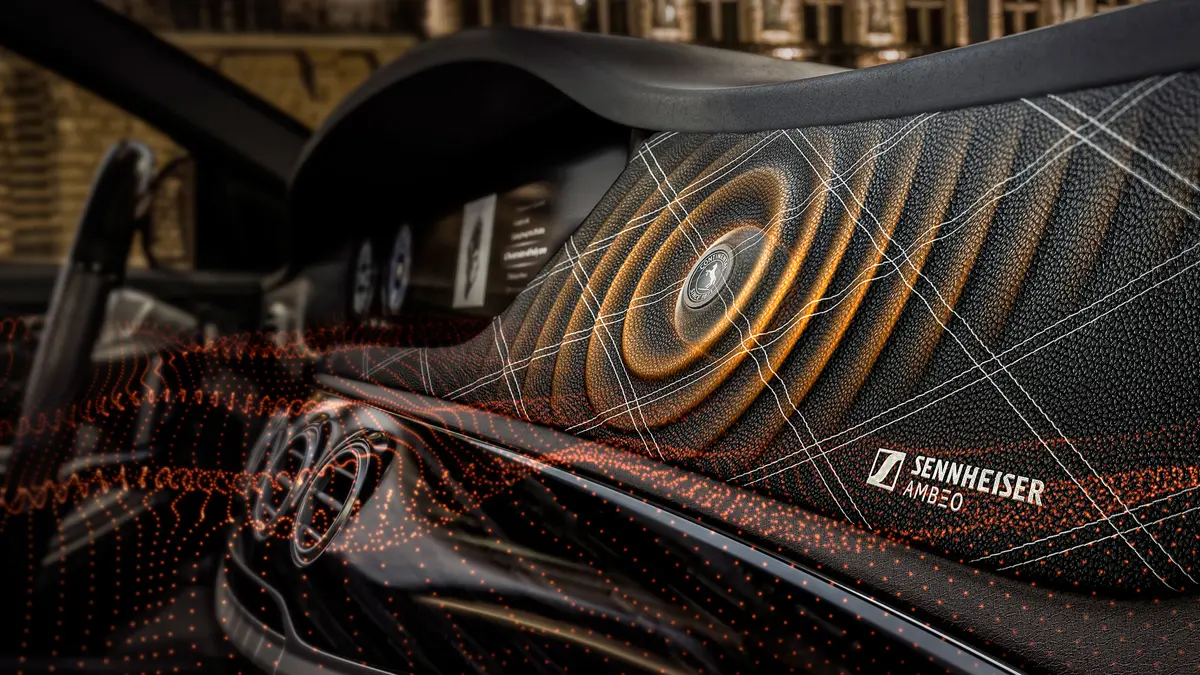
Hanover, Germany/Las Vegas, January 6, 2020 – At CES 2020 in Las Vegas (January 7-10, 2020), technology company Continental and audio specialist Sennheiser present a speakerless audio system for the vehicle interior. The unique system fills the vehicle interior with lifelike immersive sound.

The two partners are integrating Sennheiser’s patented AMBEO 3D audio technology with Continental’s Ac2ated Sound system. Continental’s innovative concept abandons conventional speaker technology altogether, exciting select surfaces in the vehicle interior to produce sound. Combined with Sennheiser’s AMBEO Mobility, the concept achieves a breathtaking 3D sound reproduction that envelops passengers in an incredibly detailed and vivid soundscape and lets them enjoy their in-car entertainment to the fullest. In comparison to conventional audio systems, Ac2ated Sound enables a reduction of weight and space of up to 90 percent. In this way, the system not only produces the highest audio quality but is also perfectly suited for electric vehicles, where saving space and weight is a high priority.

RelatedPosts

DC/DC Push‑Pull Converter vs PSFB Design Guide

Wk 2 Electronics Supply Chain Digest

Rubycon PMLCAP DC‑Link Film Capacitors in Mass Production

“For Ac2ated Sound we have brought together the highest levels of expertise in the areas of acoustics, infotainment and vehicle design. In Sennheiser we have found an audio expert who helped us make our pioneering audio system even better,” said Helmut Matschi, member of the Executive Board and Head of the business area Vehicle Networking and Information at Continental. “Together, we have developed an audio system that creates premium sound out of nowhere. Additionally, Ac2ated Sound reduces space and weight. At Continental, we call this sustainability that’s music to your ears.”

Continental_PP_Ac2ated_Sound_Sennheiser_WideShot
Ac2ated Sound and AMBEO Mobility create truly lifelike immersive 3D sound experience. Image credit: Continental AG

“We are delighted to bring our audio expertise and AMBEO Mobility software into the pioneering Ac2ated Sound system from Continental, calibrating and fine-tuning the sound quality to deliver a completely immersive and natural sound experience that opens new audio perspectives and realities,” explained Dr. Andreas Sennheiser, co-CEO of Sennheiser.

Co-CEO Daniel Sennheiser added: “Our AMBEO immersive audio solutions deliver the ultimate quality in sound capture, processing and playback. Crucially, the ability to enjoy breathtaking immersive sound does not require specific 3D audio sources – AMBEO Mobility’s spatialization algorithm can turn any stereo material into an immersive experience. By intelligently analyzing the content, the patented algorithm artistically remixes the sound to provide an emotional experience, transporting the listener into the music.”

Transforming the vehicle into an instrument

Inspired by the technology of classical string instruments, which use their wooden body as a resonance chamber, specially developed actuators excite specific surfaces in the vehicle interior. The result is an extremely natural sound experience for the occupants, who feel as if they are sitting in a concert hall surrounded by sound. Additionally, in comparison with conventional speaker systems, the audio solution has a much lower weight and significantly reduced box volume. In comparison: With a multitude of components, conventional audio systems weigh up to 40 kilograms (more than 88 pounds). By using already existing surfaces, Ac2ated Sound is distinctly more efficient in saving space. It achieves a reduction between 75 and 90 percent in contrast to existing conventional systems on the market.

At the same time, the invisible audio technology gives vehicle designers and manufacturers the freedom to do more with an automobile’s interior, as they no longer need to account for large speaker faces taking up valuable space. With Ac2ated Sound, many components are unnecessary because the surfaces in the vehicle vibrate just like speaker diaphragms. Actuators cause components such as the A-pillar trim, door trim, roof lining and rear shelf to vibrate so that they emit sound in different frequency ranges. Continental and Sennheiser will present their futuristic audio system in a private exhibit at CES 2020, where visitors can experience how the system responds to the challenges for the next generation of vehicles by reducing weight and saving space without sacrificing sound quality.

featured image source: Continental AG
Related

Source: Continental AG

Recent Posts

Rubycon PMLCAP DC‑Link Film Capacitors in Mass Production

9.1.2026
23

Bourns SSD‑1000A AEC‑Q Digital Current Sensors

8.1.2026
40

YAGEO High‑Capacitance X7R Automotive MLCC Extensions

8.1.2026
43

Taiyo Yuden Releases 165C Automotive Multilayer Metal Power Inductor in 1608 Size

7.1.2026
31

2025 Top Passive Components Blog Articles

5.1.2026
95
Credit: Institute of Science Tokyo

Researchers Demonstrated 30nm Ferroelectric Capacitor for Compact Memory

2.1.2026
34

Samsung Unveils World First CLLC Resonant 1kV 33nF C0G MLCC in 1210 Size

19.12.2025
77

Reliability Improvement in BaTiO3 MLCCs Using Ni–Sn and Ni–In Alloy Electrodes

19.12.2025
81

Littelfuse Introduces Automotive Current Sensors for EV Battery, Motor, and Safety Systems

18.12.2025
19

Upcoming Events

Jan 27
16:00 - 17:00 CET

Simplifying Vehicle Development with Automotive Ethernet and Zonal Smart Switch Technologies

Feb 24
16:00 - 17:00 CET

Designing Qi2 Wireless Power Systems: Practical Development and EMC Optimization

View Calendar

Popular Posts

  • Buck Converter Design and Calculation

    0 shares
    Share 0 Tweet 0
  • Boost Converter Design and Calculation

    0 shares
    Share 0 Tweet 0
  • LLC Resonant Converter Design and Calculation

    0 shares
    Share 0 Tweet 0
  • Flyback Converter Design and Calculation

    0 shares
    Share 0 Tweet 0
  • Ripple Current and its Effects on the Performance of Capacitors

    3 shares
    Share 3 Tweet 0
  • MLCC and Ceramic Capacitors

    0 shares
    Share 0 Tweet 0
  • What Electronics Engineer Needs to Know About Passive Low Pass Filters

    0 shares
    Share 0 Tweet 0
  • Dual Active Bridge (DAB) Topology

    0 shares
    Share 0 Tweet 0
  • SEPIC Converter Design and Calculation

    0 shares
    Share 0 Tweet 0
  • What is a Dielectric Constant and DF of Plastic Materials?

    4 shares
    Share 4 Tweet 0

Newsletter Subscription


Passive Components Blog

© EPCI - Leading Passive Components Educational and Information Site

  • Home
  • Privacy Policy
  • EPCI Membership & Advertisement
  • About

No Result
View All Result
  • Home
  • Knowledge Blog
  • PCNS

© EPCI - Leading Passive Components Educational and Information Site

This website uses cookies. By continuing to use this website you are giving consent to cookies being used. Visit our Privacy and Cookie Policy.
Go to mobile version