




Passive Components Blog
No Result
View All Result
  • Home
  • NewsFilter
    • All
    • Aerospace & Defence
    • Antenna
    • Applications
    • Automotive
    • Capacitors
    • Circuit Protection Devices
    • electro-mechanical news
    • Filters
    • Fuses
    • Inductors
    • Industrial
    • Integrated Passives
    • inter-connect news
    • Market & Supply Chain
    • Market Insights
    • Medical
    • Modelling and Simulation
    • New Materials & Supply
    • New Technologies
    • Non-linear Passives
    • Oscillators
    • Passive Sensors News
    • Resistors
    • RF & Microwave
    • Telecommunication
    • Weekly Digest

    Modelithics Releases COMPLETE Library v26.2 for Keysight Genesys

    Why Isolated DC/DC Power Supplies Fail Late, Würth Elektronik Podcast

    Wk 23 Electronics Supply Chain Digest

    Power Converter Dossier: Passive Components Design and Selection Guide 2026

    Evans Group Unifies Four High-Rel Capacitor Leaders

    Skeleton Releases Graphene‑Based UPS for AI Data Centers

    Designing 800 V DC EMC Filters: Calculation, Simulation and Measurement

    TDK Releases DC-link Film Capacitors with Ultra-low Inductance for SiC Power Converters

    Murata Introduces World First 2.2uF 100V Soft‑Term MLCC in 0805 Size for Automotive

    Trending Tags

    • Ripple Current
    • RF
    • Leakage Current
    • Tantalum vs Ceramic
    • Snubber
    • Low ESR
    • Feedthrough
    • Derating
    • Dielectric Constant
    • New Products
    • Market Reports
  • VideoFilter
    • All
    • Antenna videos
    • Capacitor videos
    • Circuit Protection Video
    • Filter videos
    • Fuse videos
    • Inductor videos
    • Inter-Connect Video
    • Non-linear passives videos
    • Oscillator videos
    • Passive sensors videos
    • Resistor videos

    Why Isolated DC/DC Power Supplies Fail Late, Würth Elektronik Podcast

    Designing 800 V DC EMC Filters: Calculation, Simulation and Measurement

    Current Sense Transformer Datasheet and Design‑in Guide

    Designing a USB Type‑C Flyback Planar Transformer with Frenetic’s Planar Tool

    Magnetics Design in High‑Frequency GaN Converters

    Qi2 Wireless Charging: Inductors, Capacitors and EMC Filters

    Two‑capacitor paradox explained for engineers

    Capacitances of Nonlinear MLCCs: What Datasheets Don’t Tell You

    Tapped Inductor Buck Converter Fundamentals

    Trending Tags

    • Capacitors explained
    • Inductors explained
    • Resistors explained
    • Filters explained
    • Application Video Guidelines
    • EMC
    • New Products
    • Ripple Current
    • Simulation
    • Tantalum vs Ceramic
  • Knowledge Blog
  • DossiersNew
  • Suppliers
    • Who is Who
  • PCNS
    • PCNS 2025
    • PCNS 2023
    • PCNS 2021
    • PCNS 2019
    • PCNS 2017
  • Events
  • Home
  • NewsFilter
    • All
    • Aerospace & Defence
    • Antenna
    • Applications
    • Automotive
    • Capacitors
    • Circuit Protection Devices
    • electro-mechanical news
    • Filters
    • Fuses
    • Inductors
    • Industrial
    • Integrated Passives
    • inter-connect news
    • Market & Supply Chain
    • Market Insights
    • Medical
    • Modelling and Simulation
    • New Materials & Supply
    • New Technologies
    • Non-linear Passives
    • Oscillators
    • Passive Sensors News
    • Resistors
    • RF & Microwave
    • Telecommunication
    • Weekly Digest

    Modelithics Releases COMPLETE Library v26.2 for Keysight Genesys

    Why Isolated DC/DC Power Supplies Fail Late, Würth Elektronik Podcast

    Wk 23 Electronics Supply Chain Digest

    Power Converter Dossier: Passive Components Design and Selection Guide 2026

    Evans Group Unifies Four High-Rel Capacitor Leaders

    Skeleton Releases Graphene‑Based UPS for AI Data Centers

    Designing 800 V DC EMC Filters: Calculation, Simulation and Measurement

    TDK Releases DC-link Film Capacitors with Ultra-low Inductance for SiC Power Converters

    Murata Introduces World First 2.2uF 100V Soft‑Term MLCC in 0805 Size for Automotive

    Trending Tags

    • Ripple Current
    • RF
    • Leakage Current
    • Tantalum vs Ceramic
    • Snubber
    • Low ESR
    • Feedthrough
    • Derating
    • Dielectric Constant
    • New Products
    • Market Reports
  • VideoFilter
    • All
    • Antenna videos
    • Capacitor videos
    • Circuit Protection Video
    • Filter videos
    • Fuse videos
    • Inductor videos
    • Inter-Connect Video
    • Non-linear passives videos
    • Oscillator videos
    • Passive sensors videos
    • Resistor videos

    Why Isolated DC/DC Power Supplies Fail Late, Würth Elektronik Podcast

    Designing 800 V DC EMC Filters: Calculation, Simulation and Measurement

    Current Sense Transformer Datasheet and Design‑in Guide

    Designing a USB Type‑C Flyback Planar Transformer with Frenetic’s Planar Tool

    Magnetics Design in High‑Frequency GaN Converters

    Qi2 Wireless Charging: Inductors, Capacitors and EMC Filters

    Two‑capacitor paradox explained for engineers

    Capacitances of Nonlinear MLCCs: What Datasheets Don’t Tell You

    Tapped Inductor Buck Converter Fundamentals

    Trending Tags

    • Capacitors explained
    • Inductors explained
    • Resistors explained
    • Filters explained
    • Application Video Guidelines
    • EMC
    • New Products
    • Ripple Current
    • Simulation
    • Tantalum vs Ceramic
  • Knowledge Blog
  • DossiersNew
  • Suppliers
    • Who is Who
  • PCNS
    • PCNS 2025
    • PCNS 2023
    • PCNS 2021
    • PCNS 2019
    • PCNS 2017
  • Events
No Result
View All Result
Passive Components Blog
No Result
View All Result

Vishay Introduced Space-Grade SMT Common Mode Choke

19.3.2026
Reading Time: 7 mins read
A A

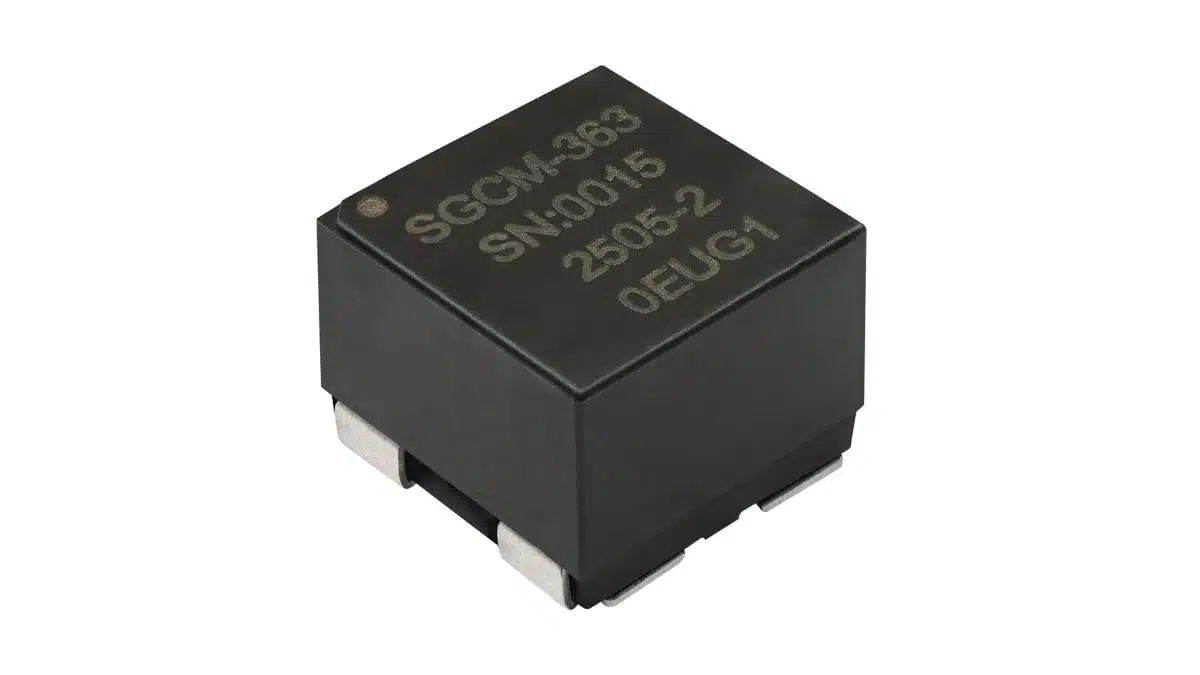
Vishay Custom Magnetics has introduced the SGCM05339, a space-grade, surface-mount common mode choke designed for EMI filtering and noise suppression in high-reliability applications.

It targets GaN and SiC switching stages and other power electronics where fast edges and high di/dt drive stringent EMC and screening requirements.

RelatedPosts

Vishay Releases High‑Current Radial Inductors up to 209 A

SPICE Simulation of Non-Linear Resistors: Vishay’s Thermistor and PPTC Modelling Ecosystem

Vishay Extends Power Inductors for DC/DC with 1212 Compact Case

Key features and benefits

The Vishay SGCM05339 common mode choke is built around a compact nanocrystalline core in a self-shielded construction, optimized for harsh space, aerospace, and defense environments. Its overmolded, ruggedized package is intended for use where vibration, thermal cycling, and contamination resistance are critical.

Key characteristics include:

  • Nanocrystalline core in a self-shielded design for reduced stray fields and improved EMC behavior in dense layouts.
  • Overmolded construction for mechanical robustness and stable electrical performance over life.
  • High common mode impedance over an extended frequency range, providing broadband EMI attenuation around fast-switching GaN and SiC edges.
  • Heat rating current capability up to 14.43 A (typical), supporting high-current power stages without excessive temperature rise.
  • Wide continuous operating temperature range from -55 °C to +130 °C, suitable for many space and military thermal profiles.
  • Dielectric withstand voltage of 1000 VRMS and minimum insulation resistance of 10 GΩ at 500 VDC, supporting isolation and safety margins in isolated power architectures.
  • Outgassing compliant per ASTM-E595, addressing contamination and materials constraints in space hardware.
  • Multiple screening options including MIL-STD-981 Family 04 Class S and Class B, and EEE-INST-002, allowing alignment with program-specific quality flows.

The device can be customized by turn count, wire gauge, temperature class, and screening options, enabling optimization of impedance, current capability, and qualification level for specific platforms.

Typical applications

The SGCM05339 is positioned as a common mode choke for power conversion stages where wide bandgap devices or high-current operation make EMI control challenging.

Typical use cases include:

  • GaN and SiC switching stages in power converters, where very fast voltage transitions increase radiated and conducted emissions.
  • Low profile, high current power supplies on space and defense platforms that must balance height constraints with EMI and thermal performance.
  • DC/DC converters in distributed power systems for satellites, avionics, and defense systems.
  • Power converters for solar panels, including spaceborne solar power conditioning units, where common mode noise can couple into sensitive telemetry or communication lines.

In these applications, the choke is placed in series with line pairs (e.g. input or output of a converter) to attenuate common mode noise components while minimally affecting differential mode power transfer.

Technical highlights

Within the SGCM05339 family, Vishay specifies the following electrical ranges:

  • Inductance per winding: 320 µH to 10 400 µH.
  • Typical common mode impedance: 540 Ω to 3600 Ω.
  • Maximum DC resistance per winding: 0.0029 Ω to 0.1318 Ω.
  • Typical heat rating current: 2.02 A to 14.43 A, defined as the series DC current causing approximately ΔT=30 ∘C\Delta T = 30\,^\circ\text{C}ΔT=30∘C.
  • Peak impedance frequency: 2.06 Hz to 31.74 Hz (per datasheet definition for this family).
  • Maximum leakage inductance: 0.35 µH to 7.75 µH.

In practice, the combination of relatively low DC resistance and high heat rating current makes the part suitable for continuous operation in higher power rails without excessive conduction loss. The wide inductance and impedance span allows engineers to trade off between stronger common mode attenuation and acceptable insertion loss, depending on the conducted EMI limits and the converter’s waveform characteristics.

The specified dielectric strength and insulation resistance support designs where the choke forms part of an isolation barrier or sits between noisy and quiet reference domains, although exact creepage and clearance distances should be taken from the detailed manufacturer datasheet.

Availability and part numbers

SGCM05339 is currently released as a single series identifier for this space-grade, surface-mount common mode choke. According to Vishay, samples and production quantities are available with typical lead times of 8 to 12 weeks, subject to screening and customization options.

Engineers should consult the SGCM05339 product page and datasheet for:

  • Detailed electrical tables for each inductance/impedance option in the series.
  • Mechanical outline, recommended pad layout, and 3D models.
  • Ordering codes covering screening level, temperature class, and any custom variants.

For program-specific screening (e.g. MIL-STD-981 Class S vs Class B or particular EEE-INST-002 flow), coordination with Vishay sales/FAE is usually required to confirm part numbers and lot-level documentation.

Design-in notes for engineers

When designing in the SGCM05339, several practical aspects are worth consideration:

  • Selecting inductance and impedance: choose the inductance per winding and typical common mode impedance based on your converter’s switching frequency, edge rates, and EMI test margins. Higher impedance values improve attenuation but may increase size and leakage inductance.
  • Thermal design: use the specified heat rating current as a reference, but verify temperatures in your own environment. Conservative derating below the maximum 14.43 A rating is recommended for long-life space missions.
  • Layout and self-shielding: the self-shielded design helps contain magnetic fields, but placement near sensitive analog or RF circuits should still be minimized. Short, symmetric routing of the differential pair through the common mode choke improves EMC performance.
  • Isolation and safety: the 1000 VRMS dielectric withstand voltage and minimum 10 GΩ insulation resistance are useful input parameters for insulation coordination. Always cross-check creepage, clearance, and insulation system requirements against mission or safety standards.
  • Screening and qualification: early in the project, align the chosen screening option (e.g. MIL-STD-981 Family 04 Class S) with customer or agency requirements to avoid later requalification. Screening impacts both cost and lead time.
  • Customization: for non-standard EMI targets or mechanical constraints, customization of turn count, wire gauge, and temperature class allows tailoring the choke’s impedance profile and current handling. Engaging with the manufacturer during early architecture trades can reduce later board spins.

For GaN and SiC designs in particular, it is important to consider how very fast dv/dt and di/dt may excite parasitics around the choke; co-design with snubbers, gate drive layout, and shielding is recommended to extract full benefit from the SGCM05339’s broadband common mode performance.

Source

This article is based on technical information provided by Vishay Intertechnology in their official new product introduction material for the SGCM05339 series, complemented by general application context for power and EMI design.

References

  1. Vishay press release – SGCM05339 space-grade surface-mount common mode choke
  2. Vishay NPI document – SGCM05339 space-grade surface-mount common mode choke
  3. SGCM05339 product page and datasheet

Related

Recent Posts

Modelithics Releases COMPLETE Library v26.2 for Keysight Genesys

8.6.2026
6

Power Converter Dossier: Passive Components Design and Selection Guide 2026

5.6.2026
24

Evans Group Unifies Four High-Rel Capacitor Leaders

5.6.2026
21

Murata and Xona Partner on LEO Satellite Navigation for Industrial Applications

3.6.2026
36

Bourns Offers Custom Magnetics for 3‑Phase Flying Capacitor Inverters

3.6.2026
27

Passive Components in 2026: From Invisible Commodity to Design Parameter

2.6.2026
64

Bourns Introduces High Current Chip Ferrite Beads for Dense Power Rails

1.6.2026
22

Vishay Releases High‑Current Radial Inductors up to 209 A

29.5.2026
31

May 2026 Interconnect, Passives and Electromechanical Components Market Insights

29.5.2026
114

Upcoming Events

Jun 16
16:00 - 17:00 CEST

EMC with EMC – EMC‑compliant design with electromechanical connectors

Jul 14
16:00 - 17:00 CEST

EMC Design Essentials: Mastering Varistors and Common Mode Chokes

Jul 21
16:00 - 17:00 CEST

Safety by design: X and Y Interference suppression capacitors for power line filters

View Calendar

Popular Posts

  • Buck Converter Design and Calculation

    0 shares
    Share 0 Tweet 0
  • Boost Converter Design and Calculation

    0 shares
    Share 0 Tweet 0
  • MLCC and Ceramic Capacitors

    0 shares
    Share 0 Tweet 0
  • Flyback Converter Design and Calculation

    0 shares
    Share 0 Tweet 0
  • LLC Resonant Converter Design and Calculation

    0 shares
    Share 0 Tweet 0
  • What Electronics Engineer Needs to Know About Passive Low Pass Filters

    0 shares
    Share 0 Tweet 0
  • Dual Active Bridge (DAB) Topology

    0 shares
    Share 0 Tweet 0
  • Capacitor Charging and Discharging

    0 shares
    Share 0 Tweet 0
  • SEPIC Converter Design and Calculation

    0 shares
    Share 0 Tweet 0
  • Earthing Systems and IEC Classification Explained

    0 shares
    Share 0 Tweet 0

Newsletter Subscription


Passive Components Blog

© EPCI - Leading Passive Components Educational and Information Site

  • Home
  • Privacy Policy
  • EPCI Membership & Advertisement
  • About

No Result
View All Result
  • Home
  • Knowledge Blog
  • Dossiers
  • PCNS

© EPCI - Leading Passive Components Educational and Information Site

This website uses cookies. By continuing to use this website you are giving consent to cookies being used. Visit our Privacy and Cookie Policy.
Go to mobile version