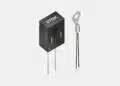




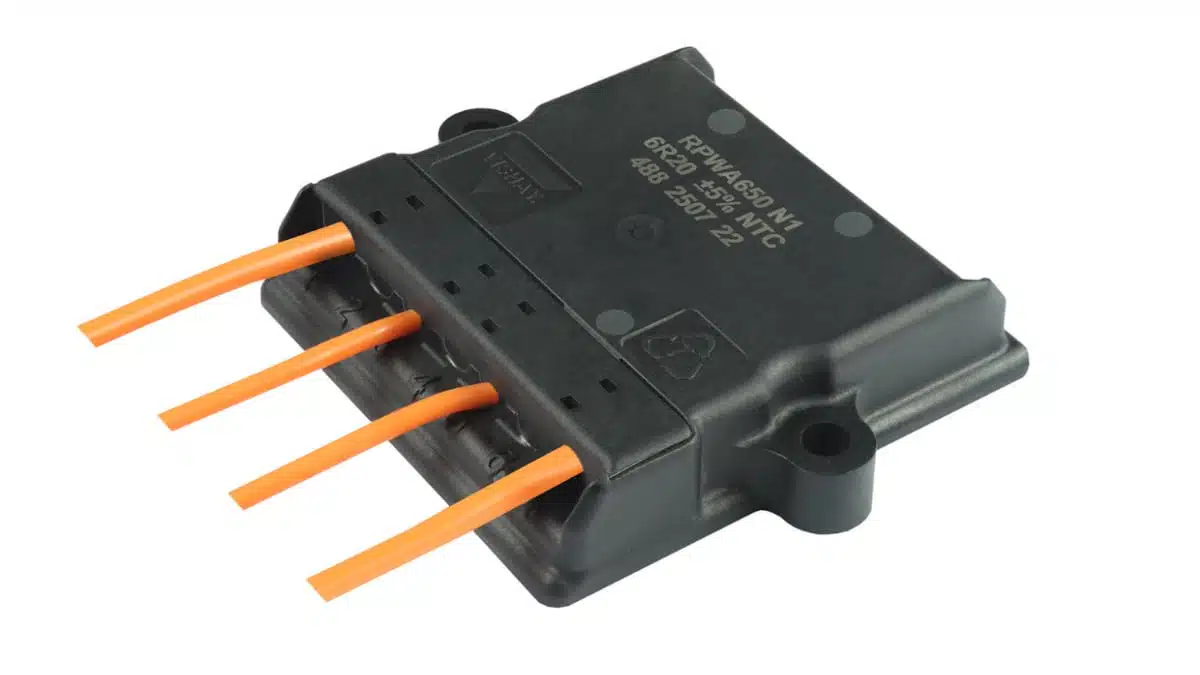
Vishay Intertechnology has released the RPWA 650 series, a new family of thick film power resistors rated at up to 650 W of continuous power in a low-profile package.
The Vishay thick film resistor series targets designers who need to shrink power-resistor footprints in automotive, industrial, energy, medical, and avionics power stages while cutting component count and assembly effort.
Key features and benefits
- Continuous power rating up to 650 W in a compact, low-profile housing
- Resistance range from 6.2 Ω to 1 MΩ, with tolerances down to ±5%
- Optional embedded NTC temperature sensor integrated into the same housing as the thermistor element
- Customizable cabling and a self-calibrating, easy-mount pressure interface that eliminates board-level soldering
- Operating temperature range from -55 °C to +155 °C, enabled by a “cold system” baseplate for efficient heat transfer to an external heatsink (not supplied)
- Maximum operating voltage up to 6000 VDC, dielectric strength to 7000 VRMS
- Typical self-inductance ≤ 40 nH
- Pulse energy capability up to 3.5 J per pulse at a 50 μs pulse width
- RoHS compliant, with AEC-Q200 qualification pending
Technical highlights
The RPWA 650 series is built on wire thick film technology, combining the low inductance typical of thick film resistive elements with the power-handling ruggedness expected from wirewound designs. This is a meaningful distinction for power engineers: low self-inductance (≤ 40 nH) matters directly in fast-switching or high dV/dt circuits, where parasitic inductance in the resistor itself can generate voltage overshoot or ringing.
The baseplate “cold system” construction is designed to move heat efficiently out of the resistive element and into an externally mounted heatsink, rather than relying primarily on the resistor body to dissipate heat into free air. This approach is common in high power-density modules, since it decouples the resistor’s thermal limit from ambient convection and instead ties it to the system-level thermal design. The wide voltage and dielectric ratings (6000 VDC / 7000 VRMS) also make the series relevant for medium- and high-voltage bus applications where creepage and isolation margins are as important as the resistive value itself.
Typical applications
According to the manufacturer, RPWA 650 series resistors are intended for circuit functions including precharge, discharge, active discharge, power conversion, and snubber operations. These functions are common across automotive, energy, industrial, medical, and avionics power systems operating in harsh environments.
Application fit
| Application area | Relevant device attributes |
|---|---|
| Precharge / discharge circuits | High voltage rating (6000 VDC), wide resistance range, pulse energy handling |
| Active discharge (e.g., EV/HEV DC-link) | High power density, low inductance, wide temperature range |
| Power conversion stages | Compact footprint, cold-plate mounting, cable-based integration |
| Snubber networks | Low self-inductance (≤ 40 nH), high pulse energy rating |
| Harsh-environment systems (automotive, avionics, medical) | -55 °C to +155 °C range, pending AEC-Q200 qualification |
Design-in notes for engineers
- Since AEC-Q200 qualification is still pending, automotive program teams should confirm qualification status and timing before locking in a design that requires it
- The external heatsink is not supplied, so thermal design (heatsink sizing, interface material, mounting pressure) must be engineered at the system level to realize the rated 650 W
- The self-calibrating pressure mount avoids soldering, but mechanical assembly tolerances and torque/pressure specifications should be verified against the datasheet to ensure consistent thermal contact
- Low self-inductance is beneficial in snubber and fast-switching applications, but overall loop inductance still depends on cabling length and layout, not the resistor alone
- With resistance values spanning six decades (6.2 Ω to 1 MΩ) and tolerances to ±5%, exact part selection and tolerance-grade availability should be confirmed according to the manufacturer datasheet
- Lead times of 8 to 12 weeks were stated for samples and production quantities at launch; purchasing teams should verify current lead times given ongoing supply chain volatility
Further reading
- Performance of AEC-Q200 Rated Power Resistors for Automotive Use
- RC Snubber Design for SMPS Protection Part II
- MIL Spec MIL-PRF vs Automotive AEC-Q200 Explained
- Thermistors Basics, NTC and PTC Thermistors
Source
This article is based on information published by Vishay Intertechnology in its official press release announcing the RPWA 650 series. Engineers should consult the current manufacturer datasheet and documentation before finalizing component qualification and design release.