


This article shows some common and also not so known capacitor symbols with brief description.
Standards
The primary electrotechnical symbol standards for capacitors are IEC 60617 and ANSI Y32.2 / IEEE 315. IEC 60617 is the main international standard and is maintained as an online database of graphical symbols for diagrams, including a rich set of capacitor symbol variants.
ANSI Y32.2 / IEEE 315 defines the traditional parallel‑plate and curved‑plate symbols widely used in North America and in many older textbooks and application notes. ISO 14617 provides a general library of graphical symbols, but for purely electrotechnical components ISO explicitly defers to IEC 60617 as the authoritative source.
In practice, IEC‑style symbols are predominant in Europe and in international projects, while ANSI/IEEE forms remain common in the US; Japanese and many Asian manufacturers follow IEC‑aligned JIS symbols. For clear communication it is important to know which symbol family your project or company has adopted and to document this in the drawing notes.
Primary standards
The primary electrotechnical symbol standards are: IEC 60617 (international) and ANSI Y32.2 / IEEE 315 (US/North America).
IEC 60617 is the main international electrotechnical symbol standard, and ANSI Y32.2 / IEEE 315 is the historic and still‑referenced US standard for electrical/electronic diagrams, including capacitors. ISO 14617 is a general graphical symbol library for diagrams, but for pure electrotechnical symbols ISO itself explicitly defers to IEC 60617 DB, which is the authoritative source for capacitor symbols and similar.
On regional usage (Europe vs US/Asia)
IEC symbols are predominantly used in Europe and many international designs, while ANSI/IEEE symbols remain common in North America; Japan and some Asian manufacturers mainly follow IEC‑aligned JIS symbols.
Key Takeaways
- The article describes various capacitor symbols along with their functions.
- There are more symbol standards: Europe (IEC “new”), US (IEEE “old”) or symbols used in Japan.
- Generic capacitors store energy and can connect in any direction, while polarized electrolytic capacitors have positive and negative terminals.
- Variable capacitors allow for adjustable capacitance, commonly used in tuning circuits.
- Specialized capacitors like temperature-dependent and voltage-dependent capacitors have unique characteristics and applications.
- The article also discusses unique designs such as differential, butterfly, and dual ganged capacitors for advanced circuit functionality.
Capacitor Symbols
Generic Capacitor
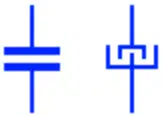
Capacitor is an electronic component that stores energy in its electric field. It is the symbol of a generic capacitor. It is a non-polar electrostatic capacitor having fixed capacitance value such as ceramic capacitors, silicon capacitors or film capacitors from the most common types. It can be connected in either direction. The second symbol represents an obsolete capacitor symbols used for non-polar capacitors.
Polarized Electrolytic Capacitor

Such type of capacitors uses electrolyte as one of its electrode that is why they are polarized. The electrolytic capacitors such as aluminum capacitors, tantalum capacitors / niobium capacitors or supercapacitors have positive and negative terminals and the top of these symbols represent the positive terminals. A polarized capacitor must be connected in circuit accordingly, otherwise it may fail in its function. The first two symbols are used in Europe (IEC “new”) while the next two symbols in US (IEEE “old”) . The 5th symbol for capacitor is used in japan.
Variable Capacitor
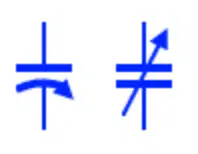
This symbol represents a variable capacitance whose capacitance can be varied during normal operation. The capacitance is varied by increasing or decreasing the effective area between the plates that effects the capacitance of the capacitor. They are used in LC tuning circuits.
Trimmer Capacitor
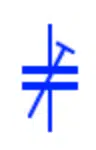
It is also a variable capacitor whose capacitance is used to calibrate a circuit during manufacturing or troubleshooting a circuit. The capacitance of such capacitor is not normally changed by users during operation.
Bipolar Capacitor

They are also known as non polar electrolytic capacitor, usually aluminum electrolytic bipolar capacitors. It is made of two electrolytic capacitor in such design that they can be used in any polarity. They differ from generic ceramic non polar capacitor by having large capacitance.
Feed through Capacitor
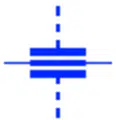
This type of capacitor is designed for DC power supply in RF systems. It supply the pure DC signal & also filters any RF component from it.
Voltage Dependent Capacitor

The capacitance of such capacitor depend on the applied voltage. Increasing or decreasing the supply voltages changes the size of the dielectric gap between the plates which increases the capacitance.
Temperature Dependent Capacitor
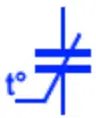
These capacitors capacitance depends on its surrounding temperature. The temperature increase or decrease may increase or decrease the capacitance of the capacitor. They are used in temperature sensing application.
Safety Capacitor Annotations (Class X/Y)
In most schematic standards, class X and class Y safety capacitors use the same basic capacitor symbol as generic or polarized capacitors, but their safety function is conveyed through reference designations and notes rather than a completely different symbol. Typical annotation practice is to label these parts as CX1, CX2, CY1, CY2, or similar, and to add explicit text such as “X2 275 VAC” or “Y1 250 VAC” near the symbol.
Safety capacitors used for EMI suppression across the mains (class X) or from line to protective earth (class Y) must comply with dedicated standards such as IEC 60384‑14, so the schematic should make their role obvious to reviewers. A good habit is to group safety capacitors in the mains input section, use consistent prefixes (CX, CY), and include a short note in the drawing legend: “Safety capacitors: symbols per IEC 60617, classification per IEC 60384‑14.”
Capacitor Symbols in EMI and Filter Circuits
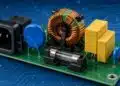
In EMI/EMC and mains input filters, capacitors are often arranged in characteristic topologies such as X capacitors (between line and neutral) and Y capacitors (between line/neutral and protective earth), forming classic single‑stage or multi‑stage filter networks. The graphical symbol remains the standard capacitor icon, but the placement and labeling (CX, CY) indicate their role as safety‑rated EMI suppression components.
Note: Feed‑through capacitors, which are used for DC supply decoupling in RF front‑ends, are drawn with the dedicated feed‑through symbol above and typically appear inline with the supply trace while providing a path to ground for RF energy. When documenting EMI filters, it helps to show the full filter structure (X capacitor, common‑mode choke, Y capacitors) using consistent capacitor symbols and to add a brief note that these are safety‑rated parts, linking to the relevant safety capacitor and EMI/EMC articles in your knowledge base.
Differential Capacitor

It is a variable capacitor with two operate stator and one common rotor. Moving the rotor increases the capacitance in one section & simultaneously decreases it in the other section. However the total capacitance remains the same.
Split Stator Capacitor

As the name suggest, such type of variable capacitor has two set of stators that are separated at 180° . A common shaft rotates the rotor that has the same vanes placed 180° apart. Such capacitors do not have the 90° limitation of a generic variable capacitor.
Dual Ganged Capacitor
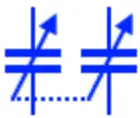
It is the combination of two variable capacitor. The variable rotor of these both capacitors is controlled using a single shaft. Thus they provide variable capacitance in both capacitors by moving a single rotor.
Butterfly Capacitor
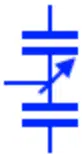
Such type of variable capacitor has two separate stators opposite to each other mounted on the body of the capacitor. The rotor whose plates are also butterfly shaped, rotates between these two stators. The capacitance in such capacitor varies equally between either stator & rotor. They are used in symmetrically tuned circuits.
Tempatrimmer / Thermotrimmer
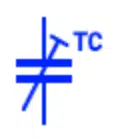
Tempatrimmer or also known as thermotrimmer is a small trimmer capacitor with a variable temperature coefficient. They are used in stabilizing the drifting VFos.
Capacitor Arrays and Integrated Passives
Modern schematics frequently use capacitor arrays and integrated passive networks to save PCB area and improve routing, especially in high‑density digital and RF designs. Graphically these parts are typically represented either by multiple capacitor symbols sharing a common reference designator with suffix letters (for example C1A, C1B, C1C) or by a boxed outline containing several internal capacitor icons, sometimes combined with resistors for RC or RLC networks.
Integrated passive components, such as RC snubber networks or filter arrays, use composite symbols that show all included passive elements inside a single package outline, but each element still follows the usual capacitor symbol conventions. When documenting such devices it is useful to add a short table in the datasheet section or BOM describing the internal network (e.g. “C1A–C1D: 100 nF, R1A–R1D: 22 Ω”).
Regional and Historical Variants – Capacitors
- DIN 40900 (Germany – Obsolete)
The German DIN 40900 standard, later superseded by IEC 60617, used capacitor symbols closely aligned with modern IEC practice, with plate- or rectangle-based representations for fixed capacitors and added markings for polarity and adjustability. Older German schematics may therefore show IEC‑style plate symbols or simplified variants rather than distinct “national” capacitor icons. - AS 1102 (Australia – Obsolete)
The Australian AS 1102 standard has been replaced by adoption of IEC 60617 and related IEC graphical symbol standards. Historical Australian schematics can show minor variations in capacitor plate spacing, orientation, and polarity marking style, but the underlying meaning remains consistent with IEC conventions. - JIS (Japanese Industrial Standards)
For capacitors, Japanese JIS C 0617 was established by adapting IEC 60617, so modern JIS symbols generally follow IEC forms, with only partial changes in capacitor symbol details. Some older Japanese schematics, especially from periods of strong US influence, may use ANSI‑style capacitor symbols with simple parallel plates and the familiar curved‑plate polarized symbol.
Symbol Selection Guidelines
Choosing Between IEC and ANSI
- International projects: Use IEC 60617 capacitor symbols (rectangle/box style for non‑polarized, boxed symbol with explicit polarity marking for polarized types) for broad international compatibility.
- US‑based projects: ANSI/IEEE 315 capacitor symbols (two parallel plates for non‑polarized, straight/curved plates for polarized) remain common in North American industry and education.
- Consistency: Never mix IEC and ANSI capacitor symbol styles within a single schematic diagram, as this can confuse readers and automated tools.
- Documentation: Always specify the symbol standard used (for example “Symbols per IEC 60617” or “Symbols per IEEE 315”) in the drawing title block or notes.
Modern Trends
Current practice shows increasing adoption of IEC 60617‑style capacitor symbols globally, including in many CAD libraries, even for designs targeting traditionally ANSI‑dominated regions. Most modern EDA tools provide both IEC and ANSI capacitor symbol sets and allow users or libraries to define the default style per project or company standard.
Schematic and EDA Library Practice
Most modern EDA tools (for example professional CAD suites and open‑source tools) provide both IEC‑style and ANSI‑style capacitor symbol libraries, and teams usually select one family as their project standard. Company libraries often define preferred symbols for generic, polarized, variable and special capacitors, along with rules for pin numbering, polarity marking and default footprint associations.
Common conventions include numbering the positive terminal of a polarized capacitor as pin 1, the negative as pin 2, and using reference designators such as C10A, C10B for multi‑section or array parts. For clarity in design reviews, it is good practice to include a short symbol legend in the schematic set (for example in the title page) that explains any non‑standard capacitor symbols or annotations, and to explicitly state the governing symbol standard (IEC 60617, ANSI/IEEE 315, or a company‑specific library derived from these).
Reference Designations and Value Notation
Regardless of the graphical symbol standard, capacitor designations follow broadly harmonized conventions:
- Reference designator: Capacitor references begin with C followed by a sequential number (C1, C2, C3, etc.).
- Value notation: Capacitance is expressed in farads (F), most often using decimal-scaled units such as nF, µF, or pF depending on magnitude.
- Tolerance: Commonly indicated as a percentage (for example ±5%, ±10%, ±20%) or with an IEC tolerance code when relevant.
- Voltage rating: Specified in volts (for example 16 V, 50 V, 450 V) and considered critical for safety and reliability, especially for polarized capacitors.
- Polarity: For polarized capacitors (electrolytic, tantalum), the positive terminal is usually indicated by a “+” mark or distinct plate style in the symbol and must match the PCB footprint and BOM.
Example Reference Designation
C15
4.7 µF ±10%
25 V.
Standards Overview for Capacitors
| Standard | Region | Status | Capacitor symbol style / notes |
|---|---|---|---|
| IEC 60617 | International | Active | Rectangle/plate‑based symbols with explicit variants for polarized, adjustable, safety‑related and special capacitors; maintained as an online database. |
| ANSI Y32.2 / IEEE 315 | United States | Active (stable) | Parallel‑plate and curved‑plate capacitor symbols; multiple styles for variable and special capacitors, widely used in North American schematics and legacy documentation. |
| ISO 14617 | International | Active | General graphical symbol framework aligned with IEC‑style passive component symbols; defers to IEC 60617 for detailed electrotechnical capacitor symbols. |
| DIN 40900 | Germany | Obsolete | Historically IEC‑like capacitor symbols; replaced by IEC 60617‑based national adoptions, but still visible in older German schematics. |
| AS 1102 | Australia | Obsolete | Superseded by IEC‑based standards; historical symbols show only minor variations in plate spacing and polarity marking. |
| JIS C 0617 | Japan | Active | Adapts IEC 60617 forms for capacitors; modern JIS symbols generally match IEC with small local differences, while older Japanese designs may use ANSI‑style icons. |
Understanding how IEC, ANSI/IEEE and related national standards express capacitor symbols helps engineers read international schematics and legacy designs without ambiguity. While the functional meaning—fixed versus variable, polarized versus non‑polar—is consistent across standards, graphical style differs mainly between IEC’s box/rectangle convention and ANSI’s plate‑based symbols, so consistent standard selection and clear documentation are essential.
Global capacitor symbol standards summary
Understanding capacitor symbol variations across IEC, ANSI/IEEE, and related national standards is important for clear communication in international electronics design. While the functional idea is consistent—fixed versus variable, polarized versus non‑polarized—the graphical style differs mainly between the IEC box/rectangle convention and the ANSI plate‑based forms, so the most important practices are choosing one style per project, maintaining internal consistency, and documenting the governing standard.
Frequently Asked Questions about Capacitor Symbols
The generic capacitor symbol represents a non-polar capacitor with a fixed capacitance value. It can be connected in either direction and is commonly used in circuit diagrams.
Polarized electrolytic capacitors are marked with positive and negative terminals. The symbol indicates polarity, and incorrect connection can cause the capacitor to fail or explode.
A variable capacitor allows capacitance adjustment during normal operation, often used in tuning circuits. A trimmer capacitor is adjusted only during manufacturing or calibration and not by end users.
Feed-through capacitors filter RF noise in DC power lines, while temperature-dependent capacitors change capacitance with temperature, making them useful in sensing applications.
For new projects intended for international use, IEC 60617‑style symbols are generally recommended, especially when collaborating across borders or with suppliers that use IEC‑aligned documentation. For projects strictly targeted at US‑based organizations that have long‑standing ANSI/IEEE practices and libraries, it can be appropriate to remain with ANSI Y32.2 / IEEE 315 as long as the chosen standard is clearly stated in the schematic notes.
Class X and class Y capacitors usually share the same graphical symbols as generic capacitors, but are labeled with CX/CY reference designators and explicit safety ratings such as “X2 275 VAC” or “Y1 250 VAC,” often in a dedicated mains input section of the schematic. Many engineering teams also add a legend entry describing these parts as safety‑rated EMI suppression capacitors per IEC 60384‑14 or equivalent national standards.