






Passive Components Blog
No Result
View All Result
  • Home
  • NewsFilter
    • All
    • Aerospace & Defence
    • Antenna
    • Applications
    • Automotive
    • Capacitors
    • Circuit Protection Devices
    • electro-mechanical news
    • Filters
    • Fuses
    • Inductors
    • Industrial
    • Integrated Passives
    • inter-connect news
    • Market & Supply Chain
    • Market Insights
    • Medical
    • Modelling and Simulation
    • New Materials & Supply
    • New Technologies
    • Non-linear Passives
    • Oscillators
    • Passive Sensors News
    • Resistors
    • RF & Microwave
    • Telecommunication
    • Weekly Digest

    YAGEO Extends its Supercapacitor Series Line-Up

    SCHURTER Presents EKO High‑Voltage Fuses for Global Energy Systems

    June 2026: AI Demand Pushes Japanese and Korean MLCC Makers to Five‑Year Shipment High

    TDK Releases SMD Common‑Mode Chokes for Compact High‑Current EMI Filtering

    July 2026 Interconnect, Passives and Electromechanical Components Market Insights

    Samsung Introduces 1000V C0G and X7 MLCCs for 800V DC Systems

    Wk 29 Electronics Supply Chain Digest

    Bourns Introduces LTCC GNSS L‑Band Diplexer for Compact RF Front Ends

    TT Electronics: How Qualification Underpins Reliable Selection of Thick‑Film Resistors

    Trending Tags

    • Ripple Current
    • RF
    • Leakage Current
    • Tantalum vs Ceramic
    • Snubber
    • Low ESR
    • Feedthrough
    • Derating
    • Dielectric Constant
    • New Products
    • Market Reports
  • VideoFilter
    • All
    • Antenna videos
    • Capacitor videos
    • Circuit Protection Video
    • Filter videos
    • Fuse videos
    • Inductor videos
    • Inter-Connect Video
    • Non-linear passives videos
    • Oscillator videos
    • Passive sensors videos
    • Resistor videos

    EMC Design Fundamentals: Safe Use of Varistors and Common Mode Chokes in Mains and Data-Line Filters

    Ferrite versus Nanocrystalline Power Inductor Cores: Turns, Gap and Size

    KYOCERA AVX Presents Antenna Integrator Studio Tutorial for Antenna Placement and RF Design

    Power Design Simulation Tools for Faster Inductor Selection and Loss Optimization

    EMC‑Compliant PCB and Connector Design Guidelines

    Why Isolated DC/DC Power Supplies Fail Late, Würth Elektronik Podcast

    Designing 800 V DC EMC Filters: Calculation, Simulation and Measurement

    Current Sense Transformer Datasheet and Design‑in Guide

    Designing a USB Type‑C Flyback Planar Transformer with Frenetic’s Planar Tool

    Trending Tags

    • Capacitors explained
    • Inductors explained
    • Resistors explained
    • Filters explained
    • Application Video Guidelines
    • EMC
    • New Products
    • Ripple Current
    • Simulation
    • Tantalum vs Ceramic
  • Knowledge Blog
  • Dossiers
    • AI Hardware Dossier
    • Power Converter Dossier
    • Automotive Dossier
    • Capacitor Dossier
    • Resistor Dossier
    • Inductor Dossier
    • Circuit Protection Dossier
  • Suppliers
    • Who is Who
  • PCNS
    • PCNS 2025
    • PCNS 2023
    • PCNS 2021
    • PCNS 2019
    • PCNS 2017
  • Events
  • Home
  • NewsFilter
    • All
    • Aerospace & Defence
    • Antenna
    • Applications
    • Automotive
    • Capacitors
    • Circuit Protection Devices
    • electro-mechanical news
    • Filters
    • Fuses
    • Inductors
    • Industrial
    • Integrated Passives
    • inter-connect news
    • Market & Supply Chain
    • Market Insights
    • Medical
    • Modelling and Simulation
    • New Materials & Supply
    • New Technologies
    • Non-linear Passives
    • Oscillators
    • Passive Sensors News
    • Resistors
    • RF & Microwave
    • Telecommunication
    • Weekly Digest

    YAGEO Extends its Supercapacitor Series Line-Up

    SCHURTER Presents EKO High‑Voltage Fuses for Global Energy Systems

    June 2026: AI Demand Pushes Japanese and Korean MLCC Makers to Five‑Year Shipment High

    TDK Releases SMD Common‑Mode Chokes for Compact High‑Current EMI Filtering

    July 2026 Interconnect, Passives and Electromechanical Components Market Insights

    Samsung Introduces 1000V C0G and X7 MLCCs for 800V DC Systems

    Wk 29 Electronics Supply Chain Digest

    Bourns Introduces LTCC GNSS L‑Band Diplexer for Compact RF Front Ends

    TT Electronics: How Qualification Underpins Reliable Selection of Thick‑Film Resistors

    Trending Tags

    • Ripple Current
    • RF
    • Leakage Current
    • Tantalum vs Ceramic
    • Snubber
    • Low ESR
    • Feedthrough
    • Derating
    • Dielectric Constant
    • New Products
    • Market Reports
  • VideoFilter
    • All
    • Antenna videos
    • Capacitor videos
    • Circuit Protection Video
    • Filter videos
    • Fuse videos
    • Inductor videos
    • Inter-Connect Video
    • Non-linear passives videos
    • Oscillator videos
    • Passive sensors videos
    • Resistor videos

    EMC Design Fundamentals: Safe Use of Varistors and Common Mode Chokes in Mains and Data-Line Filters

    Ferrite versus Nanocrystalline Power Inductor Cores: Turns, Gap and Size

    KYOCERA AVX Presents Antenna Integrator Studio Tutorial for Antenna Placement and RF Design

    Power Design Simulation Tools for Faster Inductor Selection and Loss Optimization

    EMC‑Compliant PCB and Connector Design Guidelines

    Why Isolated DC/DC Power Supplies Fail Late, Würth Elektronik Podcast

    Designing 800 V DC EMC Filters: Calculation, Simulation and Measurement

    Current Sense Transformer Datasheet and Design‑in Guide

    Designing a USB Type‑C Flyback Planar Transformer with Frenetic’s Planar Tool

    Trending Tags

    • Capacitors explained
    • Inductors explained
    • Resistors explained
    • Filters explained
    • Application Video Guidelines
    • EMC
    • New Products
    • Ripple Current
    • Simulation
    • Tantalum vs Ceramic
  • Knowledge Blog
  • Dossiers
    • AI Hardware Dossier
    • Power Converter Dossier
    • Automotive Dossier
    • Capacitor Dossier
    • Resistor Dossier
    • Inductor Dossier
    • Circuit Protection Dossier
  • Suppliers
    • Who is Who
  • PCNS
    • PCNS 2025
    • PCNS 2023
    • PCNS 2021
    • PCNS 2019
    • PCNS 2017
  • Events
No Result
View All Result
Passive Components Blog
No Result
View All Result

Contact Finish Degradation Mechanisms

1.10.2025
Reading Time: 3 mins read
A A

The two most significant contact finish degradation mechanisms are corrosion and wear. While wear is a degradation mechanism, its main effect on connector degradation is to make the contact interface more susceptible to corrosion due to wear through of the contact finish with resultant exposure of the copper alloy contact spring.

Contact Finish Degradation Mechanisms in Connectors

RelatedPosts

Polymer Materials and Processing

What is RF Connector

Connector Materials and Processes

This article explores the degradation mechanisms affecting contact finishes in connectors, focusing on wear and corrosion. It examines the impact of mating cycles and fretting on connector performance, particularly highlighting the role of fretting corrosion in tin contact finishes. Additionally, the paper discusses the corrosion mechanisms affecting noble metal finishes, emphasizing the differences in susceptibility and degradation processes between noble and non-noble metals.

Introduction:

Connectors are critical components in electronic systems, and their performance is significantly influenced by the integrity of their contact finishes. Over time, these finishes can degrade due to various wear and corrosion mechanisms, leading to reduced reliability and functionality. Understanding these degradation processes is essential for improving connector design and longevity.

Wear Mechanisms:

  1. Mating Cycle Wear:
    • Connectors undergo multiple mating cycles during their application lifetime, leading to wear through the finish. This wear is primarily due to the sliding motion between the contact surfaces, which can be extensive due to the larger sliding distances involved.
  2. Fretting Wear:
    • Fretting is a wear mechanism caused by small, repetitive motions at the contact interface, often induced by mechanical or thermally generated stresses. These motions, ranging from fractions of a micron to a few microns, can occur even when the connector is not in use.
    • Despite the smaller sliding distances compared to mating cycles, the frequency of fretting cycles can be significantly higher, making fretting wear a critical factor in connector degradation.
    • Fretting wear often leads to fretting corrosion, particularly in tin contact finishes, which is a primary degradation mechanism.

Corrosion Mechanisms:

  1. Fretting Corrosion in Tin Finishes:
    • Fretting corrosion occurs when fretting wear exposes the underlying metal, leading to oxidation and corrosion. This process is particularly prevalent in tin contact finishes, where the exposed tin reacts with environmental elements to form corrosion products.
  2. Corrosion in Noble Metal Finishes:
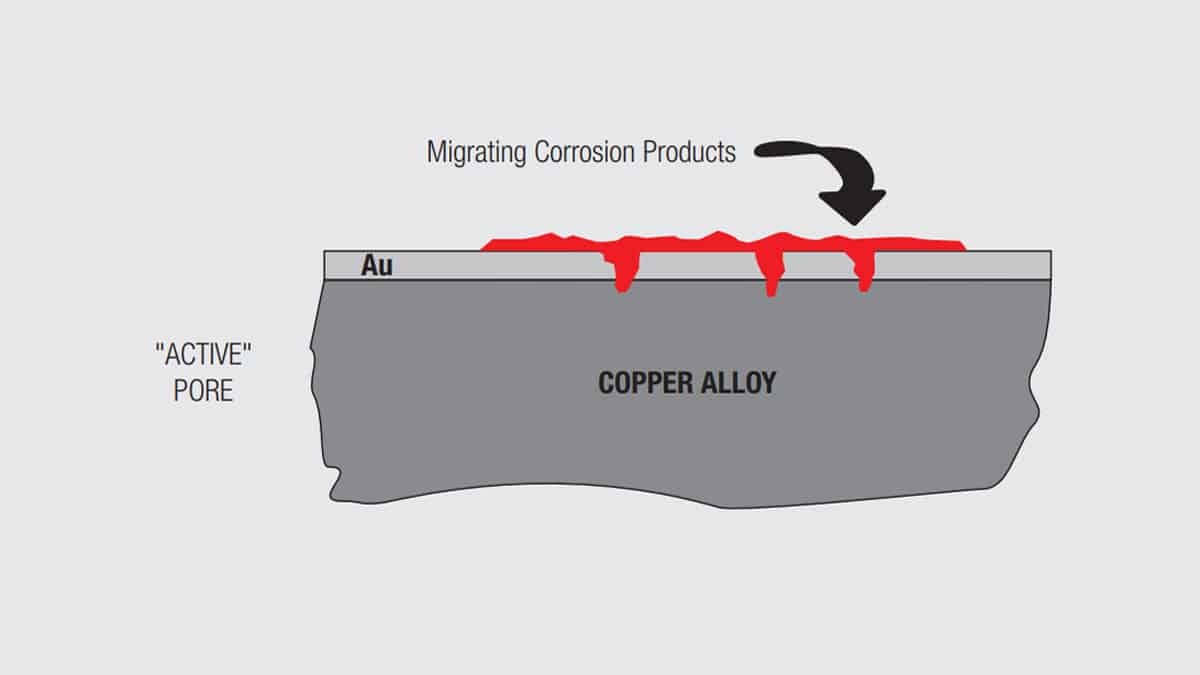
    • Noble metal finishes, such as gold, are generally resistant to corrosion in most environments. However, corrosion can still occur due to the exposure of underlying metals like copper from the contact spring.
    • The corrosion in noble metal finishes is not due to the noble metal itself but rather the corrosion of the exposed non-noble metal.

Discussion:

The degradation of contact finishes in connectors is a complex process influenced by both wear and corrosion mechanisms. Fretting wear, leading to fretting corrosion, is a significant concern for tin contact finishes, while noble metal finishes experience corrosion primarily due to the exposure of non-noble metals. Understanding these mechanisms is crucial for developing connectors with enhanced durability and performance.

Conclusion:

Addressing the degradation mechanisms of contact finishes is vital for improving connector reliability. By focusing on wear and corrosion processes, particularly fretting wear and corrosion in tin finishes and the exposure of non-noble metals in noble metal finishes, engineers can design connectors that better withstand the challenges of their application environments.
Related

Source: Wurth elektronik

Recent Posts

Circular Connectors Coding

26.11.2025
181

Connector PCB Design Challenges

3.10.2025
113

Non-Magnetic Interconnects

23.4.2025
55

10 Tips for Ensuring Reliability of Discrete Wire Assemblies

20.2.2025
91

Polymer Materials and Processing

11.8.2025
227

Basic PCB Technology Overview

1.7.2025
49

What is RF Connector

17.12.2024
69

Creepage and Clearance of Connector

25.7.2025
102

RF Connector Types: How To Choose the Right One

24.4.2026
343

Upcoming Events

Jul 29
17:30 - 18:30 CEST

To Ferrite or to Nanocrystalline in Transformer Design

Sep 29
16:00 - 17:00 CEST

Cybersecurity 2026

View Calendar

Popular Posts

  • Buck Converter Design and Calculation

    0 shares
    Share 0 Tweet 0
  • Boost Converter Design and Calculation

    0 shares
    Share 0 Tweet 0
  • YAGEO Announces July 2026 Capacitor Price Increase

    0 shares
    Share 0 Tweet 0
  • Flyback Converter Design and Calculation

    0 shares
    Share 0 Tweet 0
  • LLC Resonant Converter Design and Calculation

    0 shares
    Share 0 Tweet 0
  • MLCCs in the Age of AI: Q2 2026 Market Tightness

    0 shares
    Share 0 Tweet 0
  • MLCC and Ceramic Capacitors

    0 shares
    Share 0 Tweet 0
  • Earthing Systems and IEC Classification Explained

    0 shares
    Share 0 Tweet 0
  • Dual Active Bridge (DAB) Topology

    0 shares
    Share 0 Tweet 0
  • Nvidia Vera Rubin: Why One AI Rack Needs So Many More MLCC Capacitors

    0 shares
    Share 0 Tweet 0

Newsletter Subscription


Passive Components Blog

© EPCI - Leading Passive Components Educational and Information Site

  • Home
  • Privacy Policy
  • EPCI Membership & Advertisement
  • About

No Result
View All Result
  • Home
  • Knowledge Blog
  • Dossiers
  • PCNS

© EPCI - Leading Passive Components Educational and Information Site

This website uses cookies. By continuing to use this website you are giving consent to cookies being used. Visit our Privacy and Cookie Policy.